SUBSCRIBE TO OUR FREE NEWSLETTER
Daily news & progressive opinion—funded by the people, not the corporations—delivered straight to your inbox.
5
#000000
#FFFFFF
To donate by check, phone, or other method, see our More Ways to Give page.
Daily news & progressive opinion—funded by the people, not the corporations—delivered straight to your inbox.
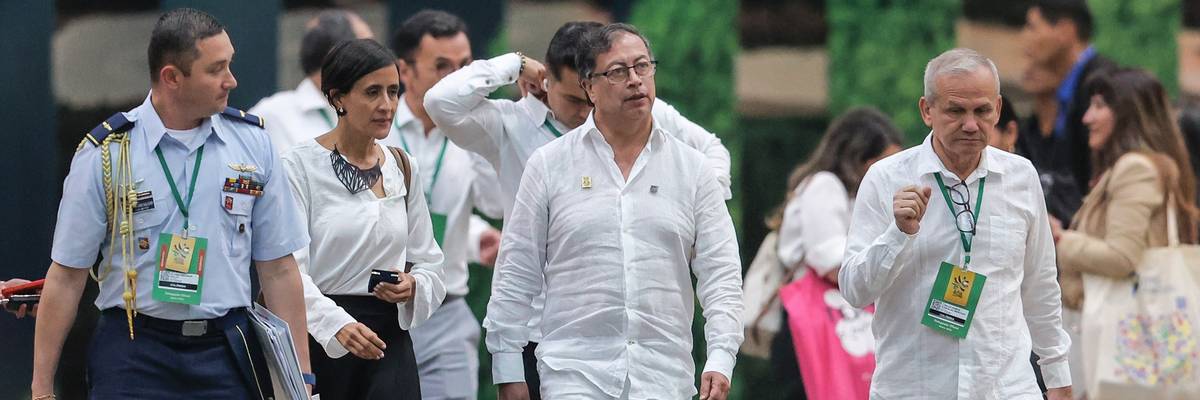
On August 8, 2023, Gustavo Petro, president of Colombia, walks through the Hangar Convention Center during the Amazon Summit in Belem, Brazil.
Investor-state dispute settlement has become a powerful weapon for multinational firms to challenge policies aimed at phasing out fossil fuels, often resulting in massive financial penalties for states that attempt to regulate or transition their economies.
As Colombia prepares to host the world’s first Global Conference on Transitioning Away from Fossil Fuels this April, a powerful coalition of more than 220 leading economists, legal scholars, and policymakers is calling on President Gustavo Petro to take bold action.
In a public letter presented on Monday in Bogota, promoted by the Center for Economic and Policy Research, Boston University Global Development Policy Center, and the NGO Public Citizen, signatories including Nobel laureate Joseph Stiglitz, economist Thomas Piketty, and Paris Agreement architect Laurence Tubiana urge Colombia to lead an international effort to dismantle investor-state dispute settlement (ISDS), a system embedded in thousands of trade and investment agreements worldwide, including in Colombia.
As of 2025, Colombia had over $13 billion in pending ISDS charges, about one-seventh of its annual budget. To compare, it would cost $42 billion to fully implement the 2017 peace agreement, while it would cost about $25 billion for the country to have universal healthcare. Without confronting ISDS, meaningful state action may be impossible.
ISDS, sometimes referred to by economists as “litigation terrorism,” allows foreign corporations to sue governments in private arbitration tribunals over public-interest regulations, including environmental protections. It has become a powerful weapon for multinational firms to challenge policies aimed at phasing out fossil fuels, often resulting in massive financial penalties for states that attempt to regulate or transition their economies.
If the world is serious about confronting the climate crisis, it must also confront the legal and economic structures that entrench fossil fuel dependence. Dismantling ISDS is a precondition for meaningful change.
“Investor-State Dispute Settlement has a track record of being very favorable to foreign corporations at the expense of local communities, the environment, and economic development,” Stiglitz noted. For countries seeking to move away from fossil fuels, ISDS creates a chilling effect; governments hesitate to enact ambitious climate policies for fear of triggering billion-dollar lawsuits.
Stiglitz added that "investor-state dispute settlements don’t just mean growing debt burdens for countries: they are also a barrier to action on the climate crisis.”
Colombia is especially exposed. The country has 129 oil and gas projects covered by ISDS provisions, leaving it vulnerable to a wave of potential claims as it pursues its energy transition.
Petro has signaled his intent to reduce reliance on these mechanisms, but has yet to follow the path of countries such as South Africa, India, and Indonesia, which have terminated ISDS-linked agreements outright after concluding they undermined national sovereignty.
Across Latin America, ISDS has quietly transferred enormous public wealth to foreign corporations. Governments have been forced to pay out tens of billions of dollars in arbitration awards, particularly in countries like Argentina, Peru, and Venezuela, which, not coincidentally, have also faced severe economic and energy crises.
This system vastly privileges foreign investors over domestic firms, bypasses national courts, and effectively grants corporations veto power over public policy. As development economist Jayati Ghosh argues, bilateral investment treaties have “weaponized” corporate influence, restricting the ability of governments to act in the public interest without delivering clear benefits in terms of increased investment.
Colombia’s upcoming conference offers a rare opportunity to challenge this global regime. The letter’s authors propose the creation of an international alliance committed to unwinding ISDS and restoring democratic control over economic policy. The European Union’s recent withdrawal from the Energy Charter Treaty, due to its protections for fossil fuel investments, signals that even advanced economies are beginning to recognize the incompatibility of ISDS with climate goals.
Yet, even as Petro pushes for a fossil fuel phaseout and questions the legitimacy of ISDS, other governments in the hemisphere are moving in the opposite direction. Ecuador’s conservative President, Daniel Noboa, a billionaire businessman dogged by allegations of corruption, authoritarianism, and links to drug traffickers, has aggressively pursued new trade and investment agreements with the United Arab Emirates, Canada, and the United States. These deals include ISDS provisions, despite both the Ecuadorian Constitution and the Ecuadorian people outright banning ISDS.
Other right-wing politicians in the region, including anarcho-capitalist Argentine President Javier Milei, have also expressed support for expanding ISDS, to further the entrenchment of corporate power in the region.
As Andrés Arauz of the Center for Economic and Policy Research puts it, ISDS creates a “fast-track legal system” that grants corporations a “license to kill” public-interest regulation through the threat of massive financial penalties.
The coalition’s message to Colombia is salient; if the world is serious about confronting the climate crisis, it must also confront the legal and economic structures that entrench fossil fuel dependence. Dismantling ISDS is a precondition for meaningful change.
In Santa Marta this April, Colombia has a chance to lead, and turn the region away from complete surrender to foreign corporate interests, instead attempting to build economies around popular prosperity, dynamic democracy, and robust constitutionalism.
Dear Common Dreams reader, It’s been nearly 30 years since I co-founded Common Dreams with my late wife, Lina Newhouser. We had the radical notion that journalism should serve the public good, not corporate profits. It was clear to us from the outset what it would take to build such a project. No paid advertisements. No corporate sponsors. No millionaire publisher telling us what to think or do. Many people said we wouldn't last a year, but we proved those doubters wrong. Together with a tremendous team of journalists and dedicated staff, we built an independent media outlet free from the constraints of profits and corporate control. Our mission has always been simple: To inform. To inspire. To ignite change for the common good. Building Common Dreams was not easy. Our survival was never guaranteed. When you take on the most powerful forces—Wall Street greed, fossil fuel industry destruction, Big Tech lobbyists, and uber-rich oligarchs who have spent billions upon billions rigging the economy and democracy in their favor—the only bulwark you have is supporters who believe in your work. But here’s the urgent message from me today. It's never been this bad out there. And it's never been this hard to keep us going. At the very moment Common Dreams is most needed, the threats we face are intensifying. We need your support now more than ever. We don't accept corporate advertising and never will. We don't have a paywall because we don't think people should be blocked from critical news based on their ability to pay. Everything we do is funded by the donations of readers like you. When everyone does the little they can afford, we are strong. But if that support retreats or dries up, so do we. Will you donate now to make sure Common Dreams not only survives but thrives? —Craig Brown, Co-founder |
As Colombia prepares to host the world’s first Global Conference on Transitioning Away from Fossil Fuels this April, a powerful coalition of more than 220 leading economists, legal scholars, and policymakers is calling on President Gustavo Petro to take bold action.
In a public letter presented on Monday in Bogota, promoted by the Center for Economic and Policy Research, Boston University Global Development Policy Center, and the NGO Public Citizen, signatories including Nobel laureate Joseph Stiglitz, economist Thomas Piketty, and Paris Agreement architect Laurence Tubiana urge Colombia to lead an international effort to dismantle investor-state dispute settlement (ISDS), a system embedded in thousands of trade and investment agreements worldwide, including in Colombia.
As of 2025, Colombia had over $13 billion in pending ISDS charges, about one-seventh of its annual budget. To compare, it would cost $42 billion to fully implement the 2017 peace agreement, while it would cost about $25 billion for the country to have universal healthcare. Without confronting ISDS, meaningful state action may be impossible.
ISDS, sometimes referred to by economists as “litigation terrorism,” allows foreign corporations to sue governments in private arbitration tribunals over public-interest regulations, including environmental protections. It has become a powerful weapon for multinational firms to challenge policies aimed at phasing out fossil fuels, often resulting in massive financial penalties for states that attempt to regulate or transition their economies.
If the world is serious about confronting the climate crisis, it must also confront the legal and economic structures that entrench fossil fuel dependence. Dismantling ISDS is a precondition for meaningful change.
“Investor-State Dispute Settlement has a track record of being very favorable to foreign corporations at the expense of local communities, the environment, and economic development,” Stiglitz noted. For countries seeking to move away from fossil fuels, ISDS creates a chilling effect; governments hesitate to enact ambitious climate policies for fear of triggering billion-dollar lawsuits.
Stiglitz added that "investor-state dispute settlements don’t just mean growing debt burdens for countries: they are also a barrier to action on the climate crisis.”
Colombia is especially exposed. The country has 129 oil and gas projects covered by ISDS provisions, leaving it vulnerable to a wave of potential claims as it pursues its energy transition.
Petro has signaled his intent to reduce reliance on these mechanisms, but has yet to follow the path of countries such as South Africa, India, and Indonesia, which have terminated ISDS-linked agreements outright after concluding they undermined national sovereignty.
Across Latin America, ISDS has quietly transferred enormous public wealth to foreign corporations. Governments have been forced to pay out tens of billions of dollars in arbitration awards, particularly in countries like Argentina, Peru, and Venezuela, which, not coincidentally, have also faced severe economic and energy crises.
This system vastly privileges foreign investors over domestic firms, bypasses national courts, and effectively grants corporations veto power over public policy. As development economist Jayati Ghosh argues, bilateral investment treaties have “weaponized” corporate influence, restricting the ability of governments to act in the public interest without delivering clear benefits in terms of increased investment.
Colombia’s upcoming conference offers a rare opportunity to challenge this global regime. The letter’s authors propose the creation of an international alliance committed to unwinding ISDS and restoring democratic control over economic policy. The European Union’s recent withdrawal from the Energy Charter Treaty, due to its protections for fossil fuel investments, signals that even advanced economies are beginning to recognize the incompatibility of ISDS with climate goals.
Yet, even as Petro pushes for a fossil fuel phaseout and questions the legitimacy of ISDS, other governments in the hemisphere are moving in the opposite direction. Ecuador’s conservative President, Daniel Noboa, a billionaire businessman dogged by allegations of corruption, authoritarianism, and links to drug traffickers, has aggressively pursued new trade and investment agreements with the United Arab Emirates, Canada, and the United States. These deals include ISDS provisions, despite both the Ecuadorian Constitution and the Ecuadorian people outright banning ISDS.
Other right-wing politicians in the region, including anarcho-capitalist Argentine President Javier Milei, have also expressed support for expanding ISDS, to further the entrenchment of corporate power in the region.
As Andrés Arauz of the Center for Economic and Policy Research puts it, ISDS creates a “fast-track legal system” that grants corporations a “license to kill” public-interest regulation through the threat of massive financial penalties.
The coalition’s message to Colombia is salient; if the world is serious about confronting the climate crisis, it must also confront the legal and economic structures that entrench fossil fuel dependence. Dismantling ISDS is a precondition for meaningful change.
In Santa Marta this April, Colombia has a chance to lead, and turn the region away from complete surrender to foreign corporate interests, instead attempting to build economies around popular prosperity, dynamic democracy, and robust constitutionalism.
As Colombia prepares to host the world’s first Global Conference on Transitioning Away from Fossil Fuels this April, a powerful coalition of more than 220 leading economists, legal scholars, and policymakers is calling on President Gustavo Petro to take bold action.
In a public letter presented on Monday in Bogota, promoted by the Center for Economic and Policy Research, Boston University Global Development Policy Center, and the NGO Public Citizen, signatories including Nobel laureate Joseph Stiglitz, economist Thomas Piketty, and Paris Agreement architect Laurence Tubiana urge Colombia to lead an international effort to dismantle investor-state dispute settlement (ISDS), a system embedded in thousands of trade and investment agreements worldwide, including in Colombia.
As of 2025, Colombia had over $13 billion in pending ISDS charges, about one-seventh of its annual budget. To compare, it would cost $42 billion to fully implement the 2017 peace agreement, while it would cost about $25 billion for the country to have universal healthcare. Without confronting ISDS, meaningful state action may be impossible.
ISDS, sometimes referred to by economists as “litigation terrorism,” allows foreign corporations to sue governments in private arbitration tribunals over public-interest regulations, including environmental protections. It has become a powerful weapon for multinational firms to challenge policies aimed at phasing out fossil fuels, often resulting in massive financial penalties for states that attempt to regulate or transition their economies.
If the world is serious about confronting the climate crisis, it must also confront the legal and economic structures that entrench fossil fuel dependence. Dismantling ISDS is a precondition for meaningful change.
“Investor-State Dispute Settlement has a track record of being very favorable to foreign corporations at the expense of local communities, the environment, and economic development,” Stiglitz noted. For countries seeking to move away from fossil fuels, ISDS creates a chilling effect; governments hesitate to enact ambitious climate policies for fear of triggering billion-dollar lawsuits.
Stiglitz added that "investor-state dispute settlements don’t just mean growing debt burdens for countries: they are also a barrier to action on the climate crisis.”
Colombia is especially exposed. The country has 129 oil and gas projects covered by ISDS provisions, leaving it vulnerable to a wave of potential claims as it pursues its energy transition.
Petro has signaled his intent to reduce reliance on these mechanisms, but has yet to follow the path of countries such as South Africa, India, and Indonesia, which have terminated ISDS-linked agreements outright after concluding they undermined national sovereignty.
Across Latin America, ISDS has quietly transferred enormous public wealth to foreign corporations. Governments have been forced to pay out tens of billions of dollars in arbitration awards, particularly in countries like Argentina, Peru, and Venezuela, which, not coincidentally, have also faced severe economic and energy crises.
This system vastly privileges foreign investors over domestic firms, bypasses national courts, and effectively grants corporations veto power over public policy. As development economist Jayati Ghosh argues, bilateral investment treaties have “weaponized” corporate influence, restricting the ability of governments to act in the public interest without delivering clear benefits in terms of increased investment.
Colombia’s upcoming conference offers a rare opportunity to challenge this global regime. The letter’s authors propose the creation of an international alliance committed to unwinding ISDS and restoring democratic control over economic policy. The European Union’s recent withdrawal from the Energy Charter Treaty, due to its protections for fossil fuel investments, signals that even advanced economies are beginning to recognize the incompatibility of ISDS with climate goals.
Yet, even as Petro pushes for a fossil fuel phaseout and questions the legitimacy of ISDS, other governments in the hemisphere are moving in the opposite direction. Ecuador’s conservative President, Daniel Noboa, a billionaire businessman dogged by allegations of corruption, authoritarianism, and links to drug traffickers, has aggressively pursued new trade and investment agreements with the United Arab Emirates, Canada, and the United States. These deals include ISDS provisions, despite both the Ecuadorian Constitution and the Ecuadorian people outright banning ISDS.
Other right-wing politicians in the region, including anarcho-capitalist Argentine President Javier Milei, have also expressed support for expanding ISDS, to further the entrenchment of corporate power in the region.
As Andrés Arauz of the Center for Economic and Policy Research puts it, ISDS creates a “fast-track legal system” that grants corporations a “license to kill” public-interest regulation through the threat of massive financial penalties.
The coalition’s message to Colombia is salient; if the world is serious about confronting the climate crisis, it must also confront the legal and economic structures that entrench fossil fuel dependence. Dismantling ISDS is a precondition for meaningful change.
In Santa Marta this April, Colombia has a chance to lead, and turn the region away from complete surrender to foreign corporate interests, instead attempting to build economies around popular prosperity, dynamic democracy, and robust constitutionalism.