SUBSCRIBE TO OUR FREE NEWSLETTER
Daily news & progressive opinion—funded by the people, not the corporations—delivered straight to your inbox.
5
#000000
#FFFFFF
To donate by check, phone, or other method, see our More Ways to Give page.
Daily news & progressive opinion—funded by the people, not the corporations—delivered straight to your inbox.
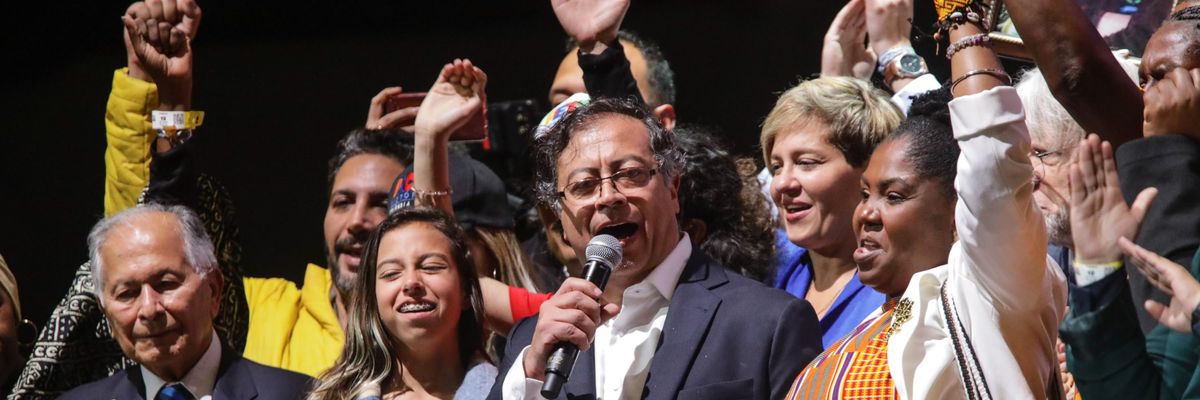
Gustavo Petro, the leftist former mayor of Bogota, celebrates in Bogota after winning Colombia's presidential election on June 19, 2022. (Photo: Juancho Torres/Anadolu Agency via Getty Images)
Former guerrilla fighter and longtime lawmaker Gustavo Petro defeated a millionaire businessman viewed as Colombia's Donald Trump on Sunday to become the South American nation's first leftist president-elect, riding a wave of mass anger over inequality, poverty, and the corruption of the right-wing political establishment.
"The government of hope has arrived," Petro, a former member of the M-19 rebel organization that disarmed in 1990 and became an influential political party, told supporters gathered in Bogota. "This story that we are writing today is a new story for Colombia, for Latin America, for the world. We are not going to betray this electorate."
"We've been subjected to the right and the extreme right for more than 200 years... and things here are bad, bad, bad."
Petro's running mate, environmental activist Francia Marquez, will become the first Black woman to serve as Colombia's vice president, spurring expectations that the new government will move to tackle surging deforestation in the Colombian Amazon and curb the nation's reliance on planet-warming fossil fuels. Petro, who will take office in August, campaigned on banning all new oil projects.
"Today all women win," Marquez said Sunday. "We are facing the greatest possibility of change in recent times."
The leftist ticket's historic victory in a nation long dominated by conservative elites--including current President Ivan Duque--was met with enthusiastic applause throughout the region and across the globe.
Luiz Inacio Lula da Silva, the former Brazilian president who is favored to retake the post in October, said Petro's win "strengthens democracy and progressive forces in Latin America."
Peru's leftist President Pedro Castillo hailed Sunday's results as a "historic democratic victory" for Colombia and said that "we are united by a common feeling that seeks collective, social, and regional integration improvements for our peoples."
"Brother Gustavo," he added, "always count on the support of Peru."
Former U.K. Labour Party leader Jeremy Corbyn joined the chorus of applause. "Incredible news from Colombia," he wrote on Twitter, "with the election of a socialist president who has shown the power of community organizing to build a popular policy platform to heal the divisions of the past and bring about social justice."
Petro's victory comes on the heels of widespread protests across Colombia in 2021, demonstrations sparked by a tax proposal from the Duque government that would have disproportionately hit the poor. An estimated 39% of Colombians lived on less than $89 a month last year.
Protests over the tax plan, which Duque ultimately withdrew, quickly ballooned into broader uprisings over the country's widespread poverty, systematic inequities, and austerity. The Colombian police--often armed with U.S.-made weaponry--responded viciously to the demonstrations, and activists were arrested en masse.
"I ask the attorney general to release our young people," Petro said during his victory speech on Sunday, prompting a jubilant response from the crowd of supporters.
In addition to vowing to democratize land ownership and combat poverty that has plagued Colombia for decades, the president-elect has pledged to end the nation's war on drugs, which it has waged alongside the U.S. for years to disastrous effect. Petro also campaigned on making Colombia's public universities free and accessible to all.
Henry Perdomo, a 60-year-old manufacturing worker, told the Washington Post shortly after he cast his vote for Petro on Sunday that "we've been subjected to the right and the extreme right for more than 200 years... and things here are bad, bad, bad."
"We need a change," he added.
Dear Common Dreams reader, It’s been nearly 30 years since I co-founded Common Dreams with my late wife, Lina Newhouser. We had the radical notion that journalism should serve the public good, not corporate profits. It was clear to us from the outset what it would take to build such a project. No paid advertisements. No corporate sponsors. No millionaire publisher telling us what to think or do. Many people said we wouldn't last a year, but we proved those doubters wrong. Together with a tremendous team of journalists and dedicated staff, we built an independent media outlet free from the constraints of profits and corporate control. Our mission has always been simple: To inform. To inspire. To ignite change for the common good. Building Common Dreams was not easy. Our survival was never guaranteed. When you take on the most powerful forces—Wall Street greed, fossil fuel industry destruction, Big Tech lobbyists, and uber-rich oligarchs who have spent billions upon billions rigging the economy and democracy in their favor—the only bulwark you have is supporters who believe in your work. But here’s the urgent message from me today. It's never been this bad out there. And it's never been this hard to keep us going. At the very moment Common Dreams is most needed, the threats we face are intensifying. We need your support now more than ever. We don't accept corporate advertising and never will. We don't have a paywall because we don't think people should be blocked from critical news based on their ability to pay. Everything we do is funded by the donations of readers like you. When everyone does the little they can afford, we are strong. But if that support retreats or dries up, so do we. Will you donate now to make sure Common Dreams not only survives but thrives? —Craig Brown, Co-founder |
Former guerrilla fighter and longtime lawmaker Gustavo Petro defeated a millionaire businessman viewed as Colombia's Donald Trump on Sunday to become the South American nation's first leftist president-elect, riding a wave of mass anger over inequality, poverty, and the corruption of the right-wing political establishment.
"The government of hope has arrived," Petro, a former member of the M-19 rebel organization that disarmed in 1990 and became an influential political party, told supporters gathered in Bogota. "This story that we are writing today is a new story for Colombia, for Latin America, for the world. We are not going to betray this electorate."
"We've been subjected to the right and the extreme right for more than 200 years... and things here are bad, bad, bad."
Petro's running mate, environmental activist Francia Marquez, will become the first Black woman to serve as Colombia's vice president, spurring expectations that the new government will move to tackle surging deforestation in the Colombian Amazon and curb the nation's reliance on planet-warming fossil fuels. Petro, who will take office in August, campaigned on banning all new oil projects.
"Today all women win," Marquez said Sunday. "We are facing the greatest possibility of change in recent times."
The leftist ticket's historic victory in a nation long dominated by conservative elites--including current President Ivan Duque--was met with enthusiastic applause throughout the region and across the globe.
Luiz Inacio Lula da Silva, the former Brazilian president who is favored to retake the post in October, said Petro's win "strengthens democracy and progressive forces in Latin America."
Peru's leftist President Pedro Castillo hailed Sunday's results as a "historic democratic victory" for Colombia and said that "we are united by a common feeling that seeks collective, social, and regional integration improvements for our peoples."
"Brother Gustavo," he added, "always count on the support of Peru."
Former U.K. Labour Party leader Jeremy Corbyn joined the chorus of applause. "Incredible news from Colombia," he wrote on Twitter, "with the election of a socialist president who has shown the power of community organizing to build a popular policy platform to heal the divisions of the past and bring about social justice."
Petro's victory comes on the heels of widespread protests across Colombia in 2021, demonstrations sparked by a tax proposal from the Duque government that would have disproportionately hit the poor. An estimated 39% of Colombians lived on less than $89 a month last year.
Protests over the tax plan, which Duque ultimately withdrew, quickly ballooned into broader uprisings over the country's widespread poverty, systematic inequities, and austerity. The Colombian police--often armed with U.S.-made weaponry--responded viciously to the demonstrations, and activists were arrested en masse.
"I ask the attorney general to release our young people," Petro said during his victory speech on Sunday, prompting a jubilant response from the crowd of supporters.
In addition to vowing to democratize land ownership and combat poverty that has plagued Colombia for decades, the president-elect has pledged to end the nation's war on drugs, which it has waged alongside the U.S. for years to disastrous effect. Petro also campaigned on making Colombia's public universities free and accessible to all.
Henry Perdomo, a 60-year-old manufacturing worker, told the Washington Post shortly after he cast his vote for Petro on Sunday that "we've been subjected to the right and the extreme right for more than 200 years... and things here are bad, bad, bad."
"We need a change," he added.
Former guerrilla fighter and longtime lawmaker Gustavo Petro defeated a millionaire businessman viewed as Colombia's Donald Trump on Sunday to become the South American nation's first leftist president-elect, riding a wave of mass anger over inequality, poverty, and the corruption of the right-wing political establishment.
"The government of hope has arrived," Petro, a former member of the M-19 rebel organization that disarmed in 1990 and became an influential political party, told supporters gathered in Bogota. "This story that we are writing today is a new story for Colombia, for Latin America, for the world. We are not going to betray this electorate."
"We've been subjected to the right and the extreme right for more than 200 years... and things here are bad, bad, bad."
Petro's running mate, environmental activist Francia Marquez, will become the first Black woman to serve as Colombia's vice president, spurring expectations that the new government will move to tackle surging deforestation in the Colombian Amazon and curb the nation's reliance on planet-warming fossil fuels. Petro, who will take office in August, campaigned on banning all new oil projects.
"Today all women win," Marquez said Sunday. "We are facing the greatest possibility of change in recent times."
The leftist ticket's historic victory in a nation long dominated by conservative elites--including current President Ivan Duque--was met with enthusiastic applause throughout the region and across the globe.
Luiz Inacio Lula da Silva, the former Brazilian president who is favored to retake the post in October, said Petro's win "strengthens democracy and progressive forces in Latin America."
Peru's leftist President Pedro Castillo hailed Sunday's results as a "historic democratic victory" for Colombia and said that "we are united by a common feeling that seeks collective, social, and regional integration improvements for our peoples."
"Brother Gustavo," he added, "always count on the support of Peru."
Former U.K. Labour Party leader Jeremy Corbyn joined the chorus of applause. "Incredible news from Colombia," he wrote on Twitter, "with the election of a socialist president who has shown the power of community organizing to build a popular policy platform to heal the divisions of the past and bring about social justice."
Petro's victory comes on the heels of widespread protests across Colombia in 2021, demonstrations sparked by a tax proposal from the Duque government that would have disproportionately hit the poor. An estimated 39% of Colombians lived on less than $89 a month last year.
Protests over the tax plan, which Duque ultimately withdrew, quickly ballooned into broader uprisings over the country's widespread poverty, systematic inequities, and austerity. The Colombian police--often armed with U.S.-made weaponry--responded viciously to the demonstrations, and activists were arrested en masse.
"I ask the attorney general to release our young people," Petro said during his victory speech on Sunday, prompting a jubilant response from the crowd of supporters.
In addition to vowing to democratize land ownership and combat poverty that has plagued Colombia for decades, the president-elect has pledged to end the nation's war on drugs, which it has waged alongside the U.S. for years to disastrous effect. Petro also campaigned on making Colombia's public universities free and accessible to all.
Henry Perdomo, a 60-year-old manufacturing worker, told the Washington Post shortly after he cast his vote for Petro on Sunday that "we've been subjected to the right and the extreme right for more than 200 years... and things here are bad, bad, bad."
"We need a change," he added.