SUBSCRIBE TO OUR FREE NEWSLETTER
Daily news & progressive opinion—funded by the people, not the corporations—delivered straight to your inbox.
5
#000000
#FFFFFF
To donate by check, phone, or other method, see our More Ways to Give page.
Daily news & progressive opinion—funded by the people, not the corporations—delivered straight to your inbox.
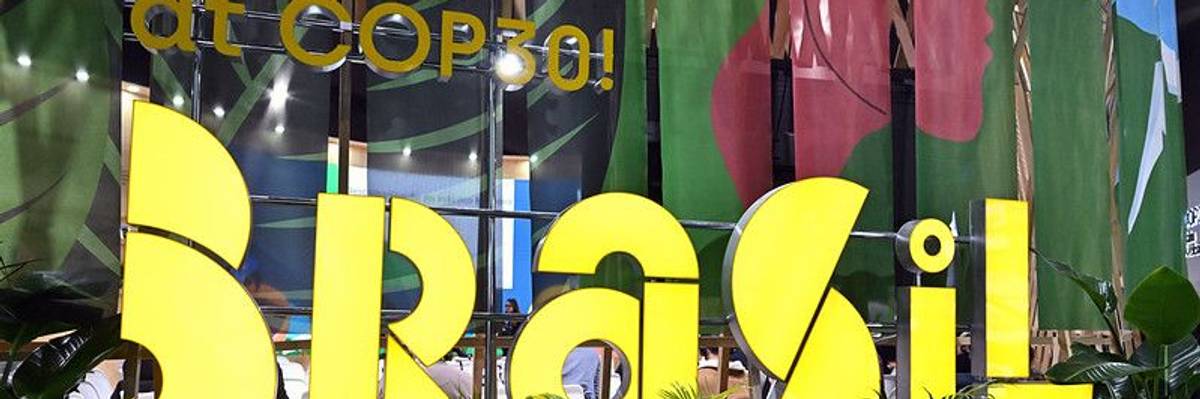
The IAEA Pavillion announces COP30 at the United Nations Climate Change Conference (UNCCC COP29) at Baku Stadium, Baku, Azerbaijan on November 14, 2024.
With 2024 confirmed as the hottest year ever on record, the US withdrawal from the Paris Agreement, and the massive financial shortfalls left by lackluster negotiations at COP29, this year's climate talks are pivotal.
The 30th Conference of the Parties to the United Nations Framework Convention on Climate Change will take place in Belém, a remote, underdeveloped, and poor region of the Brazilian Amazon.
Delegates from over 190 countries, NGOs, Indigenous representatives, and Brazil's President Luiz Inácio Lula da Silva, alongside COP President André Corrêa do Lago, will all participate in this year's high-stakes climate negotiations.
With 2024 confirmed as the hottest year ever on record, the US withdrawal from the Paris Agreement, and the massive financial shortfalls left by lackluster negotiations at COP29, this year's climate talks are pivotal.
A 2024 report by the UN revealed that current policies put the planet on track to reach a catastrophic 3.1°C warming by 2100 (Emissions Gap Report). This scenario would expose 600 million people to flooding, reduce food yields by half, cause severe water shortages, lead to insurmountable habitat and biodiversity loss, create month-long brutal heatwaves and wildfires, heighten the risks of insect-borne diseases, and profoundly deepen inequalities.
Progress will be stalled unless the global climate investment gap can be closed and pledges are finally turned into real investments.
At last year's summit, it was agreed that at least $1.3 trillion in annual climate finance would be mobilized for developing countries by 2035. This funding is intended to support a just transition to clean energy, climate adaptation policies, and addressing loss and damage from climate change.
Tackling the climate crisis is IMPOSSIBLE without adequate funding. Since President Donald Trump took office, at least $18 billion has been stripped from climate finance—6% of the new global $300 billion annual target. The current pace of financing is entirely insufficient to meet the agreed-upon goals.
At COP30, all members of the UNCCC are expected to publish their Nationally Determined Contributions (NDCs), outlining their national plans to reduce greenhouse gas emissions and adapt to climate impacts.
The NDC Synthesis Report was released in October 2025, which, according to Melanie Robinson, global climate, economics, and finance program director for World Resources Institute, "lays bare a frightening gap between what governments have promised and what is needed to protect people and planet."
Progress will be stalled unless the global climate investment gap can be closed and pledges are finally turned into real investments. This will prove even more difficult as militarization grips the planet. NATO has increased its spending commitments to an unprecedented 5% of GDP, and the EU Special Debts for Rearmament will further siphon money into warmongering, posturing, and weapons stockpiling.
A new initiative, the Global Ethical Stocktake, launched by the President of Brazil, Lula da Silva, and the United Nations Secretary-General, António Guterres, aims to integrate ethical considerations into climate negotiations, an aspect that has previously been omitted.
Jaded by a lack of action in previous COPs, former UN Secretary-General Ban Ki-moon, along with other influential figures such as Mary Robinson and Christiana Figueres, labelled the current climate policy process "no longer fit for purpose."
This year's COP president holds higher hopes than others. He is a veteran climate diplomat and serves as the current secretary for climate, energy, and environment at the Brazilian Ministry of External Affairs.
He has worked with Brazil's diplomatic corps since 1982 and has represented Brazil in similar negotiations, including as chief negotiator at Rio+20, COP28, and COP29.
In a positive initial call to action, he has called on all stakeholders in the climate negotiations process to "act decisively in the face of climate urgency through an ambitious and integrated Action Agenda at COP30."
The location of this year's climate summit is highly contentious. Destroying thousands of acres of rainforest to make way for a new four-lane highway, which is intended to ease congestion for COP visitors, is a blatant contradiction. This is the very environment Brazil has pledged to protect.
Rather than addressing the concerns, classic greenwashing terms like 'sustainable" are being used to describe the 8-mile road. Cutting through the Amazon rainforest, the road will fragment the ecosystem, disrupt the movement of wildlife, affect the livelihoods of local communities, and be inaccessible to those who live on either side of the highway. It will, however, have bike lanes and solar-powered lights!
The lack of infrastructure in the area means that more than 30 large-scale construction projects will be taking place to accommodate and prepare for the 50,000 expected visitors. The port is being redeveloped for cruise ships, and $81 million will be spent on expanding the airport to double its current capacity.
Emissions, emissions, emissions!
The expansion of the fossil fuel industry seriously contradicts the Brazilian government's climate narrative and threatens the country's credibility at COP30.
After three climate conferences in countries with restrictions on protests, Amazonian leaders and social movements are wary that their participation may be discounted and silenced. Since February, Indigenous groups have been occupying the Secretary of Education and blocking roads that cut through their territories. The protests have already begun.
Brazil is also no climate leader, but rather an empire built on oil. Its vast mining, fossil fuel, and agribusiness sectors mean that Brazil is responsible for more than 4% of total global emissions. In 2023, it emitted 2.3 billion tonnes of greenhouse gases, making Brazil the world's fifth worst polluter.
In this country of deep inequalities, the poor are disproportionately affected by climate change, including sea-level rise; heatwaves; and heavy, erratic rainfalls.
Just weeks before the conference begins, a new bill to dismantle Brazil's environmental license framework was passed. It eases restrictions on oil exploration and road development in the Amazon. A self-licensing process enables fossil fuel and construction companies to act with impunity and avoid the need for impact studies and mitigation measures.
Immediately after the bill change, Petrobras, the country's majority state-owned, scandal-ridden oil company, began drilling for oil a mere 200 miles away from Belém. The license was previously denied due to the risk of widespread biodiversity loss in this fragile ecosystem in the event of a spill. A new report reveals that since 2024, big banks have provided $2 billion in new financing for oil and gas in the Amazon.
Estimates suggest that up to 60 billion barrels of oil may exist in the Brazilian Amazon. If burned, they could emit 24 billion tonnes of carbon dioxide—more than Brazil's emissions over the past 11 years. The expansion of the fossil fuel industry seriously contradicts the Brazilian government's climate narrative and threatens the country's credibility at COP30.
"Climate is our biggest war," said Ana Toni, chief executive of COP30.
Hopes are high. Expectations are low. Change is happening, it is just painfully slow.
We need this to be the "delivery COP." One thing is for sure, COP30 will be make or break for people, our precious flora and fauna, and our planet as a whole.
This country and this world are at a monumental crossroads. US voters have an opportunity to beat back the forces of fascism and confront the billionaires who are rigging the economy, our media system, and our democracy, making it increasingly impossible for ordinary people to get by. We’re not just talking about the election. We’re talking about what must be done once these fascist elements are vanquished from power. We need a bolder set of solutions than what either major party has so far been willing to offer and a working-class movement ready to fight like hell for it. Trump didn't emerge from nowhere. The conditions that fueled MAGA authoritarianism were created by decades of radical neoliberal economic policies and a corrupt political system dominated by corporate interests. They slashed taxes on the super-rich, promising that the benefits would trickle down. They said giveaways to the corporate titans would make life more affordable for the rest of us. It was all bullshit. And when a bitter, betrayed populace searches for someone to blame, right-wing demagogues have little trouble finding scapegoats. People know when they're being lied to, but you won't hear any of this from the corporate media. Only independent journalism—powered and funded by people who believe in building a better world—can deliver truly trustworthy daily news. If you share our vision, please contribute whatever you can to sustain our work. |
The 30th Conference of the Parties to the United Nations Framework Convention on Climate Change will take place in Belém, a remote, underdeveloped, and poor region of the Brazilian Amazon.
Delegates from over 190 countries, NGOs, Indigenous representatives, and Brazil's President Luiz Inácio Lula da Silva, alongside COP President André Corrêa do Lago, will all participate in this year's high-stakes climate negotiations.
With 2024 confirmed as the hottest year ever on record, the US withdrawal from the Paris Agreement, and the massive financial shortfalls left by lackluster negotiations at COP29, this year's climate talks are pivotal.
A 2024 report by the UN revealed that current policies put the planet on track to reach a catastrophic 3.1°C warming by 2100 (Emissions Gap Report). This scenario would expose 600 million people to flooding, reduce food yields by half, cause severe water shortages, lead to insurmountable habitat and biodiversity loss, create month-long brutal heatwaves and wildfires, heighten the risks of insect-borne diseases, and profoundly deepen inequalities.
Progress will be stalled unless the global climate investment gap can be closed and pledges are finally turned into real investments.
At last year's summit, it was agreed that at least $1.3 trillion in annual climate finance would be mobilized for developing countries by 2035. This funding is intended to support a just transition to clean energy, climate adaptation policies, and addressing loss and damage from climate change.
Tackling the climate crisis is IMPOSSIBLE without adequate funding. Since President Donald Trump took office, at least $18 billion has been stripped from climate finance—6% of the new global $300 billion annual target. The current pace of financing is entirely insufficient to meet the agreed-upon goals.
At COP30, all members of the UNCCC are expected to publish their Nationally Determined Contributions (NDCs), outlining their national plans to reduce greenhouse gas emissions and adapt to climate impacts.
The NDC Synthesis Report was released in October 2025, which, according to Melanie Robinson, global climate, economics, and finance program director for World Resources Institute, "lays bare a frightening gap between what governments have promised and what is needed to protect people and planet."
Progress will be stalled unless the global climate investment gap can be closed and pledges are finally turned into real investments. This will prove even more difficult as militarization grips the planet. NATO has increased its spending commitments to an unprecedented 5% of GDP, and the EU Special Debts for Rearmament will further siphon money into warmongering, posturing, and weapons stockpiling.
A new initiative, the Global Ethical Stocktake, launched by the President of Brazil, Lula da Silva, and the United Nations Secretary-General, António Guterres, aims to integrate ethical considerations into climate negotiations, an aspect that has previously been omitted.
Jaded by a lack of action in previous COPs, former UN Secretary-General Ban Ki-moon, along with other influential figures such as Mary Robinson and Christiana Figueres, labelled the current climate policy process "no longer fit for purpose."
This year's COP president holds higher hopes than others. He is a veteran climate diplomat and serves as the current secretary for climate, energy, and environment at the Brazilian Ministry of External Affairs.
He has worked with Brazil's diplomatic corps since 1982 and has represented Brazil in similar negotiations, including as chief negotiator at Rio+20, COP28, and COP29.
In a positive initial call to action, he has called on all stakeholders in the climate negotiations process to "act decisively in the face of climate urgency through an ambitious and integrated Action Agenda at COP30."
The location of this year's climate summit is highly contentious. Destroying thousands of acres of rainforest to make way for a new four-lane highway, which is intended to ease congestion for COP visitors, is a blatant contradiction. This is the very environment Brazil has pledged to protect.
Rather than addressing the concerns, classic greenwashing terms like 'sustainable" are being used to describe the 8-mile road. Cutting through the Amazon rainforest, the road will fragment the ecosystem, disrupt the movement of wildlife, affect the livelihoods of local communities, and be inaccessible to those who live on either side of the highway. It will, however, have bike lanes and solar-powered lights!
The lack of infrastructure in the area means that more than 30 large-scale construction projects will be taking place to accommodate and prepare for the 50,000 expected visitors. The port is being redeveloped for cruise ships, and $81 million will be spent on expanding the airport to double its current capacity.
Emissions, emissions, emissions!
The expansion of the fossil fuel industry seriously contradicts the Brazilian government's climate narrative and threatens the country's credibility at COP30.
After three climate conferences in countries with restrictions on protests, Amazonian leaders and social movements are wary that their participation may be discounted and silenced. Since February, Indigenous groups have been occupying the Secretary of Education and blocking roads that cut through their territories. The protests have already begun.
Brazil is also no climate leader, but rather an empire built on oil. Its vast mining, fossil fuel, and agribusiness sectors mean that Brazil is responsible for more than 4% of total global emissions. In 2023, it emitted 2.3 billion tonnes of greenhouse gases, making Brazil the world's fifth worst polluter.
In this country of deep inequalities, the poor are disproportionately affected by climate change, including sea-level rise; heatwaves; and heavy, erratic rainfalls.
Just weeks before the conference begins, a new bill to dismantle Brazil's environmental license framework was passed. It eases restrictions on oil exploration and road development in the Amazon. A self-licensing process enables fossil fuel and construction companies to act with impunity and avoid the need for impact studies and mitigation measures.
Immediately after the bill change, Petrobras, the country's majority state-owned, scandal-ridden oil company, began drilling for oil a mere 200 miles away from Belém. The license was previously denied due to the risk of widespread biodiversity loss in this fragile ecosystem in the event of a spill. A new report reveals that since 2024, big banks have provided $2 billion in new financing for oil and gas in the Amazon.
Estimates suggest that up to 60 billion barrels of oil may exist in the Brazilian Amazon. If burned, they could emit 24 billion tonnes of carbon dioxide—more than Brazil's emissions over the past 11 years. The expansion of the fossil fuel industry seriously contradicts the Brazilian government's climate narrative and threatens the country's credibility at COP30.
"Climate is our biggest war," said Ana Toni, chief executive of COP30.
Hopes are high. Expectations are low. Change is happening, it is just painfully slow.
We need this to be the "delivery COP." One thing is for sure, COP30 will be make or break for people, our precious flora and fauna, and our planet as a whole.