SUBSCRIBE TO OUR FREE NEWSLETTER
Daily news & progressive opinion—funded by the people, not the corporations—delivered straight to your inbox.
5
#000000
#FFFFFF
To donate by check, phone, or other method, see our More Ways to Give page.
Daily news & progressive opinion—funded by the people, not the corporations—delivered straight to your inbox.
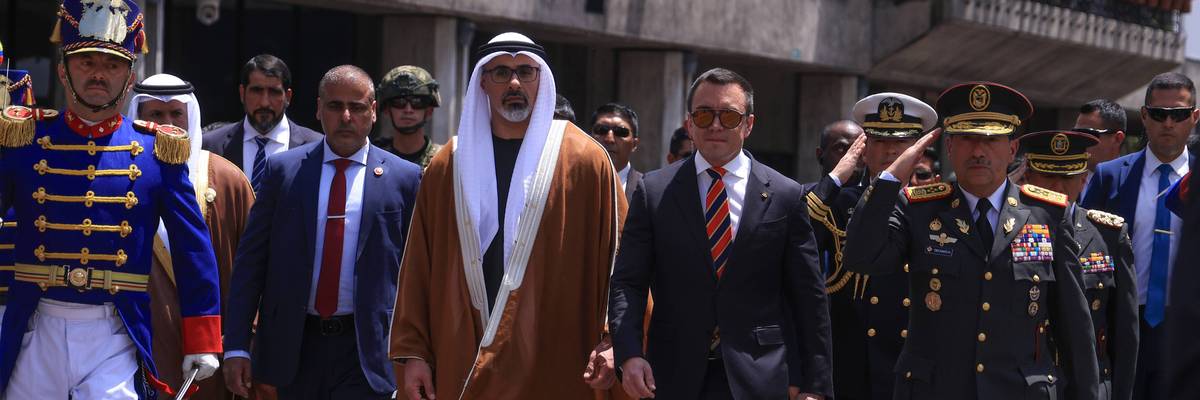
President of Ecuador Daniel Noboa (R) walks with Abu Dhabi's Crown Prince Sheikh Khaled bin Mohamed bin Zayed Al Nahyan during the Abu Dhabi's Crown Prince Sheikh Khaled Bin Mohammed Bin Zayed Al Nahyan visit at Plaza de la Independencia on March 1, 2026 in Quito, Ecuador.
The decision blocks the right-wing president's unconstitutional attempt to bypass the National Assembly. Still, this is just one step in Ecuador's continued fight for its Constitution and its democracy.
In a major rebuke to President Daniel Noboa, Ecuador's Constitutional Court ruled unanimously on March 9 that his controversial Bilateral Investment Treaty with the United Arab Emirates cannot be fast-tracked and must be approved by the National Assembly.
The decision blocks the right-wing president's unconstitutional attempt to bypass the National Assembly. Still, this is just one step in Ecuador's continued fight for its Constitution and its democracy.
This treaty is the test case for a far broader corporate coup, one that aims to resurrect a legal weapon Ecuador’s people have repeatedly rejected: Investor-State Dispute Settlement (ISDS).
The treaty, signed in a rushed ceremony in December 2025, was littered with errors, referencing the non-existent "United Arab States" and citing provisions that aren't there. When Ecuador’s pro-corporate Constitutional Court rightly demanded a corrected text, it asked for an English version, a bizarre move in a Spanish-speaking republic.
“We are witnessing a government ignoring its own Constitution and the will of its people to serve the interests of transnational capital."
In response, Noboa issued an extraordinary decree authorizing Ecuador’s ambassador to unilaterally correct the text, bypassing normal diplomatic and legal channels.
The court has now sided with Ecuador’s progressive Constitution. However, that is not where this fight ends; instead, the treaty will have to be taken through a two-stage review process, unless Noboa decides to ignore the court altogether—a move that would be unsurprising given the young autocrat’s continued destruction and dismissal of Ecuador’s other branches of government.
The Constitutional Court will have 30 days to conduct a second, deeper review of the treaty's content to verify its full conformity with the Constitution. If the treaty survives that scrutiny (or if the court does not respond in 30 days), it will go to the National Assembly, where it requires absolute majority approval. Currently, Noboa’s party only has two-fifths of the total assembly seats, with leftist, pro-Indigenous, and some centrist parties occupying the rest.
The urgency of this corporate agenda explains the government's simultaneous brutal crackdown on democratic opposition. In a move that has drawn international condemnation, an electoral judge, on the request of the Noboa-aligned prosecutor general, suspended the country's largest opposition party, the left-wing Revolución Ciudadana (RC), for nine months.
The RC would not be able to conduct any political activities, or run in the 2027 local elections. The left-wing party, which won 44% of the vote in the last presidential election, controls the country's largest cities, including Quito and Guayaquil.
Interestingly, the right-wing pro-Trump billionaire president has himself been credibly accused of electoral fraud, corruption, and stakes in the drug-trafficking trade.
The case against RC relies on the testimony of an individual awaiting trial for child sexual abuse, who was given preferential treatment in prison in exchange for implicating the party on cooked-up money laundering charges. This follows the February pre-trial detention of Guayaquil's Mayor, Aquiles Alvarez, another opposition leader targeted by the prosecutor general. This thus follows a long pattern of Noboa's crackdown on opposition. The right is also cutting off the opposition's ability to vote against Noboa's measures in the assembly.
The UAE BIT contains ISDS provisions that grant foreign investors the right to sue Ecuador in international tribunals for billions over laws or policies that harm their profits, and those they expect to make in the future, including environmental and health regulations that protect local and marginalized populations. This is explicitly prohibited by Article 422 of Ecuador’s Constitution, a prohibition upheld by the people in national referenda in 2024 and again in 2025.
“This is all very clearly unconstitutional,” says Ladan Mehranvar, a senior legal researcher at the Columbia Center on Sustainable Investment who focuses on international investment law and human rights. “They are trying to push the BIT through by sidestepping constitutional safeguards, including the requirement of prior approval by the National Assembly,” she added.
“We are witnessing a government ignoring its own Constitution and the will of its people to serve the interests of transnational capital,” said Pedro Labayen Herrera and Mario Osorio, both researchers with the Center for Economic and Political Research (CEPR) in Washington. “They are fast-tracking the UAE treaty by claiming it requires only executive ratification, thus avoiding the scrutiny of the Ecuadorian legislature and the public. That is simply false.”
There are serious concerns about the court’s independence. One justice, Claudia Salgado, nominated by Noboa, comes from a family of legal and arbitration specialists and has previously written on Ecuador’s constitutional ban on ISDS. Her apparent shift, alongside pressure from an executive that has publicly attacked and threatened the Constitutional Court judges, paints a picture of a state institution under siege. “Either the Constitutional Court is captured, or it feels threatened,” Mehranvar noted.
So why such a reckless, rushed push for a treaty with the UAE? Because it is the blueprint and the battering ram for something far more consequential, namely, a Free Trade Agreement with Canada and other pro-corporate actions that would permanently lock in ISDS for the (mostly foreign) mining industry.
There is also significant personal corruption at play. The Noboa family holds a significant stake in Silvercorp, a Canadian mining company, as well as other financial holdings with direct interests in ISDS and the president’s deregulation crusade.
An ISDS chapter in a Canada-Ecuador FTA would directly benefit the president’s own financial interests, allowing corporate actors, potentially including his family’s holdings, to sue the Ecuadorian state. “ISDS is a tool for the Noboa family to protect their own financial interest,” said Herrera and Osorio.
This agenda is being synchronized with a brutal domestic deregulation campaign. In late January, Noboa proposed gutting Ecuador’s Mining Law by replacing the mandatory environmental license with a simplified authorization, which local Indigenous groups say decimates their constitutional right to prior consultation, a key tool they use to oppose harmful extractive projects. Ecuador is one of the most biodiverse countries on Earth; about half of its territory is made up of the Amazon rainforest and Indigenous lands.
Combined with ISDS, this creates a vicious trap—remove environmental safeguards now, deter future governments from reinstating them, and use international tribunals to sue any future government that tries to reinstate them for “indirect expropriation” of future profits.
Companies could do this even without any intent to finish the projects, or invest while knowing that the projects are legally or politically untenable, winning out on billions of dollars in Ecuadorian taxpayer funds, at a time when Ecuador is facing a historic financial, energy, and security crisis, and remains one of the poorest countries in the Western Hemisphere.
The United Nations special rapporteur on human rights and the Environment has argued that ISDS has catastrophic consequences for climate action and human rights. Nobel prize-winning economist Joseph Stiglitz has even argued ISDS is “litigation terrorism,” while even the libertarian Cato Institute has said the mechanism actually threatens the rule of law, growth, and investment.
This deal and its progenitors represent the fusion of state and corporate power against democracy. It was preceded by the violent crushing of protests against subsidy removals, the criminalization of water defenders, and the continued advancement of mining projects in sensitive ecosystems like the Amazon and near the Yasuní National Park, despite, once again, popular referenda opposing them. The Noboa government has conducted a war against democracy, the rule of law, and human rights.
If the court and National Assembly allow this breach, the floodgates open for a corporate takeover dressed as trade policy, with only global mining capital standing to gain. Ecuador’s people have resisted corporatocracy many times over. Their government is now trying to force it on them by decree, while suppressing all opposition. At a time when global democracy and rights are falling off a cliff, the world must heed this crucial test.
Dear Common Dreams reader, It’s been nearly 30 years since I co-founded Common Dreams with my late wife, Lina Newhouser. We had the radical notion that journalism should serve the public good, not corporate profits. It was clear to us from the outset what it would take to build such a project. No paid advertisements. No corporate sponsors. No millionaire publisher telling us what to think or do. Many people said we wouldn't last a year, but we proved those doubters wrong. Together with a tremendous team of journalists and dedicated staff, we built an independent media outlet free from the constraints of profits and corporate control. Our mission has always been simple: To inform. To inspire. To ignite change for the common good. Building Common Dreams was not easy. Our survival was never guaranteed. When you take on the most powerful forces—Wall Street greed, fossil fuel industry destruction, Big Tech lobbyists, and uber-rich oligarchs who have spent billions upon billions rigging the economy and democracy in their favor—the only bulwark you have is supporters who believe in your work. But here’s the urgent message from me today. It's never been this bad out there. And it's never been this hard to keep us going. At the very moment Common Dreams is most needed, the threats we face are intensifying. We need your support now more than ever. We don't accept corporate advertising and never will. We don't have a paywall because we don't think people should be blocked from critical news based on their ability to pay. Everything we do is funded by the donations of readers like you. When everyone does the little they can afford, we are strong. But if that support retreats or dries up, so do we. Will you donate now to make sure Common Dreams not only survives but thrives? —Craig Brown, Co-founder |
In a major rebuke to President Daniel Noboa, Ecuador's Constitutional Court ruled unanimously on March 9 that his controversial Bilateral Investment Treaty with the United Arab Emirates cannot be fast-tracked and must be approved by the National Assembly.
The decision blocks the right-wing president's unconstitutional attempt to bypass the National Assembly. Still, this is just one step in Ecuador's continued fight for its Constitution and its democracy.
This treaty is the test case for a far broader corporate coup, one that aims to resurrect a legal weapon Ecuador’s people have repeatedly rejected: Investor-State Dispute Settlement (ISDS).
The treaty, signed in a rushed ceremony in December 2025, was littered with errors, referencing the non-existent "United Arab States" and citing provisions that aren't there. When Ecuador’s pro-corporate Constitutional Court rightly demanded a corrected text, it asked for an English version, a bizarre move in a Spanish-speaking republic.
“We are witnessing a government ignoring its own Constitution and the will of its people to serve the interests of transnational capital."
In response, Noboa issued an extraordinary decree authorizing Ecuador’s ambassador to unilaterally correct the text, bypassing normal diplomatic and legal channels.
The court has now sided with Ecuador’s progressive Constitution. However, that is not where this fight ends; instead, the treaty will have to be taken through a two-stage review process, unless Noboa decides to ignore the court altogether—a move that would be unsurprising given the young autocrat’s continued destruction and dismissal of Ecuador’s other branches of government.
The Constitutional Court will have 30 days to conduct a second, deeper review of the treaty's content to verify its full conformity with the Constitution. If the treaty survives that scrutiny (or if the court does not respond in 30 days), it will go to the National Assembly, where it requires absolute majority approval. Currently, Noboa’s party only has two-fifths of the total assembly seats, with leftist, pro-Indigenous, and some centrist parties occupying the rest.
The urgency of this corporate agenda explains the government's simultaneous brutal crackdown on democratic opposition. In a move that has drawn international condemnation, an electoral judge, on the request of the Noboa-aligned prosecutor general, suspended the country's largest opposition party, the left-wing Revolución Ciudadana (RC), for nine months.
The RC would not be able to conduct any political activities, or run in the 2027 local elections. The left-wing party, which won 44% of the vote in the last presidential election, controls the country's largest cities, including Quito and Guayaquil.
Interestingly, the right-wing pro-Trump billionaire president has himself been credibly accused of electoral fraud, corruption, and stakes in the drug-trafficking trade.
The case against RC relies on the testimony of an individual awaiting trial for child sexual abuse, who was given preferential treatment in prison in exchange for implicating the party on cooked-up money laundering charges. This follows the February pre-trial detention of Guayaquil's Mayor, Aquiles Alvarez, another opposition leader targeted by the prosecutor general. This thus follows a long pattern of Noboa's crackdown on opposition. The right is also cutting off the opposition's ability to vote against Noboa's measures in the assembly.
The UAE BIT contains ISDS provisions that grant foreign investors the right to sue Ecuador in international tribunals for billions over laws or policies that harm their profits, and those they expect to make in the future, including environmental and health regulations that protect local and marginalized populations. This is explicitly prohibited by Article 422 of Ecuador’s Constitution, a prohibition upheld by the people in national referenda in 2024 and again in 2025.
“This is all very clearly unconstitutional,” says Ladan Mehranvar, a senior legal researcher at the Columbia Center on Sustainable Investment who focuses on international investment law and human rights. “They are trying to push the BIT through by sidestepping constitutional safeguards, including the requirement of prior approval by the National Assembly,” she added.
“We are witnessing a government ignoring its own Constitution and the will of its people to serve the interests of transnational capital,” said Pedro Labayen Herrera and Mario Osorio, both researchers with the Center for Economic and Political Research (CEPR) in Washington. “They are fast-tracking the UAE treaty by claiming it requires only executive ratification, thus avoiding the scrutiny of the Ecuadorian legislature and the public. That is simply false.”
There are serious concerns about the court’s independence. One justice, Claudia Salgado, nominated by Noboa, comes from a family of legal and arbitration specialists and has previously written on Ecuador’s constitutional ban on ISDS. Her apparent shift, alongside pressure from an executive that has publicly attacked and threatened the Constitutional Court judges, paints a picture of a state institution under siege. “Either the Constitutional Court is captured, or it feels threatened,” Mehranvar noted.
So why such a reckless, rushed push for a treaty with the UAE? Because it is the blueprint and the battering ram for something far more consequential, namely, a Free Trade Agreement with Canada and other pro-corporate actions that would permanently lock in ISDS for the (mostly foreign) mining industry.
There is also significant personal corruption at play. The Noboa family holds a significant stake in Silvercorp, a Canadian mining company, as well as other financial holdings with direct interests in ISDS and the president’s deregulation crusade.
An ISDS chapter in a Canada-Ecuador FTA would directly benefit the president’s own financial interests, allowing corporate actors, potentially including his family’s holdings, to sue the Ecuadorian state. “ISDS is a tool for the Noboa family to protect their own financial interest,” said Herrera and Osorio.
This agenda is being synchronized with a brutal domestic deregulation campaign. In late January, Noboa proposed gutting Ecuador’s Mining Law by replacing the mandatory environmental license with a simplified authorization, which local Indigenous groups say decimates their constitutional right to prior consultation, a key tool they use to oppose harmful extractive projects. Ecuador is one of the most biodiverse countries on Earth; about half of its territory is made up of the Amazon rainforest and Indigenous lands.
Combined with ISDS, this creates a vicious trap—remove environmental safeguards now, deter future governments from reinstating them, and use international tribunals to sue any future government that tries to reinstate them for “indirect expropriation” of future profits.
Companies could do this even without any intent to finish the projects, or invest while knowing that the projects are legally or politically untenable, winning out on billions of dollars in Ecuadorian taxpayer funds, at a time when Ecuador is facing a historic financial, energy, and security crisis, and remains one of the poorest countries in the Western Hemisphere.
The United Nations special rapporteur on human rights and the Environment has argued that ISDS has catastrophic consequences for climate action and human rights. Nobel prize-winning economist Joseph Stiglitz has even argued ISDS is “litigation terrorism,” while even the libertarian Cato Institute has said the mechanism actually threatens the rule of law, growth, and investment.
This deal and its progenitors represent the fusion of state and corporate power against democracy. It was preceded by the violent crushing of protests against subsidy removals, the criminalization of water defenders, and the continued advancement of mining projects in sensitive ecosystems like the Amazon and near the Yasuní National Park, despite, once again, popular referenda opposing them. The Noboa government has conducted a war against democracy, the rule of law, and human rights.
If the court and National Assembly allow this breach, the floodgates open for a corporate takeover dressed as trade policy, with only global mining capital standing to gain. Ecuador’s people have resisted corporatocracy many times over. Their government is now trying to force it on them by decree, while suppressing all opposition. At a time when global democracy and rights are falling off a cliff, the world must heed this crucial test.
In a major rebuke to President Daniel Noboa, Ecuador's Constitutional Court ruled unanimously on March 9 that his controversial Bilateral Investment Treaty with the United Arab Emirates cannot be fast-tracked and must be approved by the National Assembly.
The decision blocks the right-wing president's unconstitutional attempt to bypass the National Assembly. Still, this is just one step in Ecuador's continued fight for its Constitution and its democracy.
This treaty is the test case for a far broader corporate coup, one that aims to resurrect a legal weapon Ecuador’s people have repeatedly rejected: Investor-State Dispute Settlement (ISDS).
The treaty, signed in a rushed ceremony in December 2025, was littered with errors, referencing the non-existent "United Arab States" and citing provisions that aren't there. When Ecuador’s pro-corporate Constitutional Court rightly demanded a corrected text, it asked for an English version, a bizarre move in a Spanish-speaking republic.
“We are witnessing a government ignoring its own Constitution and the will of its people to serve the interests of transnational capital."
In response, Noboa issued an extraordinary decree authorizing Ecuador’s ambassador to unilaterally correct the text, bypassing normal diplomatic and legal channels.
The court has now sided with Ecuador’s progressive Constitution. However, that is not where this fight ends; instead, the treaty will have to be taken through a two-stage review process, unless Noboa decides to ignore the court altogether—a move that would be unsurprising given the young autocrat’s continued destruction and dismissal of Ecuador’s other branches of government.
The Constitutional Court will have 30 days to conduct a second, deeper review of the treaty's content to verify its full conformity with the Constitution. If the treaty survives that scrutiny (or if the court does not respond in 30 days), it will go to the National Assembly, where it requires absolute majority approval. Currently, Noboa’s party only has two-fifths of the total assembly seats, with leftist, pro-Indigenous, and some centrist parties occupying the rest.
The urgency of this corporate agenda explains the government's simultaneous brutal crackdown on democratic opposition. In a move that has drawn international condemnation, an electoral judge, on the request of the Noboa-aligned prosecutor general, suspended the country's largest opposition party, the left-wing Revolución Ciudadana (RC), for nine months.
The RC would not be able to conduct any political activities, or run in the 2027 local elections. The left-wing party, which won 44% of the vote in the last presidential election, controls the country's largest cities, including Quito and Guayaquil.
Interestingly, the right-wing pro-Trump billionaire president has himself been credibly accused of electoral fraud, corruption, and stakes in the drug-trafficking trade.
The case against RC relies on the testimony of an individual awaiting trial for child sexual abuse, who was given preferential treatment in prison in exchange for implicating the party on cooked-up money laundering charges. This follows the February pre-trial detention of Guayaquil's Mayor, Aquiles Alvarez, another opposition leader targeted by the prosecutor general. This thus follows a long pattern of Noboa's crackdown on opposition. The right is also cutting off the opposition's ability to vote against Noboa's measures in the assembly.
The UAE BIT contains ISDS provisions that grant foreign investors the right to sue Ecuador in international tribunals for billions over laws or policies that harm their profits, and those they expect to make in the future, including environmental and health regulations that protect local and marginalized populations. This is explicitly prohibited by Article 422 of Ecuador’s Constitution, a prohibition upheld by the people in national referenda in 2024 and again in 2025.
“This is all very clearly unconstitutional,” says Ladan Mehranvar, a senior legal researcher at the Columbia Center on Sustainable Investment who focuses on international investment law and human rights. “They are trying to push the BIT through by sidestepping constitutional safeguards, including the requirement of prior approval by the National Assembly,” she added.
“We are witnessing a government ignoring its own Constitution and the will of its people to serve the interests of transnational capital,” said Pedro Labayen Herrera and Mario Osorio, both researchers with the Center for Economic and Political Research (CEPR) in Washington. “They are fast-tracking the UAE treaty by claiming it requires only executive ratification, thus avoiding the scrutiny of the Ecuadorian legislature and the public. That is simply false.”
There are serious concerns about the court’s independence. One justice, Claudia Salgado, nominated by Noboa, comes from a family of legal and arbitration specialists and has previously written on Ecuador’s constitutional ban on ISDS. Her apparent shift, alongside pressure from an executive that has publicly attacked and threatened the Constitutional Court judges, paints a picture of a state institution under siege. “Either the Constitutional Court is captured, or it feels threatened,” Mehranvar noted.
So why such a reckless, rushed push for a treaty with the UAE? Because it is the blueprint and the battering ram for something far more consequential, namely, a Free Trade Agreement with Canada and other pro-corporate actions that would permanently lock in ISDS for the (mostly foreign) mining industry.
There is also significant personal corruption at play. The Noboa family holds a significant stake in Silvercorp, a Canadian mining company, as well as other financial holdings with direct interests in ISDS and the president’s deregulation crusade.
An ISDS chapter in a Canada-Ecuador FTA would directly benefit the president’s own financial interests, allowing corporate actors, potentially including his family’s holdings, to sue the Ecuadorian state. “ISDS is a tool for the Noboa family to protect their own financial interest,” said Herrera and Osorio.
This agenda is being synchronized with a brutal domestic deregulation campaign. In late January, Noboa proposed gutting Ecuador’s Mining Law by replacing the mandatory environmental license with a simplified authorization, which local Indigenous groups say decimates their constitutional right to prior consultation, a key tool they use to oppose harmful extractive projects. Ecuador is one of the most biodiverse countries on Earth; about half of its territory is made up of the Amazon rainforest and Indigenous lands.
Combined with ISDS, this creates a vicious trap—remove environmental safeguards now, deter future governments from reinstating them, and use international tribunals to sue any future government that tries to reinstate them for “indirect expropriation” of future profits.
Companies could do this even without any intent to finish the projects, or invest while knowing that the projects are legally or politically untenable, winning out on billions of dollars in Ecuadorian taxpayer funds, at a time when Ecuador is facing a historic financial, energy, and security crisis, and remains one of the poorest countries in the Western Hemisphere.
The United Nations special rapporteur on human rights and the Environment has argued that ISDS has catastrophic consequences for climate action and human rights. Nobel prize-winning economist Joseph Stiglitz has even argued ISDS is “litigation terrorism,” while even the libertarian Cato Institute has said the mechanism actually threatens the rule of law, growth, and investment.
This deal and its progenitors represent the fusion of state and corporate power against democracy. It was preceded by the violent crushing of protests against subsidy removals, the criminalization of water defenders, and the continued advancement of mining projects in sensitive ecosystems like the Amazon and near the Yasuní National Park, despite, once again, popular referenda opposing them. The Noboa government has conducted a war against democracy, the rule of law, and human rights.
If the court and National Assembly allow this breach, the floodgates open for a corporate takeover dressed as trade policy, with only global mining capital standing to gain. Ecuador’s people have resisted corporatocracy many times over. Their government is now trying to force it on them by decree, while suppressing all opposition. At a time when global democracy and rights are falling off a cliff, the world must heed this crucial test.