

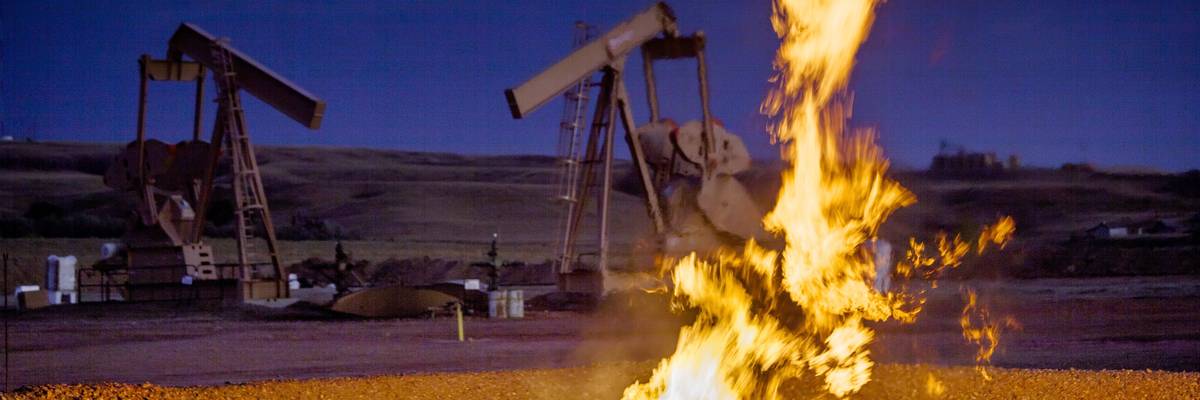
Flames from a flaring pit are seen near a well in the Bakken Oil Field.
It's Time to Make Gas a Dirty Word
The natural gas industry is destroying the climate, and destroying people’s lungs, and it’s trying to lock us into this expensive practice for decades to come.
We talk regularly about Big Oil, but it would probably make more sense to at least occasionally refer to it as Big Gas—many of the same players are involved, of course, and the two are often found in the same places, but it’s been clear for some time that oil is not a growth industry. The rapid rise of electric vehicles in most of the world undercuts projections of future use—we’re at or near the top of the plateau now, and by 2030 or so the amount of oil we use should be going down.
That’s why the hydrocarbon industry’s growth story has been largely about natural gas. It’s used for many things—heating, cooking—but above all for generating electricity, and it’s on that ground that the fossil fuel industry has set out to build its market, stressing constantly that it is clean and cheap. Two important new reports in recent days make it clear how false those claims really are.
The first comes from a Center for Climate Integrity team led by Rebecca Leber and Rebecca John. Leber has a long record covering the industry—her 2020 report in Mother Jones about the industry paying Instagram influencers to plug natural gas was an early landmark in our understanding of pay-for-play social media, as well as the lengths the industry would go to in order to tell its fibs. (“#cookingwithgas makes food taste better,” says Camille, an LA-based foodie who poses artfully with her spatula, to her 16,700 followers.”)
But as they document in the new report, which should be read in full, this is a very old story. It turns out that the natural gas industry has been playing the PR game for a very long time. As far back as the 1950s, gas had a bad image: it was known to contribute to respiratory problems when burned indoors (more on that later!), and to local air pollution. And as scientists first started analyzing the greenhouse effect in the 1970s, most of the concern was about carbon dioxide, but there was a growing realization that methane—which is essentially what natural gas is—was the smaller but still important sibling greenhouse gas. And so the industry began doing what it did best, which is lying, or, to use the technical term, “public relations.” They constructed a whole mythology around natural gas, turning it into the fossil fuel equivalent of the “other white meat”:
In the late 1980s, the gas industry and major oil companies started to brand gas as a “bridge fuel”—a clean-burning transition fuel to a renewable energy future. In reality, they planned a long-term future for natural gas, while simultaneously undermining renewables, obstructing the destination to which gas’ “bridge” was supposed to lead. Over the next 20 years, the industry effectively solidified the bridge fuel myth by co-opting the science and oversight originally intended to keep carbon and methane emissions in check.
Working together in a growing coalition that included the oil majors and ultimately several major environmental groups, the industry managed to temper concerns about methane using strategies crafted by the same firms that for decades undermined the scientific consensus about the harms of tobacco. AGA and allied groups aggressively challenged the science around methane through industry-funded studies and the creation of the objective-sounding Gas Research Institute.
But their approach was multidimensional. While muddying the waters on the industry’s methane problem, the gas industry was careful not to deny the issue of climate change outright, instead focusing attention on carbon dioxide. It paired this with relentlessly promoting the concept of gas as clean—certainly cleaner than coal or oil—and positioning gas as a bridge fuel and climate solution. In the process, the gas industry solidified partnerships with EPA with the explicit goal of fending off regulations in favor of voluntary emissions management, while also recruiting environmental organizations that would lend legitimacy to their arguments.
I want to highlight the effectiveness of this strategy with a story about… me. In 1988, before this campaign took off, I was writing The End of Nature, sometimes called the first book for a general audience on climate change. And in it I wrote:
A common suggestion is to replace much of the coal and oil we burn with natural gas, since it produces only about half as much carbon dioxide. But it natural gas—methane—escapes into the atmosphere before it burns, it traps solar radiation more efficiently than CO2… As a result, switching to natural gas may have no effect on the greenhouse effect. It might even make it worse.
So give me credit for knowing this crucial science when I was 27.
But not really, because I think I more or less forgot it over the next two decades, as the gas industry rearranged the terms of the debate, and turned it into the lesser of two climate evils, the “bridge” to a future of cleaner energy. This argument was bought wholesale by politicians, especially Democratic ones—if you go read Barack Obama’s State of the Union addresses, most of them include a paragraph praising the fracking revolution as both an economic boon and a way to reduce greenhouse gas emissions; we were replacing coal with something cleaner. The Sierra Club’s leader, Carl Pope, barnstormed around the country with one of the fracking industry’s chief spokespeople, promoting this “solution” to the climate crisis.
And so it seemed novel to me when two Cornell scientists, Bob Howarth and Tony Ingraffea, about 15 years ago, began publishing data showing that leak rates from fracking meant that natural gas was no cleaner than coal—the argument that had been there all along. I wrote some early pieces on their work for The New York Review of Books, and then published a long piece in The Nation that made the same point I’d made more than a quarter-century earlier:
Our combined emissions of methane and carbon dioxide have gone steadily and sharply up during the Obama years. We closed coal plants and opened methane leaks, and the result is that things have gotten worse.
I’ve made up for my forgetfulness, I think, by helping lead battles against fracking, and against the buildout of liquefied natural gas (LNG) export terminals; those of you who have been long subscribers to this newsletter got to participate in that latter fight, which we won in the Biden years and then lost in the Trump risorgimento. But if the PR campaign flummoxed me, imagine how well it worked on people who weren’t paying much attention at all (which included virtually everyone in political life, especially Democrats who saw natural gas as a way to have their green cake and reccycle it too). Many thanks to Leber, John, and their whole team for laying the story out in all its gory detail.
The other claim about natural gas is that it’s cheap—this is the formulation that “leaders” like New York Gov. Kathy Hochul are currently relying on as they link fracked gas and affordability as an excuse to cut back on moving towards renewables, and that data center developers are using to justify a buildout of natural gas generation.
But a report out this morning from the good folks at Oil Change International puts paid to all that. It makes clear that the industry is running out of the really cheap stuff—the fracked gas from the Permian and Appalachian shales that it’s been pumping for the last two decades. Many of those wells are playing out fast, and now it’s going to need to turn to the more “geologically complex” Haynesville shale of east Texas and Louisiana, and that will drive up costs—especially since more and more of the gas is, at least theoretically, going to be exported to Asia as the industry builds out massive shipping terminals along the Gulf of Mexico:
If industry succeeds in locking in unprecedented demand for US gas by expanding exports and domestic consumption, US supply may be pushed to its limits. Gas supply can only meet such high levels of demand if prices rise to cover the higher production costs of marginal gas supplies. This connects rising dependence on gas to rising energy costs. US consumers and those in LNG-importing countries must push policymakers to reduce dependence on fossil fuels and accelerate the transition to reliable, affordable renewable energy
The numbers are fairly startling:
Between 2026 and 2040, the average wholesale price of gas could be 80% higher than during the past decade of US LNG exports, a decade when energy price volatility was already causing hardship in the US and LNG-importing countries. Prices could double relative to the 2020 to 2025 average by the late 2030s.
In other words, those politicians locking us in to natural gas are guaranteeing that our kids will spend much of their lives paying far more for energy than they should—and far more than people in the rest of the world will be spending. Because politicians in those countries are starting to wake up. A big piece in the Times yesterday described the ways that many governments are now trying to “unshackle” themselves from natural gas, after watching the supply dry up with the closure of the Strait of Hormuz. In the Philippines, for example:
The country’s largest solar project began delivering its first megawatts of power in March. That came two weeks after the outbreak of the Iran War, which pushed up energy prices and knocked out 20% of the global LNG supply.
“That was fortunate timing. It was like fate,” said Emmanuel Rubio, the chief executive of Meralco PowerGen, the utility-backed power generation company that operates and invests in Terra Solar and gas- and coal-fired power plants in the Philippines.
For a country that imports nearly all of its fossil fuels, the solar project has proved that “we can actually be, to a certain extent, self-reliant,” he added.
The collection of lies around natural gas are collapsing in other ways, too. Another new study, this one from an Ohio team, went back to those fears around gas and indoor air pollution that dated all the way back to the 1950s, and what it found was truly startling. As Gary Fuller summarizes, replacing a gas stove with an electric burner—say, an induction cooktop, available online for $60—reduces childhood asthma dramatically. And when I say dramatically, I mean: better than the best medicine:
Ohio’s publicly owned MetroHealth began the study in December 2024 but funding was terminated early by the incoming Trump administration. It had been designed to investigate if replacing gas cooking improved asthma for 1,200 people living near Cleveland, Ohio.
Prof Ash Sehgal of Case Western Reserve University, the project’s leader, said: “We had completed the project at fewer than 100 households. As a result, over 1,100 households were unable to benefit. We also had to lay off about 20 project staff.”
The team finished the stove replacements that were underway and closed the project, but to the researchers’ surprise, the benefits could be clearly detected even in the scaled-down study of 72 homes.
Sehgal said: “We were surprised when we analysed the results and found a very large effect size. The improvements in asthma symptoms following stove change were similar to–or even greater than–those reported in clinical trials of commonly used asthma medications.”
Angela Bland, a 38-year-old resident of Akron, Ohio, said: “I didn’t realize my gas stove was the issue until I used the electric stove. I now need my inhaler way less often.”
If you want more on this study, check out Sammy Roth’s Climate Colored Goggles newsletter. He interviewed Segal too: “Our improvement was about twice as much as you typically see with medical treatment of asthma,” the researcher said. It truly is remarkable to think how much good we could do simply by dousing the campfire that most people have in their kitchen.
Anyway, to summarize: The natural gas industry is destroying the climate, and destroying people’s lungs, and it’s trying to lock us into this expensive practice for decades to come.
Any effort to slow it down is met with massive resistance. In Colorado, for instance, some towns have tried to prevent gas hookups in new buildings, requiring them to go all-electric. The industry has responded by organizing on behalf of a constitutional amendment called the “Right to Natural Gas,” which will go on the November ballot. As Maya McDaniel writes:
The proposed amendment states that “producers and utilities have the right to sell natural gas to homes and businesses.” That could force changes to building codes that encourage electric heating and cooking, undoing progress toward electrification.
“Really, it’s just a cynical attempt to lock fossil fuel industry profits into the state constitution,” said Kelly Nordini, CEO of Conservation Colorado, an environmental nonprofit. “That’s bad for people’s pocketbooks, for clean air, for clean water; it has no provisions for public health or safety.”
Really, the first lucky break for natural gas came back in the 19th century, when it acquired that moniker, to differentiate it from “manufactured” or “town” gas, made by burning coal in the absence of air, and then piped through municipalities for street lighting and other tasks. These gasworks shut down as big deposits of naturally occurring gas were discovered, hence the name.
I’ve taken to calling it ‘fracked gas’ in recent years, since that industry term for the new methods of liberating the fuel from tight rocks makes it sound almost as disgusting as it is. “Fossil gas” works too, or perhaps “asthma gas.” But our job is to make it a dirty word of some kind. The future depends on it.
We are at a crossroads
This country and this world are at a monumental crossroads. In a few short weeks, US voters will have an opportunity to beat back the forces of fascism and confront the billionaires who are rigging the economy, our media system, and our democracy, making it increasingly impossible for ordinary people to get by. We’re not just talking about the election. We’re talking about what must be done once these fascist elements are vanquished from power. We need a bolder set of solutions than what either major party has so far been willing to offer and a working-class movement ready to fight like hell for it. Trump didn't emerge from nowhere. The conditions that fueled MAGA authoritarianism were created by decades of radical neoliberal economic policies and a corrupt political system dominated by corporate interests. They slashed taxes on the super-rich, promising that the benefits would trickle down. They said giveaways to the corporate titans would make life more affordable for the rest of us. It was all bullshit. And when a bitter, betrayed populace searches for someone to blame, right-wing demagogues have little trouble finding scapegoats. People know when they're being lied to, but you won't hear any of this from the corporate media. Only independent journalism—powered and funded by people who believe in building a better world—can deliver truly trustworthy daily news. Our Fall Campaign is underway, and we need your help. To power our newsroom through the rest of the year, we need to raise $125,000 by midnight on October 31. So if you share our vision, please contribute whatever you can to sustain our work. |
We talk regularly about Big Oil, but it would probably make more sense to at least occasionally refer to it as Big Gas—many of the same players are involved, of course, and the two are often found in the same places, but it’s been clear for some time that oil is not a growth industry. The rapid rise of electric vehicles in most of the world undercuts projections of future use—we’re at or near the top of the plateau now, and by 2030 or so the amount of oil we use should be going down.
That’s why the hydrocarbon industry’s growth story has been largely about natural gas. It’s used for many things—heating, cooking—but above all for generating electricity, and it’s on that ground that the fossil fuel industry has set out to build its market, stressing constantly that it is clean and cheap. Two important new reports in recent days make it clear how false those claims really are.
The first comes from a Center for Climate Integrity team led by Rebecca Leber and Rebecca John. Leber has a long record covering the industry—her 2020 report in Mother Jones about the industry paying Instagram influencers to plug natural gas was an early landmark in our understanding of pay-for-play social media, as well as the lengths the industry would go to in order to tell its fibs. (“#cookingwithgas makes food taste better,” says Camille, an LA-based foodie who poses artfully with her spatula, to her 16,700 followers.”)
But as they document in the new report, which should be read in full, this is a very old story. It turns out that the natural gas industry has been playing the PR game for a very long time. As far back as the 1950s, gas had a bad image: it was known to contribute to respiratory problems when burned indoors (more on that later!), and to local air pollution. And as scientists first started analyzing the greenhouse effect in the 1970s, most of the concern was about carbon dioxide, but there was a growing realization that methane—which is essentially what natural gas is—was the smaller but still important sibling greenhouse gas. And so the industry began doing what it did best, which is lying, or, to use the technical term, “public relations.” They constructed a whole mythology around natural gas, turning it into the fossil fuel equivalent of the “other white meat”:
In the late 1980s, the gas industry and major oil companies started to brand gas as a “bridge fuel”—a clean-burning transition fuel to a renewable energy future. In reality, they planned a long-term future for natural gas, while simultaneously undermining renewables, obstructing the destination to which gas’ “bridge” was supposed to lead. Over the next 20 years, the industry effectively solidified the bridge fuel myth by co-opting the science and oversight originally intended to keep carbon and methane emissions in check.
Working together in a growing coalition that included the oil majors and ultimately several major environmental groups, the industry managed to temper concerns about methane using strategies crafted by the same firms that for decades undermined the scientific consensus about the harms of tobacco. AGA and allied groups aggressively challenged the science around methane through industry-funded studies and the creation of the objective-sounding Gas Research Institute.
But their approach was multidimensional. While muddying the waters on the industry’s methane problem, the gas industry was careful not to deny the issue of climate change outright, instead focusing attention on carbon dioxide. It paired this with relentlessly promoting the concept of gas as clean—certainly cleaner than coal or oil—and positioning gas as a bridge fuel and climate solution. In the process, the gas industry solidified partnerships with EPA with the explicit goal of fending off regulations in favor of voluntary emissions management, while also recruiting environmental organizations that would lend legitimacy to their arguments.
I want to highlight the effectiveness of this strategy with a story about… me. In 1988, before this campaign took off, I was writing The End of Nature, sometimes called the first book for a general audience on climate change. And in it I wrote:
A common suggestion is to replace much of the coal and oil we burn with natural gas, since it produces only about half as much carbon dioxide. But it natural gas—methane—escapes into the atmosphere before it burns, it traps solar radiation more efficiently than CO2… As a result, switching to natural gas may have no effect on the greenhouse effect. It might even make it worse.
So give me credit for knowing this crucial science when I was 27.
But not really, because I think I more or less forgot it over the next two decades, as the gas industry rearranged the terms of the debate, and turned it into the lesser of two climate evils, the “bridge” to a future of cleaner energy. This argument was bought wholesale by politicians, especially Democratic ones—if you go read Barack Obama’s State of the Union addresses, most of them include a paragraph praising the fracking revolution as both an economic boon and a way to reduce greenhouse gas emissions; we were replacing coal with something cleaner. The Sierra Club’s leader, Carl Pope, barnstormed around the country with one of the fracking industry’s chief spokespeople, promoting this “solution” to the climate crisis.
And so it seemed novel to me when two Cornell scientists, Bob Howarth and Tony Ingraffea, about 15 years ago, began publishing data showing that leak rates from fracking meant that natural gas was no cleaner than coal—the argument that had been there all along. I wrote some early pieces on their work for The New York Review of Books, and then published a long piece in The Nation that made the same point I’d made more than a quarter-century earlier:
Our combined emissions of methane and carbon dioxide have gone steadily and sharply up during the Obama years. We closed coal plants and opened methane leaks, and the result is that things have gotten worse.
I’ve made up for my forgetfulness, I think, by helping lead battles against fracking, and against the buildout of liquefied natural gas (LNG) export terminals; those of you who have been long subscribers to this newsletter got to participate in that latter fight, which we won in the Biden years and then lost in the Trump risorgimento. But if the PR campaign flummoxed me, imagine how well it worked on people who weren’t paying much attention at all (which included virtually everyone in political life, especially Democrats who saw natural gas as a way to have their green cake and reccycle it too). Many thanks to Leber, John, and their whole team for laying the story out in all its gory detail.
The other claim about natural gas is that it’s cheap—this is the formulation that “leaders” like New York Gov. Kathy Hochul are currently relying on as they link fracked gas and affordability as an excuse to cut back on moving towards renewables, and that data center developers are using to justify a buildout of natural gas generation.
But a report out this morning from the good folks at Oil Change International puts paid to all that. It makes clear that the industry is running out of the really cheap stuff—the fracked gas from the Permian and Appalachian shales that it’s been pumping for the last two decades. Many of those wells are playing out fast, and now it’s going to need to turn to the more “geologically complex” Haynesville shale of east Texas and Louisiana, and that will drive up costs—especially since more and more of the gas is, at least theoretically, going to be exported to Asia as the industry builds out massive shipping terminals along the Gulf of Mexico:
If industry succeeds in locking in unprecedented demand for US gas by expanding exports and domestic consumption, US supply may be pushed to its limits. Gas supply can only meet such high levels of demand if prices rise to cover the higher production costs of marginal gas supplies. This connects rising dependence on gas to rising energy costs. US consumers and those in LNG-importing countries must push policymakers to reduce dependence on fossil fuels and accelerate the transition to reliable, affordable renewable energy
The numbers are fairly startling:
Between 2026 and 2040, the average wholesale price of gas could be 80% higher than during the past decade of US LNG exports, a decade when energy price volatility was already causing hardship in the US and LNG-importing countries. Prices could double relative to the 2020 to 2025 average by the late 2030s.
In other words, those politicians locking us in to natural gas are guaranteeing that our kids will spend much of their lives paying far more for energy than they should—and far more than people in the rest of the world will be spending. Because politicians in those countries are starting to wake up. A big piece in the Times yesterday described the ways that many governments are now trying to “unshackle” themselves from natural gas, after watching the supply dry up with the closure of the Strait of Hormuz. In the Philippines, for example:
The country’s largest solar project began delivering its first megawatts of power in March. That came two weeks after the outbreak of the Iran War, which pushed up energy prices and knocked out 20% of the global LNG supply.
“That was fortunate timing. It was like fate,” said Emmanuel Rubio, the chief executive of Meralco PowerGen, the utility-backed power generation company that operates and invests in Terra Solar and gas- and coal-fired power plants in the Philippines.
For a country that imports nearly all of its fossil fuels, the solar project has proved that “we can actually be, to a certain extent, self-reliant,” he added.
The collection of lies around natural gas are collapsing in other ways, too. Another new study, this one from an Ohio team, went back to those fears around gas and indoor air pollution that dated all the way back to the 1950s, and what it found was truly startling. As Gary Fuller summarizes, replacing a gas stove with an electric burner—say, an induction cooktop, available online for $60—reduces childhood asthma dramatically. And when I say dramatically, I mean: better than the best medicine:
Ohio’s publicly owned MetroHealth began the study in December 2024 but funding was terminated early by the incoming Trump administration. It had been designed to investigate if replacing gas cooking improved asthma for 1,200 people living near Cleveland, Ohio.
Prof Ash Sehgal of Case Western Reserve University, the project’s leader, said: “We had completed the project at fewer than 100 households. As a result, over 1,100 households were unable to benefit. We also had to lay off about 20 project staff.”
The team finished the stove replacements that were underway and closed the project, but to the researchers’ surprise, the benefits could be clearly detected even in the scaled-down study of 72 homes.
Sehgal said: “We were surprised when we analysed the results and found a very large effect size. The improvements in asthma symptoms following stove change were similar to–or even greater than–those reported in clinical trials of commonly used asthma medications.”
Angela Bland, a 38-year-old resident of Akron, Ohio, said: “I didn’t realize my gas stove was the issue until I used the electric stove. I now need my inhaler way less often.”
If you want more on this study, check out Sammy Roth’s Climate Colored Goggles newsletter. He interviewed Segal too: “Our improvement was about twice as much as you typically see with medical treatment of asthma,” the researcher said. It truly is remarkable to think how much good we could do simply by dousing the campfire that most people have in their kitchen.
Anyway, to summarize: The natural gas industry is destroying the climate, and destroying people’s lungs, and it’s trying to lock us into this expensive practice for decades to come.
Any effort to slow it down is met with massive resistance. In Colorado, for instance, some towns have tried to prevent gas hookups in new buildings, requiring them to go all-electric. The industry has responded by organizing on behalf of a constitutional amendment called the “Right to Natural Gas,” which will go on the November ballot. As Maya McDaniel writes:
The proposed amendment states that “producers and utilities have the right to sell natural gas to homes and businesses.” That could force changes to building codes that encourage electric heating and cooking, undoing progress toward electrification.
“Really, it’s just a cynical attempt to lock fossil fuel industry profits into the state constitution,” said Kelly Nordini, CEO of Conservation Colorado, an environmental nonprofit. “That’s bad for people’s pocketbooks, for clean air, for clean water; it has no provisions for public health or safety.”
Really, the first lucky break for natural gas came back in the 19th century, when it acquired that moniker, to differentiate it from “manufactured” or “town” gas, made by burning coal in the absence of air, and then piped through municipalities for street lighting and other tasks. These gasworks shut down as big deposits of naturally occurring gas were discovered, hence the name.
I’ve taken to calling it ‘fracked gas’ in recent years, since that industry term for the new methods of liberating the fuel from tight rocks makes it sound almost as disgusting as it is. “Fossil gas” works too, or perhaps “asthma gas.” But our job is to make it a dirty word of some kind. The future depends on it.
- 'Fossil Fuels Are Killing Us': Scientists Publish Sweeping Review of Industry Harms ›
- Obama's Faulty Plan a 'Full-Throttle' Endorsement of Fracking ›
- Natural Gas vs. Renewable Energy: Beware the Latest Gas Industry Talking Points ›
- Report Exposes Decades of Climate Polluters Pushing the 'Fraud of Clean Natural Gas' ›
- Sunrise Movement and Partners Launch Gas Is Not Clean Campaign ›
We talk regularly about Big Oil, but it would probably make more sense to at least occasionally refer to it as Big Gas—many of the same players are involved, of course, and the two are often found in the same places, but it’s been clear for some time that oil is not a growth industry. The rapid rise of electric vehicles in most of the world undercuts projections of future use—we’re at or near the top of the plateau now, and by 2030 or so the amount of oil we use should be going down.
That’s why the hydrocarbon industry’s growth story has been largely about natural gas. It’s used for many things—heating, cooking—but above all for generating electricity, and it’s on that ground that the fossil fuel industry has set out to build its market, stressing constantly that it is clean and cheap. Two important new reports in recent days make it clear how false those claims really are.
The first comes from a Center for Climate Integrity team led by Rebecca Leber and Rebecca John. Leber has a long record covering the industry—her 2020 report in Mother Jones about the industry paying Instagram influencers to plug natural gas was an early landmark in our understanding of pay-for-play social media, as well as the lengths the industry would go to in order to tell its fibs. (“#cookingwithgas makes food taste better,” says Camille, an LA-based foodie who poses artfully with her spatula, to her 16,700 followers.”)
But as they document in the new report, which should be read in full, this is a very old story. It turns out that the natural gas industry has been playing the PR game for a very long time. As far back as the 1950s, gas had a bad image: it was known to contribute to respiratory problems when burned indoors (more on that later!), and to local air pollution. And as scientists first started analyzing the greenhouse effect in the 1970s, most of the concern was about carbon dioxide, but there was a growing realization that methane—which is essentially what natural gas is—was the smaller but still important sibling greenhouse gas. And so the industry began doing what it did best, which is lying, or, to use the technical term, “public relations.” They constructed a whole mythology around natural gas, turning it into the fossil fuel equivalent of the “other white meat”:
In the late 1980s, the gas industry and major oil companies started to brand gas as a “bridge fuel”—a clean-burning transition fuel to a renewable energy future. In reality, they planned a long-term future for natural gas, while simultaneously undermining renewables, obstructing the destination to which gas’ “bridge” was supposed to lead. Over the next 20 years, the industry effectively solidified the bridge fuel myth by co-opting the science and oversight originally intended to keep carbon and methane emissions in check.
Working together in a growing coalition that included the oil majors and ultimately several major environmental groups, the industry managed to temper concerns about methane using strategies crafted by the same firms that for decades undermined the scientific consensus about the harms of tobacco. AGA and allied groups aggressively challenged the science around methane through industry-funded studies and the creation of the objective-sounding Gas Research Institute.
But their approach was multidimensional. While muddying the waters on the industry’s methane problem, the gas industry was careful not to deny the issue of climate change outright, instead focusing attention on carbon dioxide. It paired this with relentlessly promoting the concept of gas as clean—certainly cleaner than coal or oil—and positioning gas as a bridge fuel and climate solution. In the process, the gas industry solidified partnerships with EPA with the explicit goal of fending off regulations in favor of voluntary emissions management, while also recruiting environmental organizations that would lend legitimacy to their arguments.
I want to highlight the effectiveness of this strategy with a story about… me. In 1988, before this campaign took off, I was writing The End of Nature, sometimes called the first book for a general audience on climate change. And in it I wrote:
A common suggestion is to replace much of the coal and oil we burn with natural gas, since it produces only about half as much carbon dioxide. But it natural gas—methane—escapes into the atmosphere before it burns, it traps solar radiation more efficiently than CO2… As a result, switching to natural gas may have no effect on the greenhouse effect. It might even make it worse.
So give me credit for knowing this crucial science when I was 27.
But not really, because I think I more or less forgot it over the next two decades, as the gas industry rearranged the terms of the debate, and turned it into the lesser of two climate evils, the “bridge” to a future of cleaner energy. This argument was bought wholesale by politicians, especially Democratic ones—if you go read Barack Obama’s State of the Union addresses, most of them include a paragraph praising the fracking revolution as both an economic boon and a way to reduce greenhouse gas emissions; we were replacing coal with something cleaner. The Sierra Club’s leader, Carl Pope, barnstormed around the country with one of the fracking industry’s chief spokespeople, promoting this “solution” to the climate crisis.
And so it seemed novel to me when two Cornell scientists, Bob Howarth and Tony Ingraffea, about 15 years ago, began publishing data showing that leak rates from fracking meant that natural gas was no cleaner than coal—the argument that had been there all along. I wrote some early pieces on their work for The New York Review of Books, and then published a long piece in The Nation that made the same point I’d made more than a quarter-century earlier:
Our combined emissions of methane and carbon dioxide have gone steadily and sharply up during the Obama years. We closed coal plants and opened methane leaks, and the result is that things have gotten worse.
I’ve made up for my forgetfulness, I think, by helping lead battles against fracking, and against the buildout of liquefied natural gas (LNG) export terminals; those of you who have been long subscribers to this newsletter got to participate in that latter fight, which we won in the Biden years and then lost in the Trump risorgimento. But if the PR campaign flummoxed me, imagine how well it worked on people who weren’t paying much attention at all (which included virtually everyone in political life, especially Democrats who saw natural gas as a way to have their green cake and reccycle it too). Many thanks to Leber, John, and their whole team for laying the story out in all its gory detail.
The other claim about natural gas is that it’s cheap—this is the formulation that “leaders” like New York Gov. Kathy Hochul are currently relying on as they link fracked gas and affordability as an excuse to cut back on moving towards renewables, and that data center developers are using to justify a buildout of natural gas generation.
But a report out this morning from the good folks at Oil Change International puts paid to all that. It makes clear that the industry is running out of the really cheap stuff—the fracked gas from the Permian and Appalachian shales that it’s been pumping for the last two decades. Many of those wells are playing out fast, and now it’s going to need to turn to the more “geologically complex” Haynesville shale of east Texas and Louisiana, and that will drive up costs—especially since more and more of the gas is, at least theoretically, going to be exported to Asia as the industry builds out massive shipping terminals along the Gulf of Mexico:
If industry succeeds in locking in unprecedented demand for US gas by expanding exports and domestic consumption, US supply may be pushed to its limits. Gas supply can only meet such high levels of demand if prices rise to cover the higher production costs of marginal gas supplies. This connects rising dependence on gas to rising energy costs. US consumers and those in LNG-importing countries must push policymakers to reduce dependence on fossil fuels and accelerate the transition to reliable, affordable renewable energy
The numbers are fairly startling:
Between 2026 and 2040, the average wholesale price of gas could be 80% higher than during the past decade of US LNG exports, a decade when energy price volatility was already causing hardship in the US and LNG-importing countries. Prices could double relative to the 2020 to 2025 average by the late 2030s.
In other words, those politicians locking us in to natural gas are guaranteeing that our kids will spend much of their lives paying far more for energy than they should—and far more than people in the rest of the world will be spending. Because politicians in those countries are starting to wake up. A big piece in the Times yesterday described the ways that many governments are now trying to “unshackle” themselves from natural gas, after watching the supply dry up with the closure of the Strait of Hormuz. In the Philippines, for example:
The country’s largest solar project began delivering its first megawatts of power in March. That came two weeks after the outbreak of the Iran War, which pushed up energy prices and knocked out 20% of the global LNG supply.
“That was fortunate timing. It was like fate,” said Emmanuel Rubio, the chief executive of Meralco PowerGen, the utility-backed power generation company that operates and invests in Terra Solar and gas- and coal-fired power plants in the Philippines.
For a country that imports nearly all of its fossil fuels, the solar project has proved that “we can actually be, to a certain extent, self-reliant,” he added.
The collection of lies around natural gas are collapsing in other ways, too. Another new study, this one from an Ohio team, went back to those fears around gas and indoor air pollution that dated all the way back to the 1950s, and what it found was truly startling. As Gary Fuller summarizes, replacing a gas stove with an electric burner—say, an induction cooktop, available online for $60—reduces childhood asthma dramatically. And when I say dramatically, I mean: better than the best medicine:
Ohio’s publicly owned MetroHealth began the study in December 2024 but funding was terminated early by the incoming Trump administration. It had been designed to investigate if replacing gas cooking improved asthma for 1,200 people living near Cleveland, Ohio.
Prof Ash Sehgal of Case Western Reserve University, the project’s leader, said: “We had completed the project at fewer than 100 households. As a result, over 1,100 households were unable to benefit. We also had to lay off about 20 project staff.”
The team finished the stove replacements that were underway and closed the project, but to the researchers’ surprise, the benefits could be clearly detected even in the scaled-down study of 72 homes.
Sehgal said: “We were surprised when we analysed the results and found a very large effect size. The improvements in asthma symptoms following stove change were similar to–or even greater than–those reported in clinical trials of commonly used asthma medications.”
Angela Bland, a 38-year-old resident of Akron, Ohio, said: “I didn’t realize my gas stove was the issue until I used the electric stove. I now need my inhaler way less often.”
If you want more on this study, check out Sammy Roth’s Climate Colored Goggles newsletter. He interviewed Segal too: “Our improvement was about twice as much as you typically see with medical treatment of asthma,” the researcher said. It truly is remarkable to think how much good we could do simply by dousing the campfire that most people have in their kitchen.
Anyway, to summarize: The natural gas industry is destroying the climate, and destroying people’s lungs, and it’s trying to lock us into this expensive practice for decades to come.
Any effort to slow it down is met with massive resistance. In Colorado, for instance, some towns have tried to prevent gas hookups in new buildings, requiring them to go all-electric. The industry has responded by organizing on behalf of a constitutional amendment called the “Right to Natural Gas,” which will go on the November ballot. As Maya McDaniel writes:
The proposed amendment states that “producers and utilities have the right to sell natural gas to homes and businesses.” That could force changes to building codes that encourage electric heating and cooking, undoing progress toward electrification.
“Really, it’s just a cynical attempt to lock fossil fuel industry profits into the state constitution,” said Kelly Nordini, CEO of Conservation Colorado, an environmental nonprofit. “That’s bad for people’s pocketbooks, for clean air, for clean water; it has no provisions for public health or safety.”
Really, the first lucky break for natural gas came back in the 19th century, when it acquired that moniker, to differentiate it from “manufactured” or “town” gas, made by burning coal in the absence of air, and then piped through municipalities for street lighting and other tasks. These gasworks shut down as big deposits of naturally occurring gas were discovered, hence the name.
I’ve taken to calling it ‘fracked gas’ in recent years, since that industry term for the new methods of liberating the fuel from tight rocks makes it sound almost as disgusting as it is. “Fossil gas” works too, or perhaps “asthma gas.” But our job is to make it a dirty word of some kind. The future depends on it.
- 'Fossil Fuels Are Killing Us': Scientists Publish Sweeping Review of Industry Harms ›
- Obama's Faulty Plan a 'Full-Throttle' Endorsement of Fracking ›
- Natural Gas vs. Renewable Energy: Beware the Latest Gas Industry Talking Points ›
- Report Exposes Decades of Climate Polluters Pushing the 'Fraud of Clean Natural Gas' ›
- Sunrise Movement and Partners Launch Gas Is Not Clean Campaign ›