SUBSCRIBE TO OUR FREE NEWSLETTER
Daily news & progressive opinion—funded by the people, not the corporations—delivered straight to your inbox.
5
#000000
#FFFFFF
To donate by check, phone, or other method, see our More Ways to Give page.
Daily news & progressive opinion—funded by the people, not the corporations—delivered straight to your inbox.
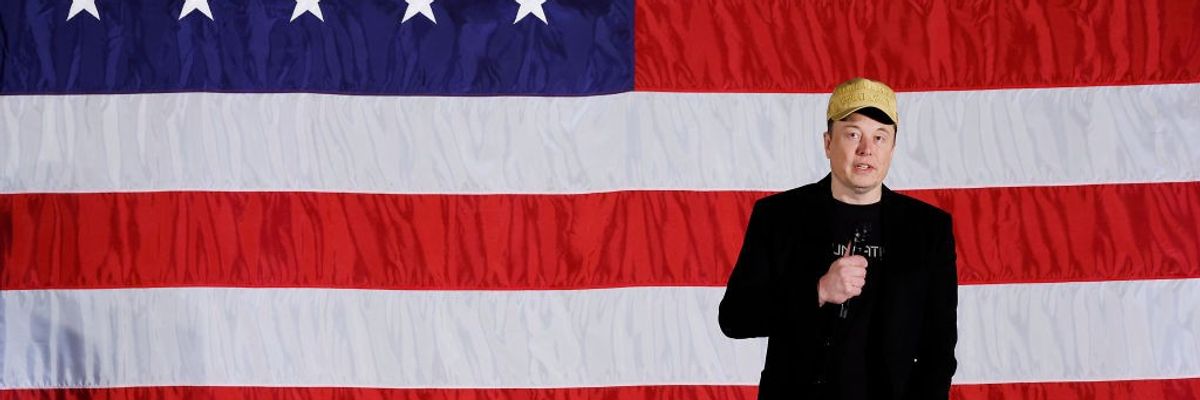
SpaceX and Tesla founder Elon Musk participates in a town hall-style meeting to promote early and absentee voting at Ridley High School on October 17, 2024 in Folsom, Pennsylvania.
Now it's time to tax it back to where much of it came from.
Once upon a time, here in the United States, we taxed the rich. Significantly. Today, by contrast, we’re actively enhancing their fortunes. Including the biggest personal fortune of them all, the quarter-trillion-dollar stash that belongs to Elon Musk, the current numero uno on the Forbes real-time list of the world’s largest fortunes.
Musk owes a hefty chunk of his own personal fortune to the taxes average Americans pay. He just happens to be, notes a just-published Politico analysis, “the single biggest beneficiary of U.S. government contracts.”
Two of Musk’s commercial operations, Tesla and SpaceX, have received billions in American taxpayer support. The federal government, Politico points out, has essentially “outsourced its space program” to SpaceX, and Tesla, a shaky electric vehicle company when Musk bought it, only “took off after receiving $465 million in subsidies from the Obama administration in 2010.”
All the tax dollars that Musk has collected from the Defense Department, NASA, and the U.S. intelligence community — coupled with the “generous government subsidies and tax credits to the electric-vehicle industry” that have so boosted Musk’s Tesla — have Council on Foreign Relations senior fellow Max Boot fairly fuming.
Taxpayers like himself, Boot notes, are subsidizing the “fire hose of falsehoods” that now appear on X, the former Twitter, the social media app that Musk bought for $44 billion two years ago. Our tax dollars have essentially supersized our world’s single wealthiest individual.
Back in the middle of the 20th century, the United States took quite a different approach to the money pouring into rich people’s pockets. From the early 1940s through the mid-1960s, the incomes of America’s richest faced a tax bite that would be unimaginable today.
In 1942, then-president Franklin Roosevelt proposed a 100 percent tax rate on income over $25,000, the equivalent of about $484,000 today. Congress wouldn’t go along with that 100 percent top rate. But lawmakers did give the okay to a 94 percent top tax rate on 1944 income over $200,000.
In the 1950s, under the Republican president Dwight Eisenhower, the federal tax rate on top-bracket income never dipped below 91 percent.
Today’s top-bracket federal income tax rate? That stands, on paper, at 37 percent on income over $693,751 for a couple filing jointly. But assorted loopholes have left the tax rate the rich face on their actual annual gains enormously lower.
In 2021, a joint report from the Biden administration’s Office of Management and Budget and Council of Economic Advisers calculated that America’s wealthiest 400 billionaire families, between 2010 and 2018, “paid an average of just 8.2 percent of their income” — counting the gains in the value of their investments — in federal individual income taxes.
“That’s a lower rate,” the report noted, “than many ordinary Americans pay.”
Could we ever get back to anything close to Eisenhower-era tax rates on the richest among us? This past March, the Biden administration proposed a 25 percent minimum tax on the total income — including unrealized capital gains — of the nation’s top 0.01 percent, households worth at least $100 million.
About the same time, progressive lawmakers — led by U.S. senator Elizabeth Warren of Massachusetts and representatives Pramila Jayapal from Washington State and Brendan Boyle from Pennsylvania — introduced the Ultra-Millionaire Tax Act, legislation that would impose a wealth tax on America’s 100,000 wealthiest households, our richest 0.05 percent.
Under this proposed legislation, wealthy households worth up to $1 billion would face an annual tax of 2 percent on their wealth over $50 million. Richer households would face an additional 1 percent tax on wealth over $1 billion.
One of the Senate co-sponsors of that legislation, Vermont’s Bernie Sanders, has also gone a step further and called for a 100 percent tax on wealth over $1 billion.
“I think people can make it on $999 million,” Sanders told journalist Chris Wallace last year.
Sanders and one of America’s most famous deep pockets, Bill Gates, have actually had a friendly podcast discussion over whether our tax rates should allow billion-dollar fortunes to even exist. The Sanders proposal, noted Gates, would tax away over 99 percent of his personal fortune. Gates would be willing to let the IRS take 62 percent, about $100 billion.
For a better America, that certainly might make a good place to start.
Dear Common Dreams reader, It’s been nearly 30 years since I co-founded Common Dreams with my late wife, Lina Newhouser. We had the radical notion that journalism should serve the public good, not corporate profits. It was clear to us from the outset what it would take to build such a project. No paid advertisements. No corporate sponsors. No millionaire publisher telling us what to think or do. Many people said we wouldn't last a year, but we proved those doubters wrong. Together with a tremendous team of journalists and dedicated staff, we built an independent media outlet free from the constraints of profits and corporate control. Our mission has always been simple: To inform. To inspire. To ignite change for the common good. Building Common Dreams was not easy. Our survival was never guaranteed. When you take on the most powerful forces—Wall Street greed, fossil fuel industry destruction, Big Tech lobbyists, and uber-rich oligarchs who have spent billions upon billions rigging the economy and democracy in their favor—the only bulwark you have is supporters who believe in your work. But here’s the urgent message from me today. It's never been this bad out there. And it's never been this hard to keep us going. At the very moment Common Dreams is most needed, the threats we face are intensifying. We need your support now more than ever. We don't accept corporate advertising and never will. We don't have a paywall because we don't think people should be blocked from critical news based on their ability to pay. Everything we do is funded by the donations of readers like you. When everyone does the little they can afford, we are strong. But if that support retreats or dries up, so do we. Will you donate now to make sure Common Dreams not only survives but thrives? —Craig Brown, Co-founder |
Once upon a time, here in the United States, we taxed the rich. Significantly. Today, by contrast, we’re actively enhancing their fortunes. Including the biggest personal fortune of them all, the quarter-trillion-dollar stash that belongs to Elon Musk, the current numero uno on the Forbes real-time list of the world’s largest fortunes.
Musk owes a hefty chunk of his own personal fortune to the taxes average Americans pay. He just happens to be, notes a just-published Politico analysis, “the single biggest beneficiary of U.S. government contracts.”
Two of Musk’s commercial operations, Tesla and SpaceX, have received billions in American taxpayer support. The federal government, Politico points out, has essentially “outsourced its space program” to SpaceX, and Tesla, a shaky electric vehicle company when Musk bought it, only “took off after receiving $465 million in subsidies from the Obama administration in 2010.”
All the tax dollars that Musk has collected from the Defense Department, NASA, and the U.S. intelligence community — coupled with the “generous government subsidies and tax credits to the electric-vehicle industry” that have so boosted Musk’s Tesla — have Council on Foreign Relations senior fellow Max Boot fairly fuming.
Taxpayers like himself, Boot notes, are subsidizing the “fire hose of falsehoods” that now appear on X, the former Twitter, the social media app that Musk bought for $44 billion two years ago. Our tax dollars have essentially supersized our world’s single wealthiest individual.
Back in the middle of the 20th century, the United States took quite a different approach to the money pouring into rich people’s pockets. From the early 1940s through the mid-1960s, the incomes of America’s richest faced a tax bite that would be unimaginable today.
In 1942, then-president Franklin Roosevelt proposed a 100 percent tax rate on income over $25,000, the equivalent of about $484,000 today. Congress wouldn’t go along with that 100 percent top rate. But lawmakers did give the okay to a 94 percent top tax rate on 1944 income over $200,000.
In the 1950s, under the Republican president Dwight Eisenhower, the federal tax rate on top-bracket income never dipped below 91 percent.
Today’s top-bracket federal income tax rate? That stands, on paper, at 37 percent on income over $693,751 for a couple filing jointly. But assorted loopholes have left the tax rate the rich face on their actual annual gains enormously lower.
In 2021, a joint report from the Biden administration’s Office of Management and Budget and Council of Economic Advisers calculated that America’s wealthiest 400 billionaire families, between 2010 and 2018, “paid an average of just 8.2 percent of their income” — counting the gains in the value of their investments — in federal individual income taxes.
“That’s a lower rate,” the report noted, “than many ordinary Americans pay.”
Could we ever get back to anything close to Eisenhower-era tax rates on the richest among us? This past March, the Biden administration proposed a 25 percent minimum tax on the total income — including unrealized capital gains — of the nation’s top 0.01 percent, households worth at least $100 million.
About the same time, progressive lawmakers — led by U.S. senator Elizabeth Warren of Massachusetts and representatives Pramila Jayapal from Washington State and Brendan Boyle from Pennsylvania — introduced the Ultra-Millionaire Tax Act, legislation that would impose a wealth tax on America’s 100,000 wealthiest households, our richest 0.05 percent.
Under this proposed legislation, wealthy households worth up to $1 billion would face an annual tax of 2 percent on their wealth over $50 million. Richer households would face an additional 1 percent tax on wealth over $1 billion.
One of the Senate co-sponsors of that legislation, Vermont’s Bernie Sanders, has also gone a step further and called for a 100 percent tax on wealth over $1 billion.
“I think people can make it on $999 million,” Sanders told journalist Chris Wallace last year.
Sanders and one of America’s most famous deep pockets, Bill Gates, have actually had a friendly podcast discussion over whether our tax rates should allow billion-dollar fortunes to even exist. The Sanders proposal, noted Gates, would tax away over 99 percent of his personal fortune. Gates would be willing to let the IRS take 62 percent, about $100 billion.
For a better America, that certainly might make a good place to start.
Once upon a time, here in the United States, we taxed the rich. Significantly. Today, by contrast, we’re actively enhancing their fortunes. Including the biggest personal fortune of them all, the quarter-trillion-dollar stash that belongs to Elon Musk, the current numero uno on the Forbes real-time list of the world’s largest fortunes.
Musk owes a hefty chunk of his own personal fortune to the taxes average Americans pay. He just happens to be, notes a just-published Politico analysis, “the single biggest beneficiary of U.S. government contracts.”
Two of Musk’s commercial operations, Tesla and SpaceX, have received billions in American taxpayer support. The federal government, Politico points out, has essentially “outsourced its space program” to SpaceX, and Tesla, a shaky electric vehicle company when Musk bought it, only “took off after receiving $465 million in subsidies from the Obama administration in 2010.”
All the tax dollars that Musk has collected from the Defense Department, NASA, and the U.S. intelligence community — coupled with the “generous government subsidies and tax credits to the electric-vehicle industry” that have so boosted Musk’s Tesla — have Council on Foreign Relations senior fellow Max Boot fairly fuming.
Taxpayers like himself, Boot notes, are subsidizing the “fire hose of falsehoods” that now appear on X, the former Twitter, the social media app that Musk bought for $44 billion two years ago. Our tax dollars have essentially supersized our world’s single wealthiest individual.
Back in the middle of the 20th century, the United States took quite a different approach to the money pouring into rich people’s pockets. From the early 1940s through the mid-1960s, the incomes of America’s richest faced a tax bite that would be unimaginable today.
In 1942, then-president Franklin Roosevelt proposed a 100 percent tax rate on income over $25,000, the equivalent of about $484,000 today. Congress wouldn’t go along with that 100 percent top rate. But lawmakers did give the okay to a 94 percent top tax rate on 1944 income over $200,000.
In the 1950s, under the Republican president Dwight Eisenhower, the federal tax rate on top-bracket income never dipped below 91 percent.
Today’s top-bracket federal income tax rate? That stands, on paper, at 37 percent on income over $693,751 for a couple filing jointly. But assorted loopholes have left the tax rate the rich face on their actual annual gains enormously lower.
In 2021, a joint report from the Biden administration’s Office of Management and Budget and Council of Economic Advisers calculated that America’s wealthiest 400 billionaire families, between 2010 and 2018, “paid an average of just 8.2 percent of their income” — counting the gains in the value of their investments — in federal individual income taxes.
“That’s a lower rate,” the report noted, “than many ordinary Americans pay.”
Could we ever get back to anything close to Eisenhower-era tax rates on the richest among us? This past March, the Biden administration proposed a 25 percent minimum tax on the total income — including unrealized capital gains — of the nation’s top 0.01 percent, households worth at least $100 million.
About the same time, progressive lawmakers — led by U.S. senator Elizabeth Warren of Massachusetts and representatives Pramila Jayapal from Washington State and Brendan Boyle from Pennsylvania — introduced the Ultra-Millionaire Tax Act, legislation that would impose a wealth tax on America’s 100,000 wealthiest households, our richest 0.05 percent.
Under this proposed legislation, wealthy households worth up to $1 billion would face an annual tax of 2 percent on their wealth over $50 million. Richer households would face an additional 1 percent tax on wealth over $1 billion.
One of the Senate co-sponsors of that legislation, Vermont’s Bernie Sanders, has also gone a step further and called for a 100 percent tax on wealth over $1 billion.
“I think people can make it on $999 million,” Sanders told journalist Chris Wallace last year.
Sanders and one of America’s most famous deep pockets, Bill Gates, have actually had a friendly podcast discussion over whether our tax rates should allow billion-dollar fortunes to even exist. The Sanders proposal, noted Gates, would tax away over 99 percent of his personal fortune. Gates would be willing to let the IRS take 62 percent, about $100 billion.
For a better America, that certainly might make a good place to start.