SUBSCRIBE TO OUR FREE NEWSLETTER
Daily news & progressive opinion—funded by the people, not the corporations—delivered straight to your inbox.
5
#000000
#FFFFFF
To donate by check, phone, or other method, see our More Ways to Give page.
Daily news & progressive opinion—funded by the people, not the corporations—delivered straight to your inbox.
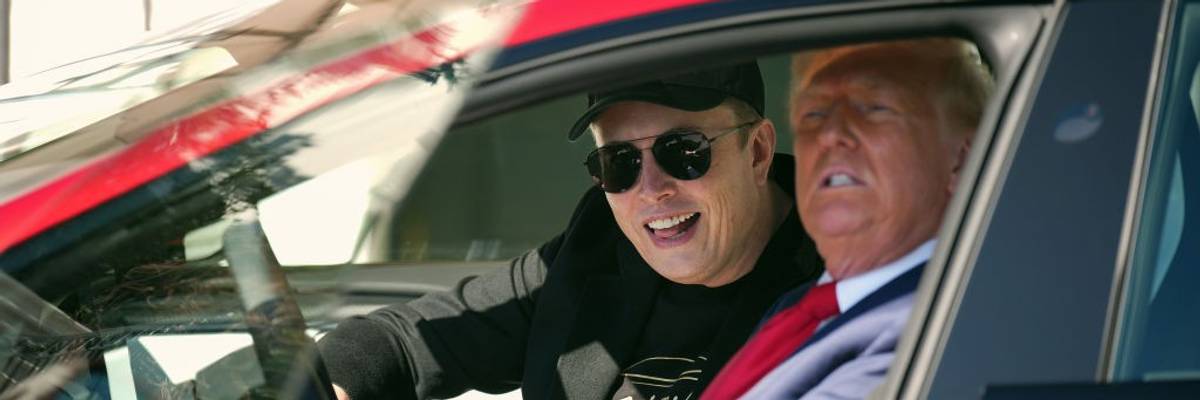
U.S. President Donald Trump and Elon Musk, CEO of Tesla and SpaceX, sit in a Tesla Model S on the South Lawn of the White House on March 11, 2025 in Washington, D.C.
"Tesla is a carbon credit company that has a couple of cars for sale," cracked one observer.
Already facing the quandary of leading the nation's largest electric vehicle maker while working as a senior adviser to EV-inimical, "drill, baby, drill" U.S. President Donald Trump, Tesla CEO Elon Musk was confronted Tuesday with the awkward reality that, absent zero-emissions tax credits implemented during the Biden administration, his company would not have made any profit during the first quarter.
In fact, Tesla would have posted a Q1 loss without the $595 million in EV tax credits, according to reporting by TechCrunch. Earnings figures released by Tesla showed $409 million in net quarterly profit, a brutal 71% plunge from a year ago. These figures follow Tesla's first-ever year-to-year sales decline. The company's stock price has also plummeted more than 50% since December.
As Splinter editor-in-chief Jacob Weindling quipped on Bluesky, "Tesla is a carbon credit company that has a couple of cars for sale."
Tesla earned $10.7 billion selling climate compliance tax credits over the past decade—a total that accounted for a third of the company's profits during that period—according to an analysis published earlier this year by Politico's E&E News. Ironically, Trump has threatened to pull the plug on some of the taxpayer-funded credits that helped make Musk the world's richest person.
"It is difficult to measure the impacts of shifting global trade policy on the automotive and energy supply chains, our cost structure, and demand for durable goods and related services," Tesla said in a recent letter to investors. "While we are making prudent investments that will set up both our vehicle and energy businesses for growth, the rate of growth this year will depend on a variety of factors, including the rate of acceleration of our autonomy efforts, production ramp at our factories, and the broader macroeconomic environment."
Tesla was already struggling before Musk—who poured hundreds of millions of dollars into Trump's 2024 campaign coffers—was tapped by the president to be the de facto head of the highly controversial Department of Government Efficiency, or DOGE. Factors including Trump's tariff whiplash, growing public revulsion at Musk and his brands, and the rise of competitors like China's BYD, the world's leading EV manufacturer, have played roles in Tesla's floundering fortunes.
"The more political he gets with DOGE, the more the brand suffers—there is no debate," Dan Ives of Wedbush Securities said earlier this month in a note to investors. "This continues to be a moment of truth for Musk to navigate this brand tornado crisis moment."
On a Tuesday call with jittery investors, Musk defended his DOGE work and said that people protesting his role in the government-eviscerating agency were "paid." However, Musk added that he would start shifting his time and attention back to Tesla "I think starting probably next month."
Earlier this month, dozens of House Democrats demanded that Trump "stop ignoring federal law and ethics rules to empower an unelected billionaire" and fire Musk by the end of May.
Ross Gerber, CEO of the investment firm Gerber Kawasaki, said on social media Tuesday: "I've done Tesla calls for 11 years. This is the worst performance I've seen in Tesla's history."
"I get Elon will tell everyone about trillions in [total addressable market] and robots taking over the world," he added, "anything to get you not to look at the facts."
New York City Councilmember Justin Brannan (D-47)—who
wants to divest the more than $1 billion that municipal pension funds have invested in Tesla—said Tuesday that the company's earnings "tanked because consumers are done with Elon Musk playing Trump's sidekick and backing cuts to seniors and working families."
"It's not just against NYC values," Brannan added. "Tesla is now a bad investment. We need to divest our city pensions from Tesla."
Dear Common Dreams reader, It’s been nearly 30 years since I co-founded Common Dreams with my late wife, Lina Newhouser. We had the radical notion that journalism should serve the public good, not corporate profits. It was clear to us from the outset what it would take to build such a project. No paid advertisements. No corporate sponsors. No millionaire publisher telling us what to think or do. Many people said we wouldn't last a year, but we proved those doubters wrong. Together with a tremendous team of journalists and dedicated staff, we built an independent media outlet free from the constraints of profits and corporate control. Our mission has always been simple: To inform. To inspire. To ignite change for the common good. Building Common Dreams was not easy. Our survival was never guaranteed. When you take on the most powerful forces—Wall Street greed, fossil fuel industry destruction, Big Tech lobbyists, and uber-rich oligarchs who have spent billions upon billions rigging the economy and democracy in their favor—the only bulwark you have is supporters who believe in your work. But here’s the urgent message from me today. It's never been this bad out there. And it's never been this hard to keep us going. At the very moment Common Dreams is most needed, the threats we face are intensifying. We need your support now more than ever. We don't accept corporate advertising and never will. We don't have a paywall because we don't think people should be blocked from critical news based on their ability to pay. Everything we do is funded by the donations of readers like you. When everyone does the little they can afford, we are strong. But if that support retreats or dries up, so do we. Will you donate now to make sure Common Dreams not only survives but thrives? —Craig Brown, Co-founder |
Already facing the quandary of leading the nation's largest electric vehicle maker while working as a senior adviser to EV-inimical, "drill, baby, drill" U.S. President Donald Trump, Tesla CEO Elon Musk was confronted Tuesday with the awkward reality that, absent zero-emissions tax credits implemented during the Biden administration, his company would not have made any profit during the first quarter.
In fact, Tesla would have posted a Q1 loss without the $595 million in EV tax credits, according to reporting by TechCrunch. Earnings figures released by Tesla showed $409 million in net quarterly profit, a brutal 71% plunge from a year ago. These figures follow Tesla's first-ever year-to-year sales decline. The company's stock price has also plummeted more than 50% since December.
As Splinter editor-in-chief Jacob Weindling quipped on Bluesky, "Tesla is a carbon credit company that has a couple of cars for sale."
Tesla earned $10.7 billion selling climate compliance tax credits over the past decade—a total that accounted for a third of the company's profits during that period—according to an analysis published earlier this year by Politico's E&E News. Ironically, Trump has threatened to pull the plug on some of the taxpayer-funded credits that helped make Musk the world's richest person.
"It is difficult to measure the impacts of shifting global trade policy on the automotive and energy supply chains, our cost structure, and demand for durable goods and related services," Tesla said in a recent letter to investors. "While we are making prudent investments that will set up both our vehicle and energy businesses for growth, the rate of growth this year will depend on a variety of factors, including the rate of acceleration of our autonomy efforts, production ramp at our factories, and the broader macroeconomic environment."
Tesla was already struggling before Musk—who poured hundreds of millions of dollars into Trump's 2024 campaign coffers—was tapped by the president to be the de facto head of the highly controversial Department of Government Efficiency, or DOGE. Factors including Trump's tariff whiplash, growing public revulsion at Musk and his brands, and the rise of competitors like China's BYD, the world's leading EV manufacturer, have played roles in Tesla's floundering fortunes.
"The more political he gets with DOGE, the more the brand suffers—there is no debate," Dan Ives of Wedbush Securities said earlier this month in a note to investors. "This continues to be a moment of truth for Musk to navigate this brand tornado crisis moment."
On a Tuesday call with jittery investors, Musk defended his DOGE work and said that people protesting his role in the government-eviscerating agency were "paid." However, Musk added that he would start shifting his time and attention back to Tesla "I think starting probably next month."
Earlier this month, dozens of House Democrats demanded that Trump "stop ignoring federal law and ethics rules to empower an unelected billionaire" and fire Musk by the end of May.
Ross Gerber, CEO of the investment firm Gerber Kawasaki, said on social media Tuesday: "I've done Tesla calls for 11 years. This is the worst performance I've seen in Tesla's history."
"I get Elon will tell everyone about trillions in [total addressable market] and robots taking over the world," he added, "anything to get you not to look at the facts."
New York City Councilmember Justin Brannan (D-47)—who
wants to divest the more than $1 billion that municipal pension funds have invested in Tesla—said Tuesday that the company's earnings "tanked because consumers are done with Elon Musk playing Trump's sidekick and backing cuts to seniors and working families."
"It's not just against NYC values," Brannan added. "Tesla is now a bad investment. We need to divest our city pensions from Tesla."
Already facing the quandary of leading the nation's largest electric vehicle maker while working as a senior adviser to EV-inimical, "drill, baby, drill" U.S. President Donald Trump, Tesla CEO Elon Musk was confronted Tuesday with the awkward reality that, absent zero-emissions tax credits implemented during the Biden administration, his company would not have made any profit during the first quarter.
In fact, Tesla would have posted a Q1 loss without the $595 million in EV tax credits, according to reporting by TechCrunch. Earnings figures released by Tesla showed $409 million in net quarterly profit, a brutal 71% plunge from a year ago. These figures follow Tesla's first-ever year-to-year sales decline. The company's stock price has also plummeted more than 50% since December.
As Splinter editor-in-chief Jacob Weindling quipped on Bluesky, "Tesla is a carbon credit company that has a couple of cars for sale."
Tesla earned $10.7 billion selling climate compliance tax credits over the past decade—a total that accounted for a third of the company's profits during that period—according to an analysis published earlier this year by Politico's E&E News. Ironically, Trump has threatened to pull the plug on some of the taxpayer-funded credits that helped make Musk the world's richest person.
"It is difficult to measure the impacts of shifting global trade policy on the automotive and energy supply chains, our cost structure, and demand for durable goods and related services," Tesla said in a recent letter to investors. "While we are making prudent investments that will set up both our vehicle and energy businesses for growth, the rate of growth this year will depend on a variety of factors, including the rate of acceleration of our autonomy efforts, production ramp at our factories, and the broader macroeconomic environment."
Tesla was already struggling before Musk—who poured hundreds of millions of dollars into Trump's 2024 campaign coffers—was tapped by the president to be the de facto head of the highly controversial Department of Government Efficiency, or DOGE. Factors including Trump's tariff whiplash, growing public revulsion at Musk and his brands, and the rise of competitors like China's BYD, the world's leading EV manufacturer, have played roles in Tesla's floundering fortunes.
"The more political he gets with DOGE, the more the brand suffers—there is no debate," Dan Ives of Wedbush Securities said earlier this month in a note to investors. "This continues to be a moment of truth for Musk to navigate this brand tornado crisis moment."
On a Tuesday call with jittery investors, Musk defended his DOGE work and said that people protesting his role in the government-eviscerating agency were "paid." However, Musk added that he would start shifting his time and attention back to Tesla "I think starting probably next month."
Earlier this month, dozens of House Democrats demanded that Trump "stop ignoring federal law and ethics rules to empower an unelected billionaire" and fire Musk by the end of May.
Ross Gerber, CEO of the investment firm Gerber Kawasaki, said on social media Tuesday: "I've done Tesla calls for 11 years. This is the worst performance I've seen in Tesla's history."
"I get Elon will tell everyone about trillions in [total addressable market] and robots taking over the world," he added, "anything to get you not to look at the facts."
New York City Councilmember Justin Brannan (D-47)—who
wants to divest the more than $1 billion that municipal pension funds have invested in Tesla—said Tuesday that the company's earnings "tanked because consumers are done with Elon Musk playing Trump's sidekick and backing cuts to seniors and working families."
"It's not just against NYC values," Brannan added. "Tesla is now a bad investment. We need to divest our city pensions from Tesla."