SUBSCRIBE TO OUR FREE NEWSLETTER
Daily news & progressive opinion—funded by the people, not the corporations—delivered straight to your inbox.
5
#000000
#FFFFFF
To donate by check, phone, or other method, see our More Ways to Give page.
Daily news & progressive opinion—funded by the people, not the corporations—delivered straight to your inbox.
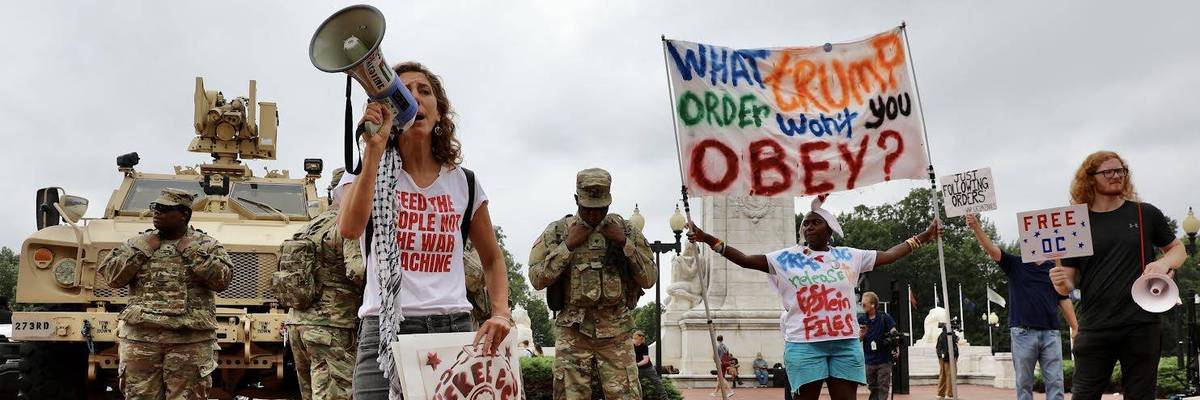
People protest the presence of the National Guard in Washington, DC.
We don't need billions of dollars going toward policing our neighbors and Social Schedulingmilitarization of our streets to make our communities safer—we need housing, education, healthcare, and a commitment to climate justice for true national security.
One year ago, the Trump administration brought 800 National Guard troops to occupy the streets of Washington, DC, part of the "Safe and Beautiful Task Force." There are now approximately 5,000 troops from 15 states deployed here, with some officially moved in and set to stay through 2029.
This does not include the alphabet soup of law enforcement agencies swarming our neighborhoods across the city, from Immigration and Customs Enforcement to the FBI, Secret Service, Department of Homeland Security, Drug Enforcement Agency, Park Police, and more.
The National Guard can be found meandering around metro stations, museums, and grocery stores there for mere posture. Despite crime being down before they were deployed here. A new analysis from the Center for American Progress found the Guard deployment has not had a measurable impact on violent crime. They are not even trained in "civilian policing," and are unable to make actual arrests.
“This was never about reducing crime, especially not violent crime,” said Chandler Hall, who wrote the study. “This has been a show of force without any evidence to bear that it’s actually working."
"If my neighbors could experience military protection as something imposed upon them, what did civilians overseas think when American forces arrived in their communities?"
The cost of the Guard is estimated at $3 million a day, with some troops said to make close to $9,000 a month, including salary, lodging, and food per diem. It is hard to track the multi-year total in billions of dollars as the administration is far from transparent with the process.
The wasteful spending from the Department of War is unsurprising. Despite the Pentagon never passing an audit, the Department of War's proposed budget is record-breaking at $1.5 trillion for one year and does not include the recent billions for the Iran war and additional billions to Israel to further the genocide in Gaza and ongoing destruction in Lebanon.
Some of the reasoning for more troops in DC was for the Freedom 250 nationalism events, beginning with a UFC fight, State Fair, and Fourth of July festivities, all of which were disastrous, from cancellations, evacuations, and heat strokes to stage parts falling, nearly killing performers. The millions of dollars that went into these spectacles strained the local community. On July 4, my friend Nicky, a 71-year-old EMT, worked an 18-hour double shift for $27 an hour while constant military flyovers cost over $1.2 million.
Karen Degraphenreid, a veteran of the US Air Force as a Major of 10 years, got involved with Free DC when the military occupation in DC began. She describes her reflections from her time overseas to experiencing the guard takeover here at home.
"Washington is the only place in the country where more than 700,000 American citizens can have troops deployed to their streets by leaders they have no voting representation in choosing. We pay federal taxes, serve in the military, and fulfill every obligation of citizenship, yet Congress can override our local government and impose decisions that fundamentally reshape life in our city. That reality forced me to reconsider what 'protection' actually means," she said.
She continued:
Many of my neighbors never asked for soldiers outside their neighborhoods. Many openly opposed their presence. To them, the deployment did not feel like reassurance. It felt like a federal government exercising power over a city that has long been denied full democratic self-government.
And that realization led me to a question I had never seriously asked during my years in uniform.
If my neighbors could experience military protection as something imposed upon them, what did civilians overseas think when American forces arrived in their communities? When we said we were bringing security and stability, did they experience it as protection? Or did they see armed strangers exercising power over places that belonged to them?
Karen is also a member of Common Defense, which holds trainings for veterans to verbally confront the National Guard. Other veterans are speaking out to encourage their fellows and active-duty members to do the same. Groups like About Face have been welcoming anti-war veterans to become more organized for years, many of whom were deployed in Afghanistan and Iraq, and are actively opposed to the genocide in Gaza and the war on Iran.
At a press conference commemorating one year of the occupation, Luke Filomena, a registered nurse with National Nurses United, expressed the imperialist boomerang we are all witnessing
I’ve seen this administration and every administration prior instead choose to spend hundreds of billions, now trillions of dollars, yearly, to go toward countless amounts of death and destruction through endless imperialist wars overseas and the funding and arming of a genocide in Gaza. I’ve been forced to watch as hospitals filled with patients and fellow healthcare workers, as well as schools filled with children, are indiscriminately bombed in Gaza and in Iran, and as the US blockade of Cuba leaves hospitals without fuel and supplies to power lifesaving medical equipment and provide care for their patients.
"Over the past year, under the Trump regime, we’re now seeing the imperialist boomerang come back, with its sights locked on the Black, brown, and immigrant communities here in DC; those who I see each day at the bedside," Filomena explained.
It's one thing to be aware of connecting the dots, and it's another to act on it. DC has been public about its opposition to the military takeover of the city. When the occupation first launched, we disrupted Vice President JD Vance and Secretary of War Pete Hegseth's photo op at Shake Shack in Union Station. A month later, Trump and almost his entire cabinet went out to dinner at a restaurant near the White House, and we disrupted it, chanting, "Free DC, Free Palestine, Trump is the Hitler of our time." We later drowned out a public appearance by Hegseth, Stephen Miller, and hundreds of National Guard at Malcolm X Park.
Opportunities to confront the administration are rarer than daily encounters with the Guard. The same week budget cuts to Supplemental and Nutrition Assistance Program were being discussed in Congress, I asked a group of troops, who often appear to be aimlessly wandering our neighborhoods in groups of four, if people in their communities would be hit by this. I've asked them if they know their neighbors and what services they could use and be funded versus them being deployed here to hang outside of a convenience store. When the forest fires created thick smoke across DC, I asked why they were here and not putting out the fires.
In these conversations, they almost always nod their head and reach for their pamphlet, telling me and others who confront them to contact their supervisor. They come from states from Mississippi to Michigan, and there have been state-by-state campaigns to get the Guard to go home. Many of them are here voluntarily, not simply "following orders" as we are led to believe.
While we have 800 military bases abroad, the war economy is inescapable for most people within the United States as well. The predatory trap the military-industrial complex has on young people of color or those in poverty means they are heavily recruited to join the various branches of the military. The increased amount of data centers across the country is also making the war economy ever more apparent.
But the state can't use the excuse of job creation anymore. The Climate and Communities Institute shows us that employment at military contractors has plummeted over the past three decades, from an estimated 3.2 million workers during the Reagan military-spending peak in the mid-1980s to 1.1 million workers in 2020. The drop occurred despite Pentagon budgets rising 22% over the same period (not accounting for inflation costs). The alternative is a care economy, a system of paid and unpaid labor, services, and relationships that support human health, well-being, and daily life, that moves away from dirty, violent jobs that rely on weapons manufacturers and the fossil fuel industry.
We cannot normalize troops on our streets. But we must address the roots that cause normalization. We've been taught to salute combat veterans for their service no matter their history; we're used to discounts for military personnel and TV shows and Hollywood movies glorifying lower-level cadets to high-ranking commanders. While militarized superheroes are a common staple in US popular culture, teachers are buying their own school supplies for their classrooms, social workers have overwhelming caseloads, EMTs are working overtime while underpaid, and many veterans are unhoused or waitlisted at the VA.
Washington, DC does not need occupation; it needs fair representation. We don't need billions of dollars going toward policing our neighbors and militarization of our streets to make our communities safer—we need housing, education, healthcare, and a commitment to climate justice for true national security. In the meantime, we have only seen our community grow stronger to protect each other—more trainings, skill sharing, documenting, court support, fundraising, and more. Every day we are supporting each other by radically building community through getting to know our neighbors more deeply in real life.
Dear Common Dreams reader, It’s been nearly 30 years since I co-founded Common Dreams with my late wife, Lina Newhouser. We had the radical notion that journalism should serve the public good, not corporate profits. It was clear to us from the outset what it would take to build such a project. No paid advertisements. No corporate sponsors. No millionaire publisher telling us what to think or do. Many people said we wouldn't last a year, but we proved those doubters wrong. Together with a tremendous team of journalists and dedicated staff, we built an independent media outlet free from the constraints of profits and corporate control. Our mission has always been simple: To inform. To inspire. To ignite change for the common good. Building Common Dreams was not easy. Our survival was never guaranteed. When you take on the most powerful forces—Wall Street greed, fossil fuel industry destruction, Big Tech lobbyists, and uber-rich oligarchs who have spent billions upon billions rigging the economy and democracy in their favor—the only bulwark you have is supporters who believe in your work. But here’s the urgent message from me today. It's never been this bad out there. And it's never been this hard to keep us going. At the very moment Common Dreams is most needed, the threats we face are intensifying. We need your support now more than ever. We don't accept corporate advertising and never will. We don't have a paywall because we don't think people should be blocked from critical news based on their ability to pay. Everything we do is funded by the donations of readers like you. When everyone does the little they can afford, we are strong. But if that support retreats or dries up, so do we. Will you donate now to make sure Common Dreams not only survives but thrives? —Craig Brown, Co-founder |
One year ago, the Trump administration brought 800 National Guard troops to occupy the streets of Washington, DC, part of the "Safe and Beautiful Task Force." There are now approximately 5,000 troops from 15 states deployed here, with some officially moved in and set to stay through 2029.
This does not include the alphabet soup of law enforcement agencies swarming our neighborhoods across the city, from Immigration and Customs Enforcement to the FBI, Secret Service, Department of Homeland Security, Drug Enforcement Agency, Park Police, and more.
The National Guard can be found meandering around metro stations, museums, and grocery stores there for mere posture. Despite crime being down before they were deployed here. A new analysis from the Center for American Progress found the Guard deployment has not had a measurable impact on violent crime. They are not even trained in "civilian policing," and are unable to make actual arrests.
“This was never about reducing crime, especially not violent crime,” said Chandler Hall, who wrote the study. “This has been a show of force without any evidence to bear that it’s actually working."
"If my neighbors could experience military protection as something imposed upon them, what did civilians overseas think when American forces arrived in their communities?"
The cost of the Guard is estimated at $3 million a day, with some troops said to make close to $9,000 a month, including salary, lodging, and food per diem. It is hard to track the multi-year total in billions of dollars as the administration is far from transparent with the process.
The wasteful spending from the Department of War is unsurprising. Despite the Pentagon never passing an audit, the Department of War's proposed budget is record-breaking at $1.5 trillion for one year and does not include the recent billions for the Iran war and additional billions to Israel to further the genocide in Gaza and ongoing destruction in Lebanon.
Some of the reasoning for more troops in DC was for the Freedom 250 nationalism events, beginning with a UFC fight, State Fair, and Fourth of July festivities, all of which were disastrous, from cancellations, evacuations, and heat strokes to stage parts falling, nearly killing performers. The millions of dollars that went into these spectacles strained the local community. On July 4, my friend Nicky, a 71-year-old EMT, worked an 18-hour double shift for $27 an hour while constant military flyovers cost over $1.2 million.
Karen Degraphenreid, a veteran of the US Air Force as a Major of 10 years, got involved with Free DC when the military occupation in DC began. She describes her reflections from her time overseas to experiencing the guard takeover here at home.
"Washington is the only place in the country where more than 700,000 American citizens can have troops deployed to their streets by leaders they have no voting representation in choosing. We pay federal taxes, serve in the military, and fulfill every obligation of citizenship, yet Congress can override our local government and impose decisions that fundamentally reshape life in our city. That reality forced me to reconsider what 'protection' actually means," she said.
She continued:
Many of my neighbors never asked for soldiers outside their neighborhoods. Many openly opposed their presence. To them, the deployment did not feel like reassurance. It felt like a federal government exercising power over a city that has long been denied full democratic self-government.
And that realization led me to a question I had never seriously asked during my years in uniform.
If my neighbors could experience military protection as something imposed upon them, what did civilians overseas think when American forces arrived in their communities? When we said we were bringing security and stability, did they experience it as protection? Or did they see armed strangers exercising power over places that belonged to them?
Karen is also a member of Common Defense, which holds trainings for veterans to verbally confront the National Guard. Other veterans are speaking out to encourage their fellows and active-duty members to do the same. Groups like About Face have been welcoming anti-war veterans to become more organized for years, many of whom were deployed in Afghanistan and Iraq, and are actively opposed to the genocide in Gaza and the war on Iran.
At a press conference commemorating one year of the occupation, Luke Filomena, a registered nurse with National Nurses United, expressed the imperialist boomerang we are all witnessing
I’ve seen this administration and every administration prior instead choose to spend hundreds of billions, now trillions of dollars, yearly, to go toward countless amounts of death and destruction through endless imperialist wars overseas and the funding and arming of a genocide in Gaza. I’ve been forced to watch as hospitals filled with patients and fellow healthcare workers, as well as schools filled with children, are indiscriminately bombed in Gaza and in Iran, and as the US blockade of Cuba leaves hospitals without fuel and supplies to power lifesaving medical equipment and provide care for their patients.
"Over the past year, under the Trump regime, we’re now seeing the imperialist boomerang come back, with its sights locked on the Black, brown, and immigrant communities here in DC; those who I see each day at the bedside," Filomena explained.
It's one thing to be aware of connecting the dots, and it's another to act on it. DC has been public about its opposition to the military takeover of the city. When the occupation first launched, we disrupted Vice President JD Vance and Secretary of War Pete Hegseth's photo op at Shake Shack in Union Station. A month later, Trump and almost his entire cabinet went out to dinner at a restaurant near the White House, and we disrupted it, chanting, "Free DC, Free Palestine, Trump is the Hitler of our time." We later drowned out a public appearance by Hegseth, Stephen Miller, and hundreds of National Guard at Malcolm X Park.
Opportunities to confront the administration are rarer than daily encounters with the Guard. The same week budget cuts to Supplemental and Nutrition Assistance Program were being discussed in Congress, I asked a group of troops, who often appear to be aimlessly wandering our neighborhoods in groups of four, if people in their communities would be hit by this. I've asked them if they know their neighbors and what services they could use and be funded versus them being deployed here to hang outside of a convenience store. When the forest fires created thick smoke across DC, I asked why they were here and not putting out the fires.
In these conversations, they almost always nod their head and reach for their pamphlet, telling me and others who confront them to contact their supervisor. They come from states from Mississippi to Michigan, and there have been state-by-state campaigns to get the Guard to go home. Many of them are here voluntarily, not simply "following orders" as we are led to believe.
While we have 800 military bases abroad, the war economy is inescapable for most people within the United States as well. The predatory trap the military-industrial complex has on young people of color or those in poverty means they are heavily recruited to join the various branches of the military. The increased amount of data centers across the country is also making the war economy ever more apparent.
But the state can't use the excuse of job creation anymore. The Climate and Communities Institute shows us that employment at military contractors has plummeted over the past three decades, from an estimated 3.2 million workers during the Reagan military-spending peak in the mid-1980s to 1.1 million workers in 2020. The drop occurred despite Pentagon budgets rising 22% over the same period (not accounting for inflation costs). The alternative is a care economy, a system of paid and unpaid labor, services, and relationships that support human health, well-being, and daily life, that moves away from dirty, violent jobs that rely on weapons manufacturers and the fossil fuel industry.
We cannot normalize troops on our streets. But we must address the roots that cause normalization. We've been taught to salute combat veterans for their service no matter their history; we're used to discounts for military personnel and TV shows and Hollywood movies glorifying lower-level cadets to high-ranking commanders. While militarized superheroes are a common staple in US popular culture, teachers are buying their own school supplies for their classrooms, social workers have overwhelming caseloads, EMTs are working overtime while underpaid, and many veterans are unhoused or waitlisted at the VA.
Washington, DC does not need occupation; it needs fair representation. We don't need billions of dollars going toward policing our neighbors and militarization of our streets to make our communities safer—we need housing, education, healthcare, and a commitment to climate justice for true national security. In the meantime, we have only seen our community grow stronger to protect each other—more trainings, skill sharing, documenting, court support, fundraising, and more. Every day we are supporting each other by radically building community through getting to know our neighbors more deeply in real life.
One year ago, the Trump administration brought 800 National Guard troops to occupy the streets of Washington, DC, part of the "Safe and Beautiful Task Force." There are now approximately 5,000 troops from 15 states deployed here, with some officially moved in and set to stay through 2029.
This does not include the alphabet soup of law enforcement agencies swarming our neighborhoods across the city, from Immigration and Customs Enforcement to the FBI, Secret Service, Department of Homeland Security, Drug Enforcement Agency, Park Police, and more.
The National Guard can be found meandering around metro stations, museums, and grocery stores there for mere posture. Despite crime being down before they were deployed here. A new analysis from the Center for American Progress found the Guard deployment has not had a measurable impact on violent crime. They are not even trained in "civilian policing," and are unable to make actual arrests.
“This was never about reducing crime, especially not violent crime,” said Chandler Hall, who wrote the study. “This has been a show of force without any evidence to bear that it’s actually working."
"If my neighbors could experience military protection as something imposed upon them, what did civilians overseas think when American forces arrived in their communities?"
The cost of the Guard is estimated at $3 million a day, with some troops said to make close to $9,000 a month, including salary, lodging, and food per diem. It is hard to track the multi-year total in billions of dollars as the administration is far from transparent with the process.
The wasteful spending from the Department of War is unsurprising. Despite the Pentagon never passing an audit, the Department of War's proposed budget is record-breaking at $1.5 trillion for one year and does not include the recent billions for the Iran war and additional billions to Israel to further the genocide in Gaza and ongoing destruction in Lebanon.
Some of the reasoning for more troops in DC was for the Freedom 250 nationalism events, beginning with a UFC fight, State Fair, and Fourth of July festivities, all of which were disastrous, from cancellations, evacuations, and heat strokes to stage parts falling, nearly killing performers. The millions of dollars that went into these spectacles strained the local community. On July 4, my friend Nicky, a 71-year-old EMT, worked an 18-hour double shift for $27 an hour while constant military flyovers cost over $1.2 million.
Karen Degraphenreid, a veteran of the US Air Force as a Major of 10 years, got involved with Free DC when the military occupation in DC began. She describes her reflections from her time overseas to experiencing the guard takeover here at home.
"Washington is the only place in the country where more than 700,000 American citizens can have troops deployed to their streets by leaders they have no voting representation in choosing. We pay federal taxes, serve in the military, and fulfill every obligation of citizenship, yet Congress can override our local government and impose decisions that fundamentally reshape life in our city. That reality forced me to reconsider what 'protection' actually means," she said.
She continued:
Many of my neighbors never asked for soldiers outside their neighborhoods. Many openly opposed their presence. To them, the deployment did not feel like reassurance. It felt like a federal government exercising power over a city that has long been denied full democratic self-government.
And that realization led me to a question I had never seriously asked during my years in uniform.
If my neighbors could experience military protection as something imposed upon them, what did civilians overseas think when American forces arrived in their communities? When we said we were bringing security and stability, did they experience it as protection? Or did they see armed strangers exercising power over places that belonged to them?
Karen is also a member of Common Defense, which holds trainings for veterans to verbally confront the National Guard. Other veterans are speaking out to encourage their fellows and active-duty members to do the same. Groups like About Face have been welcoming anti-war veterans to become more organized for years, many of whom were deployed in Afghanistan and Iraq, and are actively opposed to the genocide in Gaza and the war on Iran.
At a press conference commemorating one year of the occupation, Luke Filomena, a registered nurse with National Nurses United, expressed the imperialist boomerang we are all witnessing
I’ve seen this administration and every administration prior instead choose to spend hundreds of billions, now trillions of dollars, yearly, to go toward countless amounts of death and destruction through endless imperialist wars overseas and the funding and arming of a genocide in Gaza. I’ve been forced to watch as hospitals filled with patients and fellow healthcare workers, as well as schools filled with children, are indiscriminately bombed in Gaza and in Iran, and as the US blockade of Cuba leaves hospitals without fuel and supplies to power lifesaving medical equipment and provide care for their patients.
"Over the past year, under the Trump regime, we’re now seeing the imperialist boomerang come back, with its sights locked on the Black, brown, and immigrant communities here in DC; those who I see each day at the bedside," Filomena explained.
It's one thing to be aware of connecting the dots, and it's another to act on it. DC has been public about its opposition to the military takeover of the city. When the occupation first launched, we disrupted Vice President JD Vance and Secretary of War Pete Hegseth's photo op at Shake Shack in Union Station. A month later, Trump and almost his entire cabinet went out to dinner at a restaurant near the White House, and we disrupted it, chanting, "Free DC, Free Palestine, Trump is the Hitler of our time." We later drowned out a public appearance by Hegseth, Stephen Miller, and hundreds of National Guard at Malcolm X Park.
Opportunities to confront the administration are rarer than daily encounters with the Guard. The same week budget cuts to Supplemental and Nutrition Assistance Program were being discussed in Congress, I asked a group of troops, who often appear to be aimlessly wandering our neighborhoods in groups of four, if people in their communities would be hit by this. I've asked them if they know their neighbors and what services they could use and be funded versus them being deployed here to hang outside of a convenience store. When the forest fires created thick smoke across DC, I asked why they were here and not putting out the fires.
In these conversations, they almost always nod their head and reach for their pamphlet, telling me and others who confront them to contact their supervisor. They come from states from Mississippi to Michigan, and there have been state-by-state campaigns to get the Guard to go home. Many of them are here voluntarily, not simply "following orders" as we are led to believe.
While we have 800 military bases abroad, the war economy is inescapable for most people within the United States as well. The predatory trap the military-industrial complex has on young people of color or those in poverty means they are heavily recruited to join the various branches of the military. The increased amount of data centers across the country is also making the war economy ever more apparent.
But the state can't use the excuse of job creation anymore. The Climate and Communities Institute shows us that employment at military contractors has plummeted over the past three decades, from an estimated 3.2 million workers during the Reagan military-spending peak in the mid-1980s to 1.1 million workers in 2020. The drop occurred despite Pentagon budgets rising 22% over the same period (not accounting for inflation costs). The alternative is a care economy, a system of paid and unpaid labor, services, and relationships that support human health, well-being, and daily life, that moves away from dirty, violent jobs that rely on weapons manufacturers and the fossil fuel industry.
We cannot normalize troops on our streets. But we must address the roots that cause normalization. We've been taught to salute combat veterans for their service no matter their history; we're used to discounts for military personnel and TV shows and Hollywood movies glorifying lower-level cadets to high-ranking commanders. While militarized superheroes are a common staple in US popular culture, teachers are buying their own school supplies for their classrooms, social workers have overwhelming caseloads, EMTs are working overtime while underpaid, and many veterans are unhoused or waitlisted at the VA.
Washington, DC does not need occupation; it needs fair representation. We don't need billions of dollars going toward policing our neighbors and militarization of our streets to make our communities safer—we need housing, education, healthcare, and a commitment to climate justice for true national security. In the meantime, we have only seen our community grow stronger to protect each other—more trainings, skill sharing, documenting, court support, fundraising, and more. Every day we are supporting each other by radically building community through getting to know our neighbors more deeply in real life.