

SUBSCRIBE TO OUR FREE NEWSLETTER
Daily news & progressive opinion—funded by the people, not the corporations—delivered straight to your inbox.
5
#000000
#FFFFFF
To donate by check, phone, or other method, see our More Ways to Give page.
Daily news & progressive opinion—funded by the people, not the corporations—delivered straight to your inbox.
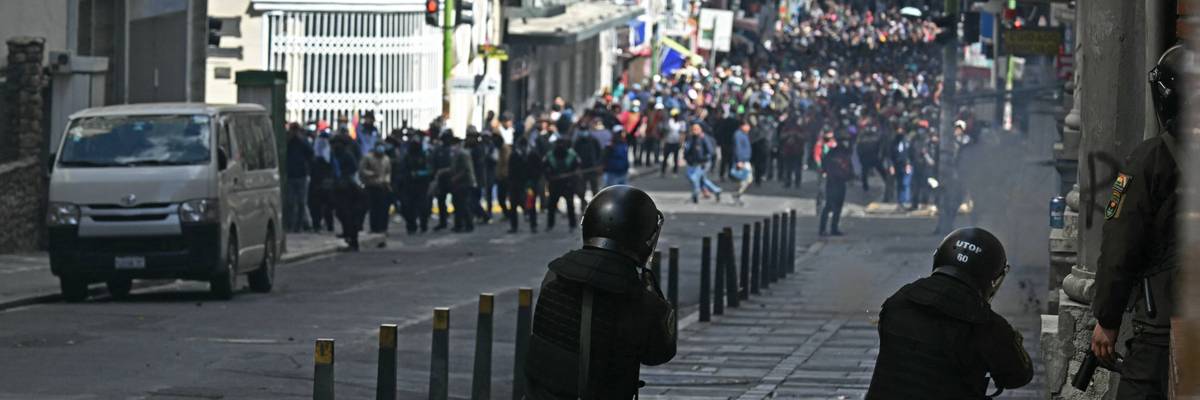
Riot police fire tear gas to demonstrators during a protest demanding the resignation of Bolivian President Rodrigo Paz, in La Paz, on May 18, 2026.
To understand why Bolivia is on the brink, we must understand a fundamental betrayal of the people by their political representatives.
For over six weeks now, Bolivia has been engulfed in a national revolt. What started as sectoral demands over public employee salaries, fuel subsidies, and land rights has metastasized into a full-throated cry for the resignation of Trump-aligned President Rodrigo Paz. The country is paralyzed by more than 100 road blockades that have severed the capital, La Paz, from the rest of the nation, cutting off food, fuel, and medicine. Ten people are dead, dozens more injured, and over 300 have been arrested. Journalists and activists have also been caught in the violence.
The government’s response has been a schizophrenic mix of hollow calls for peaceful dialogue and negotiation, and brutal repression. Paz has signed deals with some social sectors, and organized a Social Economic Council, while jailing the leaders of the groups he’s “negotiating” with.
Thousands of militarized police have been deployed, using tear gas, rubber bullets, and, according to persistent rumors the government denies, live ammunition. Leaders of various protest groups, including the Bolivian Workers’ Central (COB), the largest trade union in the country, and radical Aymara defense force Ponchos Rojos, have been jailed. The Wiphala, the sacred flag of Bolivia’s Indigenous majority, has been burned in public squares by counterprotesters while the state itself no longer displays it publicly.
As Argentinian President Javier Milei’s expatriated adviser Fernando Cerimedo put it, this government is fighting against “dirty leftists.” Cerimedo was reportedly crucial in deporting a human rights mission from Argentina this week. Protest leaders and politicians have been kidnapped in broad daylight, including one senator with the Movement Toward Socialism, taken by police in plain clothes.
When a government disregards the voting blocs that got it into office, blocks every avenue for democratic change, criminalizes dissent, and rules on behalf of a foreign-aligned racist elite, it leaves the people few political options for engagement and representation.
Far-right groups and “The Resistance” have re-popularized the slogan, “Make the homeland, kill an indian,” which had become a popular rallying cry in the 2019 coup. Those same far-right groups were also seen in San Julian, near Santa Cruz, using illegal weapons and explosives against protesters, alongside state security forces. The Paz government has not rebuked any of these figures, statements, or actions, and instead cracked down further on the left.
Internationally, the reaction maps perfectly onto the new ideological conflict dividing Latin America. The right-wing autocrats, from Argentina’s Milei and Venezuela’s Maria Corina Machado to the Trump administration, have been unequivocal. They have labeled the protesters “narco-terrorists” threatening democracy itself, with the government applauding their solidarity.
US Secretary of War Pete Hegseth declared that the US “will reject all attempts to overthrow the legitimate government.” President Donald Trump himself expressed solidarity for Paz at the Shield of the Americas, held at his very own Trump Resort in Miami. This support has emboldened the Bolivian far-right, which is openly pushing for a full “state of exception,” a euphemism for martial law that has been developed by various autocrats including Ecuador’s Daniel Noboa and El Salvador’s Nayib Bukele, to crush democracy and opposition in the name of a “war on drugs.”
That scenario is likely for Bolivia, too, where protesters labeled “narco-terrorists” would be the subject of that war on drugs. Paz and the government coalition in the Plurinational Assembly have already passed and signed a law modifying the state of exception law. The old law was passed in 2020, after the pro-US unelected government of Jeanine Anez committed multiple massacres against opposition in that state of exception, to try to tamper state abuses.
Now, many safeguards have been removed, with the law giving carte blanche to state agents to kill, seize property, shut down telecommunications, and suspend political rights. The president has also declared a 90-day humanitarian emergency, which allowed for the deployment of militarized forces in El Alto, leading to the death of one protester and multiple injuries.
To understand why Bolivia is on the brink, we must understand a fundamental betrayal of the people by their political representatives. Rodrigo Paz ran under the banner of the Christian Democratic Party (PDC), a big-tent coalition with Indigenous currents previously aligned with the left, populist anti-corruption crusaders, and hard-right figures from the Santa Cruz elite. Voters, exhausted by the chronic crises of the Luis Arce administration and facing a nightmare choice against the far-right former president Jorge “Tuto” Quiroga (who was vice president to former pro-US dictator, Hugo Banzer), held their noses and voted for what they believed was the least destructive option.
They were promised “Capitalism for Everyone,” a softer, more competent alternative that would see public programs and social rights protected while opening up the country further.
Instead, Paz’s first months have been a masterclass in neoliberal shock therapy, looking to privatize energy, cutting public services and subsidies, restructuring debt with American financial institutions, and proposing to reform Indigenous land tenure, which communities correctly interpreted as a prelude to opening communal lands to private extraction. Key subsidies ensuring many citizens’ very survival, including fuel and food subsidies, have also been cut, jump kicking the cost of living for the most vulnerable.
The result is the political destitution of the Bolivian left, which represents the vast majority of the country. The old vehicle, Evo Morales’ MAS, is decapitated and adrift. Evo himself is practically in exile with an arrest warrant hanging over his head. His protege, Andronico Rodriguez, has been a ghost in public life, and his Alianza Popular has not been able to build much momentum.
Former President Luis Arce, Evo’s former minister and now sworn enemy, is in prison, in preventive detention. Other socialist leaders, politicians, and activists have been jailed, while the cabinet has ironically vowed to continue crackdowns “against lawfare.”
The Paz government has been jailing the key leaders of the socialist era while releasing convicted terrorists and far-right racists linked to the 2019 coup government and its subsequent massacres, like Jeanine Áñez, Luis Fernando Camacho, and leaders of far-right youth groups deemed the equivalent of the Proud Boys. It has also brought back the Drug Enforcement Administration, which had been kicked out by the Morales government over alleged election interference.
Despite running as the left’s only option, and as the counter to the right, since taking office, Paz’s policy proposals, rhetoric, and platform have mostly been directed at the white, Christian, conservative elite in the tropics, rather than to the Indigenous majority in the Altiplano.
This betrayal is creating a crisis of representation in a country where trust in institutions and democracy is already very low—and in the poorest country in South America. Most of the activists in the streets voted for Paz, while many unions endorsed the PDC, but are now expressing their discontent at their interests being disregarded. One protester in La Paz told me, “We have to remind these oligarchs who the Casa Grande del Pueblo is for, and reclaim it.”
The government and its allies have worked overtime to criminalize the rage that has come from this betrayal. In the face of this repression, some groups have decided to fight fire with fire, arguing Paz’s repression has made negotiation unviable. The COB itself said it would be willing to do anything, “as in a war,” and has vowed to “increase radical pressure measures.”
As Quya Reyna, a writer, activist, and social leader argued in a manifesto for the protest movements, repression will only bring further suffering, and, if the government refuses to negotiate, this is the social cost it will bring. Another manifesto signed by some indigeneist protest groups now explicitly endorses armed resistance.
When a government disregards the voting blocs that got it into office, blocks every avenue for democratic change, criminalizes dissent, and rules on behalf of a foreign-aligned racist elite, it leaves the people few political options for engagement and representation.
The state is using its monopoly on force not to protect its citizens, but to protect the privileges of the few against the many. It cannot, then, be surprised at the rage it engenders by doing so. As Reyna added, “if you want peace, listen to the people and negotiate, don’t repress.”
Faced with this brick wall, the social movements are left with little choice but to play outside the system. In the long term, this is a terrible development for peaceful, stable, social democracy, as it may create a vicious cycle between faith in political institutions, and political violence. As one piece of graffiti scrawled in La Paz by protesters declares, “Let there be no peace for the oligarchies if there is no bread for the majority.”
Vice President Edmand Lara, a populist former police officer who was crucial to Paz’s election, has broken dramatically with the president, condemning the repression and inviting the Inter-American Commission on Human Rights to monitor the country.
The vice president has also denounced the cabinet’s own links to drug trafficking, though he has called for further crackdowns on crime, and Evo Morales. On the right, former president Tuto Quiroga, billionaire Marcelo Claure, Áñez allies, and others have pushed for Paz to step aside and allow security forces to rule, through a state of exception (essentially, martial law), while continuing economic “liberalization.”
Some reports have also indicated the military is interested in pushing Paz out, while embracing further right-wing figures. To satisfy them, Paz has given even more power to the hardliners like Ernesto Justiniano, the anti-drug czar, now minister of defense, while further alienating social sectors and moderate progressives within his cabinet, like José Luis Lupo, Lara, and billionaire Samuel Doria Medina, all of whom have urged for dialogue over repression.
This government is eating itself, while Bolivian democracy has perhaps never looked weaker.
The hard-fought promise of the Plurinational State, a multiracial social democracy with strong rights and constitutional protections, has been hollowed out by a new form of external rule for the elites, far-right racists, foreign states, and the security state. The majorities, meanwhile, have felt betrayed, and are using every means at their disposal to regain representation.
That popular movement now believes the only way forward is a fresh start—calling for Paz to resign, and for fresh elections. Until then, they will continue blocking the country, and forcing the government’s hands, to remind them of their power. Though, the right will continue blaming “dirty leftists” and “indians” for “destroying the country” and “stopping progress,” instead of blaming themselves.
To move forward, the country's leaders will have to realize that, whether in a democracy or dictatorship, they will have to govern with, and for, the Indigenous majorities, not without and against them.
Dear Common Dreams reader, It’s been nearly 30 years since I co-founded Common Dreams with my late wife, Lina Newhouser. We had the radical notion that journalism should serve the public good, not corporate profits. It was clear to us from the outset what it would take to build such a project. No paid advertisements. No corporate sponsors. No millionaire publisher telling us what to think or do. Many people said we wouldn't last a year, but we proved those doubters wrong. Together with a tremendous team of journalists and dedicated staff, we built an independent media outlet free from the constraints of profits and corporate control. Our mission has always been simple: To inform. To inspire. To ignite change for the common good. Building Common Dreams was not easy. Our survival was never guaranteed. When you take on the most powerful forces—Wall Street greed, fossil fuel industry destruction, Big Tech lobbyists, and uber-rich oligarchs who have spent billions upon billions rigging the economy and democracy in their favor—the only bulwark you have is supporters who believe in your work. But here’s the urgent message from me today. It's never been this bad out there. And it's never been this hard to keep us going. At the very moment Common Dreams is most needed, the threats we face are intensifying. We need your support now more than ever. We don't accept corporate advertising and never will. We don't have a paywall because we don't think people should be blocked from critical news based on their ability to pay. Everything we do is funded by the donations of readers like you. When everyone does the little they can afford, we are strong. But if that support retreats or dries up, so do we. Will you donate now to make sure Common Dreams not only survives but thrives? —Craig Brown, Co-founder |
For over six weeks now, Bolivia has been engulfed in a national revolt. What started as sectoral demands over public employee salaries, fuel subsidies, and land rights has metastasized into a full-throated cry for the resignation of Trump-aligned President Rodrigo Paz. The country is paralyzed by more than 100 road blockades that have severed the capital, La Paz, from the rest of the nation, cutting off food, fuel, and medicine. Ten people are dead, dozens more injured, and over 300 have been arrested. Journalists and activists have also been caught in the violence.
The government’s response has been a schizophrenic mix of hollow calls for peaceful dialogue and negotiation, and brutal repression. Paz has signed deals with some social sectors, and organized a Social Economic Council, while jailing the leaders of the groups he’s “negotiating” with.
Thousands of militarized police have been deployed, using tear gas, rubber bullets, and, according to persistent rumors the government denies, live ammunition. Leaders of various protest groups, including the Bolivian Workers’ Central (COB), the largest trade union in the country, and radical Aymara defense force Ponchos Rojos, have been jailed. The Wiphala, the sacred flag of Bolivia’s Indigenous majority, has been burned in public squares by counterprotesters while the state itself no longer displays it publicly.
As Argentinian President Javier Milei’s expatriated adviser Fernando Cerimedo put it, this government is fighting against “dirty leftists.” Cerimedo was reportedly crucial in deporting a human rights mission from Argentina this week. Protest leaders and politicians have been kidnapped in broad daylight, including one senator with the Movement Toward Socialism, taken by police in plain clothes.
When a government disregards the voting blocs that got it into office, blocks every avenue for democratic change, criminalizes dissent, and rules on behalf of a foreign-aligned racist elite, it leaves the people few political options for engagement and representation.
Far-right groups and “The Resistance” have re-popularized the slogan, “Make the homeland, kill an indian,” which had become a popular rallying cry in the 2019 coup. Those same far-right groups were also seen in San Julian, near Santa Cruz, using illegal weapons and explosives against protesters, alongside state security forces. The Paz government has not rebuked any of these figures, statements, or actions, and instead cracked down further on the left.
Internationally, the reaction maps perfectly onto the new ideological conflict dividing Latin America. The right-wing autocrats, from Argentina’s Milei and Venezuela’s Maria Corina Machado to the Trump administration, have been unequivocal. They have labeled the protesters “narco-terrorists” threatening democracy itself, with the government applauding their solidarity.
US Secretary of War Pete Hegseth declared that the US “will reject all attempts to overthrow the legitimate government.” President Donald Trump himself expressed solidarity for Paz at the Shield of the Americas, held at his very own Trump Resort in Miami. This support has emboldened the Bolivian far-right, which is openly pushing for a full “state of exception,” a euphemism for martial law that has been developed by various autocrats including Ecuador’s Daniel Noboa and El Salvador’s Nayib Bukele, to crush democracy and opposition in the name of a “war on drugs.”
That scenario is likely for Bolivia, too, where protesters labeled “narco-terrorists” would be the subject of that war on drugs. Paz and the government coalition in the Plurinational Assembly have already passed and signed a law modifying the state of exception law. The old law was passed in 2020, after the pro-US unelected government of Jeanine Anez committed multiple massacres against opposition in that state of exception, to try to tamper state abuses.
Now, many safeguards have been removed, with the law giving carte blanche to state agents to kill, seize property, shut down telecommunications, and suspend political rights. The president has also declared a 90-day humanitarian emergency, which allowed for the deployment of militarized forces in El Alto, leading to the death of one protester and multiple injuries.
To understand why Bolivia is on the brink, we must understand a fundamental betrayal of the people by their political representatives. Rodrigo Paz ran under the banner of the Christian Democratic Party (PDC), a big-tent coalition with Indigenous currents previously aligned with the left, populist anti-corruption crusaders, and hard-right figures from the Santa Cruz elite. Voters, exhausted by the chronic crises of the Luis Arce administration and facing a nightmare choice against the far-right former president Jorge “Tuto” Quiroga (who was vice president to former pro-US dictator, Hugo Banzer), held their noses and voted for what they believed was the least destructive option.
They were promised “Capitalism for Everyone,” a softer, more competent alternative that would see public programs and social rights protected while opening up the country further.
Instead, Paz’s first months have been a masterclass in neoliberal shock therapy, looking to privatize energy, cutting public services and subsidies, restructuring debt with American financial institutions, and proposing to reform Indigenous land tenure, which communities correctly interpreted as a prelude to opening communal lands to private extraction. Key subsidies ensuring many citizens’ very survival, including fuel and food subsidies, have also been cut, jump kicking the cost of living for the most vulnerable.
The result is the political destitution of the Bolivian left, which represents the vast majority of the country. The old vehicle, Evo Morales’ MAS, is decapitated and adrift. Evo himself is practically in exile with an arrest warrant hanging over his head. His protege, Andronico Rodriguez, has been a ghost in public life, and his Alianza Popular has not been able to build much momentum.
Former President Luis Arce, Evo’s former minister and now sworn enemy, is in prison, in preventive detention. Other socialist leaders, politicians, and activists have been jailed, while the cabinet has ironically vowed to continue crackdowns “against lawfare.”
The Paz government has been jailing the key leaders of the socialist era while releasing convicted terrorists and far-right racists linked to the 2019 coup government and its subsequent massacres, like Jeanine Áñez, Luis Fernando Camacho, and leaders of far-right youth groups deemed the equivalent of the Proud Boys. It has also brought back the Drug Enforcement Administration, which had been kicked out by the Morales government over alleged election interference.
Despite running as the left’s only option, and as the counter to the right, since taking office, Paz’s policy proposals, rhetoric, and platform have mostly been directed at the white, Christian, conservative elite in the tropics, rather than to the Indigenous majority in the Altiplano.
This betrayal is creating a crisis of representation in a country where trust in institutions and democracy is already very low—and in the poorest country in South America. Most of the activists in the streets voted for Paz, while many unions endorsed the PDC, but are now expressing their discontent at their interests being disregarded. One protester in La Paz told me, “We have to remind these oligarchs who the Casa Grande del Pueblo is for, and reclaim it.”
The government and its allies have worked overtime to criminalize the rage that has come from this betrayal. In the face of this repression, some groups have decided to fight fire with fire, arguing Paz’s repression has made negotiation unviable. The COB itself said it would be willing to do anything, “as in a war,” and has vowed to “increase radical pressure measures.”
As Quya Reyna, a writer, activist, and social leader argued in a manifesto for the protest movements, repression will only bring further suffering, and, if the government refuses to negotiate, this is the social cost it will bring. Another manifesto signed by some indigeneist protest groups now explicitly endorses armed resistance.
When a government disregards the voting blocs that got it into office, blocks every avenue for democratic change, criminalizes dissent, and rules on behalf of a foreign-aligned racist elite, it leaves the people few political options for engagement and representation.
The state is using its monopoly on force not to protect its citizens, but to protect the privileges of the few against the many. It cannot, then, be surprised at the rage it engenders by doing so. As Reyna added, “if you want peace, listen to the people and negotiate, don’t repress.”
Faced with this brick wall, the social movements are left with little choice but to play outside the system. In the long term, this is a terrible development for peaceful, stable, social democracy, as it may create a vicious cycle between faith in political institutions, and political violence. As one piece of graffiti scrawled in La Paz by protesters declares, “Let there be no peace for the oligarchies if there is no bread for the majority.”
Vice President Edmand Lara, a populist former police officer who was crucial to Paz’s election, has broken dramatically with the president, condemning the repression and inviting the Inter-American Commission on Human Rights to monitor the country.
The vice president has also denounced the cabinet’s own links to drug trafficking, though he has called for further crackdowns on crime, and Evo Morales. On the right, former president Tuto Quiroga, billionaire Marcelo Claure, Áñez allies, and others have pushed for Paz to step aside and allow security forces to rule, through a state of exception (essentially, martial law), while continuing economic “liberalization.”
Some reports have also indicated the military is interested in pushing Paz out, while embracing further right-wing figures. To satisfy them, Paz has given even more power to the hardliners like Ernesto Justiniano, the anti-drug czar, now minister of defense, while further alienating social sectors and moderate progressives within his cabinet, like José Luis Lupo, Lara, and billionaire Samuel Doria Medina, all of whom have urged for dialogue over repression.
This government is eating itself, while Bolivian democracy has perhaps never looked weaker.
The hard-fought promise of the Plurinational State, a multiracial social democracy with strong rights and constitutional protections, has been hollowed out by a new form of external rule for the elites, far-right racists, foreign states, and the security state. The majorities, meanwhile, have felt betrayed, and are using every means at their disposal to regain representation.
That popular movement now believes the only way forward is a fresh start—calling for Paz to resign, and for fresh elections. Until then, they will continue blocking the country, and forcing the government’s hands, to remind them of their power. Though, the right will continue blaming “dirty leftists” and “indians” for “destroying the country” and “stopping progress,” instead of blaming themselves.
To move forward, the country's leaders will have to realize that, whether in a democracy or dictatorship, they will have to govern with, and for, the Indigenous majorities, not without and against them.
For over six weeks now, Bolivia has been engulfed in a national revolt. What started as sectoral demands over public employee salaries, fuel subsidies, and land rights has metastasized into a full-throated cry for the resignation of Trump-aligned President Rodrigo Paz. The country is paralyzed by more than 100 road blockades that have severed the capital, La Paz, from the rest of the nation, cutting off food, fuel, and medicine. Ten people are dead, dozens more injured, and over 300 have been arrested. Journalists and activists have also been caught in the violence.
The government’s response has been a schizophrenic mix of hollow calls for peaceful dialogue and negotiation, and brutal repression. Paz has signed deals with some social sectors, and organized a Social Economic Council, while jailing the leaders of the groups he’s “negotiating” with.
Thousands of militarized police have been deployed, using tear gas, rubber bullets, and, according to persistent rumors the government denies, live ammunition. Leaders of various protest groups, including the Bolivian Workers’ Central (COB), the largest trade union in the country, and radical Aymara defense force Ponchos Rojos, have been jailed. The Wiphala, the sacred flag of Bolivia’s Indigenous majority, has been burned in public squares by counterprotesters while the state itself no longer displays it publicly.
As Argentinian President Javier Milei’s expatriated adviser Fernando Cerimedo put it, this government is fighting against “dirty leftists.” Cerimedo was reportedly crucial in deporting a human rights mission from Argentina this week. Protest leaders and politicians have been kidnapped in broad daylight, including one senator with the Movement Toward Socialism, taken by police in plain clothes.
When a government disregards the voting blocs that got it into office, blocks every avenue for democratic change, criminalizes dissent, and rules on behalf of a foreign-aligned racist elite, it leaves the people few political options for engagement and representation.
Far-right groups and “The Resistance” have re-popularized the slogan, “Make the homeland, kill an indian,” which had become a popular rallying cry in the 2019 coup. Those same far-right groups were also seen in San Julian, near Santa Cruz, using illegal weapons and explosives against protesters, alongside state security forces. The Paz government has not rebuked any of these figures, statements, or actions, and instead cracked down further on the left.
Internationally, the reaction maps perfectly onto the new ideological conflict dividing Latin America. The right-wing autocrats, from Argentina’s Milei and Venezuela’s Maria Corina Machado to the Trump administration, have been unequivocal. They have labeled the protesters “narco-terrorists” threatening democracy itself, with the government applauding their solidarity.
US Secretary of War Pete Hegseth declared that the US “will reject all attempts to overthrow the legitimate government.” President Donald Trump himself expressed solidarity for Paz at the Shield of the Americas, held at his very own Trump Resort in Miami. This support has emboldened the Bolivian far-right, which is openly pushing for a full “state of exception,” a euphemism for martial law that has been developed by various autocrats including Ecuador’s Daniel Noboa and El Salvador’s Nayib Bukele, to crush democracy and opposition in the name of a “war on drugs.”
That scenario is likely for Bolivia, too, where protesters labeled “narco-terrorists” would be the subject of that war on drugs. Paz and the government coalition in the Plurinational Assembly have already passed and signed a law modifying the state of exception law. The old law was passed in 2020, after the pro-US unelected government of Jeanine Anez committed multiple massacres against opposition in that state of exception, to try to tamper state abuses.
Now, many safeguards have been removed, with the law giving carte blanche to state agents to kill, seize property, shut down telecommunications, and suspend political rights. The president has also declared a 90-day humanitarian emergency, which allowed for the deployment of militarized forces in El Alto, leading to the death of one protester and multiple injuries.
To understand why Bolivia is on the brink, we must understand a fundamental betrayal of the people by their political representatives. Rodrigo Paz ran under the banner of the Christian Democratic Party (PDC), a big-tent coalition with Indigenous currents previously aligned with the left, populist anti-corruption crusaders, and hard-right figures from the Santa Cruz elite. Voters, exhausted by the chronic crises of the Luis Arce administration and facing a nightmare choice against the far-right former president Jorge “Tuto” Quiroga (who was vice president to former pro-US dictator, Hugo Banzer), held their noses and voted for what they believed was the least destructive option.
They were promised “Capitalism for Everyone,” a softer, more competent alternative that would see public programs and social rights protected while opening up the country further.
Instead, Paz’s first months have been a masterclass in neoliberal shock therapy, looking to privatize energy, cutting public services and subsidies, restructuring debt with American financial institutions, and proposing to reform Indigenous land tenure, which communities correctly interpreted as a prelude to opening communal lands to private extraction. Key subsidies ensuring many citizens’ very survival, including fuel and food subsidies, have also been cut, jump kicking the cost of living for the most vulnerable.
The result is the political destitution of the Bolivian left, which represents the vast majority of the country. The old vehicle, Evo Morales’ MAS, is decapitated and adrift. Evo himself is practically in exile with an arrest warrant hanging over his head. His protege, Andronico Rodriguez, has been a ghost in public life, and his Alianza Popular has not been able to build much momentum.
Former President Luis Arce, Evo’s former minister and now sworn enemy, is in prison, in preventive detention. Other socialist leaders, politicians, and activists have been jailed, while the cabinet has ironically vowed to continue crackdowns “against lawfare.”
The Paz government has been jailing the key leaders of the socialist era while releasing convicted terrorists and far-right racists linked to the 2019 coup government and its subsequent massacres, like Jeanine Áñez, Luis Fernando Camacho, and leaders of far-right youth groups deemed the equivalent of the Proud Boys. It has also brought back the Drug Enforcement Administration, which had been kicked out by the Morales government over alleged election interference.
Despite running as the left’s only option, and as the counter to the right, since taking office, Paz’s policy proposals, rhetoric, and platform have mostly been directed at the white, Christian, conservative elite in the tropics, rather than to the Indigenous majority in the Altiplano.
This betrayal is creating a crisis of representation in a country where trust in institutions and democracy is already very low—and in the poorest country in South America. Most of the activists in the streets voted for Paz, while many unions endorsed the PDC, but are now expressing their discontent at their interests being disregarded. One protester in La Paz told me, “We have to remind these oligarchs who the Casa Grande del Pueblo is for, and reclaim it.”
The government and its allies have worked overtime to criminalize the rage that has come from this betrayal. In the face of this repression, some groups have decided to fight fire with fire, arguing Paz’s repression has made negotiation unviable. The COB itself said it would be willing to do anything, “as in a war,” and has vowed to “increase radical pressure measures.”
As Quya Reyna, a writer, activist, and social leader argued in a manifesto for the protest movements, repression will only bring further suffering, and, if the government refuses to negotiate, this is the social cost it will bring. Another manifesto signed by some indigeneist protest groups now explicitly endorses armed resistance.
When a government disregards the voting blocs that got it into office, blocks every avenue for democratic change, criminalizes dissent, and rules on behalf of a foreign-aligned racist elite, it leaves the people few political options for engagement and representation.
The state is using its monopoly on force not to protect its citizens, but to protect the privileges of the few against the many. It cannot, then, be surprised at the rage it engenders by doing so. As Reyna added, “if you want peace, listen to the people and negotiate, don’t repress.”
Faced with this brick wall, the social movements are left with little choice but to play outside the system. In the long term, this is a terrible development for peaceful, stable, social democracy, as it may create a vicious cycle between faith in political institutions, and political violence. As one piece of graffiti scrawled in La Paz by protesters declares, “Let there be no peace for the oligarchies if there is no bread for the majority.”
Vice President Edmand Lara, a populist former police officer who was crucial to Paz’s election, has broken dramatically with the president, condemning the repression and inviting the Inter-American Commission on Human Rights to monitor the country.
The vice president has also denounced the cabinet’s own links to drug trafficking, though he has called for further crackdowns on crime, and Evo Morales. On the right, former president Tuto Quiroga, billionaire Marcelo Claure, Áñez allies, and others have pushed for Paz to step aside and allow security forces to rule, through a state of exception (essentially, martial law), while continuing economic “liberalization.”
Some reports have also indicated the military is interested in pushing Paz out, while embracing further right-wing figures. To satisfy them, Paz has given even more power to the hardliners like Ernesto Justiniano, the anti-drug czar, now minister of defense, while further alienating social sectors and moderate progressives within his cabinet, like José Luis Lupo, Lara, and billionaire Samuel Doria Medina, all of whom have urged for dialogue over repression.
This government is eating itself, while Bolivian democracy has perhaps never looked weaker.
The hard-fought promise of the Plurinational State, a multiracial social democracy with strong rights and constitutional protections, has been hollowed out by a new form of external rule for the elites, far-right racists, foreign states, and the security state. The majorities, meanwhile, have felt betrayed, and are using every means at their disposal to regain representation.
That popular movement now believes the only way forward is a fresh start—calling for Paz to resign, and for fresh elections. Until then, they will continue blocking the country, and forcing the government’s hands, to remind them of their power. Though, the right will continue blaming “dirty leftists” and “indians” for “destroying the country” and “stopping progress,” instead of blaming themselves.
To move forward, the country's leaders will have to realize that, whether in a democracy or dictatorship, they will have to govern with, and for, the Indigenous majorities, not without and against them.

