SUBSCRIBE TO OUR FREE NEWSLETTER
Daily news & progressive opinion—funded by the people, not the corporations—delivered straight to your inbox.
5
#000000
#FFFFFF
To donate by check, phone, or other method, see our More Ways to Give page.
Daily news & progressive opinion—funded by the people, not the corporations—delivered straight to your inbox.
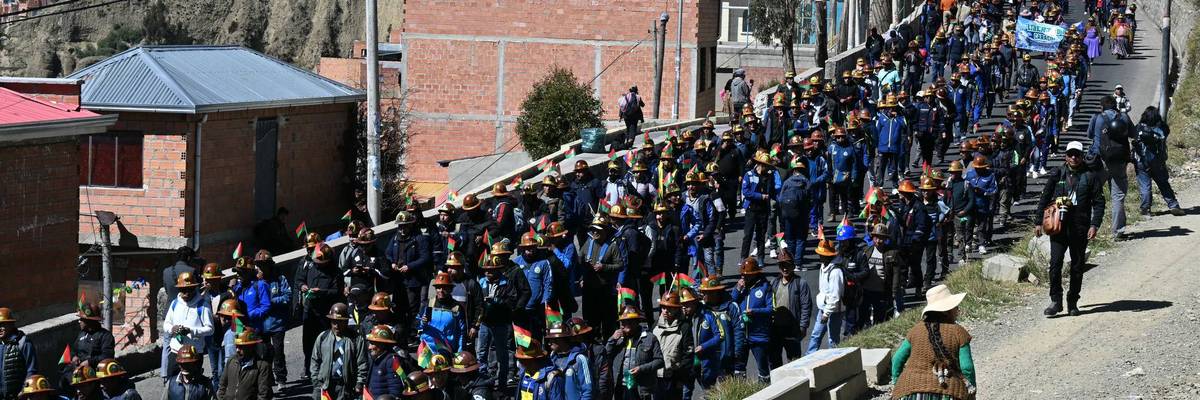
Miners march to La Paz in demand of Bolivian President Rodrigo Paz's resignation in El Alto, Bolivia, on May 14, 2026.
Peasants' unions and other groups are protesting a law that they say would allow corporate control of small farmers' land, as well as fuel shortages and a low minimum wage.
An economic crisis and the repeal of a crucial gas subsidy, fuel shortages, and a law that opponents say will allow the encroachment of corporate interests on Indigenous and peasant lands are among the central concerns of thousands of miners and other workers who have joined a march from Bolivia's northern Amazon territories to La Paz, with a major miners union in the capital joining the protest on Wednesday.
The Federation of Mining Cooperatives of La Paz and an influential peasant union met land workers and Indigenous representatives this week as they arrived in the capital after having marched 1,100 kilometers (683 miles) "for over 20 days from the tropics into freezing high-altitude terrain, many wearing nothing more substantial on their feet than plastic sandals," as Olivia Arigho-Stiles reported at Jacobin.
At least 50 marchers required medical treatment last week for exhaustion, dehydration, and other ailments, but the unions are showing no sign of ending the general strike that was begun by Bolivian Workers’ Central (COB), with the mass mobilization also including at least 70 road blockades around the country, according to the Bolivia Highway Association.
TeleSUR reported that the entry of the miners union signified "a substantial increase in pressure" on right-wing President Rodrigo Paz, whose resignation some workers' organizations are calling for.
The Federation of Mining Cooperatives joined the ongoing marches and protests after Paz failed to attend a scheduled dialogue. Miners have been alarmed by the scarcity of fuel, "a dire shortage of essential explosive material, and significant delays in the liberation of new areas designated for mining exploitation," reported TeleSUR.
The broader protests began in response to stagnant, low wages as well as Law 1720, which the government has claimed will benefit small-scale farmers by allowing them to obtain mortgages after converting their smallholdings into "medium-size" businesses.
But Roger Adan Chambi, an Aymara lawyer and specialist in Indigenous land law, told Jacobin that the measure was passed "without consulting the sectors it was supposed to benefit (peasants and small producers), jeopardizing legal security and constitutional guarantees regarding land ownership."
“Far from being an opportunity for small producers to access credit, this law weakens the property rights of peasants and Indigenous communities, especially those resisting on the agricultural frontier,” Chambi said. “Structural insecurity and the lack of basic services will, in the future, force them to mortgage or sell their plots, facilitating dispossession and the transfer of land to corporations.”
Oscar Cardoza, a peasant union leader and a representative of the marchers, declared at a public gathering in La Paz this week: “Our life is collective, not individual. The land must be respected; it’s not for sale.”
Al Jazeera reported that the end of a fuel subsidy, which was cut after Paz took office last year during what he called an "economic, financial, energy, and social emergency," also pushed COB to issue the call for a general strike.
The subsidy had been crucial for working Bolivians, and the cut has made quality fuel increasingly inaccessible.
"Starting today, a general, indefinite, and active strike is declared, until the government understands the people’s demands,” COB secretary-general Mario Argollo told a group of 1,000 supporters on May 1.
The union is also calling for a 20% increase to the nation’s minimum wage, which currently sits at 3,300 bolivianos ($477.71) per month.
Dear Common Dreams reader, It’s been nearly 30 years since I co-founded Common Dreams with my late wife, Lina Newhouser. We had the radical notion that journalism should serve the public good, not corporate profits. It was clear to us from the outset what it would take to build such a project. No paid advertisements. No corporate sponsors. No millionaire publisher telling us what to think or do. Many people said we wouldn't last a year, but we proved those doubters wrong. Together with a tremendous team of journalists and dedicated staff, we built an independent media outlet free from the constraints of profits and corporate control. Our mission has always been simple: To inform. To inspire. To ignite change for the common good. Building Common Dreams was not easy. Our survival was never guaranteed. When you take on the most powerful forces—Wall Street greed, fossil fuel industry destruction, Big Tech lobbyists, and uber-rich oligarchs who have spent billions upon billions rigging the economy and democracy in their favor—the only bulwark you have is supporters who believe in your work. But here’s the urgent message from me today. It's never been this bad out there. And it's never been this hard to keep us going. At the very moment Common Dreams is most needed, the threats we face are intensifying. We need your support now more than ever. We don't accept corporate advertising and never will. We don't have a paywall because we don't think people should be blocked from critical news based on their ability to pay. Everything we do is funded by the donations of readers like you. When everyone does the little they can afford, we are strong. But if that support retreats or dries up, so do we. Will you donate now to make sure Common Dreams not only survives but thrives? —Craig Brown, Co-founder |
An economic crisis and the repeal of a crucial gas subsidy, fuel shortages, and a law that opponents say will allow the encroachment of corporate interests on Indigenous and peasant lands are among the central concerns of thousands of miners and other workers who have joined a march from Bolivia's northern Amazon territories to La Paz, with a major miners union in the capital joining the protest on Wednesday.
The Federation of Mining Cooperatives of La Paz and an influential peasant union met land workers and Indigenous representatives this week as they arrived in the capital after having marched 1,100 kilometers (683 miles) "for over 20 days from the tropics into freezing high-altitude terrain, many wearing nothing more substantial on their feet than plastic sandals," as Olivia Arigho-Stiles reported at Jacobin.
At least 50 marchers required medical treatment last week for exhaustion, dehydration, and other ailments, but the unions are showing no sign of ending the general strike that was begun by Bolivian Workers’ Central (COB), with the mass mobilization also including at least 70 road blockades around the country, according to the Bolivia Highway Association.
TeleSUR reported that the entry of the miners union signified "a substantial increase in pressure" on right-wing President Rodrigo Paz, whose resignation some workers' organizations are calling for.
The Federation of Mining Cooperatives joined the ongoing marches and protests after Paz failed to attend a scheduled dialogue. Miners have been alarmed by the scarcity of fuel, "a dire shortage of essential explosive material, and significant delays in the liberation of new areas designated for mining exploitation," reported TeleSUR.
The broader protests began in response to stagnant, low wages as well as Law 1720, which the government has claimed will benefit small-scale farmers by allowing them to obtain mortgages after converting their smallholdings into "medium-size" businesses.
But Roger Adan Chambi, an Aymara lawyer and specialist in Indigenous land law, told Jacobin that the measure was passed "without consulting the sectors it was supposed to benefit (peasants and small producers), jeopardizing legal security and constitutional guarantees regarding land ownership."
“Far from being an opportunity for small producers to access credit, this law weakens the property rights of peasants and Indigenous communities, especially those resisting on the agricultural frontier,” Chambi said. “Structural insecurity and the lack of basic services will, in the future, force them to mortgage or sell their plots, facilitating dispossession and the transfer of land to corporations.”
Oscar Cardoza, a peasant union leader and a representative of the marchers, declared at a public gathering in La Paz this week: “Our life is collective, not individual. The land must be respected; it’s not for sale.”
Al Jazeera reported that the end of a fuel subsidy, which was cut after Paz took office last year during what he called an "economic, financial, energy, and social emergency," also pushed COB to issue the call for a general strike.
The subsidy had been crucial for working Bolivians, and the cut has made quality fuel increasingly inaccessible.
"Starting today, a general, indefinite, and active strike is declared, until the government understands the people’s demands,” COB secretary-general Mario Argollo told a group of 1,000 supporters on May 1.
The union is also calling for a 20% increase to the nation’s minimum wage, which currently sits at 3,300 bolivianos ($477.71) per month.
An economic crisis and the repeal of a crucial gas subsidy, fuel shortages, and a law that opponents say will allow the encroachment of corporate interests on Indigenous and peasant lands are among the central concerns of thousands of miners and other workers who have joined a march from Bolivia's northern Amazon territories to La Paz, with a major miners union in the capital joining the protest on Wednesday.
The Federation of Mining Cooperatives of La Paz and an influential peasant union met land workers and Indigenous representatives this week as they arrived in the capital after having marched 1,100 kilometers (683 miles) "for over 20 days from the tropics into freezing high-altitude terrain, many wearing nothing more substantial on their feet than plastic sandals," as Olivia Arigho-Stiles reported at Jacobin.
At least 50 marchers required medical treatment last week for exhaustion, dehydration, and other ailments, but the unions are showing no sign of ending the general strike that was begun by Bolivian Workers’ Central (COB), with the mass mobilization also including at least 70 road blockades around the country, according to the Bolivia Highway Association.
TeleSUR reported that the entry of the miners union signified "a substantial increase in pressure" on right-wing President Rodrigo Paz, whose resignation some workers' organizations are calling for.
The Federation of Mining Cooperatives joined the ongoing marches and protests after Paz failed to attend a scheduled dialogue. Miners have been alarmed by the scarcity of fuel, "a dire shortage of essential explosive material, and significant delays in the liberation of new areas designated for mining exploitation," reported TeleSUR.
The broader protests began in response to stagnant, low wages as well as Law 1720, which the government has claimed will benefit small-scale farmers by allowing them to obtain mortgages after converting their smallholdings into "medium-size" businesses.
But Roger Adan Chambi, an Aymara lawyer and specialist in Indigenous land law, told Jacobin that the measure was passed "without consulting the sectors it was supposed to benefit (peasants and small producers), jeopardizing legal security and constitutional guarantees regarding land ownership."
“Far from being an opportunity for small producers to access credit, this law weakens the property rights of peasants and Indigenous communities, especially those resisting on the agricultural frontier,” Chambi said. “Structural insecurity and the lack of basic services will, in the future, force them to mortgage or sell their plots, facilitating dispossession and the transfer of land to corporations.”
Oscar Cardoza, a peasant union leader and a representative of the marchers, declared at a public gathering in La Paz this week: “Our life is collective, not individual. The land must be respected; it’s not for sale.”
Al Jazeera reported that the end of a fuel subsidy, which was cut after Paz took office last year during what he called an "economic, financial, energy, and social emergency," also pushed COB to issue the call for a general strike.
The subsidy had been crucial for working Bolivians, and the cut has made quality fuel increasingly inaccessible.
"Starting today, a general, indefinite, and active strike is declared, until the government understands the people’s demands,” COB secretary-general Mario Argollo told a group of 1,000 supporters on May 1.
The union is also calling for a 20% increase to the nation’s minimum wage, which currently sits at 3,300 bolivianos ($477.71) per month.