SUBSCRIBE TO OUR FREE NEWSLETTER
Daily news & progressive opinion—funded by the people, not the corporations—delivered straight to your inbox.
5
#000000
#FFFFFF
To donate by check, phone, or other method, see our More Ways to Give page.
Daily news & progressive opinion—funded by the people, not the corporations—delivered straight to your inbox.
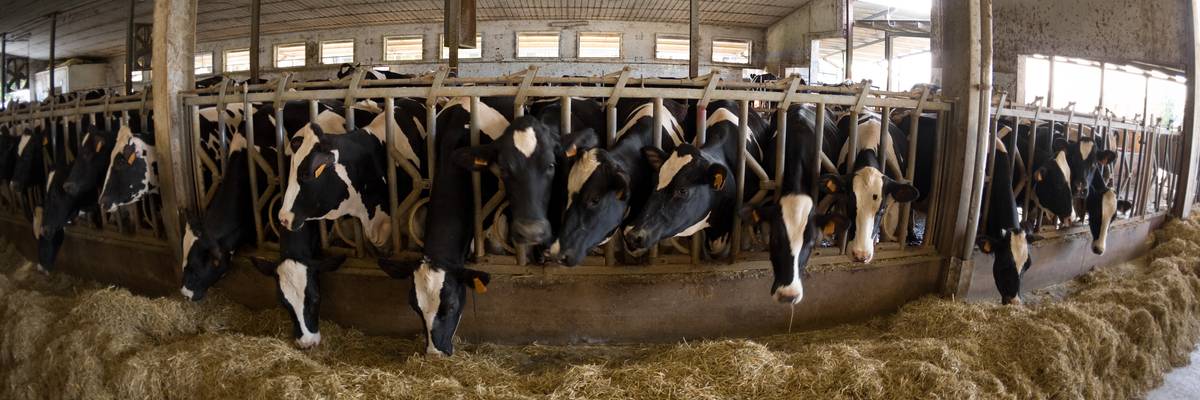
Cows are shown in factory farm conditions.
Agribusiness corporations that wield outsized power in the food system are using the exact same playbook as the oil and gas industry to delay meaningful action.
If you haven’t been following food and agriculture developments at COP28, then you might not know that this year’s COP has been dubbed as the first “Food COP.”
Food systems are responsible for a third of global greenhouse gas (GHG) emissions, and they are rarely subjected to scrutiny. But food-related emissions are finally under the spotlight at the annual climate negotiations, to complement actions on the much-needed fossil fuel phaseout.
A quick snapshot: 57% of GHGs associated with agricultural production are caused by animal farming. Livestock production accounts for roughly 32% of methane emissions, a “superheater” greenhouse gas that is 80 times more potent than carbon dioxide over a 20 year period. Reducing it in the next seven years gives us a real chance at slowing down and limiting climate chaos.
It is mind-boggling that the fate of food could be controlled so profoundly by corporate actors.
So you would think that meat and dairy companies that drive these emissions on an industrial scale should be feeling the heat at the “Food COP.” Instead, they’re being given the main stage to lay out how they should be allowed to continue their harmful activities.
Multilateral meetings like the COP are increasingly infiltrated by corporate interests showcasing high profile announcements and climate initiatives at side meetings rife with greenwashing. This trend is justified by “multistakeholderism,” an approach to policymaking that allows companies to participate in decision-making processes, even when conflicts of interest arise between climate action and corporate profits. The scope of solutions is as a result inevitably narrowed toward market-friendly interventions and voluntary initiatives rather than robust measures that involve state regulations.
The oil and gas industry has been widely documented using this tactic through infiltrating climate meetings, ultimately trying to steer the global community away from meaningful action. Big Ag (big agribusiness corporations that wield outsized power in the food system) is using the exact same playbook. At COP28, agribusinesses are going all out to dominate the narratives on food systems transition. Multinational food corporations are headlining at numerous events, sponsoring pavilions, and even working in close partnership with the COP28 Presidency’s Agenda on Food Systems. Their motto seems to be, the more in the spotlight the better.
The solutions they promote mostly focus on boosting carbon sequestration through ‘regenerative agriculture’ and enhancing farming innovation for greater efficiency. None of these approaches would require a reduction in production levels, none of them calls into question Big Ag’s flawed model of industrial agriculture that is failing our global food system.
The “Food COP” rightly puts the spotlight on the link between food production and the climate. But it’s unthinkable that the biggest emitters in that sector, hiding in plain sight, get to run the show. Some of the companies involved are part of a cluster of 15 meat and dairy companies which together are estimated to have a methane footprint as large as Russia, Canada, Australia, and Germany.
Although food system transition is not part of the negotiations this year, the space given to Big Ag’s narrative on food systems pretty much everywhere else (especially in comparison to the space given to small farmholders, fisherfolks, and Indigenous peoples) means that they will dominate the narrative on solutions to food system emissions. We must not allow this to happen.
The fact that big agribusinesses are controlling the narrative at COP does not mean it’s game over. Once international climate conferences end, politicians go home, and that’s when the real work on food systems begins.
For this commitment to become a reality, leaders must go beyond the rhetoric of Big Ag and plan a just transition that takes account of the food system as a whole. Governments must also include civil society organisations, consumer groups, Indigenous peoples, scientists, and, of course, farmers, in order to chart a course away from climate-wrecking industrial agriculture.
Decision-makers need to adopt ambitious solutions and set themselves specific targets for different GHGs, such as methane or nitrous oxide. One essential starting point is to halt the expansion of new animal factory farms. Where there are patterns of overconsumption of meat and dairy products (predominantly in the Global North), countries need to shape food environments to encourage large segments of the population to change to diets that include more plant-based food and less animal protein. This should go hand-in-hand with concrete plans for a just transition for farmers trapped in an exploitative relationship with Big Livestock, through shifting subsidies to support a transition towards agroecological farming practices so as to move away from intensive livestock rearing in giant factory farms. We need vibrant rural communities with more farms and less livestock to benefit biodiversity and the climate.
It is mind-boggling that the fate of food could be controlled so profoundly by corporate actors. The way we produce food affects us all, and we can’t let solutions proposed behind closed doors dictate how we nourish ourselves and what we put on our tables.
Dear Common Dreams reader, It’s been nearly 30 years since I co-founded Common Dreams with my late wife, Lina Newhouser. We had the radical notion that journalism should serve the public good, not corporate profits. It was clear to us from the outset what it would take to build such a project. No paid advertisements. No corporate sponsors. No millionaire publisher telling us what to think or do. Many people said we wouldn't last a year, but we proved those doubters wrong. Together with a tremendous team of journalists and dedicated staff, we built an independent media outlet free from the constraints of profits and corporate control. Our mission has always been simple: To inform. To inspire. To ignite change for the common good. Building Common Dreams was not easy. Our survival was never guaranteed. When you take on the most powerful forces—Wall Street greed, fossil fuel industry destruction, Big Tech lobbyists, and uber-rich oligarchs who have spent billions upon billions rigging the economy and democracy in their favor—the only bulwark you have is supporters who believe in your work. But here’s the urgent message from me today. It's never been this bad out there. And it's never been this hard to keep us going. At the very moment Common Dreams is most needed, the threats we face are intensifying. We need your support now more than ever. We don't accept corporate advertising and never will. We don't have a paywall because we don't think people should be blocked from critical news based on their ability to pay. Everything we do is funded by the donations of readers like you. When everyone does the little they can afford, we are strong. But if that support retreats or dries up, so do we. Will you donate now to make sure Common Dreams not only survives but thrives? —Craig Brown, Co-founder |
If you haven’t been following food and agriculture developments at COP28, then you might not know that this year’s COP has been dubbed as the first “Food COP.”
Food systems are responsible for a third of global greenhouse gas (GHG) emissions, and they are rarely subjected to scrutiny. But food-related emissions are finally under the spotlight at the annual climate negotiations, to complement actions on the much-needed fossil fuel phaseout.
A quick snapshot: 57% of GHGs associated with agricultural production are caused by animal farming. Livestock production accounts for roughly 32% of methane emissions, a “superheater” greenhouse gas that is 80 times more potent than carbon dioxide over a 20 year period. Reducing it in the next seven years gives us a real chance at slowing down and limiting climate chaos.
It is mind-boggling that the fate of food could be controlled so profoundly by corporate actors.
So you would think that meat and dairy companies that drive these emissions on an industrial scale should be feeling the heat at the “Food COP.” Instead, they’re being given the main stage to lay out how they should be allowed to continue their harmful activities.
Multilateral meetings like the COP are increasingly infiltrated by corporate interests showcasing high profile announcements and climate initiatives at side meetings rife with greenwashing. This trend is justified by “multistakeholderism,” an approach to policymaking that allows companies to participate in decision-making processes, even when conflicts of interest arise between climate action and corporate profits. The scope of solutions is as a result inevitably narrowed toward market-friendly interventions and voluntary initiatives rather than robust measures that involve state regulations.
The oil and gas industry has been widely documented using this tactic through infiltrating climate meetings, ultimately trying to steer the global community away from meaningful action. Big Ag (big agribusiness corporations that wield outsized power in the food system) is using the exact same playbook. At COP28, agribusinesses are going all out to dominate the narratives on food systems transition. Multinational food corporations are headlining at numerous events, sponsoring pavilions, and even working in close partnership with the COP28 Presidency’s Agenda on Food Systems. Their motto seems to be, the more in the spotlight the better.
The solutions they promote mostly focus on boosting carbon sequestration through ‘regenerative agriculture’ and enhancing farming innovation for greater efficiency. None of these approaches would require a reduction in production levels, none of them calls into question Big Ag’s flawed model of industrial agriculture that is failing our global food system.
The “Food COP” rightly puts the spotlight on the link between food production and the climate. But it’s unthinkable that the biggest emitters in that sector, hiding in plain sight, get to run the show. Some of the companies involved are part of a cluster of 15 meat and dairy companies which together are estimated to have a methane footprint as large as Russia, Canada, Australia, and Germany.
Although food system transition is not part of the negotiations this year, the space given to Big Ag’s narrative on food systems pretty much everywhere else (especially in comparison to the space given to small farmholders, fisherfolks, and Indigenous peoples) means that they will dominate the narrative on solutions to food system emissions. We must not allow this to happen.
The fact that big agribusinesses are controlling the narrative at COP does not mean it’s game over. Once international climate conferences end, politicians go home, and that’s when the real work on food systems begins.
For this commitment to become a reality, leaders must go beyond the rhetoric of Big Ag and plan a just transition that takes account of the food system as a whole. Governments must also include civil society organisations, consumer groups, Indigenous peoples, scientists, and, of course, farmers, in order to chart a course away from climate-wrecking industrial agriculture.
Decision-makers need to adopt ambitious solutions and set themselves specific targets for different GHGs, such as methane or nitrous oxide. One essential starting point is to halt the expansion of new animal factory farms. Where there are patterns of overconsumption of meat and dairy products (predominantly in the Global North), countries need to shape food environments to encourage large segments of the population to change to diets that include more plant-based food and less animal protein. This should go hand-in-hand with concrete plans for a just transition for farmers trapped in an exploitative relationship with Big Livestock, through shifting subsidies to support a transition towards agroecological farming practices so as to move away from intensive livestock rearing in giant factory farms. We need vibrant rural communities with more farms and less livestock to benefit biodiversity and the climate.
It is mind-boggling that the fate of food could be controlled so profoundly by corporate actors. The way we produce food affects us all, and we can’t let solutions proposed behind closed doors dictate how we nourish ourselves and what we put on our tables.
If you haven’t been following food and agriculture developments at COP28, then you might not know that this year’s COP has been dubbed as the first “Food COP.”
Food systems are responsible for a third of global greenhouse gas (GHG) emissions, and they are rarely subjected to scrutiny. But food-related emissions are finally under the spotlight at the annual climate negotiations, to complement actions on the much-needed fossil fuel phaseout.
A quick snapshot: 57% of GHGs associated with agricultural production are caused by animal farming. Livestock production accounts for roughly 32% of methane emissions, a “superheater” greenhouse gas that is 80 times more potent than carbon dioxide over a 20 year period. Reducing it in the next seven years gives us a real chance at slowing down and limiting climate chaos.
It is mind-boggling that the fate of food could be controlled so profoundly by corporate actors.
So you would think that meat and dairy companies that drive these emissions on an industrial scale should be feeling the heat at the “Food COP.” Instead, they’re being given the main stage to lay out how they should be allowed to continue their harmful activities.
Multilateral meetings like the COP are increasingly infiltrated by corporate interests showcasing high profile announcements and climate initiatives at side meetings rife with greenwashing. This trend is justified by “multistakeholderism,” an approach to policymaking that allows companies to participate in decision-making processes, even when conflicts of interest arise between climate action and corporate profits. The scope of solutions is as a result inevitably narrowed toward market-friendly interventions and voluntary initiatives rather than robust measures that involve state regulations.
The oil and gas industry has been widely documented using this tactic through infiltrating climate meetings, ultimately trying to steer the global community away from meaningful action. Big Ag (big agribusiness corporations that wield outsized power in the food system) is using the exact same playbook. At COP28, agribusinesses are going all out to dominate the narratives on food systems transition. Multinational food corporations are headlining at numerous events, sponsoring pavilions, and even working in close partnership with the COP28 Presidency’s Agenda on Food Systems. Their motto seems to be, the more in the spotlight the better.
The solutions they promote mostly focus on boosting carbon sequestration through ‘regenerative agriculture’ and enhancing farming innovation for greater efficiency. None of these approaches would require a reduction in production levels, none of them calls into question Big Ag’s flawed model of industrial agriculture that is failing our global food system.
The “Food COP” rightly puts the spotlight on the link between food production and the climate. But it’s unthinkable that the biggest emitters in that sector, hiding in plain sight, get to run the show. Some of the companies involved are part of a cluster of 15 meat and dairy companies which together are estimated to have a methane footprint as large as Russia, Canada, Australia, and Germany.
Although food system transition is not part of the negotiations this year, the space given to Big Ag’s narrative on food systems pretty much everywhere else (especially in comparison to the space given to small farmholders, fisherfolks, and Indigenous peoples) means that they will dominate the narrative on solutions to food system emissions. We must not allow this to happen.
The fact that big agribusinesses are controlling the narrative at COP does not mean it’s game over. Once international climate conferences end, politicians go home, and that’s when the real work on food systems begins.
For this commitment to become a reality, leaders must go beyond the rhetoric of Big Ag and plan a just transition that takes account of the food system as a whole. Governments must also include civil society organisations, consumer groups, Indigenous peoples, scientists, and, of course, farmers, in order to chart a course away from climate-wrecking industrial agriculture.
Decision-makers need to adopt ambitious solutions and set themselves specific targets for different GHGs, such as methane or nitrous oxide. One essential starting point is to halt the expansion of new animal factory farms. Where there are patterns of overconsumption of meat and dairy products (predominantly in the Global North), countries need to shape food environments to encourage large segments of the population to change to diets that include more plant-based food and less animal protein. This should go hand-in-hand with concrete plans for a just transition for farmers trapped in an exploitative relationship with Big Livestock, through shifting subsidies to support a transition towards agroecological farming practices so as to move away from intensive livestock rearing in giant factory farms. We need vibrant rural communities with more farms and less livestock to benefit biodiversity and the climate.
It is mind-boggling that the fate of food could be controlled so profoundly by corporate actors. The way we produce food affects us all, and we can’t let solutions proposed behind closed doors dictate how we nourish ourselves and what we put on our tables.