SUBSCRIBE TO OUR FREE NEWSLETTER
Daily news & progressive opinion—funded by the people, not the corporations—delivered straight to your inbox.
5
#000000
#FFFFFF
To donate by check, phone, or other method, see our More Ways to Give page.
Daily news & progressive opinion—funded by the people, not the corporations—delivered straight to your inbox.
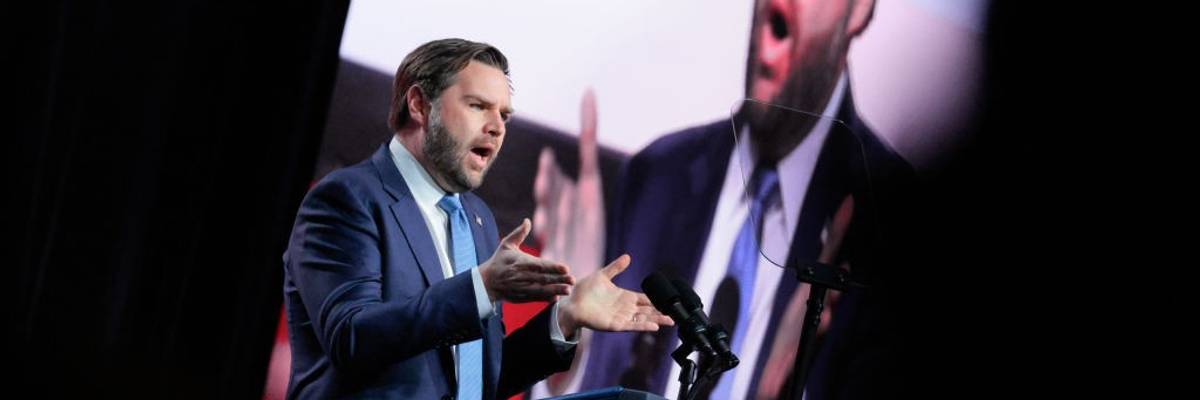
U.S. Vice President JD Vance addresses the National League of Cities: Congressional City Conference at the Marriott Marquis on March 10, 2025 in Washington, D.C.
After blaming working class Americans for their poverty, Vance just cast the deciding vote to stack the deck against them.
My wife Kitty and a number of our progressive friends have been telling me for years that I had to read U.S. Vice President JD Vance's 2016 memoir, Hillbilly Elegy.
They raved about it. Even today, nine years after it was published and Vance became vice president, they still rave.
They discounted the critics who thought that Vance was an egotistical loudmouth. So did plenty of others—sales to readers across the political spectrum made the memoir a bestseller, turning the author into a millionaire and helping to launch his political career.
True, for Vance to emerge from such a challenging childhood to become what he has become is amazing. Surely he had to be brilliant to rise so high so quickly.
Vance took his painful background and educational attainments and turned them against the very people he came from.
But this July, Vance was the tiebreaker in the razor thin vote in the U.S. Senate (51-50) for the big Trump administration budget bill that will throw millions of Americans off Medicaid and federal food assistance programs.
This is the bill Rev. William Barber and Institute for Policy Studies researchers have charged with "policy murder." (And that's no exaggeration—a recent study estimates that over 51,000 people will die each year from the healthcare cuts alone.)
How to reconcile these two realities?
So, I read the book. In sum, I challenge Vance's central claim that the dire straits of the poor are the fault of the poor.
Vance describes the turning point in his life when his grandmother straightened him out and got him off drugs and alcohol. Then he describes his acceptance at Ohio State University, his four years in the Marines, and his time at Yale Law School.
Kitty urged me to keep reading. I did, but my suspicions kept building.
Here is what tripped me up. Vance complains about poor, downtrodden "hillbillies" who have some money but they spend themselves into "the poorhouse" by buying giant TVs and iPads and pretend they are "upper class," leaving no money for a rainy day or the kids who will need college tuition.
He denigrates the poor for "choosing" not to work when they should be looking for jobs, or for getting fired for being late to work. The poor, he laments, preach responsibility, but don't walk the talk.
There is no talk of the history of policies that have driven people into poverty—and no talk of decades of budgets that have prioritized the rich over the poor, like the one Vance just cast the deciding vote on.
So what should we do with JD Vance's book?
As his vote on the devastating budget bill reveals, Vance has turned everything he knows from his own life and his extensive education against the very people he professes to want to help. He's devoting his vice presidency to convincing the public that President Donald Trump is a great leader filled with wisdom who has saved the nation from a great villain who was trying to wreck our democracy.
Vance waits in the wings, coming out from time to chastise those that oppose Trump or don't adhere to the latest right-wing politics. When Trump departs the scene, Vance will be ready to vie for the presidency.
Vance, who grew up in dire poverty like Abraham Lincoln, is vying to lead the country backward. Vance took his painful background and educational attainments and turned them against the very people he came from.
One never knows from where a great leader will come to move us forward again. But we do know that we must oppose with all our strength the pretenders that Benjamin Franklin warned us against when our republic was born.
Dear Common Dreams reader, It’s been nearly 30 years since I co-founded Common Dreams with my late wife, Lina Newhouser. We had the radical notion that journalism should serve the public good, not corporate profits. It was clear to us from the outset what it would take to build such a project. No paid advertisements. No corporate sponsors. No millionaire publisher telling us what to think or do. Many people said we wouldn't last a year, but we proved those doubters wrong. Together with a tremendous team of journalists and dedicated staff, we built an independent media outlet free from the constraints of profits and corporate control. Our mission has always been simple: To inform. To inspire. To ignite change for the common good. Building Common Dreams was not easy. Our survival was never guaranteed. When you take on the most powerful forces—Wall Street greed, fossil fuel industry destruction, Big Tech lobbyists, and uber-rich oligarchs who have spent billions upon billions rigging the economy and democracy in their favor—the only bulwark you have is supporters who believe in your work. But here’s the urgent message from me today. It's never been this bad out there. And it's never been this hard to keep us going. At the very moment Common Dreams is most needed, the threats we face are intensifying. We need your support now more than ever. We don't accept corporate advertising and never will. We don't have a paywall because we don't think people should be blocked from critical news based on their ability to pay. Everything we do is funded by the donations of readers like you. When everyone does the little they can afford, we are strong. But if that support retreats or dries up, so do we. Will you donate now to make sure Common Dreams not only survives but thrives? —Craig Brown, Co-founder |
My wife Kitty and a number of our progressive friends have been telling me for years that I had to read U.S. Vice President JD Vance's 2016 memoir, Hillbilly Elegy.
They raved about it. Even today, nine years after it was published and Vance became vice president, they still rave.
They discounted the critics who thought that Vance was an egotistical loudmouth. So did plenty of others—sales to readers across the political spectrum made the memoir a bestseller, turning the author into a millionaire and helping to launch his political career.
True, for Vance to emerge from such a challenging childhood to become what he has become is amazing. Surely he had to be brilliant to rise so high so quickly.
Vance took his painful background and educational attainments and turned them against the very people he came from.
But this July, Vance was the tiebreaker in the razor thin vote in the U.S. Senate (51-50) for the big Trump administration budget bill that will throw millions of Americans off Medicaid and federal food assistance programs.
This is the bill Rev. William Barber and Institute for Policy Studies researchers have charged with "policy murder." (And that's no exaggeration—a recent study estimates that over 51,000 people will die each year from the healthcare cuts alone.)
How to reconcile these two realities?
So, I read the book. In sum, I challenge Vance's central claim that the dire straits of the poor are the fault of the poor.
Vance describes the turning point in his life when his grandmother straightened him out and got him off drugs and alcohol. Then he describes his acceptance at Ohio State University, his four years in the Marines, and his time at Yale Law School.
Kitty urged me to keep reading. I did, but my suspicions kept building.
Here is what tripped me up. Vance complains about poor, downtrodden "hillbillies" who have some money but they spend themselves into "the poorhouse" by buying giant TVs and iPads and pretend they are "upper class," leaving no money for a rainy day or the kids who will need college tuition.
He denigrates the poor for "choosing" not to work when they should be looking for jobs, or for getting fired for being late to work. The poor, he laments, preach responsibility, but don't walk the talk.
There is no talk of the history of policies that have driven people into poverty—and no talk of decades of budgets that have prioritized the rich over the poor, like the one Vance just cast the deciding vote on.
So what should we do with JD Vance's book?
As his vote on the devastating budget bill reveals, Vance has turned everything he knows from his own life and his extensive education against the very people he professes to want to help. He's devoting his vice presidency to convincing the public that President Donald Trump is a great leader filled with wisdom who has saved the nation from a great villain who was trying to wreck our democracy.
Vance waits in the wings, coming out from time to chastise those that oppose Trump or don't adhere to the latest right-wing politics. When Trump departs the scene, Vance will be ready to vie for the presidency.
Vance, who grew up in dire poverty like Abraham Lincoln, is vying to lead the country backward. Vance took his painful background and educational attainments and turned them against the very people he came from.
One never knows from where a great leader will come to move us forward again. But we do know that we must oppose with all our strength the pretenders that Benjamin Franklin warned us against when our republic was born.
My wife Kitty and a number of our progressive friends have been telling me for years that I had to read U.S. Vice President JD Vance's 2016 memoir, Hillbilly Elegy.
They raved about it. Even today, nine years after it was published and Vance became vice president, they still rave.
They discounted the critics who thought that Vance was an egotistical loudmouth. So did plenty of others—sales to readers across the political spectrum made the memoir a bestseller, turning the author into a millionaire and helping to launch his political career.
True, for Vance to emerge from such a challenging childhood to become what he has become is amazing. Surely he had to be brilliant to rise so high so quickly.
Vance took his painful background and educational attainments and turned them against the very people he came from.
But this July, Vance was the tiebreaker in the razor thin vote in the U.S. Senate (51-50) for the big Trump administration budget bill that will throw millions of Americans off Medicaid and federal food assistance programs.
This is the bill Rev. William Barber and Institute for Policy Studies researchers have charged with "policy murder." (And that's no exaggeration—a recent study estimates that over 51,000 people will die each year from the healthcare cuts alone.)
How to reconcile these two realities?
So, I read the book. In sum, I challenge Vance's central claim that the dire straits of the poor are the fault of the poor.
Vance describes the turning point in his life when his grandmother straightened him out and got him off drugs and alcohol. Then he describes his acceptance at Ohio State University, his four years in the Marines, and his time at Yale Law School.
Kitty urged me to keep reading. I did, but my suspicions kept building.
Here is what tripped me up. Vance complains about poor, downtrodden "hillbillies" who have some money but they spend themselves into "the poorhouse" by buying giant TVs and iPads and pretend they are "upper class," leaving no money for a rainy day or the kids who will need college tuition.
He denigrates the poor for "choosing" not to work when they should be looking for jobs, or for getting fired for being late to work. The poor, he laments, preach responsibility, but don't walk the talk.
There is no talk of the history of policies that have driven people into poverty—and no talk of decades of budgets that have prioritized the rich over the poor, like the one Vance just cast the deciding vote on.
So what should we do with JD Vance's book?
As his vote on the devastating budget bill reveals, Vance has turned everything he knows from his own life and his extensive education against the very people he professes to want to help. He's devoting his vice presidency to convincing the public that President Donald Trump is a great leader filled with wisdom who has saved the nation from a great villain who was trying to wreck our democracy.
Vance waits in the wings, coming out from time to chastise those that oppose Trump or don't adhere to the latest right-wing politics. When Trump departs the scene, Vance will be ready to vie for the presidency.
Vance, who grew up in dire poverty like Abraham Lincoln, is vying to lead the country backward. Vance took his painful background and educational attainments and turned them against the very people he came from.
One never knows from where a great leader will come to move us forward again. But we do know that we must oppose with all our strength the pretenders that Benjamin Franklin warned us against when our republic was born.