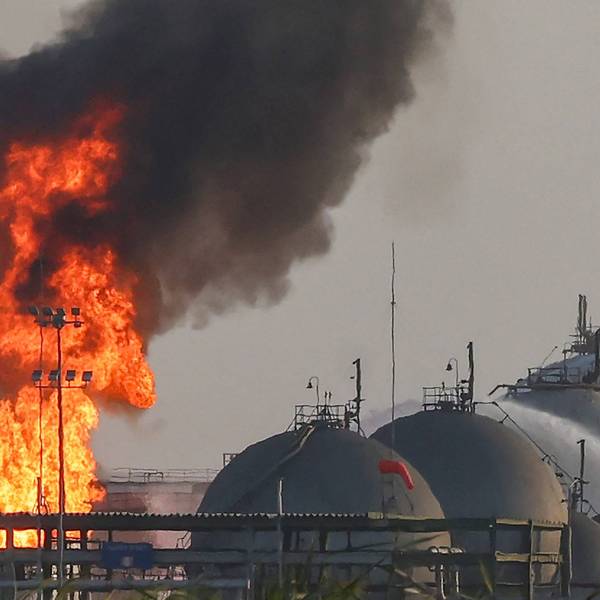
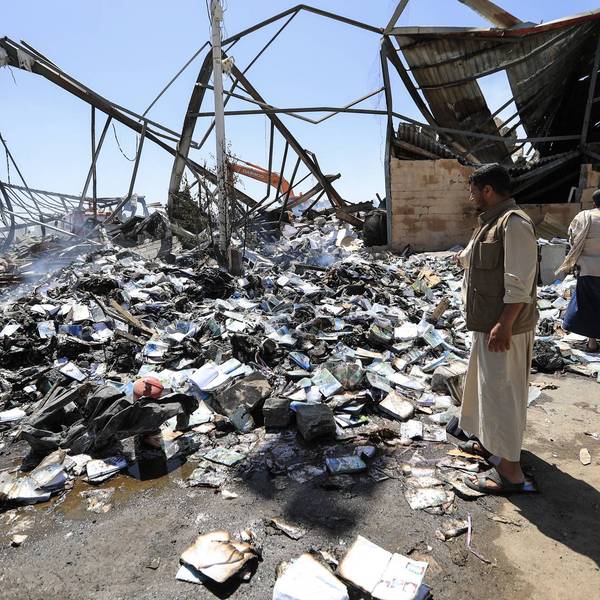

Fighters loyal to the Houthi authorities, gather during a rally to recruit more fighters, in Sanaa on September 10, 2026.
Chaos Unleashed by Trump's Iran War Escalates as Houthis Seize Key Port City in Yemen
The increased fighting is putting even more pressure on global energy markets, with the price of Brent crude topping $107 per barrel during Thursday trading.
Houthi fighters on Thursday took control of a key port city on the west coast of Yemen, putting them in a stronger position to disrupt commercial shipping—and to potentially send oil prices rocketing even higher.
According to Reuters, the Houthis seized the city of Mocha from Saudi-backed forces before moving toward the Hanish Islands, located to the northeast.
Reuters further reported that Iran's Islamic Revolutionary Guard Corps provided the Houthi fighters with weapons and guidance ahead of their successful assault.
The Houthis' seizure of more territory along the Red Sea gives the militant group a greater ability to launch attacks on vessels trying to transport oil through the Bab el-Mandeb Strait.
Petroleum exporters in the region have had to rely more heavily on the Bab el-Mandeb Strait ever since Iran shut down shipping traffic in the Strait of Hormuz in retaliation for President Donald Trump's illegal war of choice, which he launched in February without authorization from Congress.
Restricting shipments through both straits would put even greater pressure on global oil markets, which have already been under strain since the start of the Iran War.
A Thursday report from Bloomberg noted that Saudi Arabia, whose ships have been targets of Houthi attacks, revealed that its oil output has dropped to 6.24 million barrels per a day, its lowest level of oil production since 1990.
The price of Brent crude topped $107 during Thursday trading, a 6% increase from the day before. Data released Thursday by the American Automobile Association showed that the average price of gas in the US has reached $4.28 per gallon while the average price of diesel has reached a record high of $5.98 per gallon.
Fawaz Gerges, professor at the London School of Economics, said in an interview with The New York Times that the Houthis, despite receiving assistance from Iran, have their own distinct goals and see Trump's illegal war as a "golden opportunity" to make advances against Yemen's Saudi-backed government.
Additionally, said Gerges, "Iran directly and indirectly benefits from what the Houthis have been doing," since "all-out war could have major implications for the global energy supply."
Brett Erickson, managing partner at Obsidian Risk Advisors, wrote in a social media post that Iran and the Houthis have all the incentive in the world to keep the pressure on global petroleum shipping.
"Brent Crude just spiked over $107 per barrel," Erickson wrote. "Just a mere month ago, it was trading at $85. That’s a 25.9% increase in a month. And with no off-ramp for Trump until at least the midterms are over, we’re looking at a long period of elevated oil prices now."
We are at a crossroads
This country and this world are at a monumental crossroads. In a few short weeks, US voters will have an opportunity to beat back the forces of fascism and confront the billionaires who are rigging the economy, our media system, and our democracy, making it increasingly impossible for ordinary people to get by. We’re not just talking about the election. We’re talking about what must be done once these fascist elements are vanquished from power. We need a bolder set of solutions than what either major party has so far been willing to offer and a working-class movement ready to fight like hell for it. Trump didn't emerge from nowhere. The conditions that fueled MAGA authoritarianism were created by decades of radical neoliberal economic policies and a corrupt political system dominated by corporate interests. They slashed taxes on the super-rich, promising that the benefits would trickle down. They said giveaways to the corporate titans would make life more affordable for the rest of us. It was all bullshit. And when a bitter, betrayed populace searches for someone to blame, right-wing demagogues have little trouble finding scapegoats. People know when they're being lied to, but you won't hear any of this from the corporate media. Only independent journalism—powered and funded by people who believe in building a better world—can deliver truly trustworthy daily news. Our Fall Campaign is underway, and we need your help. To power our newsroom through the rest of the year, we need to raise $125,000 by midnight on October 31. So if you share our vision, please contribute whatever you can to sustain our work. |
Houthi fighters on Thursday took control of a key port city on the west coast of Yemen, putting them in a stronger position to disrupt commercial shipping—and to potentially send oil prices rocketing even higher.
According to Reuters, the Houthis seized the city of Mocha from Saudi-backed forces before moving toward the Hanish Islands, located to the northeast.
Reuters further reported that Iran's Islamic Revolutionary Guard Corps provided the Houthi fighters with weapons and guidance ahead of their successful assault.
The Houthis' seizure of more territory along the Red Sea gives the militant group a greater ability to launch attacks on vessels trying to transport oil through the Bab el-Mandeb Strait.
Petroleum exporters in the region have had to rely more heavily on the Bab el-Mandeb Strait ever since Iran shut down shipping traffic in the Strait of Hormuz in retaliation for President Donald Trump's illegal war of choice, which he launched in February without authorization from Congress.
Restricting shipments through both straits would put even greater pressure on global oil markets, which have already been under strain since the start of the Iran War.
A Thursday report from Bloomberg noted that Saudi Arabia, whose ships have been targets of Houthi attacks, revealed that its oil output has dropped to 6.24 million barrels per a day, its lowest level of oil production since 1990.
The price of Brent crude topped $107 during Thursday trading, a 6% increase from the day before. Data released Thursday by the American Automobile Association showed that the average price of gas in the US has reached $4.28 per gallon while the average price of diesel has reached a record high of $5.98 per gallon.
Fawaz Gerges, professor at the London School of Economics, said in an interview with The New York Times that the Houthis, despite receiving assistance from Iran, have their own distinct goals and see Trump's illegal war as a "golden opportunity" to make advances against Yemen's Saudi-backed government.
Additionally, said Gerges, "Iran directly and indirectly benefits from what the Houthis have been doing," since "all-out war could have major implications for the global energy supply."
Brett Erickson, managing partner at Obsidian Risk Advisors, wrote in a social media post that Iran and the Houthis have all the incentive in the world to keep the pressure on global petroleum shipping.
"Brent Crude just spiked over $107 per barrel," Erickson wrote. "Just a mere month ago, it was trading at $85. That’s a 25.9% increase in a month. And with no off-ramp for Trump until at least the midterms are over, we’re looking at a long period of elevated oil prices now."
- Trump Bombs Yemen After Houthis Revive Blockade on Israeli Ships ›
- US, UK Bomb Yemeni Capital as Part of 'Sustained' Attack on Houthis ›
- Israel Bombs Yemen Saturday in Escalation with Houthis ›
- 85,000+ Yemeni Civilians Displaced by Renewed Fighting Kicked Off by Trump's Iran War | Common Dreams ›
Houthi fighters on Thursday took control of a key port city on the west coast of Yemen, putting them in a stronger position to disrupt commercial shipping—and to potentially send oil prices rocketing even higher.
According to Reuters, the Houthis seized the city of Mocha from Saudi-backed forces before moving toward the Hanish Islands, located to the northeast.
Reuters further reported that Iran's Islamic Revolutionary Guard Corps provided the Houthi fighters with weapons and guidance ahead of their successful assault.
The Houthis' seizure of more territory along the Red Sea gives the militant group a greater ability to launch attacks on vessels trying to transport oil through the Bab el-Mandeb Strait.
Petroleum exporters in the region have had to rely more heavily on the Bab el-Mandeb Strait ever since Iran shut down shipping traffic in the Strait of Hormuz in retaliation for President Donald Trump's illegal war of choice, which he launched in February without authorization from Congress.
Restricting shipments through both straits would put even greater pressure on global oil markets, which have already been under strain since the start of the Iran War.
A Thursday report from Bloomberg noted that Saudi Arabia, whose ships have been targets of Houthi attacks, revealed that its oil output has dropped to 6.24 million barrels per a day, its lowest level of oil production since 1990.
The price of Brent crude topped $107 during Thursday trading, a 6% increase from the day before. Data released Thursday by the American Automobile Association showed that the average price of gas in the US has reached $4.28 per gallon while the average price of diesel has reached a record high of $5.98 per gallon.
Fawaz Gerges, professor at the London School of Economics, said in an interview with The New York Times that the Houthis, despite receiving assistance from Iran, have their own distinct goals and see Trump's illegal war as a "golden opportunity" to make advances against Yemen's Saudi-backed government.
Additionally, said Gerges, "Iran directly and indirectly benefits from what the Houthis have been doing," since "all-out war could have major implications for the global energy supply."
Brett Erickson, managing partner at Obsidian Risk Advisors, wrote in a social media post that Iran and the Houthis have all the incentive in the world to keep the pressure on global petroleum shipping.
"Brent Crude just spiked over $107 per barrel," Erickson wrote. "Just a mere month ago, it was trading at $85. That’s a 25.9% increase in a month. And with no off-ramp for Trump until at least the midterms are over, we’re looking at a long period of elevated oil prices now."
- Trump Bombs Yemen After Houthis Revive Blockade on Israeli Ships ›
- US, UK Bomb Yemeni Capital as Part of 'Sustained' Attack on Houthis ›
- Israel Bombs Yemen Saturday in Escalation with Houthis ›
- 85,000+ Yemeni Civilians Displaced by Renewed Fighting Kicked Off by Trump's Iran War | Common Dreams ›