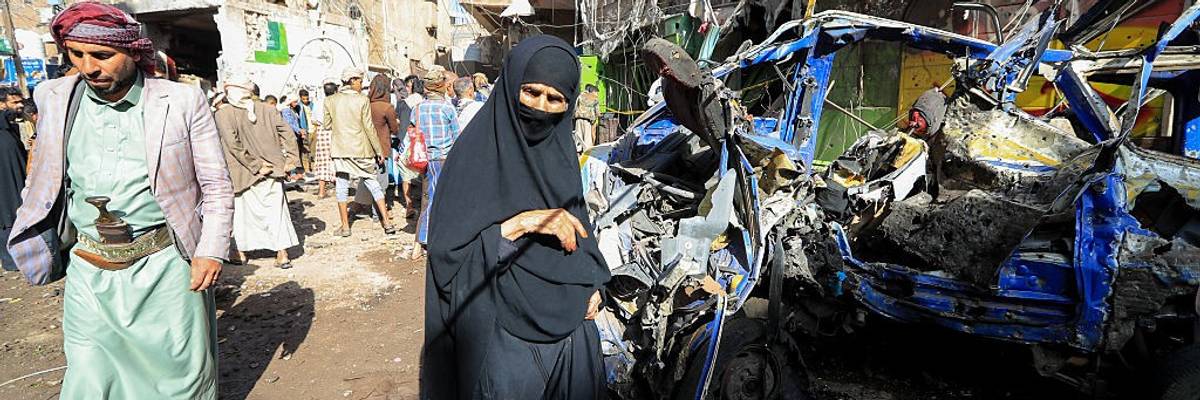
Yemenis assess the damage caused by a US airstrike on a market in the capital city of Sanaa on April 21, 2025.
Report Details 500+ Yemeni Civilian Casualties From 2023-25 US Airstrikes
"The so-called 'War on Terror' never ended in Yemen," said Costs of War Project director Stephanie Savell. "This report will allow people to hold the US government accountable for the deaths and destruction it has caused."
A report released Thursday examines the more than 500 Yemeni civilians its authors said were killed or wounded by US airstrikes in the Middle East nation during a recent 17-month period amid the open-ended so-called "War on Terror" that has left nearly one million people dead in around half a dozen nations over the past 25 years.
The report—authored by the Yemen-based group Mwatana for Human Rights and published by the Costs of War Project at Brown University's Watson Institute for International and Public Affairs—documents 46 US airstrikes that took place between December 2023 and May 2025 that caused at least 576 civilian casualties, including 213 deaths and 363 injuries. Among the casualties were at least 50 children and 25 women.
"The so-called 'War on Terror' never ended in Yemen," Costs of War Project director Stephanie Savell contended.
"It's important that we continue to account for the civilian lives lost, harmed, and disrupted in Yemen and other US war zones," she added. "This report will allow people to hold the US government accountable for the deaths and destruction it has caused in Yemen in support of the Israeli government's wars since 2023."
The overwhelming majority of the casualties covered by the publication occurred during President Donald Trump’s 2025 "Operation Rough Rider" campaign. Mwatana estimates that the operation killed 208 civilians and wounded 341, while the Pentagon has acknowledged a smaller toll of 153 killed and 243 wounded.
Seven of the 46 strikes took place between December of 2023 and January of 2025 during former President Joe Biden's "Operation Prosperity Guardian," a military campaign that came amid Houthi rebel attacks on shipping lanes in the Red Sea and the Bab al-Mandab Strait during Israel's genocidal war on Gaza.
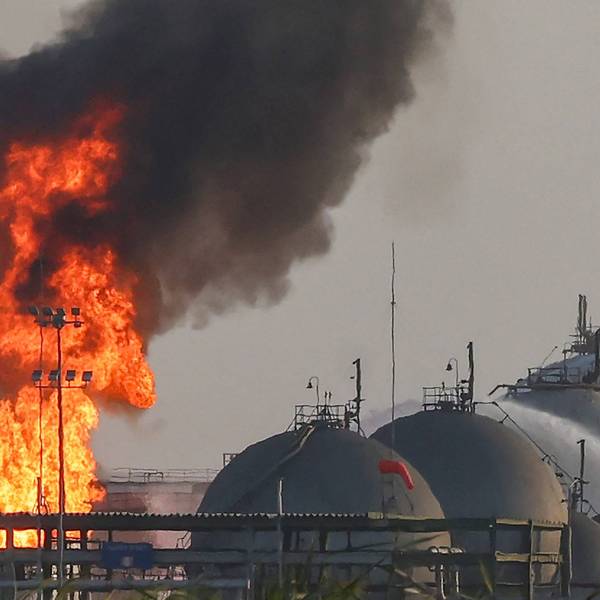
Among the deadliest attacks covered by the report was the April 2025 bombardment of Ras Isa oil port ordered by Trump, in which US strikes killed scores of people and wounded more than 150 others. Human Rights Watch called the bombing an “apparent war crime,” saying the destruction of the civilian oil facility also threatened vital fuel supplies in a country already devastated by years of war and humanitarian crisis.
The campaign also included the April 28 bombing of a detention center in Saada while jailed African migrants were sleeping. Amnesty International has called for a war crimes investigation into that attack, in which scores of migrants were killed.
Mwatana researchers conducted site visits and 59 interviews with survivors, relatives, eyewitnesses, first responders, and other sources for the new report.
"The first strike hit while we were in deep sleep. I could not believe what I saw—30 of my fellow detainees died; their bodies were charred, and the smell of burned flesh filled the air," one 25-year-old Ethiopian survivor of the Saada attack recounted. "The place was crowded with bodies, while others were screaming and calling for help and rescue... we could do nothing for them."
In addition to physical harm, survivors described the deep psychological trauma suffered by victims. One mother said her 8-year-old son Taha "saw his father after he was hit by shrapnel—how he was bleeding, and how his intestines were coming out."
"His father was screaming: ‘Run… leave me and run before the American aircraft strikes again and finishes me off,'" she continued. "Taha still cannot sleep; when he does, he wakes up terrified. Whenever he hears thunder or any loud noise, he runs in fear, his whole body trembling."
Overall, US strikes covered by the report "hit civilian structures such as homes, shops, farms, residential neighborhoods, and infrastructure," the publication notes, adding that airstrikes "also caused severe damage to infrastructure and critical facilities, compounding the humanitarian suffering of local populations by striking essential service facilities, particularly in rural areas that already face acute shortages of clean water, electricity, and health services."
"Given Yemen’s economic deterioration and the catastrophic humanitarian situation produced by the armed conflict that has been ongoing since September 2014, it is likely that the US strikes expanded the cycle of poverty in Yemen by increasing unemployment and multiplying the number of households that lost breadwinners and sources of income," the report adds.
Hundreds of thousands of Yemenis have died during the civil war that began in 2014, with international experts attributing more than 150,000 Yemeni deaths to a US-backed, Saudi-led bombing campaign and blockade. According to the UK-based casualty monitor Airwars, an estimated 445-643 Yemeni civilians have been killed by US forces during the George W. Bush, Obama, Trump, and Biden administrations.
The Costs of War Project says that in the first two decades following the September 11, 2001 attacks on the United States, "between 363,939 and 387,072 civilians were killed by multiple warring parties in post-9/11 war zones, including 12,690 civilians in Yemen."
Mwatana for Human Rights chair Radhya Al-Mutawakel said Thursday that "the losses caused by US airstrikes against civilians cannot be regarded as temporary harm that ends when military operations cease. Civilians who have lost loved ones, homes, or sources of income continue to bear the consequences of these attacks, amid economic and humanitarian conditions that do not provide them with even the minimum capacity to recover.”
"Protecting civilians is not limited to avoiding killing or injuring them; it also includes respecting civilian objects and livelihoods," Al-Mutawakel added. "The United States must assume its legal and moral responsibility to recognize the civilian victims of its military operations in Yemen, provide them with redress and reparation, and hold accountable those responsible for the violations inflicted upon them.”
We are at a crossroads
This country and this world are at a monumental crossroads. In a few short weeks, US voters will have an opportunity to beat back the forces of fascism and confront the billionaires who are rigging the economy, our media system, and our democracy, making it increasingly impossible for ordinary people to get by. We’re not just talking about the election. We’re talking about what must be done once these fascist elements are vanquished from power. We need a bolder set of solutions than what either major party has so far been willing to offer and a working-class movement ready to fight like hell for it. Trump didn't emerge from nowhere. The conditions that fueled MAGA authoritarianism were created by decades of radical neoliberal economic policies and a corrupt political system dominated by corporate interests. They slashed taxes on the super-rich, promising that the benefits would trickle down. They said giveaways to the corporate titans would make life more affordable for the rest of us. It was all bullshit. And when a bitter, betrayed populace searches for someone to blame, right-wing demagogues have little trouble finding scapegoats. People know when they're being lied to, but you won't hear any of this from the corporate media. Only independent journalism—powered and funded by people who believe in building a better world—can deliver truly trustworthy daily news. Our Fall Campaign is underway, and we need your help. To power our newsroom through the rest of the year, we need to raise $125,000 by midnight on October 31. So if you share our vision, please contribute whatever you can to sustain our work. |
A report released Thursday examines the more than 500 Yemeni civilians its authors said were killed or wounded by US airstrikes in the Middle East nation during a recent 17-month period amid the open-ended so-called "War on Terror" that has left nearly one million people dead in around half a dozen nations over the past 25 years.
The report—authored by the Yemen-based group Mwatana for Human Rights and published by the Costs of War Project at Brown University's Watson Institute for International and Public Affairs—documents 46 US airstrikes that took place between December 2023 and May 2025 that caused at least 576 civilian casualties, including 213 deaths and 363 injuries. Among the casualties were at least 50 children and 25 women.
"The so-called 'War on Terror' never ended in Yemen," Costs of War Project director Stephanie Savell contended.
"It's important that we continue to account for the civilian lives lost, harmed, and disrupted in Yemen and other US war zones," she added. "This report will allow people to hold the US government accountable for the deaths and destruction it has caused in Yemen in support of the Israeli government's wars since 2023."
The overwhelming majority of the casualties covered by the publication occurred during President Donald Trump’s 2025 "Operation Rough Rider" campaign. Mwatana estimates that the operation killed 208 civilians and wounded 341, while the Pentagon has acknowledged a smaller toll of 153 killed and 243 wounded.
Seven of the 46 strikes took place between December of 2023 and January of 2025 during former President Joe Biden's "Operation Prosperity Guardian," a military campaign that came amid Houthi rebel attacks on shipping lanes in the Red Sea and the Bab al-Mandab Strait during Israel's genocidal war on Gaza.
Among the deadliest attacks covered by the report was the April 2025 bombardment of Ras Isa oil port ordered by Trump, in which US strikes killed scores of people and wounded more than 150 others. Human Rights Watch called the bombing an “apparent war crime,” saying the destruction of the civilian oil facility also threatened vital fuel supplies in a country already devastated by years of war and humanitarian crisis.
The campaign also included the April 28 bombing of a detention center in Saada while jailed African migrants were sleeping. Amnesty International has called for a war crimes investigation into that attack, in which scores of migrants were killed.
Mwatana researchers conducted site visits and 59 interviews with survivors, relatives, eyewitnesses, first responders, and other sources for the new report.
"The first strike hit while we were in deep sleep. I could not believe what I saw—30 of my fellow detainees died; their bodies were charred, and the smell of burned flesh filled the air," one 25-year-old Ethiopian survivor of the Saada attack recounted. "The place was crowded with bodies, while others were screaming and calling for help and rescue... we could do nothing for them."
In addition to physical harm, survivors described the deep psychological trauma suffered by victims. One mother said her 8-year-old son Taha "saw his father after he was hit by shrapnel—how he was bleeding, and how his intestines were coming out."
"His father was screaming: ‘Run… leave me and run before the American aircraft strikes again and finishes me off,'" she continued. "Taha still cannot sleep; when he does, he wakes up terrified. Whenever he hears thunder or any loud noise, he runs in fear, his whole body trembling."
Overall, US strikes covered by the report "hit civilian structures such as homes, shops, farms, residential neighborhoods, and infrastructure," the publication notes, adding that airstrikes "also caused severe damage to infrastructure and critical facilities, compounding the humanitarian suffering of local populations by striking essential service facilities, particularly in rural areas that already face acute shortages of clean water, electricity, and health services."
"Given Yemen’s economic deterioration and the catastrophic humanitarian situation produced by the armed conflict that has been ongoing since September 2014, it is likely that the US strikes expanded the cycle of poverty in Yemen by increasing unemployment and multiplying the number of households that lost breadwinners and sources of income," the report adds.
Hundreds of thousands of Yemenis have died during the civil war that began in 2014, with international experts attributing more than 150,000 Yemeni deaths to a US-backed, Saudi-led bombing campaign and blockade. According to the UK-based casualty monitor Airwars, an estimated 445-643 Yemeni civilians have been killed by US forces during the George W. Bush, Obama, Trump, and Biden administrations.
The Costs of War Project says that in the first two decades following the September 11, 2001 attacks on the United States, "between 363,939 and 387,072 civilians were killed by multiple warring parties in post-9/11 war zones, including 12,690 civilians in Yemen."
Mwatana for Human Rights chair Radhya Al-Mutawakel said Thursday that "the losses caused by US airstrikes against civilians cannot be regarded as temporary harm that ends when military operations cease. Civilians who have lost loved ones, homes, or sources of income continue to bear the consequences of these attacks, amid economic and humanitarian conditions that do not provide them with even the minimum capacity to recover.”
"Protecting civilians is not limited to avoiding killing or injuring them; it also includes respecting civilian objects and livelihoods," Al-Mutawakel added. "The United States must assume its legal and moral responsibility to recognize the civilian victims of its military operations in Yemen, provide them with redress and reparation, and hold accountable those responsible for the violations inflicted upon them.”
- Yemen's Health Ministry Says Majority of 53 Killed in US Strikes 'Were Women and Children' ›
- Scores of Civilians Reportedly Among Victims of Latest US Airstrikes on Yemen ›
- After Months of Denials, Pentagon Says US Killed and Wounded Hundreds of Civilians in 2025 Yemen Airstrikes ›
- US Strikes on Yemen Oil Port That Killed 84 Civilians Called 'Apparent War Crime' ›
- Opinion | 9/11 Began a US Reign of Terror in the Middle East—Now It's Come Home | Common Dreams ›
A report released Thursday examines the more than 500 Yemeni civilians its authors said were killed or wounded by US airstrikes in the Middle East nation during a recent 17-month period amid the open-ended so-called "War on Terror" that has left nearly one million people dead in around half a dozen nations over the past 25 years.
The report—authored by the Yemen-based group Mwatana for Human Rights and published by the Costs of War Project at Brown University's Watson Institute for International and Public Affairs—documents 46 US airstrikes that took place between December 2023 and May 2025 that caused at least 576 civilian casualties, including 213 deaths and 363 injuries. Among the casualties were at least 50 children and 25 women.
"The so-called 'War on Terror' never ended in Yemen," Costs of War Project director Stephanie Savell contended.
"It's important that we continue to account for the civilian lives lost, harmed, and disrupted in Yemen and other US war zones," she added. "This report will allow people to hold the US government accountable for the deaths and destruction it has caused in Yemen in support of the Israeli government's wars since 2023."
The overwhelming majority of the casualties covered by the publication occurred during President Donald Trump’s 2025 "Operation Rough Rider" campaign. Mwatana estimates that the operation killed 208 civilians and wounded 341, while the Pentagon has acknowledged a smaller toll of 153 killed and 243 wounded.
Seven of the 46 strikes took place between December of 2023 and January of 2025 during former President Joe Biden's "Operation Prosperity Guardian," a military campaign that came amid Houthi rebel attacks on shipping lanes in the Red Sea and the Bab al-Mandab Strait during Israel's genocidal war on Gaza.
Among the deadliest attacks covered by the report was the April 2025 bombardment of Ras Isa oil port ordered by Trump, in which US strikes killed scores of people and wounded more than 150 others. Human Rights Watch called the bombing an “apparent war crime,” saying the destruction of the civilian oil facility also threatened vital fuel supplies in a country already devastated by years of war and humanitarian crisis.
The campaign also included the April 28 bombing of a detention center in Saada while jailed African migrants were sleeping. Amnesty International has called for a war crimes investigation into that attack, in which scores of migrants were killed.
Mwatana researchers conducted site visits and 59 interviews with survivors, relatives, eyewitnesses, first responders, and other sources for the new report.
"The first strike hit while we were in deep sleep. I could not believe what I saw—30 of my fellow detainees died; their bodies were charred, and the smell of burned flesh filled the air," one 25-year-old Ethiopian survivor of the Saada attack recounted. "The place was crowded with bodies, while others were screaming and calling for help and rescue... we could do nothing for them."
In addition to physical harm, survivors described the deep psychological trauma suffered by victims. One mother said her 8-year-old son Taha "saw his father after he was hit by shrapnel—how he was bleeding, and how his intestines were coming out."
"His father was screaming: ‘Run… leave me and run before the American aircraft strikes again and finishes me off,'" she continued. "Taha still cannot sleep; when he does, he wakes up terrified. Whenever he hears thunder or any loud noise, he runs in fear, his whole body trembling."
Overall, US strikes covered by the report "hit civilian structures such as homes, shops, farms, residential neighborhoods, and infrastructure," the publication notes, adding that airstrikes "also caused severe damage to infrastructure and critical facilities, compounding the humanitarian suffering of local populations by striking essential service facilities, particularly in rural areas that already face acute shortages of clean water, electricity, and health services."
"Given Yemen’s economic deterioration and the catastrophic humanitarian situation produced by the armed conflict that has been ongoing since September 2014, it is likely that the US strikes expanded the cycle of poverty in Yemen by increasing unemployment and multiplying the number of households that lost breadwinners and sources of income," the report adds.
Hundreds of thousands of Yemenis have died during the civil war that began in 2014, with international experts attributing more than 150,000 Yemeni deaths to a US-backed, Saudi-led bombing campaign and blockade. According to the UK-based casualty monitor Airwars, an estimated 445-643 Yemeni civilians have been killed by US forces during the George W. Bush, Obama, Trump, and Biden administrations.
The Costs of War Project says that in the first two decades following the September 11, 2001 attacks on the United States, "between 363,939 and 387,072 civilians were killed by multiple warring parties in post-9/11 war zones, including 12,690 civilians in Yemen."
Mwatana for Human Rights chair Radhya Al-Mutawakel said Thursday that "the losses caused by US airstrikes against civilians cannot be regarded as temporary harm that ends when military operations cease. Civilians who have lost loved ones, homes, or sources of income continue to bear the consequences of these attacks, amid economic and humanitarian conditions that do not provide them with even the minimum capacity to recover.”
"Protecting civilians is not limited to avoiding killing or injuring them; it also includes respecting civilian objects and livelihoods," Al-Mutawakel added. "The United States must assume its legal and moral responsibility to recognize the civilian victims of its military operations in Yemen, provide them with redress and reparation, and hold accountable those responsible for the violations inflicted upon them.”
- Yemen's Health Ministry Says Majority of 53 Killed in US Strikes 'Were Women and Children' ›
- Scores of Civilians Reportedly Among Victims of Latest US Airstrikes on Yemen ›
- After Months of Denials, Pentagon Says US Killed and Wounded Hundreds of Civilians in 2025 Yemen Airstrikes ›
- US Strikes on Yemen Oil Port That Killed 84 Civilians Called 'Apparent War Crime' ›
- Opinion | 9/11 Began a US Reign of Terror in the Middle East—Now It's Come Home | Common Dreams ›