SUBSCRIBE TO OUR FREE NEWSLETTER
Daily news & progressive opinion—funded by the people, not the corporations—delivered straight to your inbox.
5
#000000
#FFFFFF
To donate by check, phone, or other method, see our More Ways to Give page.
Daily news & progressive opinion—funded by the people, not the corporations—delivered straight to your inbox.
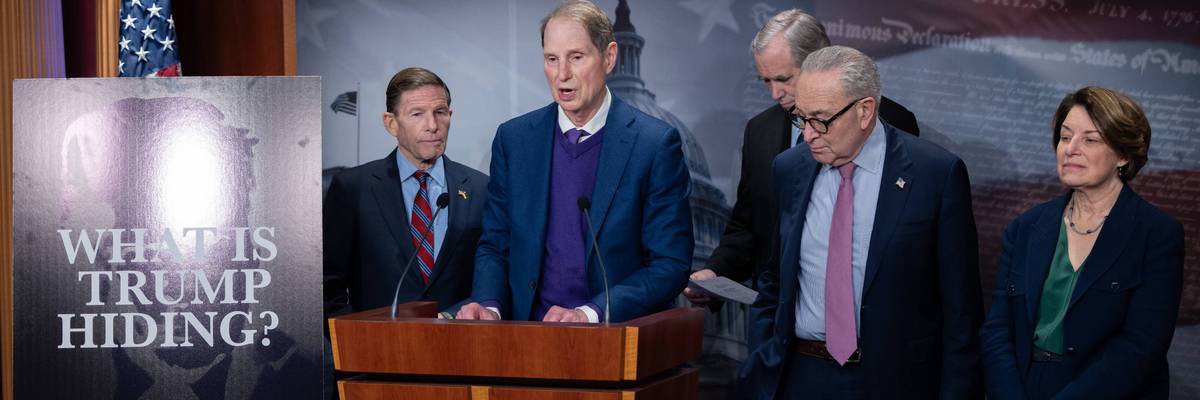
US Sen. Ron Wyden (D-Ore.) speaks at a December 16, 2025 press conference with other Senate Democrats about the release of the Epstein files, on Capitol Hill in Washington, DC.
“This report is a ready-made roadmap for prosecutors, investigators, and members of Congress to finally start holding the Epstein class accountable," said Sen. Ron Wyden.
A yearslong Senate investigation released on Tuesday revealed how some of the world's largest banks allegedly broke federal money laundering laws by failing to stop or promptly report financial transactions that allegedly helped sustain the sex trafficking of children and young women by Jeffrey Epstein, the late billionaire and former friend of President Donald Trump.
Released by Senate Finance Committee Ranking Member Ron Wyden (D-Ore.), "Looking the Other Way" examines "how years of complicity by top officials at multiple Wall Street Banks enabled Jeffrey Epstein to transfer hundreds of millions of dollars around the world to finance his sex trafficking operation."
"Major compliance failures at several Wall Street banks enabled Epstein for years," the publication states. "By failing to report—or choosing not to report—his suspicious financial transactions to federal law enforcement, these banks allowed Epstein to send cash payments and wire transfers to his victims, friends, and collaborators around the world. The bankers who needed to be asking questions didn’t ask them. Jeffrey Epstein’s crimes were hiding in plain sight."
"The investigation found significant evidence that JPMorgan Chase (JPMC), Deutsche Bank, and Bank of America violated federal anti-money laundering laws by failing to screen and report Epstein’s suspicious financial transactions in a timely manner," the report continues.
"A review by Sen. Wyden’s staff of records housed at the US Department of the Treasury as well as internal bank records determined that top executives at major Wall Street banks were aware of Epstein’s suspicious financial activity for years but withheld information from the US government and protected Epstein from federal scrutiny," the publication says.
According to the report:
Wall Street banks looked the other way as Epstein withdrew millions of dollars in cash with no clear business purpose and was party to thousands of suspicious wire transfers worth more than $1 billion. These banks failed to conduct appropriate due diligence on more than $170 million in payments to Epstein from billionaire Leon Black. In fact, documents reviewed during this investigation demonstrate that JPMC’s senior leadership repeatedly protected Epstein as a client despite repeated warnings from internal compliance personnel.
The documents also show that even after JPMC formally terminated Epstein as a client due to human trafficking concerns, the bank still waited years to report his activity to regulators, and top bankers eagerly continued to work with him informally and through other channels where he could continue to be a source of referrals for other ultrawealthy clients.
The three banks were among four financial institutions from which House Judiciary Committee Ranking Member Jamie Raskin (D-Md.) last year demanded records concerning over $1.5 billion in “suspicious” financial transactions tied to Epstein’s trafficking ring.
“I said from the start that if you want to get to the bottom of the Jeffery Epstein cover-up, you had to follow the money," Wyden said Tuesday in a statement announcing the report's publication.
"My small team of investigators did what Trump’s attorney general and treasury secretary said was impossible: They connected the dots and found evidence of multiple crimes related to Epstein’s associates," the senator continued. "Bank records they reviewed, along with public court filings, detail a shocking pattern of the biggest Wall Street banks in the country choosing to ignore clear evidence of sex trafficking and money laundering, just to keep a wealthy client on the books."
"This report is a ready-made roadmap for prosecutors, investigators, and members of Congress to finally start holding the Epstein class accountable," Wyden added.
That's highly unlikely to happen under the current Republican-controlled Congress. Republicans spent years insisting the Epstein case exposed elite corruption, promising full transparency, and rallying behind Trump's 2024 reelection bid in part because he vowed to release every file.
Trump, former Attorney General Pam Bondi, FBI Director Kash Patel, and others promised transparency. Instead, the Trump administration has missed legal deadlines, released heavily redacted records, and withheld millions of pages in what critics say are violations of the bipartisan Epstein Files Transparency Act. Signed by the president last year, the law compelled the Department of Justice (DOJ) to publish all unclassified Epstein-related records within 30 days and explain every omission to Congress.
Acting US Attorney General Todd Blanche, Trump's former personal attorney, angered many Epstein victims and others by announcing that there was no evidence of a secret client list, by falsely claiming that the DOJ was fully complying with the law, and by meeting with Epstein’s co-conspirator Ghislaine Maxwell in prison shortly before she was suspiciously transferred to a lower-security prison.
The Senate Judiciary Committee voted 12–10 Tuesday along party lines to advance Blanche's nomination to become permanent attorney general, sending it to the full upper chamber for a confirmation vote expected later this week.
As the Trump administration fails to fully comply with the Epstein Files Transparency Act, its authors—Reps. Ro Khanna (D-Calif.) and Thomas Massie (R-Ky.)—recently proposed an updated version of the legislation, which strengthens the original by allowing state attorneys general, Epstein victims, members of Congress, and certain prosecutors to sue the DOJ if it fails to release required records.
The business-focused news site Bloomberg sought comment from the three banks. Deutsche Bank declined to respond, JPMC said it began notifying regulators “after the full scope of [Epstein's] crimes became public in 2019," and a spokesperson for Bank of America said that "we take our legal and regulatory responsibilities seriously and, as we have previously said, the bank did not facilitate wrongdoing.”
An attorney for Black told Bloomberg that the report's assertions “outrageous and false.”
Wyden's report came on the same day that The New Republic's Ellie Quinlan Houghtaling revealed that CBS' "60 Minutes" killed its own scoop on Wall Street's long-standing financial ties to Epstein after the network's incoming Trump-aligned boss, Bari Weiss, fired correspondent Sharyn Alfonsi, who led the investigative report. Alfonsi had interviewed Wyden for the segment.
Yep. Earlier this year I was interviewed by Sharyn Alfonsi of 60 Minutes about my Epstein investigation. Subsequently, CBS pulled the segment and fired the reporter. The MAGA buyout of media is aiding the Trump administration’s Epstein cover up.
[image or embed]
— Senator Ron Wyden (@wyden.senate.gov) August 4, 2026 at 7:17 AM
"Yep," Wyden said on Bluesky, confirming his interview with Alfonsi. "The MAGA buyout of media is aiding the Trump administration’s Epstein cover-up."
Dear Common Dreams reader, It’s been nearly 30 years since I co-founded Common Dreams with my late wife, Lina Newhouser. We had the radical notion that journalism should serve the public good, not corporate profits. It was clear to us from the outset what it would take to build such a project. No paid advertisements. No corporate sponsors. No millionaire publisher telling us what to think or do. Many people said we wouldn't last a year, but we proved those doubters wrong. Together with a tremendous team of journalists and dedicated staff, we built an independent media outlet free from the constraints of profits and corporate control. Our mission has always been simple: To inform. To inspire. To ignite change for the common good. Building Common Dreams was not easy. Our survival was never guaranteed. When you take on the most powerful forces—Wall Street greed, fossil fuel industry destruction, Big Tech lobbyists, and uber-rich oligarchs who have spent billions upon billions rigging the economy and democracy in their favor—the only bulwark you have is supporters who believe in your work. But here’s the urgent message from me today. It's never been this bad out there. And it's never been this hard to keep us going. At the very moment Common Dreams is most needed, the threats we face are intensifying. We need your support now more than ever. We don't accept corporate advertising and never will. We don't have a paywall because we don't think people should be blocked from critical news based on their ability to pay. Everything we do is funded by the donations of readers like you. When everyone does the little they can afford, we are strong. But if that support retreats or dries up, so do we. Will you donate now to make sure Common Dreams not only survives but thrives? —Craig Brown, Co-founder |
A yearslong Senate investigation released on Tuesday revealed how some of the world's largest banks allegedly broke federal money laundering laws by failing to stop or promptly report financial transactions that allegedly helped sustain the sex trafficking of children and young women by Jeffrey Epstein, the late billionaire and former friend of President Donald Trump.
Released by Senate Finance Committee Ranking Member Ron Wyden (D-Ore.), "Looking the Other Way" examines "how years of complicity by top officials at multiple Wall Street Banks enabled Jeffrey Epstein to transfer hundreds of millions of dollars around the world to finance his sex trafficking operation."
"Major compliance failures at several Wall Street banks enabled Epstein for years," the publication states. "By failing to report—or choosing not to report—his suspicious financial transactions to federal law enforcement, these banks allowed Epstein to send cash payments and wire transfers to his victims, friends, and collaborators around the world. The bankers who needed to be asking questions didn’t ask them. Jeffrey Epstein’s crimes were hiding in plain sight."
"The investigation found significant evidence that JPMorgan Chase (JPMC), Deutsche Bank, and Bank of America violated federal anti-money laundering laws by failing to screen and report Epstein’s suspicious financial transactions in a timely manner," the report continues.
"A review by Sen. Wyden’s staff of records housed at the US Department of the Treasury as well as internal bank records determined that top executives at major Wall Street banks were aware of Epstein’s suspicious financial activity for years but withheld information from the US government and protected Epstein from federal scrutiny," the publication says.
According to the report:
Wall Street banks looked the other way as Epstein withdrew millions of dollars in cash with no clear business purpose and was party to thousands of suspicious wire transfers worth more than $1 billion. These banks failed to conduct appropriate due diligence on more than $170 million in payments to Epstein from billionaire Leon Black. In fact, documents reviewed during this investigation demonstrate that JPMC’s senior leadership repeatedly protected Epstein as a client despite repeated warnings from internal compliance personnel.
The documents also show that even after JPMC formally terminated Epstein as a client due to human trafficking concerns, the bank still waited years to report his activity to regulators, and top bankers eagerly continued to work with him informally and through other channels where he could continue to be a source of referrals for other ultrawealthy clients.
The three banks were among four financial institutions from which House Judiciary Committee Ranking Member Jamie Raskin (D-Md.) last year demanded records concerning over $1.5 billion in “suspicious” financial transactions tied to Epstein’s trafficking ring.
“I said from the start that if you want to get to the bottom of the Jeffery Epstein cover-up, you had to follow the money," Wyden said Tuesday in a statement announcing the report's publication.
"My small team of investigators did what Trump’s attorney general and treasury secretary said was impossible: They connected the dots and found evidence of multiple crimes related to Epstein’s associates," the senator continued. "Bank records they reviewed, along with public court filings, detail a shocking pattern of the biggest Wall Street banks in the country choosing to ignore clear evidence of sex trafficking and money laundering, just to keep a wealthy client on the books."
"This report is a ready-made roadmap for prosecutors, investigators, and members of Congress to finally start holding the Epstein class accountable," Wyden added.
That's highly unlikely to happen under the current Republican-controlled Congress. Republicans spent years insisting the Epstein case exposed elite corruption, promising full transparency, and rallying behind Trump's 2024 reelection bid in part because he vowed to release every file.
Trump, former Attorney General Pam Bondi, FBI Director Kash Patel, and others promised transparency. Instead, the Trump administration has missed legal deadlines, released heavily redacted records, and withheld millions of pages in what critics say are violations of the bipartisan Epstein Files Transparency Act. Signed by the president last year, the law compelled the Department of Justice (DOJ) to publish all unclassified Epstein-related records within 30 days and explain every omission to Congress.
Acting US Attorney General Todd Blanche, Trump's former personal attorney, angered many Epstein victims and others by announcing that there was no evidence of a secret client list, by falsely claiming that the DOJ was fully complying with the law, and by meeting with Epstein’s co-conspirator Ghislaine Maxwell in prison shortly before she was suspiciously transferred to a lower-security prison.
The Senate Judiciary Committee voted 12–10 Tuesday along party lines to advance Blanche's nomination to become permanent attorney general, sending it to the full upper chamber for a confirmation vote expected later this week.
As the Trump administration fails to fully comply with the Epstein Files Transparency Act, its authors—Reps. Ro Khanna (D-Calif.) and Thomas Massie (R-Ky.)—recently proposed an updated version of the legislation, which strengthens the original by allowing state attorneys general, Epstein victims, members of Congress, and certain prosecutors to sue the DOJ if it fails to release required records.
The business-focused news site Bloomberg sought comment from the three banks. Deutsche Bank declined to respond, JPMC said it began notifying regulators “after the full scope of [Epstein's] crimes became public in 2019," and a spokesperson for Bank of America said that "we take our legal and regulatory responsibilities seriously and, as we have previously said, the bank did not facilitate wrongdoing.”
An attorney for Black told Bloomberg that the report's assertions “outrageous and false.”
Wyden's report came on the same day that The New Republic's Ellie Quinlan Houghtaling revealed that CBS' "60 Minutes" killed its own scoop on Wall Street's long-standing financial ties to Epstein after the network's incoming Trump-aligned boss, Bari Weiss, fired correspondent Sharyn Alfonsi, who led the investigative report. Alfonsi had interviewed Wyden for the segment.
Yep. Earlier this year I was interviewed by Sharyn Alfonsi of 60 Minutes about my Epstein investigation. Subsequently, CBS pulled the segment and fired the reporter. The MAGA buyout of media is aiding the Trump administration’s Epstein cover up.
[image or embed]
— Senator Ron Wyden (@wyden.senate.gov) August 4, 2026 at 7:17 AM
"Yep," Wyden said on Bluesky, confirming his interview with Alfonsi. "The MAGA buyout of media is aiding the Trump administration’s Epstein cover-up."
A yearslong Senate investigation released on Tuesday revealed how some of the world's largest banks allegedly broke federal money laundering laws by failing to stop or promptly report financial transactions that allegedly helped sustain the sex trafficking of children and young women by Jeffrey Epstein, the late billionaire and former friend of President Donald Trump.
Released by Senate Finance Committee Ranking Member Ron Wyden (D-Ore.), "Looking the Other Way" examines "how years of complicity by top officials at multiple Wall Street Banks enabled Jeffrey Epstein to transfer hundreds of millions of dollars around the world to finance his sex trafficking operation."
"Major compliance failures at several Wall Street banks enabled Epstein for years," the publication states. "By failing to report—or choosing not to report—his suspicious financial transactions to federal law enforcement, these banks allowed Epstein to send cash payments and wire transfers to his victims, friends, and collaborators around the world. The bankers who needed to be asking questions didn’t ask them. Jeffrey Epstein’s crimes were hiding in plain sight."
"The investigation found significant evidence that JPMorgan Chase (JPMC), Deutsche Bank, and Bank of America violated federal anti-money laundering laws by failing to screen and report Epstein’s suspicious financial transactions in a timely manner," the report continues.
"A review by Sen. Wyden’s staff of records housed at the US Department of the Treasury as well as internal bank records determined that top executives at major Wall Street banks were aware of Epstein’s suspicious financial activity for years but withheld information from the US government and protected Epstein from federal scrutiny," the publication says.
According to the report:
Wall Street banks looked the other way as Epstein withdrew millions of dollars in cash with no clear business purpose and was party to thousands of suspicious wire transfers worth more than $1 billion. These banks failed to conduct appropriate due diligence on more than $170 million in payments to Epstein from billionaire Leon Black. In fact, documents reviewed during this investigation demonstrate that JPMC’s senior leadership repeatedly protected Epstein as a client despite repeated warnings from internal compliance personnel.
The documents also show that even after JPMC formally terminated Epstein as a client due to human trafficking concerns, the bank still waited years to report his activity to regulators, and top bankers eagerly continued to work with him informally and through other channels where he could continue to be a source of referrals for other ultrawealthy clients.
The three banks were among four financial institutions from which House Judiciary Committee Ranking Member Jamie Raskin (D-Md.) last year demanded records concerning over $1.5 billion in “suspicious” financial transactions tied to Epstein’s trafficking ring.
“I said from the start that if you want to get to the bottom of the Jeffery Epstein cover-up, you had to follow the money," Wyden said Tuesday in a statement announcing the report's publication.
"My small team of investigators did what Trump’s attorney general and treasury secretary said was impossible: They connected the dots and found evidence of multiple crimes related to Epstein’s associates," the senator continued. "Bank records they reviewed, along with public court filings, detail a shocking pattern of the biggest Wall Street banks in the country choosing to ignore clear evidence of sex trafficking and money laundering, just to keep a wealthy client on the books."
"This report is a ready-made roadmap for prosecutors, investigators, and members of Congress to finally start holding the Epstein class accountable," Wyden added.
That's highly unlikely to happen under the current Republican-controlled Congress. Republicans spent years insisting the Epstein case exposed elite corruption, promising full transparency, and rallying behind Trump's 2024 reelection bid in part because he vowed to release every file.
Trump, former Attorney General Pam Bondi, FBI Director Kash Patel, and others promised transparency. Instead, the Trump administration has missed legal deadlines, released heavily redacted records, and withheld millions of pages in what critics say are violations of the bipartisan Epstein Files Transparency Act. Signed by the president last year, the law compelled the Department of Justice (DOJ) to publish all unclassified Epstein-related records within 30 days and explain every omission to Congress.
Acting US Attorney General Todd Blanche, Trump's former personal attorney, angered many Epstein victims and others by announcing that there was no evidence of a secret client list, by falsely claiming that the DOJ was fully complying with the law, and by meeting with Epstein’s co-conspirator Ghislaine Maxwell in prison shortly before she was suspiciously transferred to a lower-security prison.
The Senate Judiciary Committee voted 12–10 Tuesday along party lines to advance Blanche's nomination to become permanent attorney general, sending it to the full upper chamber for a confirmation vote expected later this week.
As the Trump administration fails to fully comply with the Epstein Files Transparency Act, its authors—Reps. Ro Khanna (D-Calif.) and Thomas Massie (R-Ky.)—recently proposed an updated version of the legislation, which strengthens the original by allowing state attorneys general, Epstein victims, members of Congress, and certain prosecutors to sue the DOJ if it fails to release required records.
The business-focused news site Bloomberg sought comment from the three banks. Deutsche Bank declined to respond, JPMC said it began notifying regulators “after the full scope of [Epstein's] crimes became public in 2019," and a spokesperson for Bank of America said that "we take our legal and regulatory responsibilities seriously and, as we have previously said, the bank did not facilitate wrongdoing.”
An attorney for Black told Bloomberg that the report's assertions “outrageous and false.”
Wyden's report came on the same day that The New Republic's Ellie Quinlan Houghtaling revealed that CBS' "60 Minutes" killed its own scoop on Wall Street's long-standing financial ties to Epstein after the network's incoming Trump-aligned boss, Bari Weiss, fired correspondent Sharyn Alfonsi, who led the investigative report. Alfonsi had interviewed Wyden for the segment.
Yep. Earlier this year I was interviewed by Sharyn Alfonsi of 60 Minutes about my Epstein investigation. Subsequently, CBS pulled the segment and fired the reporter. The MAGA buyout of media is aiding the Trump administration’s Epstein cover up.
[image or embed]
— Senator Ron Wyden (@wyden.senate.gov) August 4, 2026 at 7:17 AM
"Yep," Wyden said on Bluesky, confirming his interview with Alfonsi. "The MAGA buyout of media is aiding the Trump administration’s Epstein cover-up."