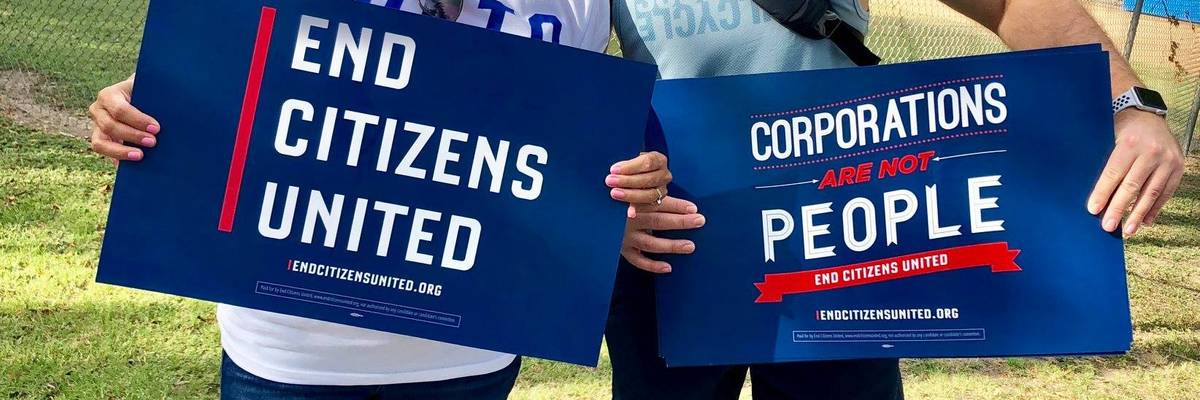
People hold signs rejecting corporate personhood and calling for the overturn of the U.S. Supreme Court's Citizens United v. Federal Election Commission ruling in Brownsville, Texas on August 21, 2018.
Criminal Corporations Are Not People, But Trump Just Pardoned One Anyway
"If you're a corporation in a favored industry, you can break the law. You can get caught. You can be prosecuted and sentenced with a $100 million fine, and it doesn't matter," said one consumer advocate.
In what could be a U.S. first, President Donald Trump last week pardoned a criminal corporation, a move that largely flew under the proverbial radar amid his pardon spree for white-collar criminals including at least one of his supporters.
On March 28, Trump pardoned HDR Global Trading, the owner and operator of the cryptocurrency exchange BitMEX; company co-founders Arthur Hayes, Benjamin Delo, and Samuel Reed; and former business development chief Gregory Dwyer.
The company and the four men hads each pleaded guilty to one count of violating the Bank Secrecy Act "by willfully failing to establish, implement, and maintain an adequate" anti-money laundering program, as required by law. In January, the U.S. Department of Justicesentenced BitMEX to a fine of $100 million, while the executives were sentenced to criminal probation and ordered to pay civil fines.
While experts noted that Trump acted within his rights to pardon the corporation, there is no known precedent for a president taking such action.
Trump's corporate pardon sends a clear message: “If you’re a corporation in a favored industry, you can break the law. You can get caught. You can be prosecuted and sentenced with a $100 million fine, and it doesn’t matter”
[image or embed]
— Rick Claypool (@rickclaypool.bsky.social) April 2, 2025 at 7:18 AM
Noting the U.S. Supreme Court's highly controversial 2010 Citizens United v. Federal Election Commission ruling—which affirmed corporate personhood and the dubious notion that unlimited outside spending on political campaigns is free speech—Stanford Law School professor Bernadette Meyler told The Intercept that "while we have seen the rise of a trend of treating corporations as persons in other areas of law, we haven't seen that so far in the area of pardoning."
Kimberly Wehle, a professor at the University of Baltimore School of Law and preeminent pardons expert, wrote for The Hill on Tuesday that the BitMEX pardons send the message that "companies involved in financial crimes don't have to worry about accountability under this president, as least when it comes to crypto, for reasons that he has no incentive to ever make known."
"BitMEX can continue its prior criminal practices with federal impunity, and maybe even rely on the pardon to thwart future investigations into related conduct by federal lawmakers or state prosecutors," Wehle added. "The biggest losers in this deal are, once again, the American people, including the more than 77 million who might finally be realizing that they voted for lawlessness last November."
"The biggest losers in this deal are, once again, the American people."
Brandon Garrett, a Duke University law professor specializing in corporate crime and punishment, told The Intercept that the BitMEX pardons are part of a wider pattern of impunity under Trump, who "now seems to be systematically pardoning corporate malefactors left and right without respect, really, to any real serious consideration about the merits of the cases [or] the larger policy implications of issuing these pardons."
As the consumer advocacy watchdog Public Citizen recently noted, "The Trump administration has dropped, withdrawn, or halted investigations and enforcement actions against over 100 corporations in its first two months in office."
Beneficiaries include companies owned or led by Trump donors or allies, including private prison giant GEO Group; Zelle network banks JPMorgan and Bank of America; crypto firms Coinbase, Gemini, Kraken, OpenSea, Ripple, and Robinhood; and Elon Musk's SpaceX.
"Trump's corporate pardons show the president's true base is the billionaire executives and corporate elites lining up to indulge their greed at the trough of Trump's corruption," Public Citizen research director Rick Claypool said last week. "Trump's soft-on-corporate crime approach invites a corporate crime spree and potentially catastrophic abuses for America's consumers, workers, and communities."
Public Citizen co-president Robert Weissman added that the Trump administration's "effective no-enforcement policy against corporations virtually guarantees more financial scams, more workplace discrimination, more poisoning of the air and water, more food contamination, more fraud, more disease, and more preventable death."
We are at a crossroads
This country and this world are at a monumental crossroads. In a few short weeks, US voters will have an opportunity to beat back the forces of fascism and confront the billionaires who are rigging the economy, our media system, and our democracy, making it increasingly impossible for ordinary people to get by. We’re not just talking about the election. We’re talking about what must be done once these fascist elements are vanquished from power. We need a bolder set of solutions than what either major party has so far been willing to offer and a working-class movement ready to fight like hell for it. Trump didn't emerge from nowhere. The conditions that fueled MAGA authoritarianism were created by decades of radical neoliberal economic policies and a corrupt political system dominated by corporate interests. They slashed taxes on the super-rich, promising that the benefits would trickle down. They said giveaways to the corporate titans would make life more affordable for the rest of us. It was all bullshit. And when a bitter, betrayed populace searches for someone to blame, right-wing demagogues have little trouble finding scapegoats. People know when they're being lied to, but you won't hear any of this from the corporate media. Only independent journalism—powered and funded by people who believe in building a better world—can deliver truly trustworthy daily news. Our Fall Campaign is underway, and we need your help. To power our newsroom through the rest of the year, we need to raise $125,000 by midnight on October 31. So if you share our vision, please contribute whatever you can to sustain our work. |
In what could be a U.S. first, President Donald Trump last week pardoned a criminal corporation, a move that largely flew under the proverbial radar amid his pardon spree for white-collar criminals including at least one of his supporters.
On March 28, Trump pardoned HDR Global Trading, the owner and operator of the cryptocurrency exchange BitMEX; company co-founders Arthur Hayes, Benjamin Delo, and Samuel Reed; and former business development chief Gregory Dwyer.
The company and the four men hads each pleaded guilty to one count of violating the Bank Secrecy Act "by willfully failing to establish, implement, and maintain an adequate" anti-money laundering program, as required by law. In January, the U.S. Department of Justicesentenced BitMEX to a fine of $100 million, while the executives were sentenced to criminal probation and ordered to pay civil fines.
While experts noted that Trump acted within his rights to pardon the corporation, there is no known precedent for a president taking such action.
Trump's corporate pardon sends a clear message: “If you’re a corporation in a favored industry, you can break the law. You can get caught. You can be prosecuted and sentenced with a $100 million fine, and it doesn’t matter”
[image or embed]
— Rick Claypool (@rickclaypool.bsky.social) April 2, 2025 at 7:18 AM
Noting the U.S. Supreme Court's highly controversial 2010 Citizens United v. Federal Election Commission ruling—which affirmed corporate personhood and the dubious notion that unlimited outside spending on political campaigns is free speech—Stanford Law School professor Bernadette Meyler told The Intercept that "while we have seen the rise of a trend of treating corporations as persons in other areas of law, we haven't seen that so far in the area of pardoning."
Kimberly Wehle, a professor at the University of Baltimore School of Law and preeminent pardons expert, wrote for The Hill on Tuesday that the BitMEX pardons send the message that "companies involved in financial crimes don't have to worry about accountability under this president, as least when it comes to crypto, for reasons that he has no incentive to ever make known."
"BitMEX can continue its prior criminal practices with federal impunity, and maybe even rely on the pardon to thwart future investigations into related conduct by federal lawmakers or state prosecutors," Wehle added. "The biggest losers in this deal are, once again, the American people, including the more than 77 million who might finally be realizing that they voted for lawlessness last November."
"The biggest losers in this deal are, once again, the American people."
Brandon Garrett, a Duke University law professor specializing in corporate crime and punishment, told The Intercept that the BitMEX pardons are part of a wider pattern of impunity under Trump, who "now seems to be systematically pardoning corporate malefactors left and right without respect, really, to any real serious consideration about the merits of the cases [or] the larger policy implications of issuing these pardons."
As the consumer advocacy watchdog Public Citizen recently noted, "The Trump administration has dropped, withdrawn, or halted investigations and enforcement actions against over 100 corporations in its first two months in office."
Beneficiaries include companies owned or led by Trump donors or allies, including private prison giant GEO Group; Zelle network banks JPMorgan and Bank of America; crypto firms Coinbase, Gemini, Kraken, OpenSea, Ripple, and Robinhood; and Elon Musk's SpaceX.
"Trump's corporate pardons show the president's true base is the billionaire executives and corporate elites lining up to indulge their greed at the trough of Trump's corruption," Public Citizen research director Rick Claypool said last week. "Trump's soft-on-corporate crime approach invites a corporate crime spree and potentially catastrophic abuses for America's consumers, workers, and communities."
Public Citizen co-president Robert Weissman added that the Trump administration's "effective no-enforcement policy against corporations virtually guarantees more financial scams, more workplace discrimination, more poisoning of the air and water, more food contamination, more fraud, more disease, and more preventable death."
- What Trump's Pardons and Retribution Say About His Fascist Threat ›
- Trump Pardons for Jan. 6 Insurrectionists Would Be 'Affront to Our Democracy' ›
- 'Rewarding Political Violence,' Felon Trump Pardons Jan. 6 Insurrectionists ›
- Opinion | By Dropping Enforcement Actions, Trump Is Putting Corporations First | Common Dreams ›
- 'Corruption, Plain and Simple': Trump Brags About Being Soft on Crypto Industry | Common Dreams ›
In what could be a U.S. first, President Donald Trump last week pardoned a criminal corporation, a move that largely flew under the proverbial radar amid his pardon spree for white-collar criminals including at least one of his supporters.
On March 28, Trump pardoned HDR Global Trading, the owner and operator of the cryptocurrency exchange BitMEX; company co-founders Arthur Hayes, Benjamin Delo, and Samuel Reed; and former business development chief Gregory Dwyer.
The company and the four men hads each pleaded guilty to one count of violating the Bank Secrecy Act "by willfully failing to establish, implement, and maintain an adequate" anti-money laundering program, as required by law. In January, the U.S. Department of Justicesentenced BitMEX to a fine of $100 million, while the executives were sentenced to criminal probation and ordered to pay civil fines.
While experts noted that Trump acted within his rights to pardon the corporation, there is no known precedent for a president taking such action.
Trump's corporate pardon sends a clear message: “If you’re a corporation in a favored industry, you can break the law. You can get caught. You can be prosecuted and sentenced with a $100 million fine, and it doesn’t matter”
[image or embed]
— Rick Claypool (@rickclaypool.bsky.social) April 2, 2025 at 7:18 AM
Noting the U.S. Supreme Court's highly controversial 2010 Citizens United v. Federal Election Commission ruling—which affirmed corporate personhood and the dubious notion that unlimited outside spending on political campaigns is free speech—Stanford Law School professor Bernadette Meyler told The Intercept that "while we have seen the rise of a trend of treating corporations as persons in other areas of law, we haven't seen that so far in the area of pardoning."
Kimberly Wehle, a professor at the University of Baltimore School of Law and preeminent pardons expert, wrote for The Hill on Tuesday that the BitMEX pardons send the message that "companies involved in financial crimes don't have to worry about accountability under this president, as least when it comes to crypto, for reasons that he has no incentive to ever make known."
"BitMEX can continue its prior criminal practices with federal impunity, and maybe even rely on the pardon to thwart future investigations into related conduct by federal lawmakers or state prosecutors," Wehle added. "The biggest losers in this deal are, once again, the American people, including the more than 77 million who might finally be realizing that they voted for lawlessness last November."
"The biggest losers in this deal are, once again, the American people."
Brandon Garrett, a Duke University law professor specializing in corporate crime and punishment, told The Intercept that the BitMEX pardons are part of a wider pattern of impunity under Trump, who "now seems to be systematically pardoning corporate malefactors left and right without respect, really, to any real serious consideration about the merits of the cases [or] the larger policy implications of issuing these pardons."
As the consumer advocacy watchdog Public Citizen recently noted, "The Trump administration has dropped, withdrawn, or halted investigations and enforcement actions against over 100 corporations in its first two months in office."
Beneficiaries include companies owned or led by Trump donors or allies, including private prison giant GEO Group; Zelle network banks JPMorgan and Bank of America; crypto firms Coinbase, Gemini, Kraken, OpenSea, Ripple, and Robinhood; and Elon Musk's SpaceX.
"Trump's corporate pardons show the president's true base is the billionaire executives and corporate elites lining up to indulge their greed at the trough of Trump's corruption," Public Citizen research director Rick Claypool said last week. "Trump's soft-on-corporate crime approach invites a corporate crime spree and potentially catastrophic abuses for America's consumers, workers, and communities."
Public Citizen co-president Robert Weissman added that the Trump administration's "effective no-enforcement policy against corporations virtually guarantees more financial scams, more workplace discrimination, more poisoning of the air and water, more food contamination, more fraud, more disease, and more preventable death."
- What Trump's Pardons and Retribution Say About His Fascist Threat ›
- Trump Pardons for Jan. 6 Insurrectionists Would Be 'Affront to Our Democracy' ›
- 'Rewarding Political Violence,' Felon Trump Pardons Jan. 6 Insurrectionists ›
- Opinion | By Dropping Enforcement Actions, Trump Is Putting Corporations First | Common Dreams ›
- 'Corruption, Plain and Simple': Trump Brags About Being Soft on Crypto Industry | Common Dreams ›