SUBSCRIBE TO OUR FREE NEWSLETTER
Daily news & progressive opinion—funded by the people, not the corporations—delivered straight to your inbox.
5
#000000
#FFFFFF
To donate by check, phone, or other method, see our More Ways to Give page.
Daily news & progressive opinion—funded by the people, not the corporations—delivered straight to your inbox.
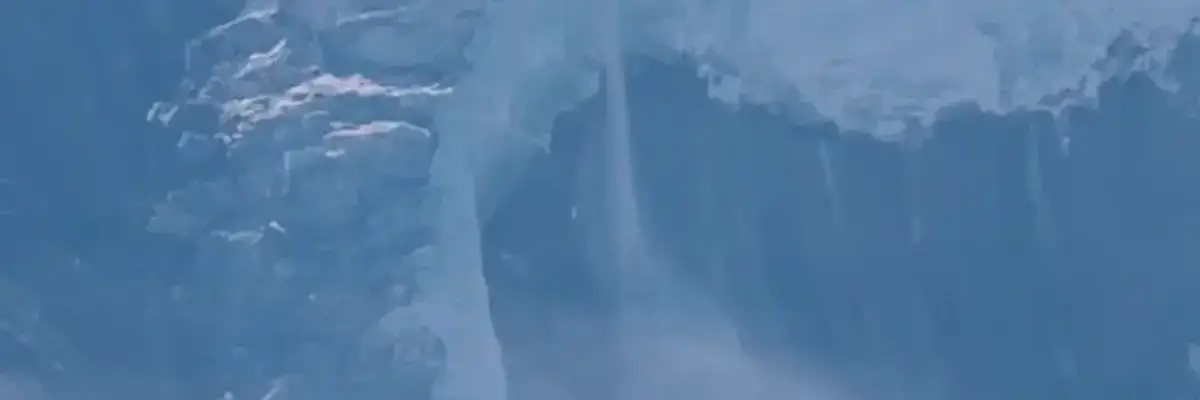
A glacier collapses on the Tibet-Nepal border.
How do we translate these horrors (of which there will be far far more as the growing El Niño envelops the world in record temperatures) into political change here in the US?
It’s been harder than usual for me to write these past few days, and that’s because the glacier collapse and subsequent calamity along the Tibet-Nepal border hit very hard. As it happens, I’ve stood in that border crossing where you’ve watched the giant wave obliterate… everything in a split second. I’d spent weeks in the high, dry, cold of Buddhist Tibet, and then crossed into the lush humid chaos of Hindu Nepal, and so I can summon up some sense of what it must have been like, and of the people who died almost before panic could grip them.
More, I knew it was coming. Not on that day, of course, but I’d been in Tibet 20 years ago partly to report on what we already knew was an enormous threat: the fallout from the rapid melt on what is sometimes called Earth’s Third Pole. The danger of these collapses, and the blocked lakes they can create, were well-known to scientists; they happen often, but usually in unpopulated valleys. I’m not going to concentrate on these reports—there’s been much good coverage in the last few days. Jonathan Watts, for instance, does the important service of laying out the exact link between the climate crisis and the collapse:
Two days before the collapse, the ground temperature hit its highest point in the last two years, according to Dr. Hamish Pritchard, a glaciologist with the British Antarctic Survey, whose team had sensors 6 miles (10 kilometers) away from the site.
“These high temperatures would have weakened the snowpack, filled crevasses with water, and thawed the bonds between ice and rock that hold these glaciers in place,” he told the Science Media Centre.
Jeff Berardelli tracks the ongoing increase in temperature in the region (it’s been about twice the global average, up 5°F since 1940). And Jonathan Mingle provides a very fine account of his own travels in the region, and of the similar smaller incidents that have happened across the years.
I want simply to ask you to focus on the image at the top of this newsletter, taken by a Chinese mountaineer named Zhia Yitie, that shows the collapse—that’s the stream in the center of the picture that looks like a waterfall. And what I want you to notice is how much ice is still there—to the naked eye it looks like 99% of the glacier remains. And this is just one glacier of perhaps 50,000 across the Himalayas and Hindu Kush. My point is: There is infinitely more damage to be done, or to put it another way there is infinitely more damage we might still be able to forestall. And that’s what should concern us.
In short: In a world beginning to turn away from oil, the United States has become the biggest force trying to insure we keep pouring carbon into the atmosphere. If the rest of that ice is going to fall off that Nepali glacier, this will be why.
Just to do the math for a minute: On average, Nepalis produce about four-tenths of a ton of carbon emissions annually, compared with about 14 tons for an American. More than 99% of the country’s electricity comes from hydropower (though much of that capacity was wiped out in last week’s floods). They are not causing the crisis that is killing them: We are.
Indeed, even as the mud was settling over the ruins of Himalayan villages we took the next steps to insure these catastrophes would continue, announcing an “agreement” with the Venezuela that we control to dramatically increase its oil production. As Al Jazeera put it:
Shortly before the deal was announced, energy analyst Gregory Brew likened reports of the impending agreement to oil concessions sought by the British Empire in the early 20th century.
“Such a thing is without precedent,” Brew wrote on social media. “The closest thing would be BP [British Petroleum] (back when it was majority owned by the UK govt) claiming ownership of Iraqi and Iranian oil reserves pre-WWII.”
Trump himself has embraced the colonial-era slogan “Manifest Destiny”, as part of his plan for a “growing nation” that “increases our wealth” and “expands our territory."
This is literal colonialism, in the service of President Donald Trump’s Big Oil donors—it’s pretty much precisely what we did to Iran’s Mohammad Mossadegh in 1953, triggering a set of bloody events that continue to this day.
And it comes, of course, as we continue to sabotage renewable energy—this week’s installment, thanks to great investigative reporting from Evan Halper, finds the White House paying a European firm to cancel yet more wind leases, on the condition that the money be “reinvested” with a big Trump donor building export facilities for liquefied natural gas on the Louisiana coast.
In short: In a world beginning to turn away from oil, the United States has become the biggest force trying to insure we keep pouring carbon into the atmosphere. If the rest of that ice is going to fall off that Nepali glacier, this will be why.
Which means that the question I promised to raise in last week’s newsletter is more important than ever: How do we translate these horrors (of which there will be far far more as the growing El Niño envelops the world in record temperatures) into political change here?
To be clear: I don’t mean before November’s midterms. The issues on which that will be fought—democracy, data centers, dementia—are baked in by this point. Gas prices will play a crucial role too, which means that anyone challenging the GOP should be pointing out the absurdity of our energy policy: The polling is clear that Americans hate Trump’s attacks on wind and solar. I’ll be spending the rest of the fall out on the trail with the Third Act and Gray Pac, mobilizing voters in key races; for the moment the goal is just to reestablish some beachhead for sanity in DC.
But physics is giving us very little time now, and so the next set of elections in this country will be, I think, our last real chance to make the sea change—replacing oil and gas with sun and wind—that is our best hope for limiting warming. And the El Niño will be peaking just as the Democratic candidates start jockeying for position. So it is not too early to start trying to get them thinking about all this.
Matt Pawa, the lawyer who helped launch much of the litigation to hold oil companies responsible for global warming, has helpfully provided a three-part summation of why Democrats should run in part on climate. It is lawyerly in the best sense of the word, which is to say filled with fact—he finds the long-term polling data, offers the historical examples dating back to 1988, and brings it home with what I think will be the most salient argument: Clean energy is potentially very cheap energy:
We are in an utterly extraordinary moment of energy transformation. Yet powerful corporations are keeping us stuck burning stuff from the dinosaur era to make energy. It’s dangerously heating up the climate and causing extreme weather. It kills millions of people who breathe bad air. It poisons our water. And yet renewable energy is now the cheapest way to make energy. This is not a moment for climate silence. It’s a moment for action.
You can see this dynamic playing out right now in the UK, which isn’t in the midst of an election but—since a parliamentary system means a kind of daily political battle—is nonetheless trying to figure out how to grapple with the shock they got this summer: week after week of blistering heat, and the drought that came with it. The green and pleasant land spent most of the summer brown and sweaty. (Not only that, but it turns out that shoppers shop less if the temperature gets above 25°C, and so businesses are grump too).
It’s all put the Labour government in a difficult spot. On the one hand, they’d like to appease the Murdoch press and open up more of the North Sea to drilling. This would accomplish nothing to reduce energy prices, since oil prices are set on a global market and there’s not enough crude left off UK shores to influence that number. But it would send a signal of “moderation,” which is the same kind of signal that American politicians—New York Gov. Kathy Hochul, say—have tried to send with their embrace of gas. (It turns out, new reporting shows this week, that Hochul was also lobbied persuasasively by a natural gas front group).
But the problem is that danged heat, and the upsurge in concern, anger, and activism it’s causing among voters—it turns out that that latent hope for a workable future emerges quickly once the temperature rises. And so we’ve seen in recent weeks a spate of new data comparing the climate damage from North Sea oil drilling to the economic benefit: “The economic damage caused by the carbon pollution from the oil and gas produced would be between £119bn and £336bn in the coming decades, compared with the £28.7bn in value to the UK estimated by Adura, the fossil fuel company promoting the new fields.”
As Matthew Taylor lays out in a long and useful essay, it’s become a crucial question in UK politics, with the surging Greens on one side and the Conservatives and far-right Reform on the other:
The leader of Reform UK, Nigel Farage, and the Conservative Party leader, Kemi Badenoch, have called for a massive expansion of drilling in the North Sea, claiming they would reverse the ban on new licences if elected.
In a speech this year, Farage declared that the UK should be “self-sufficient in gas.” Badenoch followed with the promise of a growing UK oil and gas industry that would “ensure our energy security for generations to come.”
At the moment, the new Labour leader Andy Burnham is trying to figure out if there’s a straddle available. His new environment secretary, the wonderfully named Angela Eagle, tried to bluster her way through in a recent column for The Guardian but I suspect that promises of “healthier ecosystems” to fight fire risk won’t cut it. People are generally sophisticated enough by now to know that the real question hinges on fossil fuels.
I don’t know how the UK decision on drilling will fall next week—again, there’s a lot that’s been baked in by now—but I do know that ambitious American politicians would be well-advised to get ahead of this storm. I don’t think it’s hard. The basic argument goes like this:
"Donald Trump and the GOP are corrupt and stupid to insist that the future lies with fossil fuel. I will stop coddling Big Oil and instead start making it much easier to America to run on energy from the sun and wind. Instead of shutting down wind farms we’ll be opening them up; instead of tariffing solar panels we’ll be making it simple for Americans to stick them on the roof and balcony. This is our best chance to cut the risk and cost of catastrophe (not to mention rising insurance prices). It’s also our best chance to let Americans enjoy the plummeting energy prices that other parts of the world have begun to see. And it may be the only path we have to restoring even a little of our standing in a world that now sees us as a reckless and rogue state."
If nothing else, prospective candidates should be thinking of it as a way to El Niño-proof their campaigns. And they should get on it sooner rather than later.
Dear Common Dreams reader, It’s been nearly 30 years since I co-founded Common Dreams with my late wife, Lina Newhouser. We had the radical notion that journalism should serve the public good, not corporate profits. It was clear to us from the outset what it would take to build such a project. No paid advertisements. No corporate sponsors. No millionaire publisher telling us what to think or do. Many people said we wouldn't last a year, but we proved those doubters wrong. Together with a tremendous team of journalists and dedicated staff, we built an independent media outlet free from the constraints of profits and corporate control. Our mission has always been simple: To inform. To inspire. To ignite change for the common good. Building Common Dreams was not easy. Our survival was never guaranteed. When you take on the most powerful forces—Wall Street greed, fossil fuel industry destruction, Big Tech lobbyists, and uber-rich oligarchs who have spent billions upon billions rigging the economy and democracy in their favor—the only bulwark you have is supporters who believe in your work. But here’s the urgent message from me today. It's never been this bad out there. And it's never been this hard to keep us going. At the very moment Common Dreams is most needed, the threats we face are intensifying. We need your support now more than ever. We don't accept corporate advertising and never will. We don't have a paywall because we don't think people should be blocked from critical news based on their ability to pay. Everything we do is funded by the donations of readers like you. When everyone does the little they can afford, we are strong. But if that support retreats or dries up, so do we. Will you donate now to make sure Common Dreams not only survives but thrives? —Craig Brown, Co-founder |
It’s been harder than usual for me to write these past few days, and that’s because the glacier collapse and subsequent calamity along the Tibet-Nepal border hit very hard. As it happens, I’ve stood in that border crossing where you’ve watched the giant wave obliterate… everything in a split second. I’d spent weeks in the high, dry, cold of Buddhist Tibet, and then crossed into the lush humid chaos of Hindu Nepal, and so I can summon up some sense of what it must have been like, and of the people who died almost before panic could grip them.
More, I knew it was coming. Not on that day, of course, but I’d been in Tibet 20 years ago partly to report on what we already knew was an enormous threat: the fallout from the rapid melt on what is sometimes called Earth’s Third Pole. The danger of these collapses, and the blocked lakes they can create, were well-known to scientists; they happen often, but usually in unpopulated valleys. I’m not going to concentrate on these reports—there’s been much good coverage in the last few days. Jonathan Watts, for instance, does the important service of laying out the exact link between the climate crisis and the collapse:
Two days before the collapse, the ground temperature hit its highest point in the last two years, according to Dr. Hamish Pritchard, a glaciologist with the British Antarctic Survey, whose team had sensors 6 miles (10 kilometers) away from the site.
“These high temperatures would have weakened the snowpack, filled crevasses with water, and thawed the bonds between ice and rock that hold these glaciers in place,” he told the Science Media Centre.
Jeff Berardelli tracks the ongoing increase in temperature in the region (it’s been about twice the global average, up 5°F since 1940). And Jonathan Mingle provides a very fine account of his own travels in the region, and of the similar smaller incidents that have happened across the years.
I want simply to ask you to focus on the image at the top of this newsletter, taken by a Chinese mountaineer named Zhia Yitie, that shows the collapse—that’s the stream in the center of the picture that looks like a waterfall. And what I want you to notice is how much ice is still there—to the naked eye it looks like 99% of the glacier remains. And this is just one glacier of perhaps 50,000 across the Himalayas and Hindu Kush. My point is: There is infinitely more damage to be done, or to put it another way there is infinitely more damage we might still be able to forestall. And that’s what should concern us.
In short: In a world beginning to turn away from oil, the United States has become the biggest force trying to insure we keep pouring carbon into the atmosphere. If the rest of that ice is going to fall off that Nepali glacier, this will be why.
Just to do the math for a minute: On average, Nepalis produce about four-tenths of a ton of carbon emissions annually, compared with about 14 tons for an American. More than 99% of the country’s electricity comes from hydropower (though much of that capacity was wiped out in last week’s floods). They are not causing the crisis that is killing them: We are.
Indeed, even as the mud was settling over the ruins of Himalayan villages we took the next steps to insure these catastrophes would continue, announcing an “agreement” with the Venezuela that we control to dramatically increase its oil production. As Al Jazeera put it:
Shortly before the deal was announced, energy analyst Gregory Brew likened reports of the impending agreement to oil concessions sought by the British Empire in the early 20th century.
“Such a thing is without precedent,” Brew wrote on social media. “The closest thing would be BP [British Petroleum] (back when it was majority owned by the UK govt) claiming ownership of Iraqi and Iranian oil reserves pre-WWII.”
Trump himself has embraced the colonial-era slogan “Manifest Destiny”, as part of his plan for a “growing nation” that “increases our wealth” and “expands our territory."
This is literal colonialism, in the service of President Donald Trump’s Big Oil donors—it’s pretty much precisely what we did to Iran’s Mohammad Mossadegh in 1953, triggering a set of bloody events that continue to this day.
And it comes, of course, as we continue to sabotage renewable energy—this week’s installment, thanks to great investigative reporting from Evan Halper, finds the White House paying a European firm to cancel yet more wind leases, on the condition that the money be “reinvested” with a big Trump donor building export facilities for liquefied natural gas on the Louisiana coast.
In short: In a world beginning to turn away from oil, the United States has become the biggest force trying to insure we keep pouring carbon into the atmosphere. If the rest of that ice is going to fall off that Nepali glacier, this will be why.
Which means that the question I promised to raise in last week’s newsletter is more important than ever: How do we translate these horrors (of which there will be far far more as the growing El Niño envelops the world in record temperatures) into political change here?
To be clear: I don’t mean before November’s midterms. The issues on which that will be fought—democracy, data centers, dementia—are baked in by this point. Gas prices will play a crucial role too, which means that anyone challenging the GOP should be pointing out the absurdity of our energy policy: The polling is clear that Americans hate Trump’s attacks on wind and solar. I’ll be spending the rest of the fall out on the trail with the Third Act and Gray Pac, mobilizing voters in key races; for the moment the goal is just to reestablish some beachhead for sanity in DC.
But physics is giving us very little time now, and so the next set of elections in this country will be, I think, our last real chance to make the sea change—replacing oil and gas with sun and wind—that is our best hope for limiting warming. And the El Niño will be peaking just as the Democratic candidates start jockeying for position. So it is not too early to start trying to get them thinking about all this.
Matt Pawa, the lawyer who helped launch much of the litigation to hold oil companies responsible for global warming, has helpfully provided a three-part summation of why Democrats should run in part on climate. It is lawyerly in the best sense of the word, which is to say filled with fact—he finds the long-term polling data, offers the historical examples dating back to 1988, and brings it home with what I think will be the most salient argument: Clean energy is potentially very cheap energy:
We are in an utterly extraordinary moment of energy transformation. Yet powerful corporations are keeping us stuck burning stuff from the dinosaur era to make energy. It’s dangerously heating up the climate and causing extreme weather. It kills millions of people who breathe bad air. It poisons our water. And yet renewable energy is now the cheapest way to make energy. This is not a moment for climate silence. It’s a moment for action.
You can see this dynamic playing out right now in the UK, which isn’t in the midst of an election but—since a parliamentary system means a kind of daily political battle—is nonetheless trying to figure out how to grapple with the shock they got this summer: week after week of blistering heat, and the drought that came with it. The green and pleasant land spent most of the summer brown and sweaty. (Not only that, but it turns out that shoppers shop less if the temperature gets above 25°C, and so businesses are grump too).
It’s all put the Labour government in a difficult spot. On the one hand, they’d like to appease the Murdoch press and open up more of the North Sea to drilling. This would accomplish nothing to reduce energy prices, since oil prices are set on a global market and there’s not enough crude left off UK shores to influence that number. But it would send a signal of “moderation,” which is the same kind of signal that American politicians—New York Gov. Kathy Hochul, say—have tried to send with their embrace of gas. (It turns out, new reporting shows this week, that Hochul was also lobbied persuasasively by a natural gas front group).
But the problem is that danged heat, and the upsurge in concern, anger, and activism it’s causing among voters—it turns out that that latent hope for a workable future emerges quickly once the temperature rises. And so we’ve seen in recent weeks a spate of new data comparing the climate damage from North Sea oil drilling to the economic benefit: “The economic damage caused by the carbon pollution from the oil and gas produced would be between £119bn and £336bn in the coming decades, compared with the £28.7bn in value to the UK estimated by Adura, the fossil fuel company promoting the new fields.”
As Matthew Taylor lays out in a long and useful essay, it’s become a crucial question in UK politics, with the surging Greens on one side and the Conservatives and far-right Reform on the other:
The leader of Reform UK, Nigel Farage, and the Conservative Party leader, Kemi Badenoch, have called for a massive expansion of drilling in the North Sea, claiming they would reverse the ban on new licences if elected.
In a speech this year, Farage declared that the UK should be “self-sufficient in gas.” Badenoch followed with the promise of a growing UK oil and gas industry that would “ensure our energy security for generations to come.”
At the moment, the new Labour leader Andy Burnham is trying to figure out if there’s a straddle available. His new environment secretary, the wonderfully named Angela Eagle, tried to bluster her way through in a recent column for The Guardian but I suspect that promises of “healthier ecosystems” to fight fire risk won’t cut it. People are generally sophisticated enough by now to know that the real question hinges on fossil fuels.
I don’t know how the UK decision on drilling will fall next week—again, there’s a lot that’s been baked in by now—but I do know that ambitious American politicians would be well-advised to get ahead of this storm. I don’t think it’s hard. The basic argument goes like this:
"Donald Trump and the GOP are corrupt and stupid to insist that the future lies with fossil fuel. I will stop coddling Big Oil and instead start making it much easier to America to run on energy from the sun and wind. Instead of shutting down wind farms we’ll be opening them up; instead of tariffing solar panels we’ll be making it simple for Americans to stick them on the roof and balcony. This is our best chance to cut the risk and cost of catastrophe (not to mention rising insurance prices). It’s also our best chance to let Americans enjoy the plummeting energy prices that other parts of the world have begun to see. And it may be the only path we have to restoring even a little of our standing in a world that now sees us as a reckless and rogue state."
If nothing else, prospective candidates should be thinking of it as a way to El Niño-proof their campaigns. And they should get on it sooner rather than later.
It’s been harder than usual for me to write these past few days, and that’s because the glacier collapse and subsequent calamity along the Tibet-Nepal border hit very hard. As it happens, I’ve stood in that border crossing where you’ve watched the giant wave obliterate… everything in a split second. I’d spent weeks in the high, dry, cold of Buddhist Tibet, and then crossed into the lush humid chaos of Hindu Nepal, and so I can summon up some sense of what it must have been like, and of the people who died almost before panic could grip them.
More, I knew it was coming. Not on that day, of course, but I’d been in Tibet 20 years ago partly to report on what we already knew was an enormous threat: the fallout from the rapid melt on what is sometimes called Earth’s Third Pole. The danger of these collapses, and the blocked lakes they can create, were well-known to scientists; they happen often, but usually in unpopulated valleys. I’m not going to concentrate on these reports—there’s been much good coverage in the last few days. Jonathan Watts, for instance, does the important service of laying out the exact link between the climate crisis and the collapse:
Two days before the collapse, the ground temperature hit its highest point in the last two years, according to Dr. Hamish Pritchard, a glaciologist with the British Antarctic Survey, whose team had sensors 6 miles (10 kilometers) away from the site.
“These high temperatures would have weakened the snowpack, filled crevasses with water, and thawed the bonds between ice and rock that hold these glaciers in place,” he told the Science Media Centre.
Jeff Berardelli tracks the ongoing increase in temperature in the region (it’s been about twice the global average, up 5°F since 1940). And Jonathan Mingle provides a very fine account of his own travels in the region, and of the similar smaller incidents that have happened across the years.
I want simply to ask you to focus on the image at the top of this newsletter, taken by a Chinese mountaineer named Zhia Yitie, that shows the collapse—that’s the stream in the center of the picture that looks like a waterfall. And what I want you to notice is how much ice is still there—to the naked eye it looks like 99% of the glacier remains. And this is just one glacier of perhaps 50,000 across the Himalayas and Hindu Kush. My point is: There is infinitely more damage to be done, or to put it another way there is infinitely more damage we might still be able to forestall. And that’s what should concern us.
In short: In a world beginning to turn away from oil, the United States has become the biggest force trying to insure we keep pouring carbon into the atmosphere. If the rest of that ice is going to fall off that Nepali glacier, this will be why.
Just to do the math for a minute: On average, Nepalis produce about four-tenths of a ton of carbon emissions annually, compared with about 14 tons for an American. More than 99% of the country’s electricity comes from hydropower (though much of that capacity was wiped out in last week’s floods). They are not causing the crisis that is killing them: We are.
Indeed, even as the mud was settling over the ruins of Himalayan villages we took the next steps to insure these catastrophes would continue, announcing an “agreement” with the Venezuela that we control to dramatically increase its oil production. As Al Jazeera put it:
Shortly before the deal was announced, energy analyst Gregory Brew likened reports of the impending agreement to oil concessions sought by the British Empire in the early 20th century.
“Such a thing is without precedent,” Brew wrote on social media. “The closest thing would be BP [British Petroleum] (back when it was majority owned by the UK govt) claiming ownership of Iraqi and Iranian oil reserves pre-WWII.”
Trump himself has embraced the colonial-era slogan “Manifest Destiny”, as part of his plan for a “growing nation” that “increases our wealth” and “expands our territory."
This is literal colonialism, in the service of President Donald Trump’s Big Oil donors—it’s pretty much precisely what we did to Iran’s Mohammad Mossadegh in 1953, triggering a set of bloody events that continue to this day.
And it comes, of course, as we continue to sabotage renewable energy—this week’s installment, thanks to great investigative reporting from Evan Halper, finds the White House paying a European firm to cancel yet more wind leases, on the condition that the money be “reinvested” with a big Trump donor building export facilities for liquefied natural gas on the Louisiana coast.
In short: In a world beginning to turn away from oil, the United States has become the biggest force trying to insure we keep pouring carbon into the atmosphere. If the rest of that ice is going to fall off that Nepali glacier, this will be why.
Which means that the question I promised to raise in last week’s newsletter is more important than ever: How do we translate these horrors (of which there will be far far more as the growing El Niño envelops the world in record temperatures) into political change here?
To be clear: I don’t mean before November’s midterms. The issues on which that will be fought—democracy, data centers, dementia—are baked in by this point. Gas prices will play a crucial role too, which means that anyone challenging the GOP should be pointing out the absurdity of our energy policy: The polling is clear that Americans hate Trump’s attacks on wind and solar. I’ll be spending the rest of the fall out on the trail with the Third Act and Gray Pac, mobilizing voters in key races; for the moment the goal is just to reestablish some beachhead for sanity in DC.
But physics is giving us very little time now, and so the next set of elections in this country will be, I think, our last real chance to make the sea change—replacing oil and gas with sun and wind—that is our best hope for limiting warming. And the El Niño will be peaking just as the Democratic candidates start jockeying for position. So it is not too early to start trying to get them thinking about all this.
Matt Pawa, the lawyer who helped launch much of the litigation to hold oil companies responsible for global warming, has helpfully provided a three-part summation of why Democrats should run in part on climate. It is lawyerly in the best sense of the word, which is to say filled with fact—he finds the long-term polling data, offers the historical examples dating back to 1988, and brings it home with what I think will be the most salient argument: Clean energy is potentially very cheap energy:
We are in an utterly extraordinary moment of energy transformation. Yet powerful corporations are keeping us stuck burning stuff from the dinosaur era to make energy. It’s dangerously heating up the climate and causing extreme weather. It kills millions of people who breathe bad air. It poisons our water. And yet renewable energy is now the cheapest way to make energy. This is not a moment for climate silence. It’s a moment for action.
You can see this dynamic playing out right now in the UK, which isn’t in the midst of an election but—since a parliamentary system means a kind of daily political battle—is nonetheless trying to figure out how to grapple with the shock they got this summer: week after week of blistering heat, and the drought that came with it. The green and pleasant land spent most of the summer brown and sweaty. (Not only that, but it turns out that shoppers shop less if the temperature gets above 25°C, and so businesses are grump too).
It’s all put the Labour government in a difficult spot. On the one hand, they’d like to appease the Murdoch press and open up more of the North Sea to drilling. This would accomplish nothing to reduce energy prices, since oil prices are set on a global market and there’s not enough crude left off UK shores to influence that number. But it would send a signal of “moderation,” which is the same kind of signal that American politicians—New York Gov. Kathy Hochul, say—have tried to send with their embrace of gas. (It turns out, new reporting shows this week, that Hochul was also lobbied persuasasively by a natural gas front group).
But the problem is that danged heat, and the upsurge in concern, anger, and activism it’s causing among voters—it turns out that that latent hope for a workable future emerges quickly once the temperature rises. And so we’ve seen in recent weeks a spate of new data comparing the climate damage from North Sea oil drilling to the economic benefit: “The economic damage caused by the carbon pollution from the oil and gas produced would be between £119bn and £336bn in the coming decades, compared with the £28.7bn in value to the UK estimated by Adura, the fossil fuel company promoting the new fields.”
As Matthew Taylor lays out in a long and useful essay, it’s become a crucial question in UK politics, with the surging Greens on one side and the Conservatives and far-right Reform on the other:
The leader of Reform UK, Nigel Farage, and the Conservative Party leader, Kemi Badenoch, have called for a massive expansion of drilling in the North Sea, claiming they would reverse the ban on new licences if elected.
In a speech this year, Farage declared that the UK should be “self-sufficient in gas.” Badenoch followed with the promise of a growing UK oil and gas industry that would “ensure our energy security for generations to come.”
At the moment, the new Labour leader Andy Burnham is trying to figure out if there’s a straddle available. His new environment secretary, the wonderfully named Angela Eagle, tried to bluster her way through in a recent column for The Guardian but I suspect that promises of “healthier ecosystems” to fight fire risk won’t cut it. People are generally sophisticated enough by now to know that the real question hinges on fossil fuels.
I don’t know how the UK decision on drilling will fall next week—again, there’s a lot that’s been baked in by now—but I do know that ambitious American politicians would be well-advised to get ahead of this storm. I don’t think it’s hard. The basic argument goes like this:
"Donald Trump and the GOP are corrupt and stupid to insist that the future lies with fossil fuel. I will stop coddling Big Oil and instead start making it much easier to America to run on energy from the sun and wind. Instead of shutting down wind farms we’ll be opening them up; instead of tariffing solar panels we’ll be making it simple for Americans to stick them on the roof and balcony. This is our best chance to cut the risk and cost of catastrophe (not to mention rising insurance prices). It’s also our best chance to let Americans enjoy the plummeting energy prices that other parts of the world have begun to see. And it may be the only path we have to restoring even a little of our standing in a world that now sees us as a reckless and rogue state."
If nothing else, prospective candidates should be thinking of it as a way to El Niño-proof their campaigns. And they should get on it sooner rather than later.