SUBSCRIBE TO OUR FREE NEWSLETTER
Daily news & progressive opinion—funded by the people, not the corporations—delivered straight to your inbox.
5
#000000
#FFFFFF
To donate by check, phone, or other method, see our More Ways to Give page.
Daily news & progressive opinion—funded by the people, not the corporations—delivered straight to your inbox.
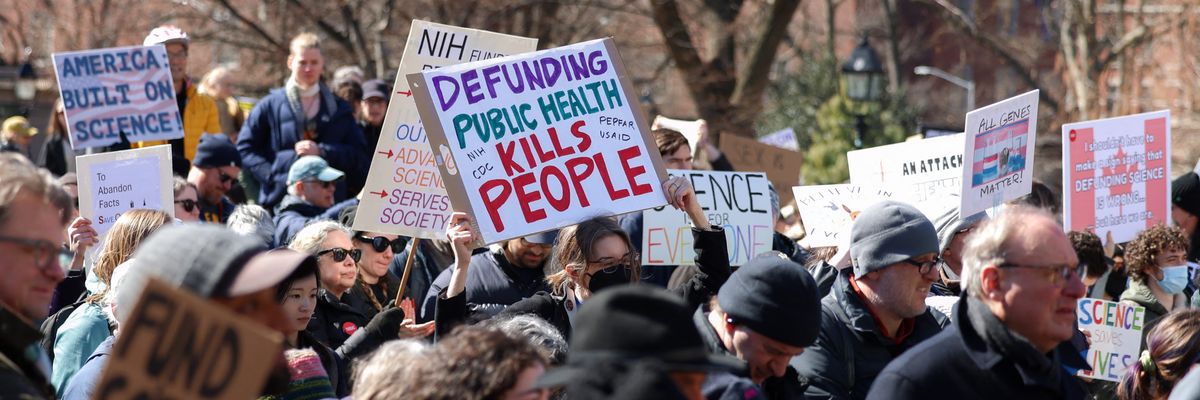
Demonstrators take part in a "Stand Up For Science" rally at Washington Square Park in New York on March 7, 2025.
"When research stops, people suffer and people die," said one campaigner.
Scientists and their supporters in dozens of U.S. cities—as well as across Europe—rallied on Friday to demand the Trump administration end its assault on federal agencies, including those that research health, the climate, and other life-or-death issues.
The main "Stand Up for Science" rally was held Friday afternoon at the Lincoln Memorial, with advocates responding to a call made by Emory University doctoral candidate Colette Delawalla last month—as federal employees were learning of President Donald Trump's efforts to limit research grants at the National Institutes of Health (NIH), the administration's order for the Centers for Disease Control and Prevention (CDC) to purge any articles that mention gender identity or LGBTQ+ issues, and as Lee Zeldin, who has opposed clean air and water protections, took the helm of the Environmental Protection Agency (EPA).
"I'm planning a Stand Up for Science protest in D.C.," wrote Delawalla in frustration on the social media platform Bluesky on February 8.
Since Delawalla and other organizers, including University of North Carolina at Chapel Hill doctoral student J.P. Flores and Cold Spring Harbor Laboratory biologist Emma Courtney, began planning the event in Washington, the science community's alarm over the actions of the Trump administration has only grown.
In late February, reporting showed that the Trump administration had circumvented court rulings in order to block tens of billions of dollars in NIH grants that fund crucial research on numerous diseases.
At the rally on Friday, former NIH Director Francis Collins said the science research that takes place at the agency is "for the people."
With numerous global public health threats currently evolving—the spread of avian flu and several measles outbreaks in the U.S. and a new variant of mpox discovered in the Democratic Republic of Congo—Collins said that "this would be a terrible time to dismantle our infectious disease research and our global public health efforts."
"The success of the American public science enterprise, which is the envy of the rest of the world over the past decades, it is of the people, by the people, and for the people," said Collins. "It's one of our nation's greatest achievements, enabling stunning discoveries about how life works, extending life expectancy, reducing disease burden, and, by the way, science is responsible for more than 50% of the economic growth of the United States since World War II."
Other recent anti-science actions by the Trump administration and Republicans in Congress include: the passage of a bill to end the Methane Emissions Reduction Program; right-wing billionaire Elon Musk's continued efforts via the so-called Department of Government Efficiency (DOGE) to cut science and research spending at federal agencies, and the last week's firing of hundreds of staffers at the National Oceanic and Atmospheric Administration (NOAA).
Trump and Musk's actions have led universities to begin reducing admissions and even rescinding placement offers to post-graduate programs, threatening the future of biomedical research.
"When research stops, people suffer and people die," said Samantha Jade Durán, a disability justice advocate, at the Stand Up for Science rally in Washington, D.C. on Friday. "We cannot let that happen. We have seen what's possible when we invest in science. Polio was eradicated. HIV was transformed from a death sentence to a manageable and undetectable condition. Cancer treatments are getting better every year, and these breakthroughs didn't happen by accident. They happened because we chose to fund science."
On social media, organizers on Friday posted images of large rallies in Atlanta, Boston, Philadelphia, and New York City.
Solidarity marches also took place in Paris and Montpelier, France.
The rallies on Friday, said U.S. organizers, are "just the beginning."
"Our policy goals include a restoration of federal scientific funding, the reinstatement of wrongfully terminated employees at federal agencies, an end to governmental interference and censorship in science, and a renewed commitment to diversity, equity, inclusion, and accessibility in science," said organizers in the U.S. "We are also committed to empowering scientists—and anyone who has benefited from scientific advancements—to engage in sustained advocacy in the years to come."
Dear Common Dreams reader, It’s been nearly 30 years since I co-founded Common Dreams with my late wife, Lina Newhouser. We had the radical notion that journalism should serve the public good, not corporate profits. It was clear to us from the outset what it would take to build such a project. No paid advertisements. No corporate sponsors. No millionaire publisher telling us what to think or do. Many people said we wouldn't last a year, but we proved those doubters wrong. Together with a tremendous team of journalists and dedicated staff, we built an independent media outlet free from the constraints of profits and corporate control. Our mission has always been simple: To inform. To inspire. To ignite change for the common good. Building Common Dreams was not easy. Our survival was never guaranteed. When you take on the most powerful forces—Wall Street greed, fossil fuel industry destruction, Big Tech lobbyists, and uber-rich oligarchs who have spent billions upon billions rigging the economy and democracy in their favor—the only bulwark you have is supporters who believe in your work. But here’s the urgent message from me today. It's never been this bad out there. And it's never been this hard to keep us going. At the very moment Common Dreams is most needed, the threats we face are intensifying. We need your support now more than ever. We don't accept corporate advertising and never will. We don't have a paywall because we don't think people should be blocked from critical news based on their ability to pay. Everything we do is funded by the donations of readers like you. When everyone does the little they can afford, we are strong. But if that support retreats or dries up, so do we. Will you donate now to make sure Common Dreams not only survives but thrives? —Craig Brown, Co-founder |
Scientists and their supporters in dozens of U.S. cities—as well as across Europe—rallied on Friday to demand the Trump administration end its assault on federal agencies, including those that research health, the climate, and other life-or-death issues.
The main "Stand Up for Science" rally was held Friday afternoon at the Lincoln Memorial, with advocates responding to a call made by Emory University doctoral candidate Colette Delawalla last month—as federal employees were learning of President Donald Trump's efforts to limit research grants at the National Institutes of Health (NIH), the administration's order for the Centers for Disease Control and Prevention (CDC) to purge any articles that mention gender identity or LGBTQ+ issues, and as Lee Zeldin, who has opposed clean air and water protections, took the helm of the Environmental Protection Agency (EPA).
"I'm planning a Stand Up for Science protest in D.C.," wrote Delawalla in frustration on the social media platform Bluesky on February 8.
Since Delawalla and other organizers, including University of North Carolina at Chapel Hill doctoral student J.P. Flores and Cold Spring Harbor Laboratory biologist Emma Courtney, began planning the event in Washington, the science community's alarm over the actions of the Trump administration has only grown.
In late February, reporting showed that the Trump administration had circumvented court rulings in order to block tens of billions of dollars in NIH grants that fund crucial research on numerous diseases.
At the rally on Friday, former NIH Director Francis Collins said the science research that takes place at the agency is "for the people."
With numerous global public health threats currently evolving—the spread of avian flu and several measles outbreaks in the U.S. and a new variant of mpox discovered in the Democratic Republic of Congo—Collins said that "this would be a terrible time to dismantle our infectious disease research and our global public health efforts."
"The success of the American public science enterprise, which is the envy of the rest of the world over the past decades, it is of the people, by the people, and for the people," said Collins. "It's one of our nation's greatest achievements, enabling stunning discoveries about how life works, extending life expectancy, reducing disease burden, and, by the way, science is responsible for more than 50% of the economic growth of the United States since World War II."
Other recent anti-science actions by the Trump administration and Republicans in Congress include: the passage of a bill to end the Methane Emissions Reduction Program; right-wing billionaire Elon Musk's continued efforts via the so-called Department of Government Efficiency (DOGE) to cut science and research spending at federal agencies, and the last week's firing of hundreds of staffers at the National Oceanic and Atmospheric Administration (NOAA).
Trump and Musk's actions have led universities to begin reducing admissions and even rescinding placement offers to post-graduate programs, threatening the future of biomedical research.
"When research stops, people suffer and people die," said Samantha Jade Durán, a disability justice advocate, at the Stand Up for Science rally in Washington, D.C. on Friday. "We cannot let that happen. We have seen what's possible when we invest in science. Polio was eradicated. HIV was transformed from a death sentence to a manageable and undetectable condition. Cancer treatments are getting better every year, and these breakthroughs didn't happen by accident. They happened because we chose to fund science."
On social media, organizers on Friday posted images of large rallies in Atlanta, Boston, Philadelphia, and New York City.
Solidarity marches also took place in Paris and Montpelier, France.
The rallies on Friday, said U.S. organizers, are "just the beginning."
"Our policy goals include a restoration of federal scientific funding, the reinstatement of wrongfully terminated employees at federal agencies, an end to governmental interference and censorship in science, and a renewed commitment to diversity, equity, inclusion, and accessibility in science," said organizers in the U.S. "We are also committed to empowering scientists—and anyone who has benefited from scientific advancements—to engage in sustained advocacy in the years to come."
Scientists and their supporters in dozens of U.S. cities—as well as across Europe—rallied on Friday to demand the Trump administration end its assault on federal agencies, including those that research health, the climate, and other life-or-death issues.
The main "Stand Up for Science" rally was held Friday afternoon at the Lincoln Memorial, with advocates responding to a call made by Emory University doctoral candidate Colette Delawalla last month—as federal employees were learning of President Donald Trump's efforts to limit research grants at the National Institutes of Health (NIH), the administration's order for the Centers for Disease Control and Prevention (CDC) to purge any articles that mention gender identity or LGBTQ+ issues, and as Lee Zeldin, who has opposed clean air and water protections, took the helm of the Environmental Protection Agency (EPA).
"I'm planning a Stand Up for Science protest in D.C.," wrote Delawalla in frustration on the social media platform Bluesky on February 8.
Since Delawalla and other organizers, including University of North Carolina at Chapel Hill doctoral student J.P. Flores and Cold Spring Harbor Laboratory biologist Emma Courtney, began planning the event in Washington, the science community's alarm over the actions of the Trump administration has only grown.
In late February, reporting showed that the Trump administration had circumvented court rulings in order to block tens of billions of dollars in NIH grants that fund crucial research on numerous diseases.
At the rally on Friday, former NIH Director Francis Collins said the science research that takes place at the agency is "for the people."
With numerous global public health threats currently evolving—the spread of avian flu and several measles outbreaks in the U.S. and a new variant of mpox discovered in the Democratic Republic of Congo—Collins said that "this would be a terrible time to dismantle our infectious disease research and our global public health efforts."
"The success of the American public science enterprise, which is the envy of the rest of the world over the past decades, it is of the people, by the people, and for the people," said Collins. "It's one of our nation's greatest achievements, enabling stunning discoveries about how life works, extending life expectancy, reducing disease burden, and, by the way, science is responsible for more than 50% of the economic growth of the United States since World War II."
Other recent anti-science actions by the Trump administration and Republicans in Congress include: the passage of a bill to end the Methane Emissions Reduction Program; right-wing billionaire Elon Musk's continued efforts via the so-called Department of Government Efficiency (DOGE) to cut science and research spending at federal agencies, and the last week's firing of hundreds of staffers at the National Oceanic and Atmospheric Administration (NOAA).
Trump and Musk's actions have led universities to begin reducing admissions and even rescinding placement offers to post-graduate programs, threatening the future of biomedical research.
"When research stops, people suffer and people die," said Samantha Jade Durán, a disability justice advocate, at the Stand Up for Science rally in Washington, D.C. on Friday. "We cannot let that happen. We have seen what's possible when we invest in science. Polio was eradicated. HIV was transformed from a death sentence to a manageable and undetectable condition. Cancer treatments are getting better every year, and these breakthroughs didn't happen by accident. They happened because we chose to fund science."
On social media, organizers on Friday posted images of large rallies in Atlanta, Boston, Philadelphia, and New York City.
Solidarity marches also took place in Paris and Montpelier, France.
The rallies on Friday, said U.S. organizers, are "just the beginning."
"Our policy goals include a restoration of federal scientific funding, the reinstatement of wrongfully terminated employees at federal agencies, an end to governmental interference and censorship in science, and a renewed commitment to diversity, equity, inclusion, and accessibility in science," said organizers in the U.S. "We are also committed to empowering scientists—and anyone who has benefited from scientific advancements—to engage in sustained advocacy in the years to come."