SUBSCRIBE TO OUR FREE NEWSLETTER
Daily news & progressive opinion—funded by the people, not the corporations—delivered straight to your inbox.
5
#000000
#FFFFFF
To donate by check, phone, or other method, see our More Ways to Give page.
Daily news & progressive opinion—funded by the people, not the corporations—delivered straight to your inbox.
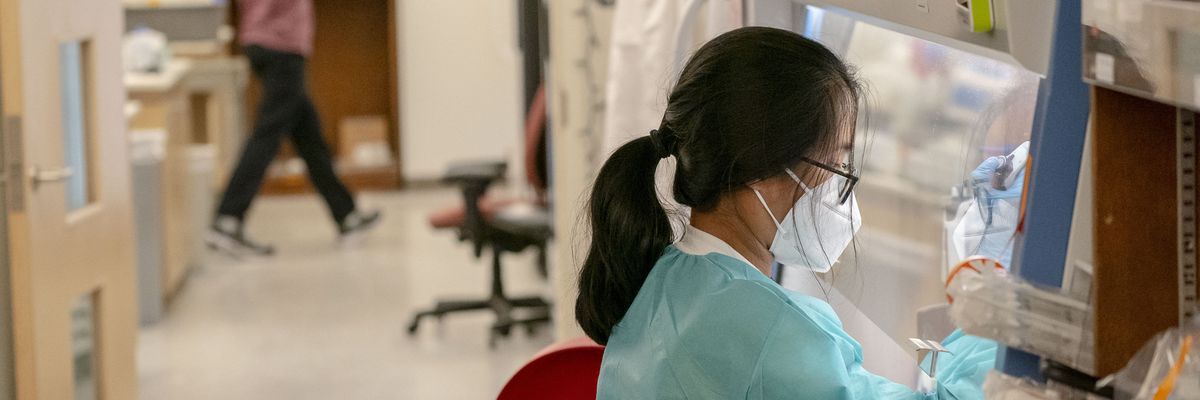
A researcher washes cells of serum, separated from the blood of vaccinated mice, while working on vaccine and protein research in the Veesler Lab at the University of Washington on May 10, 2022 in Seattle, Washington
"It is difficult to overstate what a catastrophe this will be for the U.S. research and education systems, particular in biomedical fields," said one biology professor.
As a result of what one Democratic leader said was the Trump administration's latest "direct violation of the law," institutions that receive grants from the National Institutes of Health have been ordered, starting Monday, to limit indirect costs for research grants—a move that the White House suggested was aimed at reducing unnecessary spending, but which experts said would quickly force scientists across the country to halt potentially lifesaving research.
U.S. Rep. Rosa DeLauro (D-Conn.), ranking member of the House Appropriations Committee, warned that limiting NIH grants will cause "irreparable damage to ongoing research to develop cures and treatments for cancer, Alzheimer's disease and related dementias, ALS, diabetes, mental health disorders, opioid abuse, genetic diseases, rare diseases, and other diseases and conditions affecting American families."
The NIH Office of Policy for Extramural Research Administration (OPERA) wrote in a memo last Friday that of $35 billion spent on research grants in 2023, $9 billion was spent on indirect costs such as equipment, operations, maintenance, accounting, and personnel.
Universities and other organizations that receive research grants allocate an average of 27-28% of their grant funding to indirect costs, said OPERA, which suggested that such spending impedes the United States' ability to "have the best medical research in the world."
"It is accordingly vital to ensure that as many funds as possible go towards direct scientific research costs rather than administrative overhead," said OPERA.
But researchers warned that instead of ensuring "the best medical research," the loss of the funding will likely lead to layoffs of essential organizational staff, halted studies, cut-backs on lab space and equipment, and, potentially, the eventual "collapse of biomedical discovery in the United States," as STAT News reported.
"If this goes into action on Monday, it actually, literally has the ability of stopping and grinding research to a halt—soon," Robert Winn, director of the Massey Comprehensive Cancer Center at Virginia Commonwealth University, told STAT News. "How does an institution now climb out of a multimillion-dollar hole?"
Universities and medical research centers could lose $100 million per year or more under the new grant limits, the outlet reported.
DeLauro noted that in addition to endangering people who rely on medical research, the NIH's order violates a provision that has been included in appropriations bills every year since 2018, explicitly prohibiting any administration from imposing limits on "facilities and administration" costs at research institutions.
The provision was enacted after President Donald Trump's first attempt to cut NIH research funding by nearly 20% in 2017 was met by opposition from Republicans as well as Democrats.
"The Trump administration is attempting to steal critical funds promised to scientific research institutions funded by the NIH, despite an explicit legal prohibition against this action," said DeLauro. "Based on this legal statute, which is clear and unequivocal, [Department of Government Efficiency leader Elon] Musk and the Trump administration are prohibited from implementing its new policy to cut funding for biomedical research that was approved by Congress."
As STAT News reported, the indirect costs impacted by the NIH policy change include the general upkeep of running research organizations, rent, janitorial services, and other administrative costs.
Those costs, said Carl Bergstrom, a biology professor at the University of Washington, "are essential" to fund crucial scientific research.
6. The policy does not just affect funding going forward. All existing NIH grants will have their indirect rates cut to 15% as of today, the date of issuance. For a large university, this creates a sudden and catastrophic shortfall of hundreds of millions of dollars against already budgeted funds.
[image or embed]
— Carl T. Bergstrom (@carlbergstrom.com) February 7, 2025 at 7:33 PM
Bergstrom noted in a post on the social media app Bluesky that the policy change "did not come out of nowhere," but was a "core component" of a chapter by Heritage Foundation fellow Lindsey Burke on education in the right-wing policy agenda Project 2025.
"It is difficult to overstate what a catastrophe this will be for the U.S. research and education systems, particular in biomedical fields," said Bergstrom. "It is deliberate and wanton devastation entirely out of scale with any concern about [diversity, equity, and inclusion] activities on campuses. The goal is destroy U.S. universities."
DeLauro said she expects a federal judge to ultimately block the NIH order, as several judges have granted injunctions and restraining orders to stop the administration from taking control of a U.S. Treasury Department payment system, halting federal grants and loans, and suspending birthright citizenship.
"President Trump is taking an axe to our efforts to find cures to diseases and disorders that are tearing apart families across the country. President Trump and Elon Musk's proposal to cut billions of dollars for research institutions will cost lives and put the United States on a path to decline," said DeLauro. "They must immediately reverse this unlawful policy."
Dear Common Dreams reader, It’s been nearly 30 years since I co-founded Common Dreams with my late wife, Lina Newhouser. We had the radical notion that journalism should serve the public good, not corporate profits. It was clear to us from the outset what it would take to build such a project. No paid advertisements. No corporate sponsors. No millionaire publisher telling us what to think or do. Many people said we wouldn't last a year, but we proved those doubters wrong. Together with a tremendous team of journalists and dedicated staff, we built an independent media outlet free from the constraints of profits and corporate control. Our mission has always been simple: To inform. To inspire. To ignite change for the common good. Building Common Dreams was not easy. Our survival was never guaranteed. When you take on the most powerful forces—Wall Street greed, fossil fuel industry destruction, Big Tech lobbyists, and uber-rich oligarchs who have spent billions upon billions rigging the economy and democracy in their favor—the only bulwark you have is supporters who believe in your work. But here’s the urgent message from me today. It's never been this bad out there. And it's never been this hard to keep us going. At the very moment Common Dreams is most needed, the threats we face are intensifying. We need your support now more than ever. We don't accept corporate advertising and never will. We don't have a paywall because we don't think people should be blocked from critical news based on their ability to pay. Everything we do is funded by the donations of readers like you. When everyone does the little they can afford, we are strong. But if that support retreats or dries up, so do we. Will you donate now to make sure Common Dreams not only survives but thrives? —Craig Brown, Co-founder |
As a result of what one Democratic leader said was the Trump administration's latest "direct violation of the law," institutions that receive grants from the National Institutes of Health have been ordered, starting Monday, to limit indirect costs for research grants—a move that the White House suggested was aimed at reducing unnecessary spending, but which experts said would quickly force scientists across the country to halt potentially lifesaving research.
U.S. Rep. Rosa DeLauro (D-Conn.), ranking member of the House Appropriations Committee, warned that limiting NIH grants will cause "irreparable damage to ongoing research to develop cures and treatments for cancer, Alzheimer's disease and related dementias, ALS, diabetes, mental health disorders, opioid abuse, genetic diseases, rare diseases, and other diseases and conditions affecting American families."
The NIH Office of Policy for Extramural Research Administration (OPERA) wrote in a memo last Friday that of $35 billion spent on research grants in 2023, $9 billion was spent on indirect costs such as equipment, operations, maintenance, accounting, and personnel.
Universities and other organizations that receive research grants allocate an average of 27-28% of their grant funding to indirect costs, said OPERA, which suggested that such spending impedes the United States' ability to "have the best medical research in the world."
"It is accordingly vital to ensure that as many funds as possible go towards direct scientific research costs rather than administrative overhead," said OPERA.
But researchers warned that instead of ensuring "the best medical research," the loss of the funding will likely lead to layoffs of essential organizational staff, halted studies, cut-backs on lab space and equipment, and, potentially, the eventual "collapse of biomedical discovery in the United States," as STAT News reported.
"If this goes into action on Monday, it actually, literally has the ability of stopping and grinding research to a halt—soon," Robert Winn, director of the Massey Comprehensive Cancer Center at Virginia Commonwealth University, told STAT News. "How does an institution now climb out of a multimillion-dollar hole?"
Universities and medical research centers could lose $100 million per year or more under the new grant limits, the outlet reported.
DeLauro noted that in addition to endangering people who rely on medical research, the NIH's order violates a provision that has been included in appropriations bills every year since 2018, explicitly prohibiting any administration from imposing limits on "facilities and administration" costs at research institutions.
The provision was enacted after President Donald Trump's first attempt to cut NIH research funding by nearly 20% in 2017 was met by opposition from Republicans as well as Democrats.
"The Trump administration is attempting to steal critical funds promised to scientific research institutions funded by the NIH, despite an explicit legal prohibition against this action," said DeLauro. "Based on this legal statute, which is clear and unequivocal, [Department of Government Efficiency leader Elon] Musk and the Trump administration are prohibited from implementing its new policy to cut funding for biomedical research that was approved by Congress."
As STAT News reported, the indirect costs impacted by the NIH policy change include the general upkeep of running research organizations, rent, janitorial services, and other administrative costs.
Those costs, said Carl Bergstrom, a biology professor at the University of Washington, "are essential" to fund crucial scientific research.
6. The policy does not just affect funding going forward. All existing NIH grants will have their indirect rates cut to 15% as of today, the date of issuance. For a large university, this creates a sudden and catastrophic shortfall of hundreds of millions of dollars against already budgeted funds.
[image or embed]
— Carl T. Bergstrom (@carlbergstrom.com) February 7, 2025 at 7:33 PM
Bergstrom noted in a post on the social media app Bluesky that the policy change "did not come out of nowhere," but was a "core component" of a chapter by Heritage Foundation fellow Lindsey Burke on education in the right-wing policy agenda Project 2025.
"It is difficult to overstate what a catastrophe this will be for the U.S. research and education systems, particular in biomedical fields," said Bergstrom. "It is deliberate and wanton devastation entirely out of scale with any concern about [diversity, equity, and inclusion] activities on campuses. The goal is destroy U.S. universities."
DeLauro said she expects a federal judge to ultimately block the NIH order, as several judges have granted injunctions and restraining orders to stop the administration from taking control of a U.S. Treasury Department payment system, halting federal grants and loans, and suspending birthright citizenship.
"President Trump is taking an axe to our efforts to find cures to diseases and disorders that are tearing apart families across the country. President Trump and Elon Musk's proposal to cut billions of dollars for research institutions will cost lives and put the United States on a path to decline," said DeLauro. "They must immediately reverse this unlawful policy."
As a result of what one Democratic leader said was the Trump administration's latest "direct violation of the law," institutions that receive grants from the National Institutes of Health have been ordered, starting Monday, to limit indirect costs for research grants—a move that the White House suggested was aimed at reducing unnecessary spending, but which experts said would quickly force scientists across the country to halt potentially lifesaving research.
U.S. Rep. Rosa DeLauro (D-Conn.), ranking member of the House Appropriations Committee, warned that limiting NIH grants will cause "irreparable damage to ongoing research to develop cures and treatments for cancer, Alzheimer's disease and related dementias, ALS, diabetes, mental health disorders, opioid abuse, genetic diseases, rare diseases, and other diseases and conditions affecting American families."
The NIH Office of Policy for Extramural Research Administration (OPERA) wrote in a memo last Friday that of $35 billion spent on research grants in 2023, $9 billion was spent on indirect costs such as equipment, operations, maintenance, accounting, and personnel.
Universities and other organizations that receive research grants allocate an average of 27-28% of their grant funding to indirect costs, said OPERA, which suggested that such spending impedes the United States' ability to "have the best medical research in the world."
"It is accordingly vital to ensure that as many funds as possible go towards direct scientific research costs rather than administrative overhead," said OPERA.
But researchers warned that instead of ensuring "the best medical research," the loss of the funding will likely lead to layoffs of essential organizational staff, halted studies, cut-backs on lab space and equipment, and, potentially, the eventual "collapse of biomedical discovery in the United States," as STAT News reported.
"If this goes into action on Monday, it actually, literally has the ability of stopping and grinding research to a halt—soon," Robert Winn, director of the Massey Comprehensive Cancer Center at Virginia Commonwealth University, told STAT News. "How does an institution now climb out of a multimillion-dollar hole?"
Universities and medical research centers could lose $100 million per year or more under the new grant limits, the outlet reported.
DeLauro noted that in addition to endangering people who rely on medical research, the NIH's order violates a provision that has been included in appropriations bills every year since 2018, explicitly prohibiting any administration from imposing limits on "facilities and administration" costs at research institutions.
The provision was enacted after President Donald Trump's first attempt to cut NIH research funding by nearly 20% in 2017 was met by opposition from Republicans as well as Democrats.
"The Trump administration is attempting to steal critical funds promised to scientific research institutions funded by the NIH, despite an explicit legal prohibition against this action," said DeLauro. "Based on this legal statute, which is clear and unequivocal, [Department of Government Efficiency leader Elon] Musk and the Trump administration are prohibited from implementing its new policy to cut funding for biomedical research that was approved by Congress."
As STAT News reported, the indirect costs impacted by the NIH policy change include the general upkeep of running research organizations, rent, janitorial services, and other administrative costs.
Those costs, said Carl Bergstrom, a biology professor at the University of Washington, "are essential" to fund crucial scientific research.
6. The policy does not just affect funding going forward. All existing NIH grants will have their indirect rates cut to 15% as of today, the date of issuance. For a large university, this creates a sudden and catastrophic shortfall of hundreds of millions of dollars against already budgeted funds.
[image or embed]
— Carl T. Bergstrom (@carlbergstrom.com) February 7, 2025 at 7:33 PM
Bergstrom noted in a post on the social media app Bluesky that the policy change "did not come out of nowhere," but was a "core component" of a chapter by Heritage Foundation fellow Lindsey Burke on education in the right-wing policy agenda Project 2025.
"It is difficult to overstate what a catastrophe this will be for the U.S. research and education systems, particular in biomedical fields," said Bergstrom. "It is deliberate and wanton devastation entirely out of scale with any concern about [diversity, equity, and inclusion] activities on campuses. The goal is destroy U.S. universities."
DeLauro said she expects a federal judge to ultimately block the NIH order, as several judges have granted injunctions and restraining orders to stop the administration from taking control of a U.S. Treasury Department payment system, halting federal grants and loans, and suspending birthright citizenship.
"President Trump is taking an axe to our efforts to find cures to diseases and disorders that are tearing apart families across the country. President Trump and Elon Musk's proposal to cut billions of dollars for research institutions will cost lives and put the United States on a path to decline," said DeLauro. "They must immediately reverse this unlawful policy."