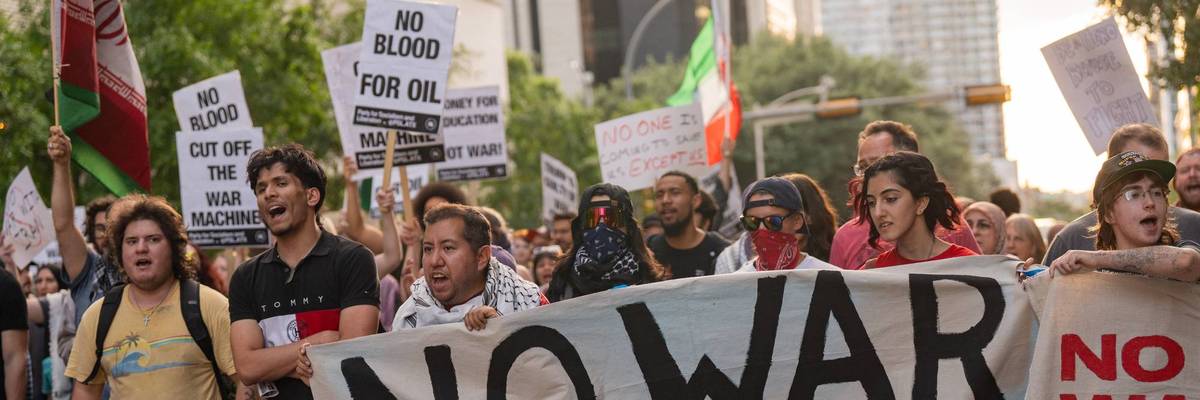
Protesters march to show opposition to the war in Iran in Austin, Texas, on April 8, 2026.
Trump’s Horrific, Illegal Iran War Has ‘Costs Us Billions While Making Us Less Safe’
"This is a self-inflicted wound, it's a choice, and it can be undone."
A group of experts says that President Donald Trump's illegal war with Iran, which has been massively expensive and has made Americans less safe, shows the need for a radical overhaul of US foreign policy.
Scholars at the Political Economy Research Institute (PERI) at the University of Massachusetts on Wednesday are holding a webinar to present ideas for reducing the US military footprint and using the savings to invest in programs that will directly benefit working-class Americans.
In a video posted on social media ahead of the webinar, PERI experts advocated for making major changes to US foreign policy, which they argued has left the country overstretched.
"The Iran War costs us billions while making us less safe," says a message accompanying the video on PERI’s social media account. "By reining in military spending and taxing the wealthy to pay their fair share, we can fund critical services like universal preschool, infrastructure investments, and Medicare for All."
The Iran War costs us billions while making us less safe.
By reining in military spending and taxing the wealthy to pay their fair share, we can fund critical services like universal preschool, infrastructure investments, and medicare for all. pic.twitter.com/daOFLyWHEr
— PERI (@PERIatUMass) September 30, 2026
Lindsay Koshgarian, program director of the National Priorities Project (NPP), made the case that the US can no longer enforce a policy of "maintaining dominance over the entire world."
"We have endless wars in the Middle East, a war of choice with Iran at the moment," said Koshgarian. "Clearly, something is broken about our foreign policy. It's extremely costly and, in fact, it actually makes us less safe."
Koshgarian then outlined her plan for what she described as "a smaller, safer military" that would slash US presence overseas and generate between $200 billion to $500 billion of savings per year.
Heidi Peltier, senior researcher at the Watson School of International and Public Affairs at Brown University, pointed to Trump's request for an "astronomical" $1.5 trillion military budget to argue that America's priorities have become completely warped.
"The money is there," Peltier said. "The question really is, what are our priorities?"
Peltier's research aims to "demilitarize" federal spending by reducing the annual US Department of Defense budget by 10%, which would free up $100 billion more to spend on domestic priorities.
Aaron Medlin, professor of international studies at Boston College, pointed to the ways Trump's illegal war had made the price of energy more expensive and was inflicting economic pain on working-class Americans.
Medlin said that his work focuses on raising taxes on the wealthy by taxing income generated from owning assets at the same rate as income generated from working, while also imposing a minimum tax on fortunes over $100 million, and small levies on stock, bond, and derivatives trades.
In total, Medlin estimates that the proposed tax package would raise more than $2 trillion annually.
"The United States is just becoming unaffordable for a huge share of Americans," he said. "This is a self-inflicted wound, it's a choice, and it can be undone."
The experts' proposals for reducing the US military footprint and taxing extreme wealth came on the same day that petroleum industry analyst Patrick De Haan estimated that Americans have now spent over $75 billion more on gasoline since the start of the Iran War.
When higher gas prices are combined with rising rates for diesel, the Costs of War Project at Brown's Watson Institute estimates that Americans have spent an extra $121.7 billion.
We are at a crossroads
This country and this world are at a monumental crossroads. In a few short weeks, US voters will have an opportunity to beat back the forces of fascism and confront the billionaires who are rigging the economy, our media system, and our democracy, making it increasingly impossible for ordinary people to get by. We’re not just talking about the election. We’re talking about what must be done once these fascist elements are vanquished from power. We need a bolder set of solutions than what either major party has so far been willing to offer and a working-class movement ready to fight like hell for it. Trump didn't emerge from nowhere. The conditions that fueled MAGA authoritarianism were created by decades of radical neoliberal economic policies and a corrupt political system dominated by corporate interests. They slashed taxes on the super-rich, promising that the benefits would trickle down. They said giveaways to the corporate titans would make life more affordable for the rest of us. It was all bullshit. And when a bitter, betrayed populace searches for someone to blame, right-wing demagogues have little trouble finding scapegoats. People know when they're being lied to, but you won't hear any of this from the corporate media. Only independent journalism—powered and funded by people who believe in building a better world—can deliver truly trustworthy daily news. Our Fall Campaign is underway, and we need your help. To power our newsroom through the rest of the year, we need to raise $125,000 by midnight on October 31. So if you share our vision, please contribute whatever you can to sustain our work. |
A group of experts says that President Donald Trump's illegal war with Iran, which has been massively expensive and has made Americans less safe, shows the need for a radical overhaul of US foreign policy.
Scholars at the Political Economy Research Institute (PERI) at the University of Massachusetts on Wednesday are holding a webinar to present ideas for reducing the US military footprint and using the savings to invest in programs that will directly benefit working-class Americans.
In a video posted on social media ahead of the webinar, PERI experts advocated for making major changes to US foreign policy, which they argued has left the country overstretched.
"The Iran War costs us billions while making us less safe," says a message accompanying the video on PERI’s social media account. "By reining in military spending and taxing the wealthy to pay their fair share, we can fund critical services like universal preschool, infrastructure investments, and Medicare for All."
The Iran War costs us billions while making us less safe.
By reining in military spending and taxing the wealthy to pay their fair share, we can fund critical services like universal preschool, infrastructure investments, and medicare for all. pic.twitter.com/daOFLyWHEr
— PERI (@PERIatUMass) September 30, 2026
Lindsay Koshgarian, program director of the National Priorities Project (NPP), made the case that the US can no longer enforce a policy of "maintaining dominance over the entire world."
"We have endless wars in the Middle East, a war of choice with Iran at the moment," said Koshgarian. "Clearly, something is broken about our foreign policy. It's extremely costly and, in fact, it actually makes us less safe."
Koshgarian then outlined her plan for what she described as "a smaller, safer military" that would slash US presence overseas and generate between $200 billion to $500 billion of savings per year.
Heidi Peltier, senior researcher at the Watson School of International and Public Affairs at Brown University, pointed to Trump's request for an "astronomical" $1.5 trillion military budget to argue that America's priorities have become completely warped.
"The money is there," Peltier said. "The question really is, what are our priorities?"
Peltier's research aims to "demilitarize" federal spending by reducing the annual US Department of Defense budget by 10%, which would free up $100 billion more to spend on domestic priorities.
Aaron Medlin, professor of international studies at Boston College, pointed to the ways Trump's illegal war had made the price of energy more expensive and was inflicting economic pain on working-class Americans.
Medlin said that his work focuses on raising taxes on the wealthy by taxing income generated from owning assets at the same rate as income generated from working, while also imposing a minimum tax on fortunes over $100 million, and small levies on stock, bond, and derivatives trades.
In total, Medlin estimates that the proposed tax package would raise more than $2 trillion annually.
"The United States is just becoming unaffordable for a huge share of Americans," he said. "This is a self-inflicted wound, it's a choice, and it can be undone."
The experts' proposals for reducing the US military footprint and taxing extreme wealth came on the same day that petroleum industry analyst Patrick De Haan estimated that Americans have now spent over $75 billion more on gasoline since the start of the Iran War.
When higher gas prices are combined with rising rates for diesel, the Costs of War Project at Brown's Watson Institute estimates that Americans have spent an extra $121.7 billion.
- The Costs of Trump's Unnecessary, Illegal War on Iran Keep Mounting ›
- CBO Finds Trump's Iran War Has Already Cost Nearly $40 Billion—And That's a 'Conservative' Estimate ›
- A War Without the Name: The Billion-Dollar Cost of America’s Iran Conflict ›
- Opinion | Find Out How Much Trump's Senseless Iran War Is Costing You, Personally | Common Dreams ›
- Opinion | The Cost of War Comes Due Before the Ballot | Common Dreams ›
- 'We May Do Another Little Epic Fury,' Trump Says After Claiming Not to Know About Possible Strike on Iran | Common Dreams ›