SUBSCRIBE TO OUR FREE NEWSLETTER
Daily news & progressive opinion—funded by the people, not the corporations—delivered straight to your inbox.
5
#000000
#FFFFFF
To donate by check, phone, or other method, see our More Ways to Give page.
Daily news & progressive opinion—funded by the people, not the corporations—delivered straight to your inbox.
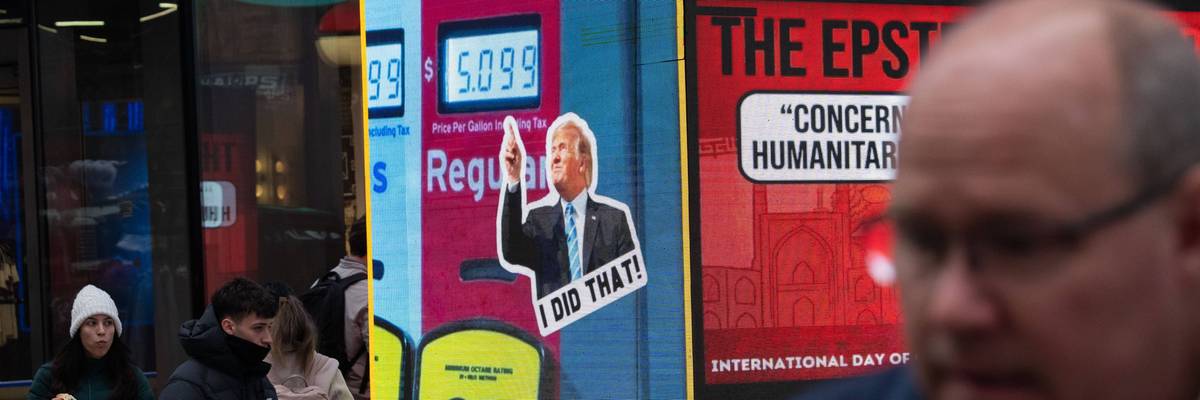
A truck with an image of US President Donald Trump and rising gas prices drives past during a rally for Al Quds Day on March 13, 2026 in New York City.
To be clear, this isn’t the cost of the weapons and soldiers fighting the war, which the Pentagon estimates to be around $44 billion. This is the higher cost you’re paying to fill up your gas tank and to buy products that cost more to move.
Affordability is getting worse, especially if you have to drive to work or anywhere else.
By late September, the total cost of the higher gas and diesel prices triggered by President Donald Trump’s war against Iran exceeded $103 billion, according to my organization’s analysis of the federal government’s energy data. And those higher prices aren’t showing any sign of slowing. If current trends hold, the price tag by the end of this year will approach $180 billion.
For the average household, that comes out to $750 extra so far, and that figure is on pace to top $1,300 by year’s end.
If life feels more expensive today, that’s because it is.
For a family of four with two drivers, those costs are even higher, topping $1,000 already and slated to be over $1,700 by the end of the year if the war continues. Our interactive tool, online at itep.org/iran-war-fuel-cost, lets you punch in your region and household size to get a sense of how much your family’s costs are rising.
To be clear, this isn’t the cost of the weapons and soldiers fighting the war, which the Pentagon estimates to be around $44 billion. This is the higher cost you’re paying to fill up your gas tank and to buy products that cost more to move.
In a normal year, fall is when drivers get some reprieve at the pump. As summer travel winds down, demand for gas falls, and prices should fall too. But not in 2026.
According to AAA, Americans have never paid this much for gas at this time of year. The national average gas price is $4.47 per gallon as of this writing, and a growing number of states are seeing average prices top $5 per gallon.
Equally troubling is the sky-high price of diesel fuel, which has hit record highs this year and now stands at $6.45 per gallon. When diesel prices rise, the cost of making and shipping products rises too. While most of us don’t buy diesel fuel ourselves, this raises the cost of everything else, bumping up the high rate of inflation we’ve already been seeing.
These soaring fuel costs hurt businesses, local governments, and families.
Businesses have had to shell out $48 billion extra for motor fuel this year, mostly on diesel, because of the Iran War.
Local governments also feel the squeeze. Higher fuel prices make it more expensive to operate school buses, garbage trucks, construction equipment, fire trucks, police cars, and other vehicles and machinery. So far this year our local and state governments have had to pay over $2.7 billion extra for fuel because of the Iran War, and we expect that figure to top $4 billion by the close of the year. This expense, of course, ultimately falls on local taxpayers.
These expenses come on top of other new costs for households like rising interest rates, the Trump administration’s widespread tariffs on products you buy every day, and high healthcare prices, made worse by cuts to government programs like food assistance and Obamacare.
If life feels more expensive today, that’s because it is. The higher price you’re paying for gas because of the Iran War isn’t the whole reason for that. But it sure doesn’t help.
Dear Common Dreams reader, It’s been nearly 30 years since I co-founded Common Dreams with my late wife, Lina Newhouser. We had the radical notion that journalism should serve the public good, not corporate profits. It was clear to us from the outset what it would take to build such a project. No paid advertisements. No corporate sponsors. No millionaire publisher telling us what to think or do. Many people said we wouldn't last a year, but we proved those doubters wrong. Together with a tremendous team of journalists and dedicated staff, we built an independent media outlet free from the constraints of profits and corporate control. Our mission has always been simple: To inform. To inspire. To ignite change for the common good. Building Common Dreams was not easy. Our survival was never guaranteed. When you take on the most powerful forces—Wall Street greed, fossil fuel industry destruction, Big Tech lobbyists, and uber-rich oligarchs who have spent billions upon billions rigging the economy and democracy in their favor—the only bulwark you have is supporters who believe in your work. But here’s the urgent message from me today. It's never been this bad out there. And it's never been this hard to keep us going. At the very moment Common Dreams is most needed, the threats we face are intensifying. We need your support now more than ever. We don't accept corporate advertising and never will. We don't have a paywall because we don't think people should be blocked from critical news based on their ability to pay. Everything we do is funded by the donations of readers like you. When everyone does the little they can afford, we are strong. But if that support retreats or dries up, so do we. Will you donate now to make sure Common Dreams not only survives but thrives? —Craig Brown, Co-founder |
Affordability is getting worse, especially if you have to drive to work or anywhere else.
By late September, the total cost of the higher gas and diesel prices triggered by President Donald Trump’s war against Iran exceeded $103 billion, according to my organization’s analysis of the federal government’s energy data. And those higher prices aren’t showing any sign of slowing. If current trends hold, the price tag by the end of this year will approach $180 billion.
For the average household, that comes out to $750 extra so far, and that figure is on pace to top $1,300 by year’s end.
If life feels more expensive today, that’s because it is.
For a family of four with two drivers, those costs are even higher, topping $1,000 already and slated to be over $1,700 by the end of the year if the war continues. Our interactive tool, online at itep.org/iran-war-fuel-cost, lets you punch in your region and household size to get a sense of how much your family’s costs are rising.
To be clear, this isn’t the cost of the weapons and soldiers fighting the war, which the Pentagon estimates to be around $44 billion. This is the higher cost you’re paying to fill up your gas tank and to buy products that cost more to move.
In a normal year, fall is when drivers get some reprieve at the pump. As summer travel winds down, demand for gas falls, and prices should fall too. But not in 2026.
According to AAA, Americans have never paid this much for gas at this time of year. The national average gas price is $4.47 per gallon as of this writing, and a growing number of states are seeing average prices top $5 per gallon.
Equally troubling is the sky-high price of diesel fuel, which has hit record highs this year and now stands at $6.45 per gallon. When diesel prices rise, the cost of making and shipping products rises too. While most of us don’t buy diesel fuel ourselves, this raises the cost of everything else, bumping up the high rate of inflation we’ve already been seeing.
These soaring fuel costs hurt businesses, local governments, and families.
Businesses have had to shell out $48 billion extra for motor fuel this year, mostly on diesel, because of the Iran War.
Local governments also feel the squeeze. Higher fuel prices make it more expensive to operate school buses, garbage trucks, construction equipment, fire trucks, police cars, and other vehicles and machinery. So far this year our local and state governments have had to pay over $2.7 billion extra for fuel because of the Iran War, and we expect that figure to top $4 billion by the close of the year. This expense, of course, ultimately falls on local taxpayers.
These expenses come on top of other new costs for households like rising interest rates, the Trump administration’s widespread tariffs on products you buy every day, and high healthcare prices, made worse by cuts to government programs like food assistance and Obamacare.
If life feels more expensive today, that’s because it is. The higher price you’re paying for gas because of the Iran War isn’t the whole reason for that. But it sure doesn’t help.
Affordability is getting worse, especially if you have to drive to work or anywhere else.
By late September, the total cost of the higher gas and diesel prices triggered by President Donald Trump’s war against Iran exceeded $103 billion, according to my organization’s analysis of the federal government’s energy data. And those higher prices aren’t showing any sign of slowing. If current trends hold, the price tag by the end of this year will approach $180 billion.
For the average household, that comes out to $750 extra so far, and that figure is on pace to top $1,300 by year’s end.
If life feels more expensive today, that’s because it is.
For a family of four with two drivers, those costs are even higher, topping $1,000 already and slated to be over $1,700 by the end of the year if the war continues. Our interactive tool, online at itep.org/iran-war-fuel-cost, lets you punch in your region and household size to get a sense of how much your family’s costs are rising.
To be clear, this isn’t the cost of the weapons and soldiers fighting the war, which the Pentagon estimates to be around $44 billion. This is the higher cost you’re paying to fill up your gas tank and to buy products that cost more to move.
In a normal year, fall is when drivers get some reprieve at the pump. As summer travel winds down, demand for gas falls, and prices should fall too. But not in 2026.
According to AAA, Americans have never paid this much for gas at this time of year. The national average gas price is $4.47 per gallon as of this writing, and a growing number of states are seeing average prices top $5 per gallon.
Equally troubling is the sky-high price of diesel fuel, which has hit record highs this year and now stands at $6.45 per gallon. When diesel prices rise, the cost of making and shipping products rises too. While most of us don’t buy diesel fuel ourselves, this raises the cost of everything else, bumping up the high rate of inflation we’ve already been seeing.
These soaring fuel costs hurt businesses, local governments, and families.
Businesses have had to shell out $48 billion extra for motor fuel this year, mostly on diesel, because of the Iran War.
Local governments also feel the squeeze. Higher fuel prices make it more expensive to operate school buses, garbage trucks, construction equipment, fire trucks, police cars, and other vehicles and machinery. So far this year our local and state governments have had to pay over $2.7 billion extra for fuel because of the Iran War, and we expect that figure to top $4 billion by the close of the year. This expense, of course, ultimately falls on local taxpayers.
These expenses come on top of other new costs for households like rising interest rates, the Trump administration’s widespread tariffs on products you buy every day, and high healthcare prices, made worse by cuts to government programs like food assistance and Obamacare.
If life feels more expensive today, that’s because it is. The higher price you’re paying for gas because of the Iran War isn’t the whole reason for that. But it sure doesn’t help.