
SUBSCRIBE TO OUR FREE NEWSLETTER
Daily news & progressive opinion—funded by the people, not the corporations—delivered straight to your inbox.
5
#000000
#FFFFFF
To donate by check, phone, or other method, see our More Ways to Give page.


Daily news & progressive opinion—funded by the people, not the corporations—delivered straight to your inbox.
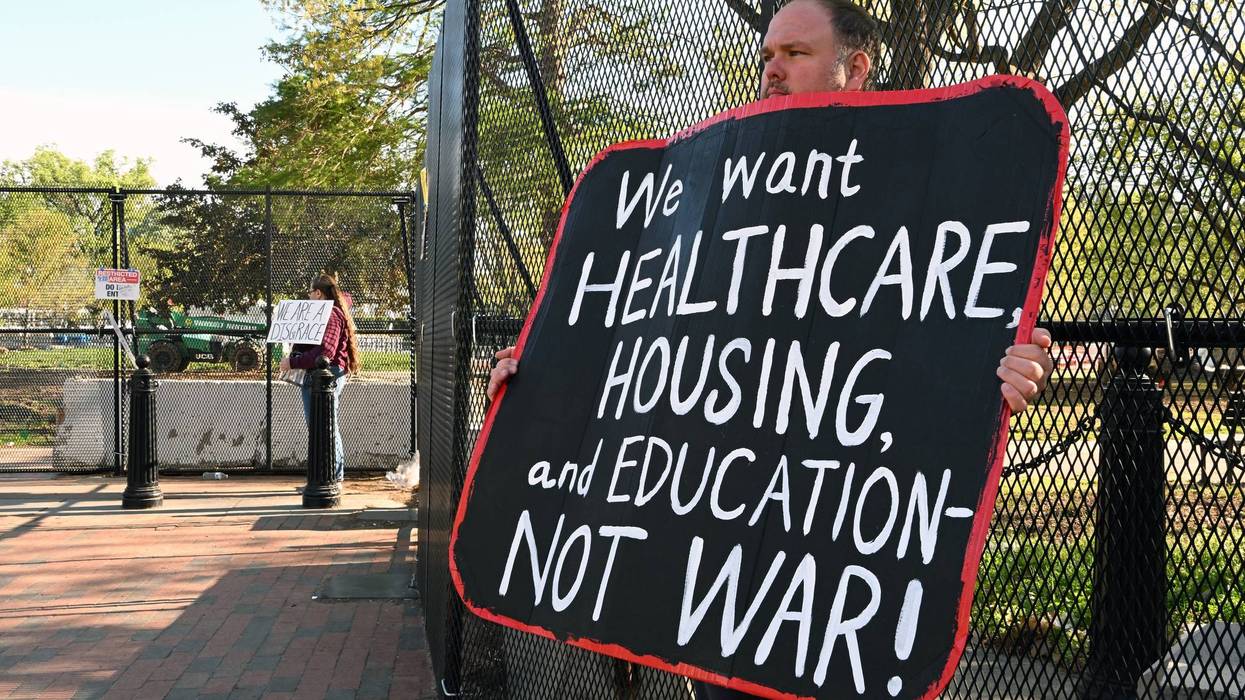
"Our tax dollars are doing more to bomb children in Iran and other countries than to feed and educate children here."
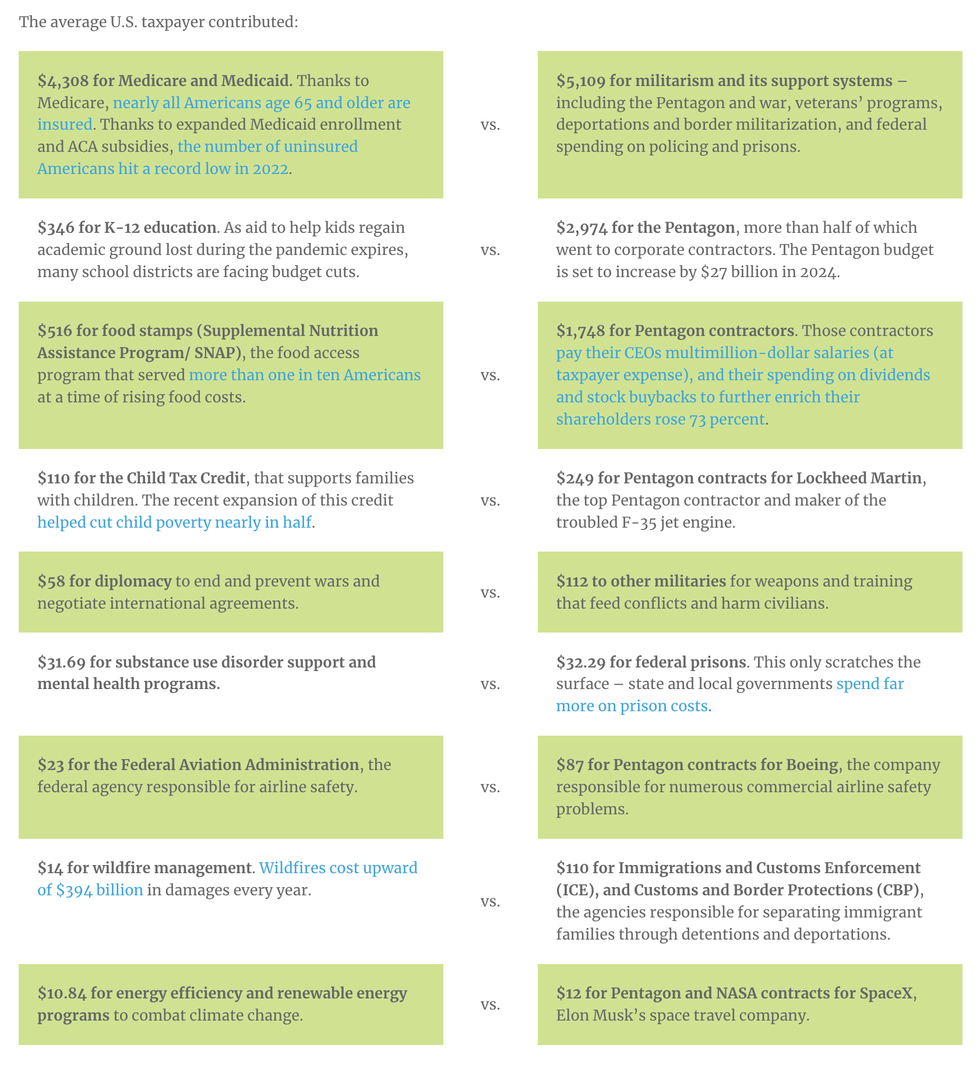
A new analysis released Thursday estimates that the average American taxpayer shelled out over $4,000 to the federal government last year "for militarism and its support systems" such as the Pentagon, whose already-massive annual budget is poised to surge to $1.5 trillion if President Donald Trump gets his way.
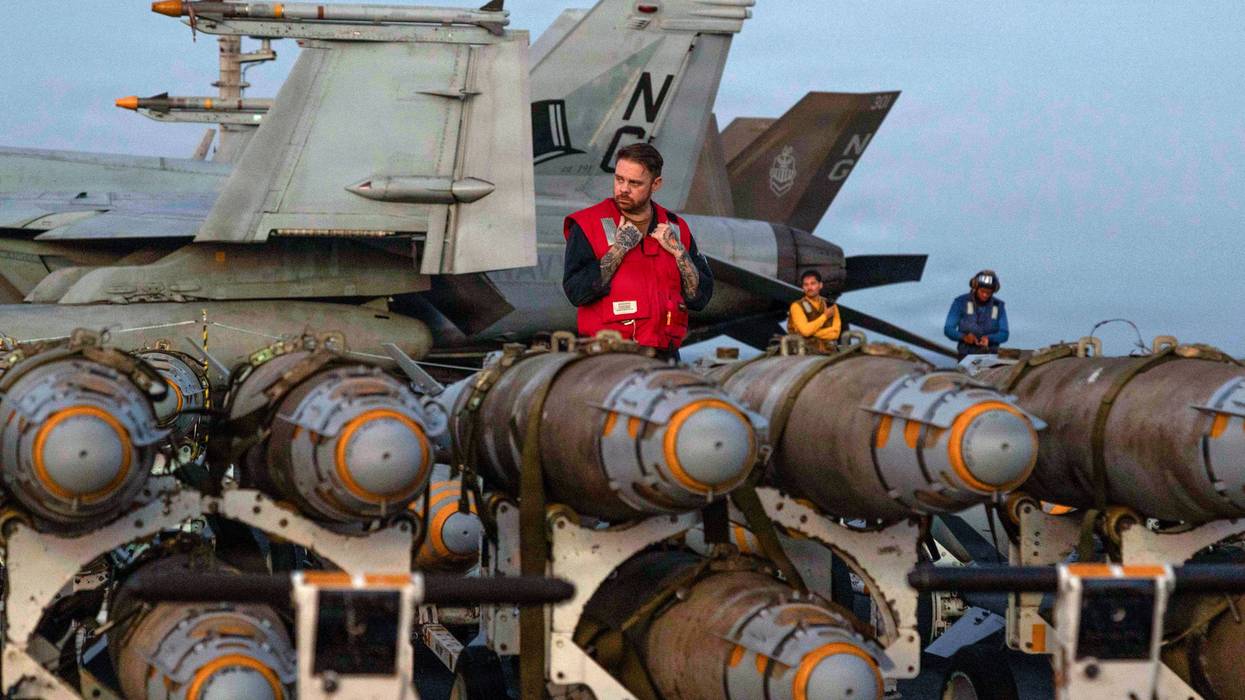
The National Priorities Project (NPP) at the Institute for Policy Studies found in its latest annual Tax Receipt report that, through their federal taxes, the average US taxpayer contributed $4,049.35 to Pentagon contractors, military personnel, nuclear weapons, aid to foreign militaries, and last year's bombing of Iran's nuclear energy facilities. That's significantly more than the average US taxpayer contributed to healthcare for low-income Americans through Medicaid—$2,492.
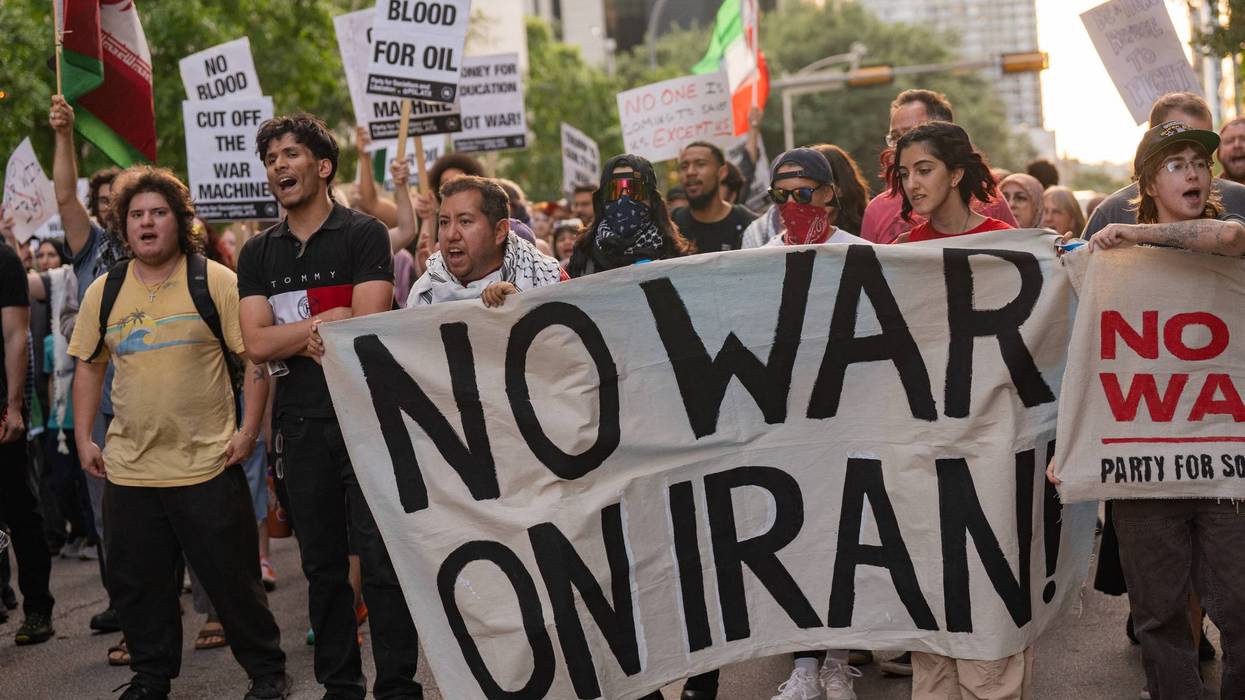
NPP's estimated militarism sum for last year does not include costs related to the current, massively unpopular US-Israeli war on Iran, which began on February 28, 2026 and has already cost Americans billions at the pump.
"But if we place the 2026 Iran war costs in the context of our 2025 tax receipt and put the cost at $35 billion—a line the US is likely on the verge of crossing—the average taxpayer will have paid $130 for the war on Iran, eight times more than the $16 the average taxpayer paid for a full year of home heating and energy assistance in 2025," NPP said.
The $1,870 that the average US taxpayer paid toward Pentagon contractors in 2025 was "fifteen times as much as the $124 the average taxpayer paid for school lunches and other nutrition programs," the analysis found.
“It’s shameful that our tax dollars are doing more to bomb children in Iran and other countries than to feed and educate children here," said Lindsay Koshgarian, NPP's program director. "Instead of spending even more of our hard-earned dollars on war and mass deportation, we deserve a massive reinvestment in making this country a place where we can all survive and thrive."
"We’re facing chronic underinvestment in this country, from healthcare to education and more. That money has instead been funding a $1 trillion war machine and a class of Pentagon contractors getting rich off our tax dollars."
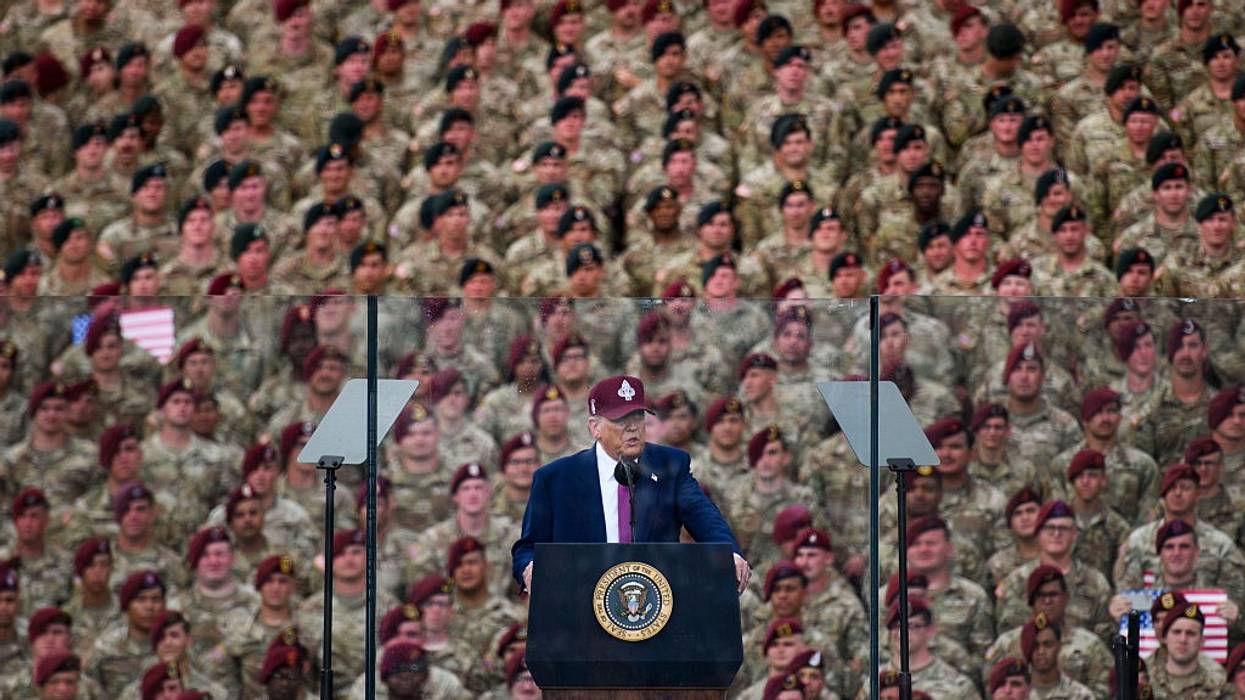
NPP noted that Trump's recent request for a $1.5 trillion US military budget for the coming fiscal year would, if approved by Congress, further drive up costs for American taxpayers.
"Our tax receipt shows why so many people in this country are struggling," said Koshgarian. "We’re facing chronic underinvestment in this country, from healthcare to education and more. That money has instead been funding a $1 trillion war machine and a class of Pentagon contractors getting rich off our tax dollars. The good news is that if we reverse our backwards priorities, we can start to make Americans’ lives better."
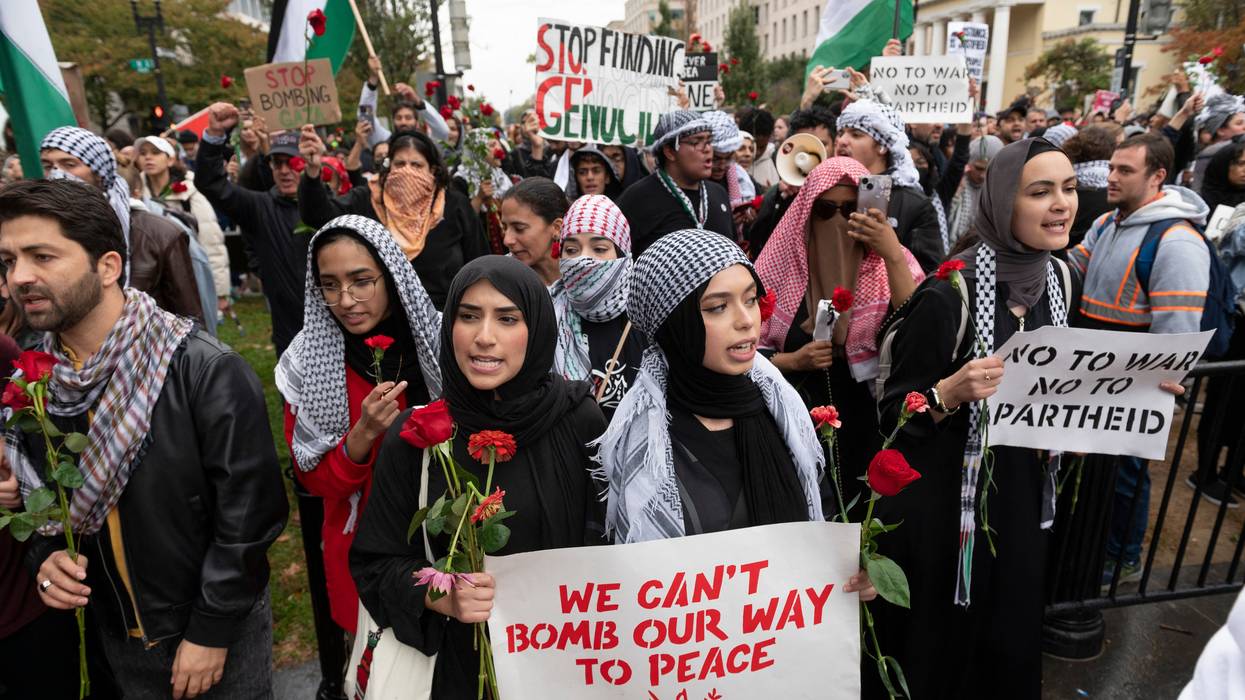
MarketWatch reported earlier this week that Americans are "increasingly saying they won't pay their taxes this year as a political protest," citing the illegal war on Iran and Trump's unleashing of federal immigration agents and National Guard troops on US cities.
Activist and attorney Rachel Cohen wrote in Current Affairs magazine last month that she is not paying her federal income taxes this year, noting that "our enormous military budget is going to illegal wars of aggression in multiple hemispheres."
"When I learned about pacifists who participated in draft refusal during the Vietnam War," Cohen wrote, "I was confident they were doing the right thing, and that if I were similarly situated, I would have joined them."
"Medicare for All, or endless foreign wars?" asked Democratic US Senate candidate Graham Platner. "Anyone in the House or Senate giving the wrong answer should lose their seat."
The daily price tag of US President Donald Trump's illegal war on Iran would be enough to cover the daily costs of federal nutrition assistance for more than 40 million Americans, as well as daily Medicaid costs for the roughly 16 million people expected to lose health coverage due to the Republican budget package that Trump signed into law last year.
That's according to an analysis published Thursday by the National Priorities Project (NPP), which noted that—on an annual basis—the estimated $1 billion-per-day cost of the US war on Iran is "higher than the appropriated budget of any federal agency except the Pentagon itself."
"That money could cover the things we need here at home," wrote NPP's Alliyah Lusuegro and Lindsay Koshgarian. "The tradeoff is clear: the Trump administration—backed by several members of Congress—is cutting healthcare and food assistance for millions of families while spending $1 billion a day on this emerging war."
"The question isn’t whether the money exists—it's what we choose to spend it on," they wrote.
In a social media post on Friday, Democratic US Senate candidate Graham Platner—a veteran of the Iraq and Afghanistan wars—posed what he characterized as a "simple question" to members of Congress: "Medicare for All, or endless foreign wars?"
"Anyone in the House or Senate giving the wrong answer," Platner added, "should lose their seat."
"The cost of the war in Iraq ended up being almost $3 trillion. This could be astronomical, easily.”
The Pentagon's early estimate of the Iran war's cost was first reported by Atlantic journalist Nancy Youssef, who cited an unnamed congressional official.
In a separate analysis released earlier this week, the Center for Strategic and International Studies put the cost of the first 100 hours of the Iran war at $3.7 billion, or $891.4 million per day. The Pentagon is reportedly planning to ask Congress to approve at least $50 billion in supplemental funding for the war, a historically unpopular assault that lawmakers did not authorize.
“Without support from the American people, Donald Trump led the country into a reckless war with Iran that has taken the lives of six service members and injured several others," said Kendall Witmer, rapid response director for the Democratic National Committee. "Now, the White House is scrambling to come up with a plan as the cost of Trump’s war skyrockets. Working families are already struggling with soaring prices and a hollowed-out job market—they can't afford Trump’s war of choice."
On Thursday, Rep. Brendan Boyle (D-Pa.) asked the nonpartisan Congressional Budget Office to conduct a thorough analysis of the financial costs of the Iran war, including scenarios in which the assault drags on for more than five weeks and the US launches a ground invasion.
“Taxpayers deserve a nonpartisan estimate of the financial and economic impact of President Trump’s reckless war in Iran that has already led to the tragic deaths of American servicemembers," said Boyle. "American families don’t want billions of dollars wasted on an unnecessary war—they want lower costs and affordable healthcare.”
Koshgarian of NPP told CNN that the costs of war are "highly unpredictable, and so we won’t know the cost of it until it’s over."
"The cost of the war in Iraq ended up being almost $3 trillion,” Koshgarian said. “This could be astronomical, easily.”
"This militarized spending comes at the expense of federal programs—like public housing—that actually do prevent crime and improve health and education outcomes," said researcher Hanna Homestead.
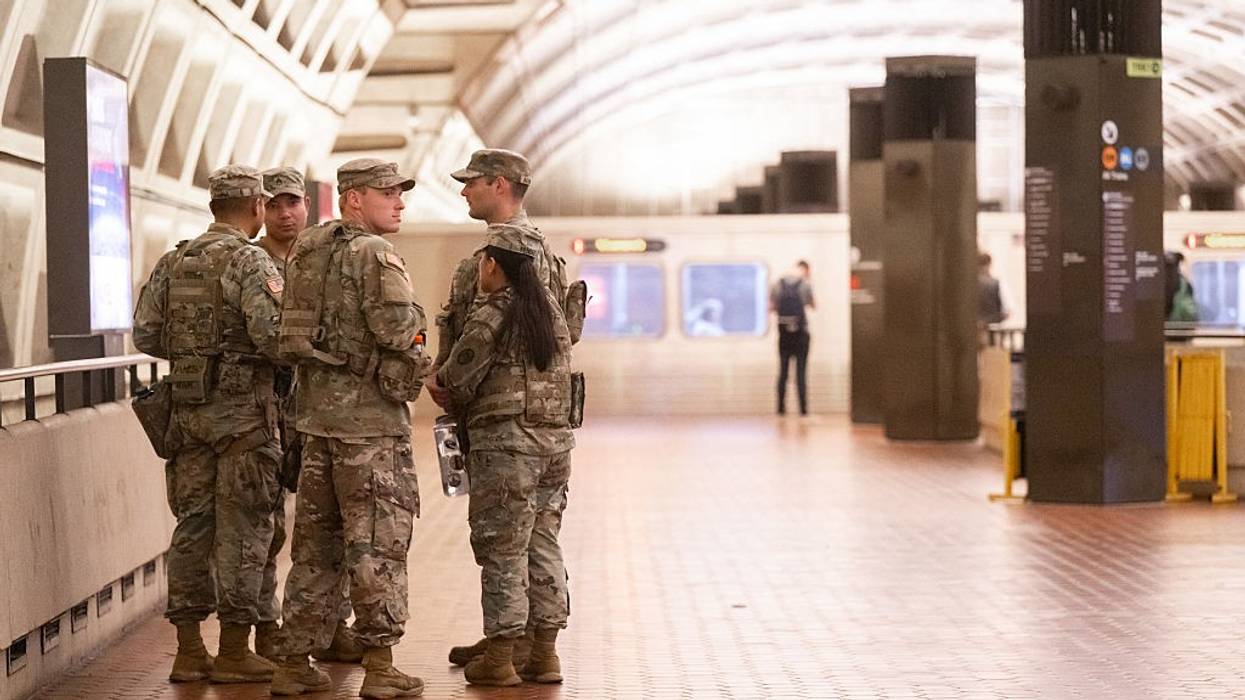
Last week, when Trump federalized Washington, DC's police force and deployed the National Guard to occupy its streets, one of his main orders was to "end vagrancy" by destroying homeless encampments and arresting and forcibly relocating the people taking shelter there.
But according to an investigation published on Wednesday by Hanna Homestead of the National Priorities Project, in collaboration with The Intercept, deploying the National Guard and "getting rid of the slums" is costing far more than it would cost to simply provide housing to every homeless person in the city.
Governors from six US states have sent troops to Washington to help Trump's effort, swelling the ranks to nearly 2,100 who will soon be on patrol.
According to previous reporting, National Guard deployments cost the US government $530 per guard member each day. Using that figure, Homestead estimated that it would cost just over $1.1 million.
She added that "the number of troops will likely continue to grow. And with no deadline for the DC deployment, those costs could add up for months or even years."
According to the most recent data from the Department of Housing and Urban Development (HUD), there are about 5,600 people experiencing either sheltered and unsheltered homelessness in DC on a given night. Operating an affordable housing unit for each one of them, the data shows, costs about $45.44 per person, per day, on average in DC.
Providing affordable housing to every homeless person in DC would cost an estimated $255,166, which is 4.3 times less than the cost of Trump's military deployment.
"Taxpayers like you and me bear the cost of this cruel power grab," Homestead said. "This militarized spending comes at the expense of federal programs—like public housing—that actually do prevent crime and improve health and education outcomes."
Last week, White House Press Secretary Karoline Leavitt told reporters that over 70 encampments had been cleared since Trump's order to federalize the police. She also said that over 600 people had been arrested, though it was not specified how many of them were homeless.
Trump has sought to conflate homelessness with criminality, suggesting that the nation's capital had been "overtaken by violent gangs and bloodthirsty criminals, roving mobs of wild youth, drugged-out maniacs, and homeless people."
While his solution has been a show of military force against people with nowhere to go, a large body of research suggests that the approach of providing "Housing First"—meaning a stable place to stay with no preconditions for sobriety or treatment—reduces crime.
A 2021 study from UCLA found that providing homeless people with targeted housing assistance reduced the probability of committing a crime by 80%.
"Arresting or ticketing people for sleeping outside makes homelessness worse, wastes taxpayer money, and simply does not work," said Jesse Rabinowitz of the National Homelessness Law Center. "The solution to homelessness is housing and supports, not handcuffs and jails."
But in addition to a crackdown on the homeless, the Trump administration is also pushing to eliminate funds for public housing. The White House's proposed budget for fiscal year 2026 slashes funding for HUD's Continuum of Care program, which provided cities with funding for initiatives to house the homeless.
According to the National Alliance to End Homelessness, the proposal would effectively end funding of permanent supportive housing for 170,000 residents and potentially increase the number of homeless people in the US by 36%.
"Arresting people for no reason other than the fact that they have no home is inhumane and unjust," said Amber W. Harding, executive director of the Washington Legal Clinic for the Homeless. "It is particularly cruel to do so knowing that federal and local housing programs have been slashed and that DC does not have enough shelter beds."
"Fines, arrests, and encampment evictions make homelessness worse, further traumatize our homeless neighbors while disconnecting them from community and support," said Dana White, Director of Advocacy at Miriam's Kitchen, a DC-based homeless services organization. "If policing resolved homelessness, we wouldn't have homelessness here in DC or anywhere else in this country."