

SUBSCRIBE TO OUR FREE NEWSLETTER
Daily news & progressive opinion—funded by the people, not the corporations—delivered straight to your inbox.
5
#000000
#FFFFFF
To donate by check, phone, or other method, see our More Ways to Give page.
Daily news & progressive opinion—funded by the people, not the corporations—delivered straight to your inbox.
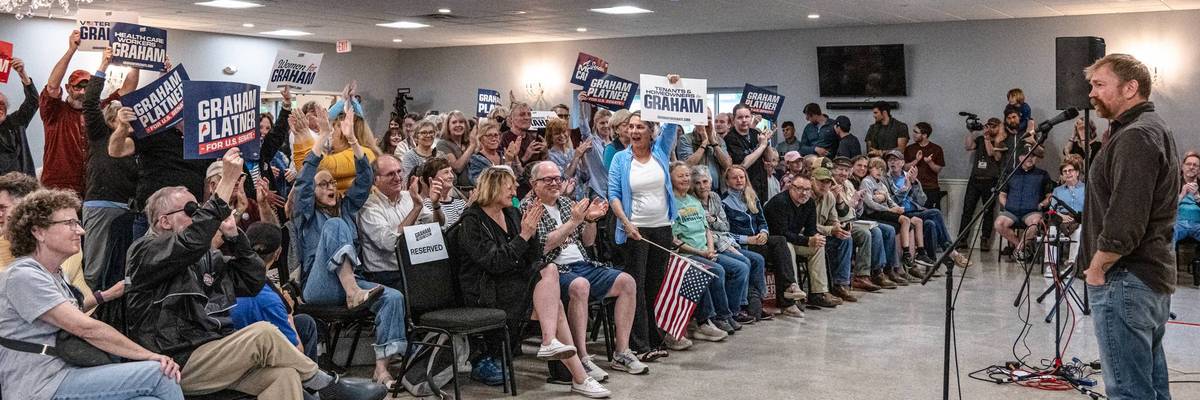
Democratic US Senate candidate Graham Platner speaks to voters at a town hall at the Elks Lodge 188 on June 7, 2026 in Portland, Maine.
“We’re going to win on Tuesday, and we’re going to win in November, and we’re going to take power back for the people in this country," said the US Senate candidate from Maine.
At Democratic US Senate candidate Graham Platner's final town hall ahead of Tuesday's primary election in Maine, the combat veteran and oyster farmer received a warm welcome from roughly 400 attendees who appeared eager to focus on the candidate's policy platform and issues affecting working Mainers rather than numerous attacks that have been launched against him in recent months.
Platner walked into a meeting room at an Elks Lodge in Portland, Maine's largest city, to a standing ovation and said, as he had at a rally on Friday with Rep. Ro Khanna (D-Calif.) in Bar Harbor, that Mainers have shown they "have my back."
“We’re going to win on Tuesday, and we’re going to win in November, and we’re going to take power back for the people in this country," he told the crowd.
After speaking for close to an hour about issues including economic inequality, his goal of being "a voice that says no to war" in the US Senate, and his push for Medicare for All, Platner opened the floor for questions that focused on repealing Citizens United, his plan to pass a billionaire wealth tax, and the lawmakers and Senate committees the political newcomer has begun building relationships with as he aims to unseat Republican Sen. Susan Collins.
He named Sen. Rand Paul (R-Ky.) as a lawmaker he has little in common with ideologically but with whom he shares a goal of ending "forever wars," and listed Sens. Chris Van Hollen (D-Md.), Bernie Sanders (I-Vt.), and Elizabeth Warren (D-Mass.) as some of the other senators he hopes to work with closely.
One woman stood up to note that some in the national corporate media have appeared certain in recent days that they "know" the voters of Maine and that they are likely to turn against Platner following news stories about his past marital struggles, former relationships, comments he made online years ago, and a tattoo he got while in the Marines.
"What do people not understand about Mainers?" the voter asked.
Platner answered that he's had conversations about economic inequality with people across the state—including at more than 80 town halls—and said that those focused on the controversies don't understand "how clear-eyed" and "how frustrated" Maine voters are with the political status quo.
“I think a lot of folks at the national level misunderstand,” he said at one point. “The reason they keep getting everything wrong is they think this is a race about me, but it isn’t. This is a race about us. This is a race about the future of politics in Maine."
One voter, Kurt Fedora of Buxton, told The Associated Press that he views the controversies that the national media has focused on in recent months as a smear campaign.
"They’re really reaching far to try to pin something on him. And it’s politics as usual,” Fedora told the outlet.
As Common Dreams noted Sunday, The New York Times' reporting last week on allegations that Platner was physically aggressive in past relationships—which he denied—has not appeared to make a dent in his campaign's fundraising. As he rallied with Khanna the day after the report came out, the campaign announced it had raised over $200,000 that day—"more money than on any day" since Gov. Janet Mills suspended her campaign in April.
Similarly, when earlier stories broke about his tattoo and Reddit posts, Platner only widened his lead over Mills in primary polls.
One attendee named Paul told Common Dreams that at the Sunday town hall, Platner had "described a system that needs to be changed," and that the same system "is out to destroy him in any way they can" by publishing stories like one that focused on Platner's text messages with women early in his marriage.
"There was no way I could care less about that," he said. "I always like to say, it's between him and his wife."
Another supporter, Claudia, added that ahead of Tuesday's primary election, she is "looking at the bigger picture."
"This country is in a really dangerous state. I mean, it's terrifying every day," she told Common Dreams. "You want more Susan Collins? I don't think so."
"I really appreciated the fact that he knows that he needs to have people with whom he has a relationship in Washington and with whom he can work," she added, turning her attention to the substance of Platner's remarks. "I feel like he's done a really good job of not only appreciating what so many of the issues are, but how he can engage with people down there [in DC]."
Platner emphasized that the Democratic Party has tried to unseat Collins numerous times since she took office in 1997, most recently with moderate state lawmaker Sara Gideon in 2020. Mills spoke affectionately about Collins last September, a month before she jumped into the race, saying she appreciates "everything she is doing" during President Donald Trump's second term.
Collins has long cast herself as a "moderate" and a defender of women's rights in particular, despite the fact that she has voted to confirm more than a dozen anti-choice judges in Trump's second administration alone.
“We are going to beat someone that the establishment of the Democratic Party has failed to unseat for 30 years,” Platner said. “We are going to beat someone who, for years, has tried to trick us all into thinking that she’s a moderate.”
While focusing their attention on Platner's policy platform, some in the crowd at the town hall suggested they were eager to rally for the candidate partially because of the recent attacks on his character. One attendee, Laurie Hudson, passed around a card she had made that read, "We are your Graham-ily and we've got your back," asking others in the audience to sign. She presented it to Platner after his opening remarks.
Platner urged attendees to get involved not only in his campaign's get-out-the-vote efforts in the final days of the primary campaign—by "going out into our communities and having hard conversations"—but in a larger movement powered by the working class, aimed at beating back Trump's agenda and the corporations and dark money groups that helped pave his way to the White House by pouring billions of dollars into elections.
"Throughout history, the only thing that's ever beaten fascism is a broad-based working-class coalition," said Platner. "This is a race about building power the old-fashioned way, from the ground up... Join a labor union, go help out at the local food pantry, go help out at a food bank, but you've got to do something. Because the moment we're in right now, it's going to require all of us.
Dear Common Dreams reader, It’s been nearly 30 years since I co-founded Common Dreams with my late wife, Lina Newhouser. We had the radical notion that journalism should serve the public good, not corporate profits. It was clear to us from the outset what it would take to build such a project. No paid advertisements. No corporate sponsors. No millionaire publisher telling us what to think or do. Many people said we wouldn't last a year, but we proved those doubters wrong. Together with a tremendous team of journalists and dedicated staff, we built an independent media outlet free from the constraints of profits and corporate control. Our mission has always been simple: To inform. To inspire. To ignite change for the common good. Building Common Dreams was not easy. Our survival was never guaranteed. When you take on the most powerful forces—Wall Street greed, fossil fuel industry destruction, Big Tech lobbyists, and uber-rich oligarchs who have spent billions upon billions rigging the economy and democracy in their favor—the only bulwark you have is supporters who believe in your work. But here’s the urgent message from me today. It's never been this bad out there. And it's never been this hard to keep us going. At the very moment Common Dreams is most needed, the threats we face are intensifying. We need your support now more than ever. We don't accept corporate advertising and never will. We don't have a paywall because we don't think people should be blocked from critical news based on their ability to pay. Everything we do is funded by the donations of readers like you. When everyone does the little they can afford, we are strong. But if that support retreats or dries up, so do we. Will you donate now to make sure Common Dreams not only survives but thrives? —Craig Brown, Co-founder |
At Democratic US Senate candidate Graham Platner's final town hall ahead of Tuesday's primary election in Maine, the combat veteran and oyster farmer received a warm welcome from roughly 400 attendees who appeared eager to focus on the candidate's policy platform and issues affecting working Mainers rather than numerous attacks that have been launched against him in recent months.
Platner walked into a meeting room at an Elks Lodge in Portland, Maine's largest city, to a standing ovation and said, as he had at a rally on Friday with Rep. Ro Khanna (D-Calif.) in Bar Harbor, that Mainers have shown they "have my back."
“We’re going to win on Tuesday, and we’re going to win in November, and we’re going to take power back for the people in this country," he told the crowd.
After speaking for close to an hour about issues including economic inequality, his goal of being "a voice that says no to war" in the US Senate, and his push for Medicare for All, Platner opened the floor for questions that focused on repealing Citizens United, his plan to pass a billionaire wealth tax, and the lawmakers and Senate committees the political newcomer has begun building relationships with as he aims to unseat Republican Sen. Susan Collins.
He named Sen. Rand Paul (R-Ky.) as a lawmaker he has little in common with ideologically but with whom he shares a goal of ending "forever wars," and listed Sens. Chris Van Hollen (D-Md.), Bernie Sanders (I-Vt.), and Elizabeth Warren (D-Mass.) as some of the other senators he hopes to work with closely.
One woman stood up to note that some in the national corporate media have appeared certain in recent days that they "know" the voters of Maine and that they are likely to turn against Platner following news stories about his past marital struggles, former relationships, comments he made online years ago, and a tattoo he got while in the Marines.
"What do people not understand about Mainers?" the voter asked.
Platner answered that he's had conversations about economic inequality with people across the state—including at more than 80 town halls—and said that those focused on the controversies don't understand "how clear-eyed" and "how frustrated" Maine voters are with the political status quo.
“I think a lot of folks at the national level misunderstand,” he said at one point. “The reason they keep getting everything wrong is they think this is a race about me, but it isn’t. This is a race about us. This is a race about the future of politics in Maine."
One voter, Kurt Fedora of Buxton, told The Associated Press that he views the controversies that the national media has focused on in recent months as a smear campaign.
"They’re really reaching far to try to pin something on him. And it’s politics as usual,” Fedora told the outlet.
As Common Dreams noted Sunday, The New York Times' reporting last week on allegations that Platner was physically aggressive in past relationships—which he denied—has not appeared to make a dent in his campaign's fundraising. As he rallied with Khanna the day after the report came out, the campaign announced it had raised over $200,000 that day—"more money than on any day" since Gov. Janet Mills suspended her campaign in April.
Similarly, when earlier stories broke about his tattoo and Reddit posts, Platner only widened his lead over Mills in primary polls.
One attendee named Paul told Common Dreams that at the Sunday town hall, Platner had "described a system that needs to be changed," and that the same system "is out to destroy him in any way they can" by publishing stories like one that focused on Platner's text messages with women early in his marriage.
"There was no way I could care less about that," he said. "I always like to say, it's between him and his wife."
Another supporter, Claudia, added that ahead of Tuesday's primary election, she is "looking at the bigger picture."
"This country is in a really dangerous state. I mean, it's terrifying every day," she told Common Dreams. "You want more Susan Collins? I don't think so."
"I really appreciated the fact that he knows that he needs to have people with whom he has a relationship in Washington and with whom he can work," she added, turning her attention to the substance of Platner's remarks. "I feel like he's done a really good job of not only appreciating what so many of the issues are, but how he can engage with people down there [in DC]."
Platner emphasized that the Democratic Party has tried to unseat Collins numerous times since she took office in 1997, most recently with moderate state lawmaker Sara Gideon in 2020. Mills spoke affectionately about Collins last September, a month before she jumped into the race, saying she appreciates "everything she is doing" during President Donald Trump's second term.
Collins has long cast herself as a "moderate" and a defender of women's rights in particular, despite the fact that she has voted to confirm more than a dozen anti-choice judges in Trump's second administration alone.
“We are going to beat someone that the establishment of the Democratic Party has failed to unseat for 30 years,” Platner said. “We are going to beat someone who, for years, has tried to trick us all into thinking that she’s a moderate.”
While focusing their attention on Platner's policy platform, some in the crowd at the town hall suggested they were eager to rally for the candidate partially because of the recent attacks on his character. One attendee, Laurie Hudson, passed around a card she had made that read, "We are your Graham-ily and we've got your back," asking others in the audience to sign. She presented it to Platner after his opening remarks.
Platner urged attendees to get involved not only in his campaign's get-out-the-vote efforts in the final days of the primary campaign—by "going out into our communities and having hard conversations"—but in a larger movement powered by the working class, aimed at beating back Trump's agenda and the corporations and dark money groups that helped pave his way to the White House by pouring billions of dollars into elections.
"Throughout history, the only thing that's ever beaten fascism is a broad-based working-class coalition," said Platner. "This is a race about building power the old-fashioned way, from the ground up... Join a labor union, go help out at the local food pantry, go help out at a food bank, but you've got to do something. Because the moment we're in right now, it's going to require all of us.
At Democratic US Senate candidate Graham Platner's final town hall ahead of Tuesday's primary election in Maine, the combat veteran and oyster farmer received a warm welcome from roughly 400 attendees who appeared eager to focus on the candidate's policy platform and issues affecting working Mainers rather than numerous attacks that have been launched against him in recent months.
Platner walked into a meeting room at an Elks Lodge in Portland, Maine's largest city, to a standing ovation and said, as he had at a rally on Friday with Rep. Ro Khanna (D-Calif.) in Bar Harbor, that Mainers have shown they "have my back."
“We’re going to win on Tuesday, and we’re going to win in November, and we’re going to take power back for the people in this country," he told the crowd.
After speaking for close to an hour about issues including economic inequality, his goal of being "a voice that says no to war" in the US Senate, and his push for Medicare for All, Platner opened the floor for questions that focused on repealing Citizens United, his plan to pass a billionaire wealth tax, and the lawmakers and Senate committees the political newcomer has begun building relationships with as he aims to unseat Republican Sen. Susan Collins.
He named Sen. Rand Paul (R-Ky.) as a lawmaker he has little in common with ideologically but with whom he shares a goal of ending "forever wars," and listed Sens. Chris Van Hollen (D-Md.), Bernie Sanders (I-Vt.), and Elizabeth Warren (D-Mass.) as some of the other senators he hopes to work with closely.
One woman stood up to note that some in the national corporate media have appeared certain in recent days that they "know" the voters of Maine and that they are likely to turn against Platner following news stories about his past marital struggles, former relationships, comments he made online years ago, and a tattoo he got while in the Marines.
"What do people not understand about Mainers?" the voter asked.
Platner answered that he's had conversations about economic inequality with people across the state—including at more than 80 town halls—and said that those focused on the controversies don't understand "how clear-eyed" and "how frustrated" Maine voters are with the political status quo.
“I think a lot of folks at the national level misunderstand,” he said at one point. “The reason they keep getting everything wrong is they think this is a race about me, but it isn’t. This is a race about us. This is a race about the future of politics in Maine."
One voter, Kurt Fedora of Buxton, told The Associated Press that he views the controversies that the national media has focused on in recent months as a smear campaign.
"They’re really reaching far to try to pin something on him. And it’s politics as usual,” Fedora told the outlet.
As Common Dreams noted Sunday, The New York Times' reporting last week on allegations that Platner was physically aggressive in past relationships—which he denied—has not appeared to make a dent in his campaign's fundraising. As he rallied with Khanna the day after the report came out, the campaign announced it had raised over $200,000 that day—"more money than on any day" since Gov. Janet Mills suspended her campaign in April.
Similarly, when earlier stories broke about his tattoo and Reddit posts, Platner only widened his lead over Mills in primary polls.
One attendee named Paul told Common Dreams that at the Sunday town hall, Platner had "described a system that needs to be changed," and that the same system "is out to destroy him in any way they can" by publishing stories like one that focused on Platner's text messages with women early in his marriage.
"There was no way I could care less about that," he said. "I always like to say, it's between him and his wife."
Another supporter, Claudia, added that ahead of Tuesday's primary election, she is "looking at the bigger picture."
"This country is in a really dangerous state. I mean, it's terrifying every day," she told Common Dreams. "You want more Susan Collins? I don't think so."
"I really appreciated the fact that he knows that he needs to have people with whom he has a relationship in Washington and with whom he can work," she added, turning her attention to the substance of Platner's remarks. "I feel like he's done a really good job of not only appreciating what so many of the issues are, but how he can engage with people down there [in DC]."
Platner emphasized that the Democratic Party has tried to unseat Collins numerous times since she took office in 1997, most recently with moderate state lawmaker Sara Gideon in 2020. Mills spoke affectionately about Collins last September, a month before she jumped into the race, saying she appreciates "everything she is doing" during President Donald Trump's second term.
Collins has long cast herself as a "moderate" and a defender of women's rights in particular, despite the fact that she has voted to confirm more than a dozen anti-choice judges in Trump's second administration alone.
“We are going to beat someone that the establishment of the Democratic Party has failed to unseat for 30 years,” Platner said. “We are going to beat someone who, for years, has tried to trick us all into thinking that she’s a moderate.”
While focusing their attention on Platner's policy platform, some in the crowd at the town hall suggested they were eager to rally for the candidate partially because of the recent attacks on his character. One attendee, Laurie Hudson, passed around a card she had made that read, "We are your Graham-ily and we've got your back," asking others in the audience to sign. She presented it to Platner after his opening remarks.
Platner urged attendees to get involved not only in his campaign's get-out-the-vote efforts in the final days of the primary campaign—by "going out into our communities and having hard conversations"—but in a larger movement powered by the working class, aimed at beating back Trump's agenda and the corporations and dark money groups that helped pave his way to the White House by pouring billions of dollars into elections.
"Throughout history, the only thing that's ever beaten fascism is a broad-based working-class coalition," said Platner. "This is a race about building power the old-fashioned way, from the ground up... Join a labor union, go help out at the local food pantry, go help out at a food bank, but you've got to do something. Because the moment we're in right now, it's going to require all of us.

