SUBSCRIBE TO OUR FREE NEWSLETTER
Daily news & progressive opinion—funded by the people, not the corporations—delivered straight to your inbox.
5
#000000
#FFFFFF
To donate by check, phone, or other method, see our More Ways to Give page.
Daily news & progressive opinion—funded by the people, not the corporations—delivered straight to your inbox.
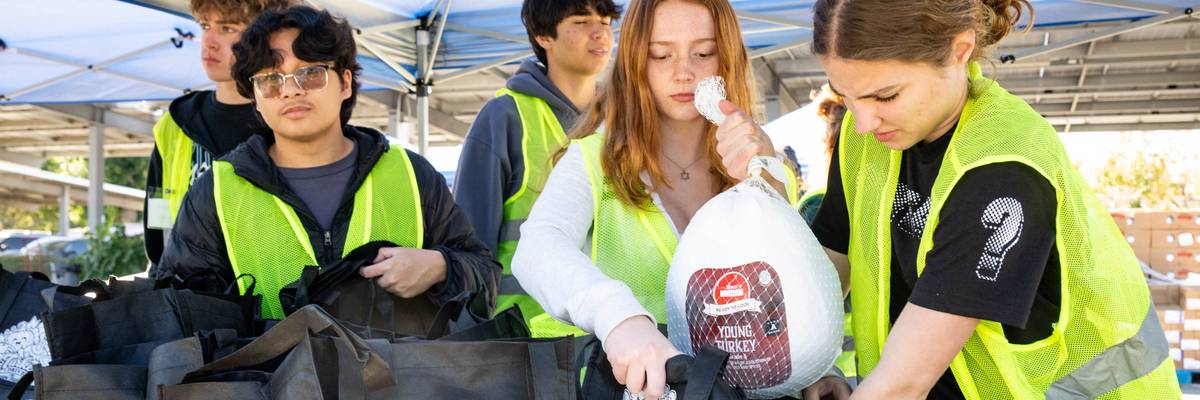
Volunteers load turkeys during a food giveaway for more than 1,000 families in Van Nuys, California on November 23, 2026.
"One in four kids in our service area are at risk of hunger," said one charity official in Texas. "That's the worst that that stat's ever been in the 16 years that I've been doing food bank work."
Food banks across the United States reported unusually high demand around the Thanksgiving holiday as families squeezed by high grocery prices and federal aid cuts turned to charitable groups to help put food on the table.
Julie Butner, president and CEO of Tarrant Area Food Bank—which serves more than a dozen counties in North Texas—told CBS News on Thursday that "the demand is bigger than I expected." She said the food bank expected 4,000 families to turn out for their annual holiday-season market, but more than 5,400 showed up.
The president of Feeding America, which manages a network of more than 250 food banks nationwide, told NPR that "we are really seeing a new era of elevated and sustained demand across the country."
"We're serving 25% more people than we were pre-pandemic. And the numbers continue to climb," said Linda Nageotte, pointing to the significance of the Supplemental Nutrition Assistance Program (SNAP) cuts enacted by President Donald Trump and congressional Republicans last year.
"For every meal's worth of food your local food bank distributes, the SNAP program has historically provided nine meals," Nageotte observed. "So even if we were to be able to double or triple or quadruple in size as a national food bank network, which we can't, we wouldn't be able to make up the gaps. The SNAP program is so important."
Mark Jackson, chief development officer for the Central Texas Food Bank, said earlier this week that "one in four kids in our service area are at risk of hunger."
"That's the worst that that stat's ever been in the 16 years that I've been doing food bank work," said Jackson.
Just two weeks before Thanksgiving Day, the Trump administration unveiled a proposed rule targeting a policy that allows states to automatically enroll certain people in SNAP if they're receiving other federal benefits. According to the Trump administration's own analysis, the new rule would take SNAP assistance from 6.3 million people in fiscal year 2029, the rule's first year in full effect. Among those impacted would be children who would lose access to free school meals.
Since the summer of 2025, when Trump signed a sprawling Republican budget measure into law, around 5.5 million people have lost SNAP benefits—a number that's expected to keep growing as the GOP law's changes take effect.
"As families struggle with the rising cost of groceries, this administration is making it even harder to put food on the table," Rep. Jim Himes (D-Conn.) wrote in a social media post on Thursday.
A recent analysis by the Groundwork Collaborative and The Century Foundation found that a full Thanksgiving meal cost families around 11% more than last year.
"Some holiday staples are running 30% higher or more, including a box of macaroni pasta (up 40.2%) and green beans (up 36.7%)," the group found.
MS NOW editor Zeeshan Aleem wrote in a column on Thursday that "for the first time since 2022, Americans will see a year-over-year increase in the price of goods for Thanksgiving dinner, according to the American Farm Bureau Federation."
"The Farm Bureau attributes those higher costs in part to higher diesel prices (driven higher by the war in Iran), which make processing and transporting foods like potatoes and cranberries more expensive," Aleem noted. "Every day, the ruse of right-wing populism becomes clearer. Trump claimed to be a champion on behalf of the people, but he spends his energy focusing on helping make the rich richer, and leaves scraps for the poor."
This country and this world are at a monumental crossroads. US voters have an opportunity to beat back the forces of fascism and confront the billionaires who are rigging the economy, our media system, and our democracy, making it increasingly impossible for ordinary people to get by. We’re not just talking about the election. We’re talking about what must be done once these fascist elements are vanquished from power. We need a bolder set of solutions than what either major party has so far been willing to offer and a working-class movement ready to fight like hell for it. Trump didn't emerge from nowhere. The conditions that fueled MAGA authoritarianism were created by decades of radical neoliberal economic policies and a corrupt political system dominated by corporate interests. They slashed taxes on the super-rich, promising that the benefits would trickle down. They said giveaways to the corporate titans would make life more affordable for the rest of us. It was all bullshit. And when a bitter, betrayed populace searches for someone to blame, right-wing demagogues have little trouble finding scapegoats. People know when they're being lied to, but you won't hear any of this from the corporate media. Only independent journalism—powered and funded by people who believe in building a better world—can deliver truly trustworthy daily news. If you share our vision, please contribute whatever you can to sustain our work. |
Food banks across the United States reported unusually high demand around the Thanksgiving holiday as families squeezed by high grocery prices and federal aid cuts turned to charitable groups to help put food on the table.
Julie Butner, president and CEO of Tarrant Area Food Bank—which serves more than a dozen counties in North Texas—told CBS News on Thursday that "the demand is bigger than I expected." She said the food bank expected 4,000 families to turn out for their annual holiday-season market, but more than 5,400 showed up.
The president of Feeding America, which manages a network of more than 250 food banks nationwide, told NPR that "we are really seeing a new era of elevated and sustained demand across the country."
"We're serving 25% more people than we were pre-pandemic. And the numbers continue to climb," said Linda Nageotte, pointing to the significance of the Supplemental Nutrition Assistance Program (SNAP) cuts enacted by President Donald Trump and congressional Republicans last year.
"For every meal's worth of food your local food bank distributes, the SNAP program has historically provided nine meals," Nageotte observed. "So even if we were to be able to double or triple or quadruple in size as a national food bank network, which we can't, we wouldn't be able to make up the gaps. The SNAP program is so important."
Mark Jackson, chief development officer for the Central Texas Food Bank, said earlier this week that "one in four kids in our service area are at risk of hunger."
"That's the worst that that stat's ever been in the 16 years that I've been doing food bank work," said Jackson.
Just two weeks before Thanksgiving Day, the Trump administration unveiled a proposed rule targeting a policy that allows states to automatically enroll certain people in SNAP if they're receiving other federal benefits. According to the Trump administration's own analysis, the new rule would take SNAP assistance from 6.3 million people in fiscal year 2029, the rule's first year in full effect. Among those impacted would be children who would lose access to free school meals.
Since the summer of 2025, when Trump signed a sprawling Republican budget measure into law, around 5.5 million people have lost SNAP benefits—a number that's expected to keep growing as the GOP law's changes take effect.
"As families struggle with the rising cost of groceries, this administration is making it even harder to put food on the table," Rep. Jim Himes (D-Conn.) wrote in a social media post on Thursday.
A recent analysis by the Groundwork Collaborative and The Century Foundation found that a full Thanksgiving meal cost families around 11% more than last year.
"Some holiday staples are running 30% higher or more, including a box of macaroni pasta (up 40.2%) and green beans (up 36.7%)," the group found.
MS NOW editor Zeeshan Aleem wrote in a column on Thursday that "for the first time since 2022, Americans will see a year-over-year increase in the price of goods for Thanksgiving dinner, according to the American Farm Bureau Federation."
"The Farm Bureau attributes those higher costs in part to higher diesel prices (driven higher by the war in Iran), which make processing and transporting foods like potatoes and cranberries more expensive," Aleem noted. "Every day, the ruse of right-wing populism becomes clearer. Trump claimed to be a champion on behalf of the people, but he spends his energy focusing on helping make the rich richer, and leaves scraps for the poor."