SUBSCRIBE TO OUR FREE NEWSLETTER
Daily news & progressive opinion—funded by the people, not the corporations—delivered straight to your inbox.
5
#000000
#FFFFFF
To donate by check, phone, or other method, see our More Ways to Give page.
Daily news & progressive opinion—funded by the people, not the corporations—delivered straight to your inbox.
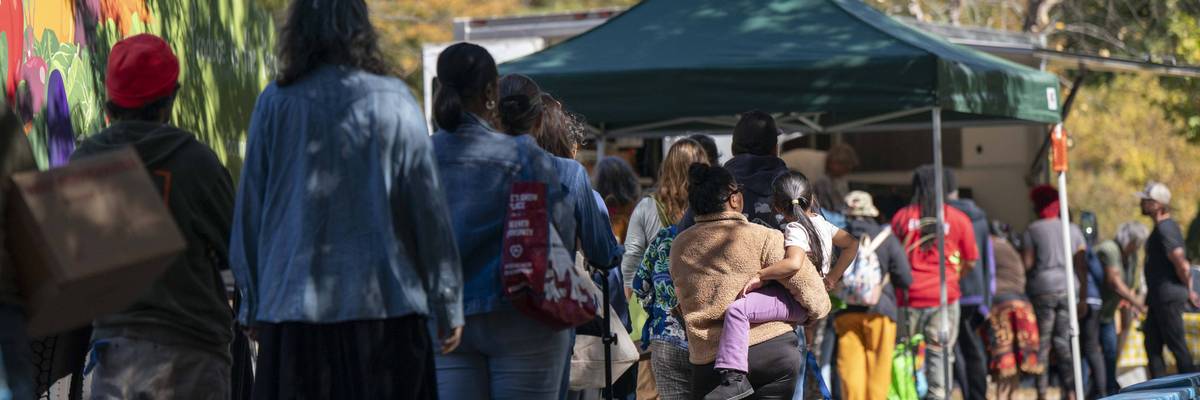
People line up to receive food at the Bounty & Soul food bank on October 30, 2026 in Asheville, North Carolina.
"The Trump administration is doubling down on making it harder for people to feed their families, after already enacting the deepest cuts to SNAP in history."
The Trump administration on Tuesday rolled out a proposed rule that would further restrict access to the United States' largest and most effective anti-hunger program, taking benefits from more than 6 million people—including many children—as grocery prices continue to rise and food bank demand surges nationwide.
The US Department of Agriculture's proposal, published in the Federal Register on Tuesday, targets a policy known as broad-based categorical eligibility (BBCE), which allows states to deem recipients of other federal benefits eligible for the Supplemental Nutrition Assistance Program (SNAP). Experts say the policy reduces administrative burdens for states and individuals by streamlining the SNAP application process.
Under the new rule, households with annual gross incomes above 130 percent of the poverty line—roughly $35,500 per year for a family of three—would lose SNAP benefits, according to an analysis released Tuesday by the Center on Budget and Policy Priorities (CBPP), a liberal think tank.
"In the midterm elections, the public indicated they want their elected officials to focus on making life affordable. Yet the Trump administration is doubling down on making it harder for people to feed their families, after already enacting the deepest cuts to SNAP in history," said Ty Jones Cox, vice president for food assistance at CBPP. "These attacks are part of the administration’s broader policy agenda that has raised costs and made it harder for working families to afford their basic needs, all to partially pay for trillions of dollars in tax cuts heavily weighted to the wealthy and fund its extreme and aggressive immigration detention apparatus."
According to the Trump administration's own analysis, the proposed rule would strip SNAP benefits from 3.2 million households—or around 6.3 million individuals—in fiscal year 2029, the first year the rule would take full effect. The USDA's proposal is open to public comment for just 30 days.
The Food Research & Action Center (FRAC) warned in a statement Tuesday that the impact of the rule "could be far worse" than the administration's projection, pointing to the disastrous and ongoing effects of SNAP cuts enacted under the 2025 Trump-GOP budget law. An estimated 5.5 million people—including roughly 1.5 million children—have lost SNAP benefits since the budget law's enactment, an outcome that Trump administration officials have celebrated.
Condemning the new proposal as "unconscionable," FRAC warned the rule's impacts would extend beyond the SNAP program, including by reducing access to free school meals, "making children hungry at home and at school."
"Children who lose SNAP are no longer automatically eligible for free school meals. Some would no longer be eligible for free school meals; others would be at risk of falling through the cracks when they go through the school meal application process," the group said. "The proposed rule would also negatively affect babies and toddlers, and pregnant, postpartum, and breastfeeding parents who are automatically income eligible for the Special Supplemental Nutrition Program for Women, Infants, and Children (WIC), because they participate in SNAP. This rule would make it more difficult for households that lose SNAP to apply for WIC. Losing both SNAP and WIC would harm hundreds of thousands of infants and young children during their initial stages of development."
BBCE has long been a target of right-wing policy architects and Republican lawmakers. Project 2025, the policy blueprint released by the conservative Heritage Foundation, called for reforming the policy.
Rep. Angie Craig (D-Minn.), the top Democrat on the House Agriculture Committee, condemned the USDA's proposal as "heartless and cruel," warning it would make it harder for families "to meet basic needs" and undercut states' efforts to "streamline federal programs."
"SNAP is a highly effective and efficient program when it is allowed to work as designed," said Craig. "Unfortunately, the Trump administration and the outgoing Republican majority in Congress have undermined the program’s integrity at every turn, harming millions of vulnerable Americans in the process."
This country and this world are at a monumental crossroads. US voters have an opportunity to beat back the forces of fascism and confront the billionaires who are rigging the economy, our media system, and our democracy, making it increasingly impossible for ordinary people to get by. We’re not just talking about the election. We’re talking about what must be done once these fascist elements are vanquished from power. We need a bolder set of solutions than what either major party has so far been willing to offer and a working-class movement ready to fight like hell for it. Trump didn't emerge from nowhere. The conditions that fueled MAGA authoritarianism were created by decades of radical neoliberal economic policies and a corrupt political system dominated by corporate interests. They slashed taxes on the super-rich, promising that the benefits would trickle down. They said giveaways to the corporate titans would make life more affordable for the rest of us. It was all bullshit. And when a bitter, betrayed populace searches for someone to blame, right-wing demagogues have little trouble finding scapegoats. People know when they're being lied to, but you won't hear any of this from the corporate media. Only independent journalism—powered and funded by people who believe in building a better world—can deliver truly trustworthy daily news. If you share our vision, please contribute whatever you can to sustain our work. |
The Trump administration on Tuesday rolled out a proposed rule that would further restrict access to the United States' largest and most effective anti-hunger program, taking benefits from more than 6 million people—including many children—as grocery prices continue to rise and food bank demand surges nationwide.
The US Department of Agriculture's proposal, published in the Federal Register on Tuesday, targets a policy known as broad-based categorical eligibility (BBCE), which allows states to deem recipients of other federal benefits eligible for the Supplemental Nutrition Assistance Program (SNAP). Experts say the policy reduces administrative burdens for states and individuals by streamlining the SNAP application process.
Under the new rule, households with annual gross incomes above 130 percent of the poverty line—roughly $35,500 per year for a family of three—would lose SNAP benefits, according to an analysis released Tuesday by the Center on Budget and Policy Priorities (CBPP), a liberal think tank.
"In the midterm elections, the public indicated they want their elected officials to focus on making life affordable. Yet the Trump administration is doubling down on making it harder for people to feed their families, after already enacting the deepest cuts to SNAP in history," said Ty Jones Cox, vice president for food assistance at CBPP. "These attacks are part of the administration’s broader policy agenda that has raised costs and made it harder for working families to afford their basic needs, all to partially pay for trillions of dollars in tax cuts heavily weighted to the wealthy and fund its extreme and aggressive immigration detention apparatus."
According to the Trump administration's own analysis, the proposed rule would strip SNAP benefits from 3.2 million households—or around 6.3 million individuals—in fiscal year 2029, the first year the rule would take full effect. The USDA's proposal is open to public comment for just 30 days.
The Food Research & Action Center (FRAC) warned in a statement Tuesday that the impact of the rule "could be far worse" than the administration's projection, pointing to the disastrous and ongoing effects of SNAP cuts enacted under the 2025 Trump-GOP budget law. An estimated 5.5 million people—including roughly 1.5 million children—have lost SNAP benefits since the budget law's enactment, an outcome that Trump administration officials have celebrated.
Condemning the new proposal as "unconscionable," FRAC warned the rule's impacts would extend beyond the SNAP program, including by reducing access to free school meals, "making children hungry at home and at school."
"Children who lose SNAP are no longer automatically eligible for free school meals. Some would no longer be eligible for free school meals; others would be at risk of falling through the cracks when they go through the school meal application process," the group said. "The proposed rule would also negatively affect babies and toddlers, and pregnant, postpartum, and breastfeeding parents who are automatically income eligible for the Special Supplemental Nutrition Program for Women, Infants, and Children (WIC), because they participate in SNAP. This rule would make it more difficult for households that lose SNAP to apply for WIC. Losing both SNAP and WIC would harm hundreds of thousands of infants and young children during their initial stages of development."
BBCE has long been a target of right-wing policy architects and Republican lawmakers. Project 2025, the policy blueprint released by the conservative Heritage Foundation, called for reforming the policy.
Rep. Angie Craig (D-Minn.), the top Democrat on the House Agriculture Committee, condemned the USDA's proposal as "heartless and cruel," warning it would make it harder for families "to meet basic needs" and undercut states' efforts to "streamline federal programs."
"SNAP is a highly effective and efficient program when it is allowed to work as designed," said Craig. "Unfortunately, the Trump administration and the outgoing Republican majority in Congress have undermined the program’s integrity at every turn, harming millions of vulnerable Americans in the process."