SUBSCRIBE TO OUR FREE NEWSLETTER
Daily news & progressive opinion—funded by the people, not the corporations—delivered straight to your inbox.
5
#000000
#FFFFFF
To donate by check, phone, or other method, see our More Ways to Give page.
Daily news & progressive opinion—funded by the people, not the corporations—delivered straight to your inbox.
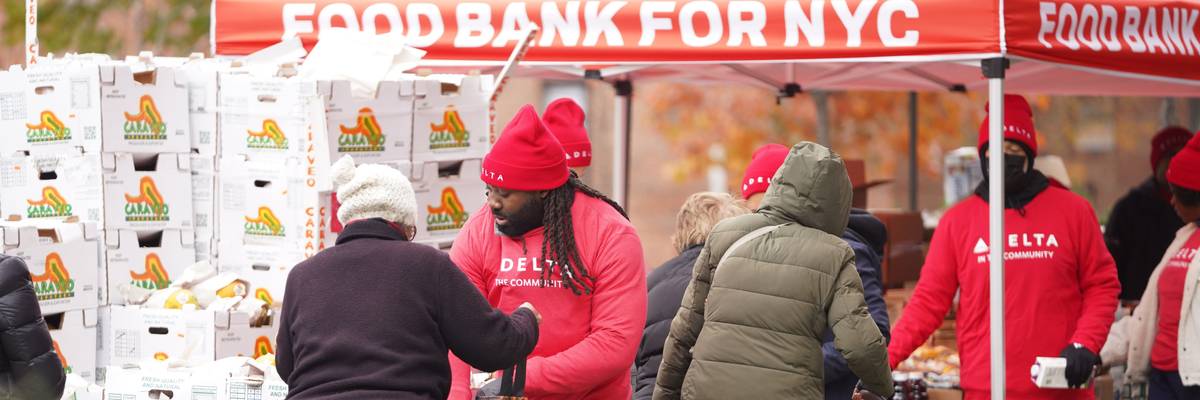
People get free food items at a distribution station in New York City on November 12, 2025.
"Losing SNAP benefits is likely to raise food insecurity for many families."
Cuts to federal food assistance in Republicans' 2025 budget law are leading to drops in participation that are significantly higher than those projected by the Congressional Budget Office, according to an analysis published on Tuesday by economist Diane Schanzenbach.
Schanzenbach, a professor at the McCourt School of Public Policy at Georgetown University, found that participation in the Supplemental Nutrition Assistance Program (SNAP) fell by 13% in the year after President Donald Trump signed the One Big Beautiful Bill Act into law in July 2025.
The decline in SNAP enrollment has been "much faster and deeper than anticipated," Schanzenbach wrote, and participation in the program is now at its lowest rate since 2009.
"SNAP participation fell in every state except Alaska," the economist explained. "The size of the drops varied widely: over 50% in Arizona, about 20% in Texas and 22% in Florida, compared with 7% in California and 9% in New York."
Given that the unemployment rate has gone up since the start of Trump's second term, there is no chance that drops of this size can be attributed to normal changes in economic conditions, Schanzenbach added, making it likely the GOP budget law’s cuts to the program are a main culprit.
The most high-profile change to the program was expanding work requirements to more recipients, but Schanzenbach found that these new eligibility rules alone "don't account for the full decline."
"Families with children are largely outside the new work requirements, yet an estimated 2 million fewer children received SNAP in October 2026 than in July 2025," she explained. "This likely reflects some combination of eligible households lost at renewal over paperwork, fewer new applicants, and immigrant families staying away for fear of immigration enforcement, including members who remain eligible."
State governments are another important variable determining SNAP participation declines, and Schanzenbach pointed to Arizona as an example of what happens when a state moves aggressively to reduce the risk of incurring financial penalties under the budget law's payment error rate provisions.
"Arizona moved earliest and most aggressively to cut its error rate, and its caseload fell by about half between July 2025 and July 2026, the steepest drop in the country," she wrote. "At the same time, the number of state staff determining eligibility fell from 1,370 in July 2024 to 880 a year later. Applicants described phone lines that wouldn't connect, being informed of interview appointments after they were scheduled to occur, and cases closed over a single wrong document."
The impact of these cuts on hunger is now more difficult to determine, Schanzenbach said, because the US Department of Agriculture no longer conducts an annual Food Security Survey.
That said, the economist projected that "losing SNAP benefits is likely to raise food insecurity for many families," while pointing to the increased activity seen at food banks across the US as evidence of the cuts' impact.
"In the face of these dramatic reductions in SNAP participation," Schanzenbach wrote in her conclusion, "it becomes even more important to restore the collection of national food insecurity data so that policymakers can assess whether the shrinking caseload means more families are going without enough to eat."
This country and this world are at a monumental crossroads. US voters have an opportunity to beat back the forces of fascism and confront the billionaires who are rigging the economy, our media system, and our democracy, making it increasingly impossible for ordinary people to get by. We’re not just talking about the election. We’re talking about what must be done once these fascist elements are vanquished from power. We need a bolder set of solutions than what either major party has so far been willing to offer and a working-class movement ready to fight like hell for it. Trump didn't emerge from nowhere. The conditions that fueled MAGA authoritarianism were created by decades of radical neoliberal economic policies and a corrupt political system dominated by corporate interests. They slashed taxes on the super-rich, promising that the benefits would trickle down. They said giveaways to the corporate titans would make life more affordable for the rest of us. It was all bullshit. And when a bitter, betrayed populace searches for someone to blame, right-wing demagogues have little trouble finding scapegoats. People know when they're being lied to, but you won't hear any of this from the corporate media. Only independent journalism—powered and funded by people who believe in building a better world—can deliver truly trustworthy daily news. If you share our vision, please contribute whatever you can to sustain our work. |
Cuts to federal food assistance in Republicans' 2025 budget law are leading to drops in participation that are significantly higher than those projected by the Congressional Budget Office, according to an analysis published on Tuesday by economist Diane Schanzenbach.
Schanzenbach, a professor at the McCourt School of Public Policy at Georgetown University, found that participation in the Supplemental Nutrition Assistance Program (SNAP) fell by 13% in the year after President Donald Trump signed the One Big Beautiful Bill Act into law in July 2025.
The decline in SNAP enrollment has been "much faster and deeper than anticipated," Schanzenbach wrote, and participation in the program is now at its lowest rate since 2009.
"SNAP participation fell in every state except Alaska," the economist explained. "The size of the drops varied widely: over 50% in Arizona, about 20% in Texas and 22% in Florida, compared with 7% in California and 9% in New York."
Given that the unemployment rate has gone up since the start of Trump's second term, there is no chance that drops of this size can be attributed to normal changes in economic conditions, Schanzenbach added, making it likely the GOP budget law’s cuts to the program are a main culprit.
The most high-profile change to the program was expanding work requirements to more recipients, but Schanzenbach found that these new eligibility rules alone "don't account for the full decline."
"Families with children are largely outside the new work requirements, yet an estimated 2 million fewer children received SNAP in October 2026 than in July 2025," she explained. "This likely reflects some combination of eligible households lost at renewal over paperwork, fewer new applicants, and immigrant families staying away for fear of immigration enforcement, including members who remain eligible."
State governments are another important variable determining SNAP participation declines, and Schanzenbach pointed to Arizona as an example of what happens when a state moves aggressively to reduce the risk of incurring financial penalties under the budget law's payment error rate provisions.
"Arizona moved earliest and most aggressively to cut its error rate, and its caseload fell by about half between July 2025 and July 2026, the steepest drop in the country," she wrote. "At the same time, the number of state staff determining eligibility fell from 1,370 in July 2024 to 880 a year later. Applicants described phone lines that wouldn't connect, being informed of interview appointments after they were scheduled to occur, and cases closed over a single wrong document."
The impact of these cuts on hunger is now more difficult to determine, Schanzenbach said, because the US Department of Agriculture no longer conducts an annual Food Security Survey.
That said, the economist projected that "losing SNAP benefits is likely to raise food insecurity for many families," while pointing to the increased activity seen at food banks across the US as evidence of the cuts' impact.
"In the face of these dramatic reductions in SNAP participation," Schanzenbach wrote in her conclusion, "it becomes even more important to restore the collection of national food insecurity data so that policymakers can assess whether the shrinking caseload means more families are going without enough to eat."