SUBSCRIBE TO OUR FREE NEWSLETTER
Daily news & progressive opinion—funded by the people, not the corporations—delivered straight to your inbox.
5
#000000
#FFFFFF
To donate by check, phone, or other method, see our More Ways to Give page.
Daily news & progressive opinion—funded by the people, not the corporations—delivered straight to your inbox.
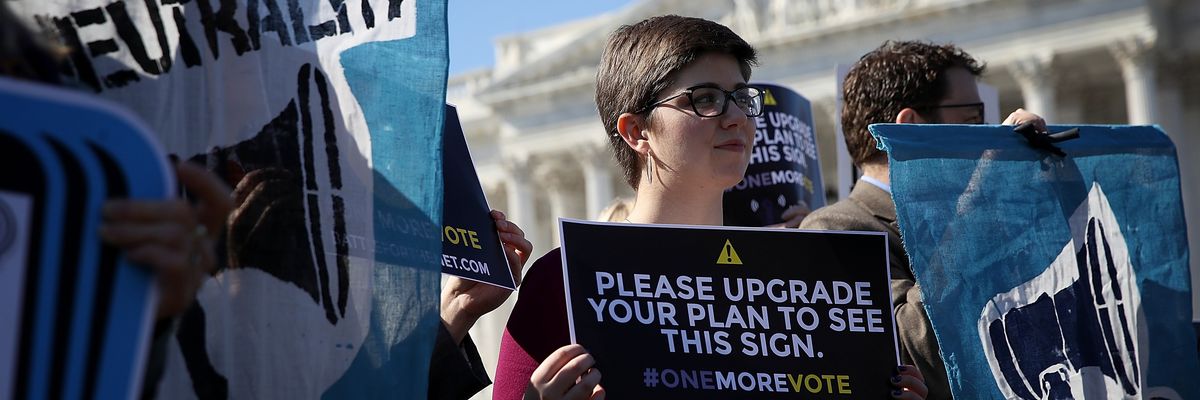
Proponents of an open and unregulated internet attend a news conference at the U.S. Capitol February 27, 2018 in Washington, D.C.
The ruling creates a "dangerous regulatory gap that leaves consumers vulnerable and gives broadband providers unchecked power over Americans’ internet access," said one advocate.
Citing last year's U.S. Supreme Court decision that stripped federal agencies of their regulatory powers, an all-Republican panel on the U.S. Court of Appeals for the 6th Circuit on Thursday ruled that the Federal Communications Commission lacks the authority to reinstate net neutrality rules.
The panel ruled that broadband is an "information service" instead of a "telecommunications service," which is more heavily regulated under the Communications Act, and said the FCC did not have the authority to prohibit telecommunications companies from blocking or throttling internet content and creating "fast lanes" for certain web companies that pay a fee.
Last April the FCC voted to reinstate net neutrality rules, which were first introduced under the Obama administration but were repealed by former Republican FCC Chair Ajit Pai, who was appointed by President-elect Donald Trump.
The ruling cited by the 6th Circuit panel was Loper Bright Enterprises v. Raimondo, which overturned the so-called Chevron doctrine last year. Under the decades-old legal precedent, judges have typically deferred to federal agencies' reasonable interpretation of a law if Congress has not specifically addressed an issue.
"Applying Loper Bright means we can end the FCC's vacillations" between imposing and repealing net neutrality rules, said the judges on Thursday.
The ruling serves as "a reminder that agencies are going to be neutered across any and all industries," said one observer.
John Bergmayer, legal director for the free expression and digital rights group Public Knowledge, said that by "rejecting the FCC's authority to classify broadband as a telecommunications service, the court has ignored decades of precedent and fundamentally misunderstood both the technical realities of how broadband works and Congress' clear intent in the Communications Act."
The ruling creates a "dangerous regulatory gap that leaves consumers vulnerable and gives broadband providers unchecked power over Americans’ internet access," added Bergmayer. The decision could harm the FCC's ability to protect against everything from broadband privacy violations to threats to universal service programs for low-income and rural households.
Matt Wood, vice president of policy and general counsel for another media justice group, Free Press, said the ruling was "just plainly wrong at every level of analysis."
"In April, the FCC issued an order that properly restored the agency's congressionally granted oversight authority to protect people from any [internet service provider] discrimination and manipulation. That commonsense FCC order tried to ensure that the companies providing America with the essential communications service of this century don't get to operate free from any real oversight," said Wood.
Companies and industry groups that sued over the regulations, including the Ohio Telecom Association, "baselessly claim that any regulation will hurt their bottom line," Wood added. "Treating broadband like a common-carrier service does nothing to dampen or dissuade private investment in this crucial infrastructure. And the question for any court interpreting the Communications Act must be what is in the public's best interest, not just one industry sector's financial interests."
The groups, along with FCC Chair Jessica Rosenworcel, called on Congress to take legislative action to protect internet users and small web businesses from discrimination.
"Consumers across the country have told us again and again that they want an internet that is fast, open, and fair. With this decision it is clear that Congress now needs to heed their call, take up the charge for net neutrality, and put open internet principles in federal law," Rosenworcel said.
Congress must "clarify the FCC's authority—and responsibility—to protect the Open Internet and broadband users," said Bergmayer.
Bergmayer also noted that the ruling leaves states' ability to enforce their own net neutrality laws in place, and said the group "will continue to look to states and local governments to help lead on broadband policy."
Dear Common Dreams reader, It’s been nearly 30 years since I co-founded Common Dreams with my late wife, Lina Newhouser. We had the radical notion that journalism should serve the public good, not corporate profits. It was clear to us from the outset what it would take to build such a project. No paid advertisements. No corporate sponsors. No millionaire publisher telling us what to think or do. Many people said we wouldn't last a year, but we proved those doubters wrong. Together with a tremendous team of journalists and dedicated staff, we built an independent media outlet free from the constraints of profits and corporate control. Our mission has always been simple: To inform. To inspire. To ignite change for the common good. Building Common Dreams was not easy. Our survival was never guaranteed. When you take on the most powerful forces—Wall Street greed, fossil fuel industry destruction, Big Tech lobbyists, and uber-rich oligarchs who have spent billions upon billions rigging the economy and democracy in their favor—the only bulwark you have is supporters who believe in your work. But here’s the urgent message from me today. It's never been this bad out there. And it's never been this hard to keep us going. At the very moment Common Dreams is most needed, the threats we face are intensifying. We need your support now more than ever. We don't accept corporate advertising and never will. We don't have a paywall because we don't think people should be blocked from critical news based on their ability to pay. Everything we do is funded by the donations of readers like you. When everyone does the little they can afford, we are strong. But if that support retreats or dries up, so do we. Will you donate now to make sure Common Dreams not only survives but thrives? —Craig Brown, Co-founder |
Citing last year's U.S. Supreme Court decision that stripped federal agencies of their regulatory powers, an all-Republican panel on the U.S. Court of Appeals for the 6th Circuit on Thursday ruled that the Federal Communications Commission lacks the authority to reinstate net neutrality rules.
The panel ruled that broadband is an "information service" instead of a "telecommunications service," which is more heavily regulated under the Communications Act, and said the FCC did not have the authority to prohibit telecommunications companies from blocking or throttling internet content and creating "fast lanes" for certain web companies that pay a fee.
Last April the FCC voted to reinstate net neutrality rules, which were first introduced under the Obama administration but were repealed by former Republican FCC Chair Ajit Pai, who was appointed by President-elect Donald Trump.
The ruling cited by the 6th Circuit panel was Loper Bright Enterprises v. Raimondo, which overturned the so-called Chevron doctrine last year. Under the decades-old legal precedent, judges have typically deferred to federal agencies' reasonable interpretation of a law if Congress has not specifically addressed an issue.
"Applying Loper Bright means we can end the FCC's vacillations" between imposing and repealing net neutrality rules, said the judges on Thursday.
The ruling serves as "a reminder that agencies are going to be neutered across any and all industries," said one observer.
John Bergmayer, legal director for the free expression and digital rights group Public Knowledge, said that by "rejecting the FCC's authority to classify broadband as a telecommunications service, the court has ignored decades of precedent and fundamentally misunderstood both the technical realities of how broadband works and Congress' clear intent in the Communications Act."
The ruling creates a "dangerous regulatory gap that leaves consumers vulnerable and gives broadband providers unchecked power over Americans’ internet access," added Bergmayer. The decision could harm the FCC's ability to protect against everything from broadband privacy violations to threats to universal service programs for low-income and rural households.
Matt Wood, vice president of policy and general counsel for another media justice group, Free Press, said the ruling was "just plainly wrong at every level of analysis."
"In April, the FCC issued an order that properly restored the agency's congressionally granted oversight authority to protect people from any [internet service provider] discrimination and manipulation. That commonsense FCC order tried to ensure that the companies providing America with the essential communications service of this century don't get to operate free from any real oversight," said Wood.
Companies and industry groups that sued over the regulations, including the Ohio Telecom Association, "baselessly claim that any regulation will hurt their bottom line," Wood added. "Treating broadband like a common-carrier service does nothing to dampen or dissuade private investment in this crucial infrastructure. And the question for any court interpreting the Communications Act must be what is in the public's best interest, not just one industry sector's financial interests."
The groups, along with FCC Chair Jessica Rosenworcel, called on Congress to take legislative action to protect internet users and small web businesses from discrimination.
"Consumers across the country have told us again and again that they want an internet that is fast, open, and fair. With this decision it is clear that Congress now needs to heed their call, take up the charge for net neutrality, and put open internet principles in federal law," Rosenworcel said.
Congress must "clarify the FCC's authority—and responsibility—to protect the Open Internet and broadband users," said Bergmayer.
Bergmayer also noted that the ruling leaves states' ability to enforce their own net neutrality laws in place, and said the group "will continue to look to states and local governments to help lead on broadband policy."
Citing last year's U.S. Supreme Court decision that stripped federal agencies of their regulatory powers, an all-Republican panel on the U.S. Court of Appeals for the 6th Circuit on Thursday ruled that the Federal Communications Commission lacks the authority to reinstate net neutrality rules.
The panel ruled that broadband is an "information service" instead of a "telecommunications service," which is more heavily regulated under the Communications Act, and said the FCC did not have the authority to prohibit telecommunications companies from blocking or throttling internet content and creating "fast lanes" for certain web companies that pay a fee.
Last April the FCC voted to reinstate net neutrality rules, which were first introduced under the Obama administration but were repealed by former Republican FCC Chair Ajit Pai, who was appointed by President-elect Donald Trump.
The ruling cited by the 6th Circuit panel was Loper Bright Enterprises v. Raimondo, which overturned the so-called Chevron doctrine last year. Under the decades-old legal precedent, judges have typically deferred to federal agencies' reasonable interpretation of a law if Congress has not specifically addressed an issue.
"Applying Loper Bright means we can end the FCC's vacillations" between imposing and repealing net neutrality rules, said the judges on Thursday.
The ruling serves as "a reminder that agencies are going to be neutered across any and all industries," said one observer.
John Bergmayer, legal director for the free expression and digital rights group Public Knowledge, said that by "rejecting the FCC's authority to classify broadband as a telecommunications service, the court has ignored decades of precedent and fundamentally misunderstood both the technical realities of how broadband works and Congress' clear intent in the Communications Act."
The ruling creates a "dangerous regulatory gap that leaves consumers vulnerable and gives broadband providers unchecked power over Americans’ internet access," added Bergmayer. The decision could harm the FCC's ability to protect against everything from broadband privacy violations to threats to universal service programs for low-income and rural households.
Matt Wood, vice president of policy and general counsel for another media justice group, Free Press, said the ruling was "just plainly wrong at every level of analysis."
"In April, the FCC issued an order that properly restored the agency's congressionally granted oversight authority to protect people from any [internet service provider] discrimination and manipulation. That commonsense FCC order tried to ensure that the companies providing America with the essential communications service of this century don't get to operate free from any real oversight," said Wood.
Companies and industry groups that sued over the regulations, including the Ohio Telecom Association, "baselessly claim that any regulation will hurt their bottom line," Wood added. "Treating broadband like a common-carrier service does nothing to dampen or dissuade private investment in this crucial infrastructure. And the question for any court interpreting the Communications Act must be what is in the public's best interest, not just one industry sector's financial interests."
The groups, along with FCC Chair Jessica Rosenworcel, called on Congress to take legislative action to protect internet users and small web businesses from discrimination.
"Consumers across the country have told us again and again that they want an internet that is fast, open, and fair. With this decision it is clear that Congress now needs to heed their call, take up the charge for net neutrality, and put open internet principles in federal law," Rosenworcel said.
Congress must "clarify the FCC's authority—and responsibility—to protect the Open Internet and broadband users," said Bergmayer.
Bergmayer also noted that the ruling leaves states' ability to enforce their own net neutrality laws in place, and said the group "will continue to look to states and local governments to help lead on broadband policy."