SUBSCRIBE TO OUR FREE NEWSLETTER
Daily news & progressive opinion—funded by the people, not the corporations—delivered straight to your inbox.
5
#000000
#FFFFFF
To donate by check, phone, or other method, see our More Ways to Give page.
Daily news & progressive opinion—funded by the people, not the corporations—delivered straight to your inbox.
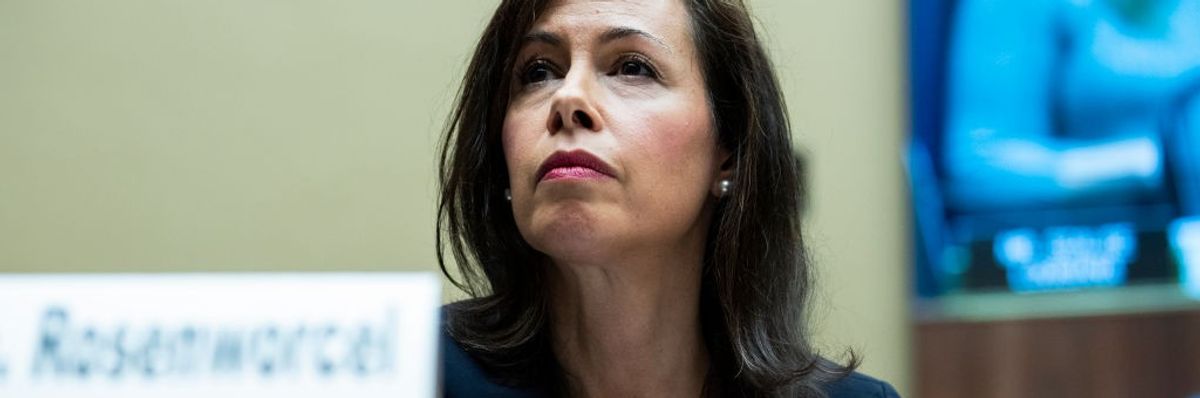
Federal Communications Commission Chair Jessica Rosenworcel testifies during a U.S. House hearing in Washington, D.C. on March 31, 2022.
"Today's ruling is a setback, but a temporary one," said one campaigner. "The nation's communications regulator must be able to oversee the nation’s communications infrastructure."
Net neutrality advocates on Thursday sharply condemned a U.S. appellate court decision blocking implementation of the Biden administration's broadband policy while a legal challenge launched by the telecommunications industry moves forward.
Federal Communications Commission Chair Jessica Rosenworcel joined with Commissioners Anna Gomez and Geoffrey Starks in April to reclassify broadband as a public service under Title II of the Communications Act—undoing damage done during the Trump administration.
Internet service providers (ISPs) are fighting to stop the FCC's order. After temporarily delaying the rules last month, the U.S. Court of Appeals for the 6th Circuit just granted a stay. Oral arguments aren't expected until October or November.
"The 6th Circuit's stay will leave Americans without critical net neutrality protections and leave the Federal Communications Commission without its rightful authority over broadband," warned U.S. Sens. Ed Markey (D-Mass.) and Ron Wyden (D-Ore.) in a joint statement Thursday.
"We need net neutrality to protect the free and open internet and ensure that internet gatekeepers cannot control what we see, who we talk with, and how we communicate online."
"That is unacceptable," added the senators, who have led the fight for reviving net neutrality rules in Congress. "We need net neutrality to protect the free and open internet and ensure that internet gatekeepers cannot control what we see, who we talk with, and how we communicate online."
Advocacy groups were similarly critical. John Bergmayer, legal director at Public Knowledge, said that "it is unfortunate that the court granted the ISPs' request for a stay of the FCC's net neutrality rules. These rules would bar broadband providers from throttling connection speeds, blocking websites, and discriminating in favor of preferred internet traffic."
"Millions of Americans have expressed support for these rules by submitting comments with the FCC urging the agency to enact these protections," he noted. "Consumers need net neutrality rules as well as the other consumer benefits provided by the FCC's recognition that broadband is a 'telecommunications' service, including online privacy, public safety and national security, and affordable, competitive broadband service."
"Despite this court's action, we remain confident that the FCC's rules—and classification of broadband as a telecommunication service under Title II of the Communications Act—will ultimately be upheld, just as they were before—or that Congress will step in to reinstate these popular and necessary protections," Bergmayer added.
Free Press vice president of policy and general counsel Matt Wood also characterized the stay as unfortunate but stressed that "we believe that the litigation to follow will dispel these unfounded phone-and cable-company arguments about Title II's supposed harms and about the commission's authority to classify broadband providers properly under the statute."
"Industry lobbyists and other net neutrality opponents have argued, loudly but cynically, that the Trump-era repeal somehow spurred broadband deployment and speed increases, claiming that the rules' presence impairs those upgrades. This is nonsense, as Free Press has shown time and time again by examining the companies' own financial statements and investor briefings," he highlighted. "Today's order unfortunately accepts the false premise that the FCC's rules prevent broadband providers from rolling out new products. ISPs make such claims only in court; they never make them to their investors."
"Today's ruling is a setback, but a temporary one. The nation's communications regulator must be able to oversee the nation’s communications infrastructure," Wood continued. "While we hit a procedural hurdle today, Free Press is determined to see the FCC's decision go into effect. The 6th Circuit will still need to evaluate the ISPs' and FCC's arguments in full when it reviews the case on the merits. We're confident that we will ultimately prevail in this case, even in the wake of this disappointing outcome and even in light of recent Supreme Court decisions aimed at weakening federal agencies' oversight."
Rosenworcel was also determined to defend the FCC's decision, declaring Thursday that "the American public wants an internet that is fast, open, and fair. Today's decision by the 6th Circuit is a setback but we will not give up the fight for net neutrality."
Dear Common Dreams reader, It’s been nearly 30 years since I co-founded Common Dreams with my late wife, Lina Newhouser. We had the radical notion that journalism should serve the public good, not corporate profits. It was clear to us from the outset what it would take to build such a project. No paid advertisements. No corporate sponsors. No millionaire publisher telling us what to think or do. Many people said we wouldn't last a year, but we proved those doubters wrong. Together with a tremendous team of journalists and dedicated staff, we built an independent media outlet free from the constraints of profits and corporate control. Our mission has always been simple: To inform. To inspire. To ignite change for the common good. Building Common Dreams was not easy. Our survival was never guaranteed. When you take on the most powerful forces—Wall Street greed, fossil fuel industry destruction, Big Tech lobbyists, and uber-rich oligarchs who have spent billions upon billions rigging the economy and democracy in their favor—the only bulwark you have is supporters who believe in your work. But here’s the urgent message from me today. It's never been this bad out there. And it's never been this hard to keep us going. At the very moment Common Dreams is most needed, the threats we face are intensifying. We need your support now more than ever. We don't accept corporate advertising and never will. We don't have a paywall because we don't think people should be blocked from critical news based on their ability to pay. Everything we do is funded by the donations of readers like you. When everyone does the little they can afford, we are strong. But if that support retreats or dries up, so do we. Will you donate now to make sure Common Dreams not only survives but thrives? —Craig Brown, Co-founder |
Net neutrality advocates on Thursday sharply condemned a U.S. appellate court decision blocking implementation of the Biden administration's broadband policy while a legal challenge launched by the telecommunications industry moves forward.
Federal Communications Commission Chair Jessica Rosenworcel joined with Commissioners Anna Gomez and Geoffrey Starks in April to reclassify broadband as a public service under Title II of the Communications Act—undoing damage done during the Trump administration.
Internet service providers (ISPs) are fighting to stop the FCC's order. After temporarily delaying the rules last month, the U.S. Court of Appeals for the 6th Circuit just granted a stay. Oral arguments aren't expected until October or November.
"The 6th Circuit's stay will leave Americans without critical net neutrality protections and leave the Federal Communications Commission without its rightful authority over broadband," warned U.S. Sens. Ed Markey (D-Mass.) and Ron Wyden (D-Ore.) in a joint statement Thursday.
"We need net neutrality to protect the free and open internet and ensure that internet gatekeepers cannot control what we see, who we talk with, and how we communicate online."
"That is unacceptable," added the senators, who have led the fight for reviving net neutrality rules in Congress. "We need net neutrality to protect the free and open internet and ensure that internet gatekeepers cannot control what we see, who we talk with, and how we communicate online."
Advocacy groups were similarly critical. John Bergmayer, legal director at Public Knowledge, said that "it is unfortunate that the court granted the ISPs' request for a stay of the FCC's net neutrality rules. These rules would bar broadband providers from throttling connection speeds, blocking websites, and discriminating in favor of preferred internet traffic."
"Millions of Americans have expressed support for these rules by submitting comments with the FCC urging the agency to enact these protections," he noted. "Consumers need net neutrality rules as well as the other consumer benefits provided by the FCC's recognition that broadband is a 'telecommunications' service, including online privacy, public safety and national security, and affordable, competitive broadband service."
"Despite this court's action, we remain confident that the FCC's rules—and classification of broadband as a telecommunication service under Title II of the Communications Act—will ultimately be upheld, just as they were before—or that Congress will step in to reinstate these popular and necessary protections," Bergmayer added.
Free Press vice president of policy and general counsel Matt Wood also characterized the stay as unfortunate but stressed that "we believe that the litigation to follow will dispel these unfounded phone-and cable-company arguments about Title II's supposed harms and about the commission's authority to classify broadband providers properly under the statute."
"Industry lobbyists and other net neutrality opponents have argued, loudly but cynically, that the Trump-era repeal somehow spurred broadband deployment and speed increases, claiming that the rules' presence impairs those upgrades. This is nonsense, as Free Press has shown time and time again by examining the companies' own financial statements and investor briefings," he highlighted. "Today's order unfortunately accepts the false premise that the FCC's rules prevent broadband providers from rolling out new products. ISPs make such claims only in court; they never make them to their investors."
"Today's ruling is a setback, but a temporary one. The nation's communications regulator must be able to oversee the nation’s communications infrastructure," Wood continued. "While we hit a procedural hurdle today, Free Press is determined to see the FCC's decision go into effect. The 6th Circuit will still need to evaluate the ISPs' and FCC's arguments in full when it reviews the case on the merits. We're confident that we will ultimately prevail in this case, even in the wake of this disappointing outcome and even in light of recent Supreme Court decisions aimed at weakening federal agencies' oversight."
Rosenworcel was also determined to defend the FCC's decision, declaring Thursday that "the American public wants an internet that is fast, open, and fair. Today's decision by the 6th Circuit is a setback but we will not give up the fight for net neutrality."
Net neutrality advocates on Thursday sharply condemned a U.S. appellate court decision blocking implementation of the Biden administration's broadband policy while a legal challenge launched by the telecommunications industry moves forward.
Federal Communications Commission Chair Jessica Rosenworcel joined with Commissioners Anna Gomez and Geoffrey Starks in April to reclassify broadband as a public service under Title II of the Communications Act—undoing damage done during the Trump administration.
Internet service providers (ISPs) are fighting to stop the FCC's order. After temporarily delaying the rules last month, the U.S. Court of Appeals for the 6th Circuit just granted a stay. Oral arguments aren't expected until October or November.
"The 6th Circuit's stay will leave Americans without critical net neutrality protections and leave the Federal Communications Commission without its rightful authority over broadband," warned U.S. Sens. Ed Markey (D-Mass.) and Ron Wyden (D-Ore.) in a joint statement Thursday.
"We need net neutrality to protect the free and open internet and ensure that internet gatekeepers cannot control what we see, who we talk with, and how we communicate online."
"That is unacceptable," added the senators, who have led the fight for reviving net neutrality rules in Congress. "We need net neutrality to protect the free and open internet and ensure that internet gatekeepers cannot control what we see, who we talk with, and how we communicate online."
Advocacy groups were similarly critical. John Bergmayer, legal director at Public Knowledge, said that "it is unfortunate that the court granted the ISPs' request for a stay of the FCC's net neutrality rules. These rules would bar broadband providers from throttling connection speeds, blocking websites, and discriminating in favor of preferred internet traffic."
"Millions of Americans have expressed support for these rules by submitting comments with the FCC urging the agency to enact these protections," he noted. "Consumers need net neutrality rules as well as the other consumer benefits provided by the FCC's recognition that broadband is a 'telecommunications' service, including online privacy, public safety and national security, and affordable, competitive broadband service."
"Despite this court's action, we remain confident that the FCC's rules—and classification of broadband as a telecommunication service under Title II of the Communications Act—will ultimately be upheld, just as they were before—or that Congress will step in to reinstate these popular and necessary protections," Bergmayer added.
Free Press vice president of policy and general counsel Matt Wood also characterized the stay as unfortunate but stressed that "we believe that the litigation to follow will dispel these unfounded phone-and cable-company arguments about Title II's supposed harms and about the commission's authority to classify broadband providers properly under the statute."
"Industry lobbyists and other net neutrality opponents have argued, loudly but cynically, that the Trump-era repeal somehow spurred broadband deployment and speed increases, claiming that the rules' presence impairs those upgrades. This is nonsense, as Free Press has shown time and time again by examining the companies' own financial statements and investor briefings," he highlighted. "Today's order unfortunately accepts the false premise that the FCC's rules prevent broadband providers from rolling out new products. ISPs make such claims only in court; they never make them to their investors."
"Today's ruling is a setback, but a temporary one. The nation's communications regulator must be able to oversee the nation’s communications infrastructure," Wood continued. "While we hit a procedural hurdle today, Free Press is determined to see the FCC's decision go into effect. The 6th Circuit will still need to evaluate the ISPs' and FCC's arguments in full when it reviews the case on the merits. We're confident that we will ultimately prevail in this case, even in the wake of this disappointing outcome and even in light of recent Supreme Court decisions aimed at weakening federal agencies' oversight."
Rosenworcel was also determined to defend the FCC's decision, declaring Thursday that "the American public wants an internet that is fast, open, and fair. Today's decision by the 6th Circuit is a setback but we will not give up the fight for net neutrality."