SUBSCRIBE TO OUR FREE NEWSLETTER
Daily news & progressive opinion—funded by the people, not the corporations—delivered straight to your inbox.
5
#000000
#FFFFFF
To donate by check, phone, or other method, see our More Ways to Give page.
Daily news & progressive opinion—funded by the people, not the corporations—delivered straight to your inbox.
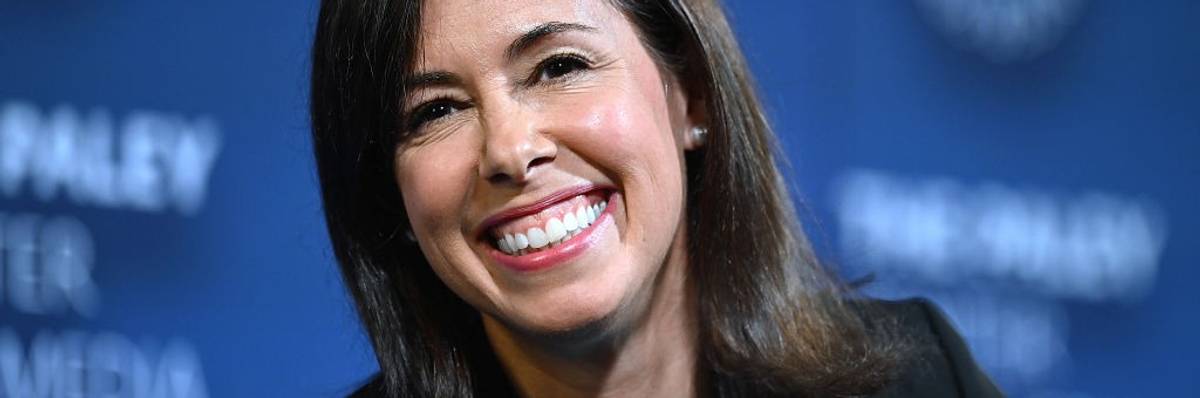
Federal Communications Commission Chair Jessica Rosenworcel attends the Paley International Council Summit in New York City on November 8, 2022.
"Today marks the last day that internet service providers can continue to put profit over people," said one advocate.
Open internet advocates on Thursday applauded the Federal Communications Commission's long-anticipated vote to revive net neutrality rules and reestablish FCC oversight of broadband.
The 3-2 vote along party lines to reclassify broadband as a public service under Title II of the Communications Act came seven months after FCC Chair Jessica Rosenworcel announced the push in the wake of the U.S. Senate confirming Commissioner Anna Gomez.
Commissioner Geoffrey Starks joined Rosenworcel and Gomez to launch the rulemaking process last year and finalize the policy change on Thursday. Commissioner Brendan Carr and Nathan Simington both aligned with the powerful telecom industry by opposing the effort to prevent internet service providers from blocking, throttling, or engaging in paid prioritization of lawful online content.
Demand Progress Education Fund senior campaigner Joey DeFrancesco said the revival "has been desperately needed" since former FCC Chair Ajit Pai—an appointee of former Republican President Donald Trump—led the "disastrous decision" in 2017 to gut a 2015 agency policy codifying the principle that has been foundational to the internet since its inception.
"Internet access is not a luxury, but a necessity to participate in society and survive in our modern economy," DeFrancesco stressed. "The FCC's new rule will ensure the commission has the full ability to expand broadband and the authority to ensure access to an open internet."
"The FCC's vote today returns the internet to the American people."
Free Press co-CEO Craig Aaron declared that "everyone should celebrate today's FCC vote."
"Public support for net neutrality is overwhelming, and people understand why we need a federal watchdog to protect everyone's access to the most essential communications platform of our time," he noted. "The FCC heard the outcry and did its job: delivering on promises to stand with internet users and against big telecom companies and their trade groups, which have spent untold millions of dollars to spread lies about net neutrality and thwart any oversight or regulation."
Aaron praised Rosenworcel and her staff for leading the restoration effort, as well as Starks and Gomez for working with her to reverse the Trump FCC's move and ensure "that the agency can once again protect internet users whenever big phone and cable companies like AT&T, Comcast, Spectrum, and Verizon attempt to harm them."
"Big cable and phone companies won't be able to pick and choose what any of us can say or see online. Net neutrality is a guarantee that these companies will carry our data across the internet without undue interference or unreasonable discrimination," he emphasized. "This is what democracy should look like: Public servants responding to public sentiment, taking steps to protect just and reasonable services and free expression, and showing that the government is capable of defending the public interest."
Michael Copps, a former FCC commissioner and current Common Cause special adviser, was similarly enthusiastic, saying that "if I weren't out of the country today, I would be personally at the FCC jumping up and down, saluting the majority for reinstituting the network neutrality rules that were so foolishly eliminated by the previous commission."
"Our communications technologies are evolving so swiftly, affecting so many important aspects of our individual lives, that they must be available to all of us on a nondiscriminatory basis. And they must advance the public interest, protecting consumers, fostering competition, and providing us all the news and information we need as we fight to maintain our democracy," he continued. "We still have much to do; but today, let's celebrate a huge step forward."
The vote notably comes during an election year—and as Democratic President Joe Biden, a net neutrality supporter, is gearing up for a November rematch against Trump.
"The internet is crucial to civic engagement in the United States today. It functions as a virtual public square where social justice movements organize and garner support," said Common Cause's Ishan Mehta. "The FCC's vote today returns the internet to the American people."
Jenna Leventoff, senior policy counsel at the ACLU, also piled on the praise, proclaiming that "today marks the last day that internet service providers can continue to put profit over people."
"We are thrilled that the FCC now has the authority it needs to protect consumers, promote the exercise of First Amendment rights online, and ensure that everyone has access to high-quality, affordable internet," she said. "However, we urge the commission not to exercise its authority to preempt consistent state laws that grant consumers additional protections."
John Bergmayer, legal director at Public Knowledge, also celebrated the vote while stressing that the commission's work is far from over. In addition to warning of court fights to come, he said that "broadband providers will continue attempting to rebrand their old plans for internet fast and slow lanes, hoping to sneak them through."
"The FCC will need to diligently enforce its rules," Bergmayer argued, "including clarifying that discrimination in favor of certain apps or categories of traffic 'impairs' and 'degrades' traffic that is left in the slow lane, and that broadband providers cannot simply take apps that people use on the internet every day and package them as a separate 'nonbroadband' service."
"The FCC must also ensure that practices that are not expressly prohibited but still unreasonably interfere with the ability of end users to freely use the internet, or of edge providers to freely compete, are disallowed," he added. "These practices include discriminatory zero-rating and network interconnection practices."
Like Leventoff, he also recognized the vital role of states with stricter policies, saying that those "with excellent net neutrality and broadband consumer protection statutes, like California, can be a nationwide model for other states and the FCC to adopt to strengthen their own rules."
Dear Common Dreams reader, It’s been nearly 30 years since I co-founded Common Dreams with my late wife, Lina Newhouser. We had the radical notion that journalism should serve the public good, not corporate profits. It was clear to us from the outset what it would take to build such a project. No paid advertisements. No corporate sponsors. No millionaire publisher telling us what to think or do. Many people said we wouldn't last a year, but we proved those doubters wrong. Together with a tremendous team of journalists and dedicated staff, we built an independent media outlet free from the constraints of profits and corporate control. Our mission has always been simple: To inform. To inspire. To ignite change for the common good. Building Common Dreams was not easy. Our survival was never guaranteed. When you take on the most powerful forces—Wall Street greed, fossil fuel industry destruction, Big Tech lobbyists, and uber-rich oligarchs who have spent billions upon billions rigging the economy and democracy in their favor—the only bulwark you have is supporters who believe in your work. But here’s the urgent message from me today. It's never been this bad out there. And it's never been this hard to keep us going. At the very moment Common Dreams is most needed, the threats we face are intensifying. We need your support now more than ever. We don't accept corporate advertising and never will. We don't have a paywall because we don't think people should be blocked from critical news based on their ability to pay. Everything we do is funded by the donations of readers like you. When everyone does the little they can afford, we are strong. But if that support retreats or dries up, so do we. Will you donate now to make sure Common Dreams not only survives but thrives? —Craig Brown, Co-founder |
Open internet advocates on Thursday applauded the Federal Communications Commission's long-anticipated vote to revive net neutrality rules and reestablish FCC oversight of broadband.
The 3-2 vote along party lines to reclassify broadband as a public service under Title II of the Communications Act came seven months after FCC Chair Jessica Rosenworcel announced the push in the wake of the U.S. Senate confirming Commissioner Anna Gomez.
Commissioner Geoffrey Starks joined Rosenworcel and Gomez to launch the rulemaking process last year and finalize the policy change on Thursday. Commissioner Brendan Carr and Nathan Simington both aligned with the powerful telecom industry by opposing the effort to prevent internet service providers from blocking, throttling, or engaging in paid prioritization of lawful online content.
Demand Progress Education Fund senior campaigner Joey DeFrancesco said the revival "has been desperately needed" since former FCC Chair Ajit Pai—an appointee of former Republican President Donald Trump—led the "disastrous decision" in 2017 to gut a 2015 agency policy codifying the principle that has been foundational to the internet since its inception.
"Internet access is not a luxury, but a necessity to participate in society and survive in our modern economy," DeFrancesco stressed. "The FCC's new rule will ensure the commission has the full ability to expand broadband and the authority to ensure access to an open internet."
"The FCC's vote today returns the internet to the American people."
Free Press co-CEO Craig Aaron declared that "everyone should celebrate today's FCC vote."
"Public support for net neutrality is overwhelming, and people understand why we need a federal watchdog to protect everyone's access to the most essential communications platform of our time," he noted. "The FCC heard the outcry and did its job: delivering on promises to stand with internet users and against big telecom companies and their trade groups, which have spent untold millions of dollars to spread lies about net neutrality and thwart any oversight or regulation."
Aaron praised Rosenworcel and her staff for leading the restoration effort, as well as Starks and Gomez for working with her to reverse the Trump FCC's move and ensure "that the agency can once again protect internet users whenever big phone and cable companies like AT&T, Comcast, Spectrum, and Verizon attempt to harm them."
"Big cable and phone companies won't be able to pick and choose what any of us can say or see online. Net neutrality is a guarantee that these companies will carry our data across the internet without undue interference or unreasonable discrimination," he emphasized. "This is what democracy should look like: Public servants responding to public sentiment, taking steps to protect just and reasonable services and free expression, and showing that the government is capable of defending the public interest."
Michael Copps, a former FCC commissioner and current Common Cause special adviser, was similarly enthusiastic, saying that "if I weren't out of the country today, I would be personally at the FCC jumping up and down, saluting the majority for reinstituting the network neutrality rules that were so foolishly eliminated by the previous commission."
"Our communications technologies are evolving so swiftly, affecting so many important aspects of our individual lives, that they must be available to all of us on a nondiscriminatory basis. And they must advance the public interest, protecting consumers, fostering competition, and providing us all the news and information we need as we fight to maintain our democracy," he continued. "We still have much to do; but today, let's celebrate a huge step forward."
The vote notably comes during an election year—and as Democratic President Joe Biden, a net neutrality supporter, is gearing up for a November rematch against Trump.
"The internet is crucial to civic engagement in the United States today. It functions as a virtual public square where social justice movements organize and garner support," said Common Cause's Ishan Mehta. "The FCC's vote today returns the internet to the American people."
Jenna Leventoff, senior policy counsel at the ACLU, also piled on the praise, proclaiming that "today marks the last day that internet service providers can continue to put profit over people."
"We are thrilled that the FCC now has the authority it needs to protect consumers, promote the exercise of First Amendment rights online, and ensure that everyone has access to high-quality, affordable internet," she said. "However, we urge the commission not to exercise its authority to preempt consistent state laws that grant consumers additional protections."
John Bergmayer, legal director at Public Knowledge, also celebrated the vote while stressing that the commission's work is far from over. In addition to warning of court fights to come, he said that "broadband providers will continue attempting to rebrand their old plans for internet fast and slow lanes, hoping to sneak them through."
"The FCC will need to diligently enforce its rules," Bergmayer argued, "including clarifying that discrimination in favor of certain apps or categories of traffic 'impairs' and 'degrades' traffic that is left in the slow lane, and that broadband providers cannot simply take apps that people use on the internet every day and package them as a separate 'nonbroadband' service."
"The FCC must also ensure that practices that are not expressly prohibited but still unreasonably interfere with the ability of end users to freely use the internet, or of edge providers to freely compete, are disallowed," he added. "These practices include discriminatory zero-rating and network interconnection practices."
Like Leventoff, he also recognized the vital role of states with stricter policies, saying that those "with excellent net neutrality and broadband consumer protection statutes, like California, can be a nationwide model for other states and the FCC to adopt to strengthen their own rules."
Open internet advocates on Thursday applauded the Federal Communications Commission's long-anticipated vote to revive net neutrality rules and reestablish FCC oversight of broadband.
The 3-2 vote along party lines to reclassify broadband as a public service under Title II of the Communications Act came seven months after FCC Chair Jessica Rosenworcel announced the push in the wake of the U.S. Senate confirming Commissioner Anna Gomez.
Commissioner Geoffrey Starks joined Rosenworcel and Gomez to launch the rulemaking process last year and finalize the policy change on Thursday. Commissioner Brendan Carr and Nathan Simington both aligned with the powerful telecom industry by opposing the effort to prevent internet service providers from blocking, throttling, or engaging in paid prioritization of lawful online content.
Demand Progress Education Fund senior campaigner Joey DeFrancesco said the revival "has been desperately needed" since former FCC Chair Ajit Pai—an appointee of former Republican President Donald Trump—led the "disastrous decision" in 2017 to gut a 2015 agency policy codifying the principle that has been foundational to the internet since its inception.
"Internet access is not a luxury, but a necessity to participate in society and survive in our modern economy," DeFrancesco stressed. "The FCC's new rule will ensure the commission has the full ability to expand broadband and the authority to ensure access to an open internet."
"The FCC's vote today returns the internet to the American people."
Free Press co-CEO Craig Aaron declared that "everyone should celebrate today's FCC vote."
"Public support for net neutrality is overwhelming, and people understand why we need a federal watchdog to protect everyone's access to the most essential communications platform of our time," he noted. "The FCC heard the outcry and did its job: delivering on promises to stand with internet users and against big telecom companies and their trade groups, which have spent untold millions of dollars to spread lies about net neutrality and thwart any oversight or regulation."
Aaron praised Rosenworcel and her staff for leading the restoration effort, as well as Starks and Gomez for working with her to reverse the Trump FCC's move and ensure "that the agency can once again protect internet users whenever big phone and cable companies like AT&T, Comcast, Spectrum, and Verizon attempt to harm them."
"Big cable and phone companies won't be able to pick and choose what any of us can say or see online. Net neutrality is a guarantee that these companies will carry our data across the internet without undue interference or unreasonable discrimination," he emphasized. "This is what democracy should look like: Public servants responding to public sentiment, taking steps to protect just and reasonable services and free expression, and showing that the government is capable of defending the public interest."
Michael Copps, a former FCC commissioner and current Common Cause special adviser, was similarly enthusiastic, saying that "if I weren't out of the country today, I would be personally at the FCC jumping up and down, saluting the majority for reinstituting the network neutrality rules that were so foolishly eliminated by the previous commission."
"Our communications technologies are evolving so swiftly, affecting so many important aspects of our individual lives, that they must be available to all of us on a nondiscriminatory basis. And they must advance the public interest, protecting consumers, fostering competition, and providing us all the news and information we need as we fight to maintain our democracy," he continued. "We still have much to do; but today, let's celebrate a huge step forward."
The vote notably comes during an election year—and as Democratic President Joe Biden, a net neutrality supporter, is gearing up for a November rematch against Trump.
"The internet is crucial to civic engagement in the United States today. It functions as a virtual public square where social justice movements organize and garner support," said Common Cause's Ishan Mehta. "The FCC's vote today returns the internet to the American people."
Jenna Leventoff, senior policy counsel at the ACLU, also piled on the praise, proclaiming that "today marks the last day that internet service providers can continue to put profit over people."
"We are thrilled that the FCC now has the authority it needs to protect consumers, promote the exercise of First Amendment rights online, and ensure that everyone has access to high-quality, affordable internet," she said. "However, we urge the commission not to exercise its authority to preempt consistent state laws that grant consumers additional protections."
John Bergmayer, legal director at Public Knowledge, also celebrated the vote while stressing that the commission's work is far from over. In addition to warning of court fights to come, he said that "broadband providers will continue attempting to rebrand their old plans for internet fast and slow lanes, hoping to sneak them through."
"The FCC will need to diligently enforce its rules," Bergmayer argued, "including clarifying that discrimination in favor of certain apps or categories of traffic 'impairs' and 'degrades' traffic that is left in the slow lane, and that broadband providers cannot simply take apps that people use on the internet every day and package them as a separate 'nonbroadband' service."
"The FCC must also ensure that practices that are not expressly prohibited but still unreasonably interfere with the ability of end users to freely use the internet, or of edge providers to freely compete, are disallowed," he added. "These practices include discriminatory zero-rating and network interconnection practices."
Like Leventoff, he also recognized the vital role of states with stricter policies, saying that those "with excellent net neutrality and broadband consumer protection statutes, like California, can be a nationwide model for other states and the FCC to adopt to strengthen their own rules."