SUBSCRIBE TO OUR FREE NEWSLETTER
Daily news & progressive opinion—funded by the people, not the corporations—delivered straight to your inbox.
5
#000000
#FFFFFF
To donate by check, phone, or other method, see our More Ways to Give page.
Daily news & progressive opinion—funded by the people, not the corporations—delivered straight to your inbox.
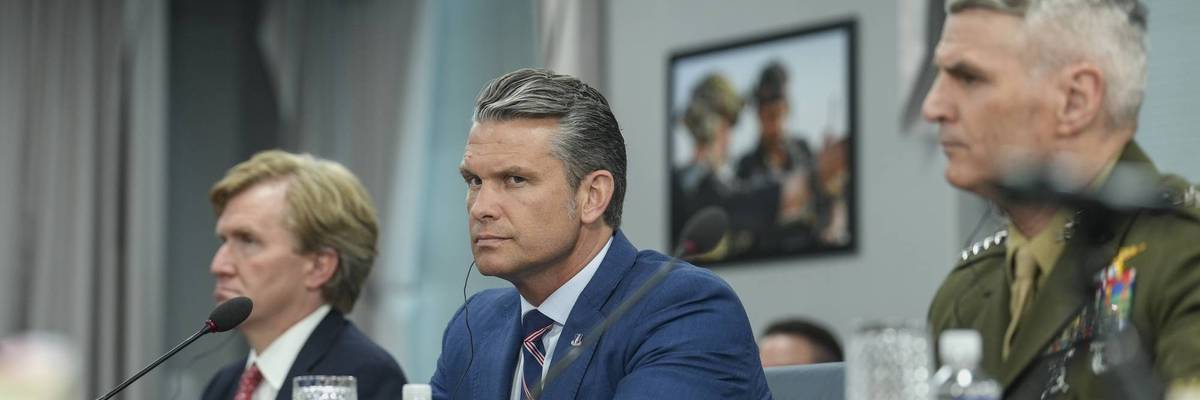
Pentagon Secretary Pete Hegseth listens during a meeting with Iraqi Prime Minister Ali al-Zaidi on July 14, 2026 in Arlington, Virginia.
Pentagon Secretary Pete Hegseth posted a photo of a surveillance tower at an Iranian port collapsing due to US airstrikes.
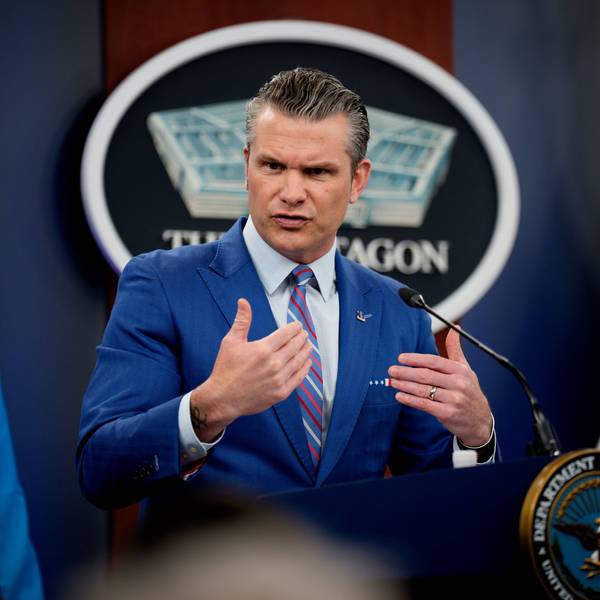
US Pentagon Secretary Pete Hegseth late Thursday gloatingly posted a photo of an Iranian tower collapsing due to the Trump administration's massive, illegal assault on the Middle East country's infrastructure, including bridges, railways, and power facilities.
The photo Hegseth posted to social media appeared to show the surveillance tower at Iran’s Chabahar Port enveloped in smoke and crumbling to the ground amid US forces' aggressive bombing campaign. Ryan Costello, policy director at the National Iranian American Council (NIAC), called Hegseth's post "disgusting online revelry in the bombardment of Iran and its infrastructure."
The Associated Press reported that US strikes on bridges and other infrastructure in southern Iran overnight into Friday killed at least eight people.
"The highway and railway bridge strikes appeared aimed at cutting off Bandar Abbas, Iran’s main port, from roads leading into the Islamic Republic’s central region onward to Tehran, the capital," AP noted.
US strikes, authorized by President Donald Trump, also targeted Iranian power infrastructure amid extreme heat.
The latest wave of US attacks came days after Trump threatened to "knock out all of [Iran's] power plants" and bridges "unless they get to the table and negotiate."
Deliberately attacking civilian infrastructure is a war crime. Kenneth Roth, former executive director of Human Rights Watch, said Friday that while "there may be some nominal military use of the bridges," the US attacks "potentially disrupt the movement of goods needed for Iran’s 90 million people."
"Trump doesn't care, but military commanders, who could face prosecution, should," Roth added.
https://t.co/jZlSVRePRC pic.twitter.com/Nj5o0oiphH
— Pete Hegseth (@PeteHegseth) July 17, 2026
NIAC said Friday that "the distinction between military and civilian infrastructure has become increasingly blurred," as "bridges, ports, airports, railways, power networks, and communications facilities sustain civilian life and economic activity, even if they at times are used for military purposes."
"Their destruction produces civilian casualties, isolates communities, interrupts emergency services, restricts food and fuel distribution, and leaves civilians without electricity during extreme summer heat," the group added. "As the campaign expands, the humanitarian consequences are therefore likely to grow even if Washington continues to classify the targets as militarily relevant."
On Thursday, NIAC released a report detailing the "civilian catastrophe" inflicted by the US-Israeli war on Iran, which began in late February. Estimates indicate that the civilian death toll from the war on Iran could be over 2,000—including hundreds of children, a majority of them killed in a US strike on an elementary school in Minab on the first day of the war.
Additionally, millions of Iranians have been displaced by the US-Israeli bombardment and more than 125,000 "civilian units"—including residential housing—have been damaged or destroyed," NIAC observed in its report.
"The evidence compiled in this report, independently corroborated across UN agencies, human rights organizations, and satellite analysis, points to a pattern of harm to civilians, homes, schools, and medical infrastructure that warrants urgent international attention," NIAC said.
Dear Common Dreams reader, It’s been nearly 30 years since I co-founded Common Dreams with my late wife, Lina Newhouser. We had the radical notion that journalism should serve the public good, not corporate profits. It was clear to us from the outset what it would take to build such a project. No paid advertisements. No corporate sponsors. No millionaire publisher telling us what to think or do. Many people said we wouldn't last a year, but we proved those doubters wrong. Together with a tremendous team of journalists and dedicated staff, we built an independent media outlet free from the constraints of profits and corporate control. Our mission has always been simple: To inform. To inspire. To ignite change for the common good. Building Common Dreams was not easy. Our survival was never guaranteed. When you take on the most powerful forces—Wall Street greed, fossil fuel industry destruction, Big Tech lobbyists, and uber-rich oligarchs who have spent billions upon billions rigging the economy and democracy in their favor—the only bulwark you have is supporters who believe in your work. But here’s the urgent message from me today. It's never been this bad out there. And it's never been this hard to keep us going. At the very moment Common Dreams is most needed, the threats we face are intensifying. We need your support now more than ever. We don't accept corporate advertising and never will. We don't have a paywall because we don't think people should be blocked from critical news based on their ability to pay. Everything we do is funded by the donations of readers like you. When everyone does the little they can afford, we are strong. But if that support retreats or dries up, so do we. Will you donate now to make sure Common Dreams not only survives but thrives? —Craig Brown, Co-founder |
US Pentagon Secretary Pete Hegseth late Thursday gloatingly posted a photo of an Iranian tower collapsing due to the Trump administration's massive, illegal assault on the Middle East country's infrastructure, including bridges, railways, and power facilities.
The photo Hegseth posted to social media appeared to show the surveillance tower at Iran’s Chabahar Port enveloped in smoke and crumbling to the ground amid US forces' aggressive bombing campaign. Ryan Costello, policy director at the National Iranian American Council (NIAC), called Hegseth's post "disgusting online revelry in the bombardment of Iran and its infrastructure."
The Associated Press reported that US strikes on bridges and other infrastructure in southern Iran overnight into Friday killed at least eight people.
"The highway and railway bridge strikes appeared aimed at cutting off Bandar Abbas, Iran’s main port, from roads leading into the Islamic Republic’s central region onward to Tehran, the capital," AP noted.
US strikes, authorized by President Donald Trump, also targeted Iranian power infrastructure amid extreme heat.
The latest wave of US attacks came days after Trump threatened to "knock out all of [Iran's] power plants" and bridges "unless they get to the table and negotiate."
Deliberately attacking civilian infrastructure is a war crime. Kenneth Roth, former executive director of Human Rights Watch, said Friday that while "there may be some nominal military use of the bridges," the US attacks "potentially disrupt the movement of goods needed for Iran’s 90 million people."
"Trump doesn't care, but military commanders, who could face prosecution, should," Roth added.
https://t.co/jZlSVRePRC pic.twitter.com/Nj5o0oiphH
— Pete Hegseth (@PeteHegseth) July 17, 2026
NIAC said Friday that "the distinction between military and civilian infrastructure has become increasingly blurred," as "bridges, ports, airports, railways, power networks, and communications facilities sustain civilian life and economic activity, even if they at times are used for military purposes."
"Their destruction produces civilian casualties, isolates communities, interrupts emergency services, restricts food and fuel distribution, and leaves civilians without electricity during extreme summer heat," the group added. "As the campaign expands, the humanitarian consequences are therefore likely to grow even if Washington continues to classify the targets as militarily relevant."
On Thursday, NIAC released a report detailing the "civilian catastrophe" inflicted by the US-Israeli war on Iran, which began in late February. Estimates indicate that the civilian death toll from the war on Iran could be over 2,000—including hundreds of children, a majority of them killed in a US strike on an elementary school in Minab on the first day of the war.
Additionally, millions of Iranians have been displaced by the US-Israeli bombardment and more than 125,000 "civilian units"—including residential housing—have been damaged or destroyed," NIAC observed in its report.
"The evidence compiled in this report, independently corroborated across UN agencies, human rights organizations, and satellite analysis, points to a pattern of harm to civilians, homes, schools, and medical infrastructure that warrants urgent international attention," NIAC said.
US Pentagon Secretary Pete Hegseth late Thursday gloatingly posted a photo of an Iranian tower collapsing due to the Trump administration's massive, illegal assault on the Middle East country's infrastructure, including bridges, railways, and power facilities.
The photo Hegseth posted to social media appeared to show the surveillance tower at Iran’s Chabahar Port enveloped in smoke and crumbling to the ground amid US forces' aggressive bombing campaign. Ryan Costello, policy director at the National Iranian American Council (NIAC), called Hegseth's post "disgusting online revelry in the bombardment of Iran and its infrastructure."
The Associated Press reported that US strikes on bridges and other infrastructure in southern Iran overnight into Friday killed at least eight people.
"The highway and railway bridge strikes appeared aimed at cutting off Bandar Abbas, Iran’s main port, from roads leading into the Islamic Republic’s central region onward to Tehran, the capital," AP noted.
US strikes, authorized by President Donald Trump, also targeted Iranian power infrastructure amid extreme heat.
The latest wave of US attacks came days after Trump threatened to "knock out all of [Iran's] power plants" and bridges "unless they get to the table and negotiate."
Deliberately attacking civilian infrastructure is a war crime. Kenneth Roth, former executive director of Human Rights Watch, said Friday that while "there may be some nominal military use of the bridges," the US attacks "potentially disrupt the movement of goods needed for Iran’s 90 million people."
"Trump doesn't care, but military commanders, who could face prosecution, should," Roth added.
https://t.co/jZlSVRePRC pic.twitter.com/Nj5o0oiphH
— Pete Hegseth (@PeteHegseth) July 17, 2026
NIAC said Friday that "the distinction between military and civilian infrastructure has become increasingly blurred," as "bridges, ports, airports, railways, power networks, and communications facilities sustain civilian life and economic activity, even if they at times are used for military purposes."
"Their destruction produces civilian casualties, isolates communities, interrupts emergency services, restricts food and fuel distribution, and leaves civilians without electricity during extreme summer heat," the group added. "As the campaign expands, the humanitarian consequences are therefore likely to grow even if Washington continues to classify the targets as militarily relevant."
On Thursday, NIAC released a report detailing the "civilian catastrophe" inflicted by the US-Israeli war on Iran, which began in late February. Estimates indicate that the civilian death toll from the war on Iran could be over 2,000—including hundreds of children, a majority of them killed in a US strike on an elementary school in Minab on the first day of the war.
Additionally, millions of Iranians have been displaced by the US-Israeli bombardment and more than 125,000 "civilian units"—including residential housing—have been damaged or destroyed," NIAC observed in its report.
"The evidence compiled in this report, independently corroborated across UN agencies, human rights organizations, and satellite analysis, points to a pattern of harm to civilians, homes, schools, and medical infrastructure that warrants urgent international attention," NIAC said.