SUBSCRIBE TO OUR FREE NEWSLETTER
Daily news & progressive opinion—funded by the people, not the corporations—delivered straight to your inbox.
5
#000000
#FFFFFF
To donate by check, phone, or other method, see our More Ways to Give page.
Daily news & progressive opinion—funded by the people, not the corporations—delivered straight to your inbox.
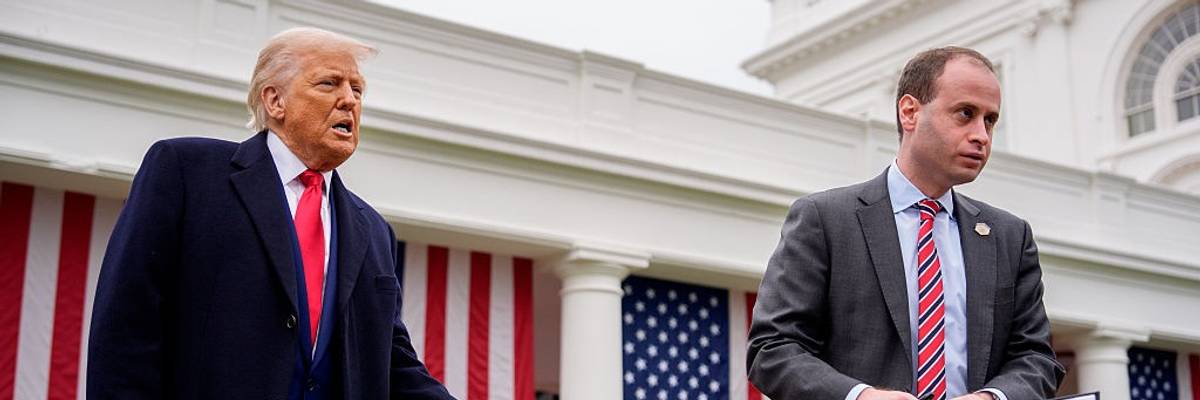
U.S. President Donald Trump stands with White House staff secretary Will Scharf before signing executive orders imposing sweeping tariffs on April 2, 2025 in Washington, D.C.
"What Republicans are trying to jam through Congress right now is a level of economic recklessness we’ve never seen before," said a group of Democratic lawmakers.
A new analysis indicates Republicans' plan to extend soon-to-expire provisions of their party's 2017 tax law, as well as their push to tack on additional tax breaks largely benefiting the rich and big corporations, would cost $7 trillion over the next decade, a figure that a group of congressional Democrats called "staggering."
The analysis from the nonpartisan Joint Committee on Taxation (JCT), published on Thursday, updates previous estimates that suggested the GOP effort to extend expiring provisions of the 2017 law would cost $4.6 trillion over a 10-year period. The new assessment shows that extending the law's temporary provisions—which disproportionately favored the wealthy—would cost $5.5 trillion over the next decade.
The projected cost of the GOP agenda balloons to $7 trillion after adding Senate Republicans' call for $1.5 trillion in additional tax cuts in the budget resolution they advanced in a party-line vote on Thursday. The GOP has come under fire for using an accounting trick to claim their proposed tax cuts would have no budgetary impact.
"The Republican handouts to billionaires and corporations will come at a staggering cost, and it's unconscionable that their plan to pay for those handouts includes kicking millions of Americans off their health insurance, hiking the cost of living with tariffs, and driving up child hunger," Sen. Ron Wyden (D-Ore.), Sen. Jeff Merkley (D-Ore.), Rep. Richard Neal (D-Mass.), and Rep. Brendan Boyle (D-Pa.) said in a joint statement issued in response to the JCT figures.
"Even after making painful cuts that will inflict hardship on typical American families, Republicans will still risk sending us into a catastrophic debt spiral that does permanent harm to our economy," the Democrats added. "What Republicans are trying to jam through Congress right now is a level of economic recklessness we've never seen before."
The JCT's updated cost analysis came as President Donald Trump plowed ahead with what's been characterized as the biggest tax hike in U.S. history, one that will hit working-class Americans in the form of price increases on household staples and other goods.
Trump administration officials, not known for providing reliable numbers, have claimed the president's sweeping new tariffs could produce roughly $6 trillion in federal revenue over the next decade. The Trump tariffs have sent financial markets into a tailspin, heightened recession fears, and prompted swift retaliation from targeted nations, including China.
In an appearance on MSNBC on Thursday, Boyle—the top Democrat on the House Budget Committee—said Trump's tariffs represent "the single largest tax increase in American history."
"It's a tax that everyone will pay in this country, based on the goods that they buy," said Boyle. "However, it's also a tax that is highly regressive—the poorest amongst us will end up paying a higher percentage of their income."
A previous version of this story incorrectly stated the analysis was conducted by the Congressional Budget Office. It was conducted by the Joint Committee on Taxation.
Dear Common Dreams reader, It’s been nearly 30 years since I co-founded Common Dreams with my late wife, Lina Newhouser. We had the radical notion that journalism should serve the public good, not corporate profits. It was clear to us from the outset what it would take to build such a project. No paid advertisements. No corporate sponsors. No millionaire publisher telling us what to think or do. Many people said we wouldn't last a year, but we proved those doubters wrong. Together with a tremendous team of journalists and dedicated staff, we built an independent media outlet free from the constraints of profits and corporate control. Our mission has always been simple: To inform. To inspire. To ignite change for the common good. Building Common Dreams was not easy. Our survival was never guaranteed. When you take on the most powerful forces—Wall Street greed, fossil fuel industry destruction, Big Tech lobbyists, and uber-rich oligarchs who have spent billions upon billions rigging the economy and democracy in their favor—the only bulwark you have is supporters who believe in your work. But here’s the urgent message from me today. It's never been this bad out there. And it's never been this hard to keep us going. At the very moment Common Dreams is most needed, the threats we face are intensifying. We need your support now more than ever. We don't accept corporate advertising and never will. We don't have a paywall because we don't think people should be blocked from critical news based on their ability to pay. Everything we do is funded by the donations of readers like you. When everyone does the little they can afford, we are strong. But if that support retreats or dries up, so do we. Will you donate now to make sure Common Dreams not only survives but thrives? —Craig Brown, Co-founder |
A new analysis indicates Republicans' plan to extend soon-to-expire provisions of their party's 2017 tax law, as well as their push to tack on additional tax breaks largely benefiting the rich and big corporations, would cost $7 trillion over the next decade, a figure that a group of congressional Democrats called "staggering."
The analysis from the nonpartisan Joint Committee on Taxation (JCT), published on Thursday, updates previous estimates that suggested the GOP effort to extend expiring provisions of the 2017 law would cost $4.6 trillion over a 10-year period. The new assessment shows that extending the law's temporary provisions—which disproportionately favored the wealthy—would cost $5.5 trillion over the next decade.
The projected cost of the GOP agenda balloons to $7 trillion after adding Senate Republicans' call for $1.5 trillion in additional tax cuts in the budget resolution they advanced in a party-line vote on Thursday. The GOP has come under fire for using an accounting trick to claim their proposed tax cuts would have no budgetary impact.
"The Republican handouts to billionaires and corporations will come at a staggering cost, and it's unconscionable that their plan to pay for those handouts includes kicking millions of Americans off their health insurance, hiking the cost of living with tariffs, and driving up child hunger," Sen. Ron Wyden (D-Ore.), Sen. Jeff Merkley (D-Ore.), Rep. Richard Neal (D-Mass.), and Rep. Brendan Boyle (D-Pa.) said in a joint statement issued in response to the JCT figures.
"Even after making painful cuts that will inflict hardship on typical American families, Republicans will still risk sending us into a catastrophic debt spiral that does permanent harm to our economy," the Democrats added. "What Republicans are trying to jam through Congress right now is a level of economic recklessness we've never seen before."
The JCT's updated cost analysis came as President Donald Trump plowed ahead with what's been characterized as the biggest tax hike in U.S. history, one that will hit working-class Americans in the form of price increases on household staples and other goods.
Trump administration officials, not known for providing reliable numbers, have claimed the president's sweeping new tariffs could produce roughly $6 trillion in federal revenue over the next decade. The Trump tariffs have sent financial markets into a tailspin, heightened recession fears, and prompted swift retaliation from targeted nations, including China.
In an appearance on MSNBC on Thursday, Boyle—the top Democrat on the House Budget Committee—said Trump's tariffs represent "the single largest tax increase in American history."
"It's a tax that everyone will pay in this country, based on the goods that they buy," said Boyle. "However, it's also a tax that is highly regressive—the poorest amongst us will end up paying a higher percentage of their income."
A previous version of this story incorrectly stated the analysis was conducted by the Congressional Budget Office. It was conducted by the Joint Committee on Taxation.
A new analysis indicates Republicans' plan to extend soon-to-expire provisions of their party's 2017 tax law, as well as their push to tack on additional tax breaks largely benefiting the rich and big corporations, would cost $7 trillion over the next decade, a figure that a group of congressional Democrats called "staggering."
The analysis from the nonpartisan Joint Committee on Taxation (JCT), published on Thursday, updates previous estimates that suggested the GOP effort to extend expiring provisions of the 2017 law would cost $4.6 trillion over a 10-year period. The new assessment shows that extending the law's temporary provisions—which disproportionately favored the wealthy—would cost $5.5 trillion over the next decade.
The projected cost of the GOP agenda balloons to $7 trillion after adding Senate Republicans' call for $1.5 trillion in additional tax cuts in the budget resolution they advanced in a party-line vote on Thursday. The GOP has come under fire for using an accounting trick to claim their proposed tax cuts would have no budgetary impact.
"The Republican handouts to billionaires and corporations will come at a staggering cost, and it's unconscionable that their plan to pay for those handouts includes kicking millions of Americans off their health insurance, hiking the cost of living with tariffs, and driving up child hunger," Sen. Ron Wyden (D-Ore.), Sen. Jeff Merkley (D-Ore.), Rep. Richard Neal (D-Mass.), and Rep. Brendan Boyle (D-Pa.) said in a joint statement issued in response to the JCT figures.
"Even after making painful cuts that will inflict hardship on typical American families, Republicans will still risk sending us into a catastrophic debt spiral that does permanent harm to our economy," the Democrats added. "What Republicans are trying to jam through Congress right now is a level of economic recklessness we've never seen before."
The JCT's updated cost analysis came as President Donald Trump plowed ahead with what's been characterized as the biggest tax hike in U.S. history, one that will hit working-class Americans in the form of price increases on household staples and other goods.
Trump administration officials, not known for providing reliable numbers, have claimed the president's sweeping new tariffs could produce roughly $6 trillion in federal revenue over the next decade. The Trump tariffs have sent financial markets into a tailspin, heightened recession fears, and prompted swift retaliation from targeted nations, including China.
In an appearance on MSNBC on Thursday, Boyle—the top Democrat on the House Budget Committee—said Trump's tariffs represent "the single largest tax increase in American history."
"It's a tax that everyone will pay in this country, based on the goods that they buy," said Boyle. "However, it's also a tax that is highly regressive—the poorest amongst us will end up paying a higher percentage of their income."
A previous version of this story incorrectly stated the analysis was conducted by the Congressional Budget Office. It was conducted by the Joint Committee on Taxation.