SUBSCRIBE TO OUR FREE NEWSLETTER
Daily news & progressive opinion—funded by the people, not the corporations—delivered straight to your inbox.
5
#000000
#FFFFFF
To donate by check, phone, or other method, see our More Ways to Give page.
Daily news & progressive opinion—funded by the people, not the corporations—delivered straight to your inbox.
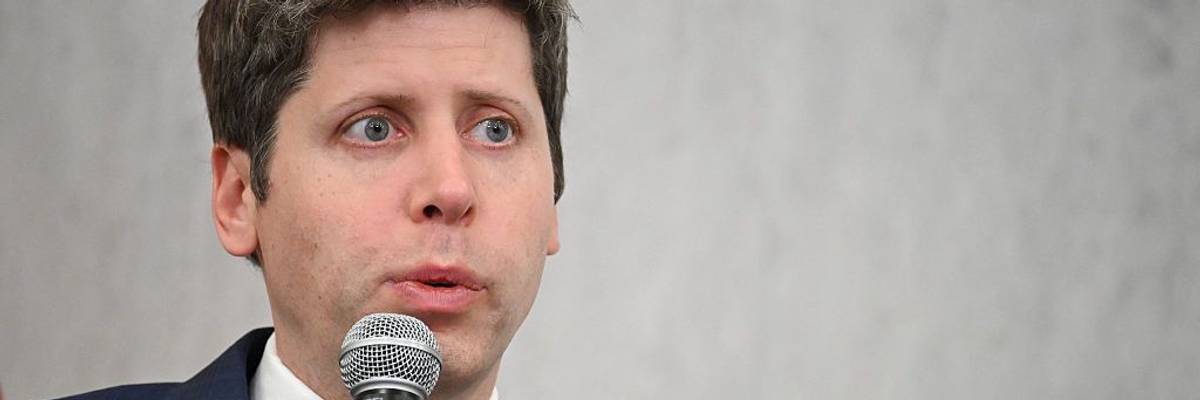
"We can push OpenAI over the edge," said one group encouraging a boycott of the AI giant.
Calls to boycott OpenAI have been growing over the last several days after the artificial intelligence giant reached a deal with the US Department of Defense to use its ChatGPT chatbot across its classified network.
OpenAI CEO Sam Altman on Friday said that the deal reached with the Pentagon would have "prohibitions on domestic mass surveillance" and maintain "human responsibility for the use of force, including for autonomous weapon systems."
The DOD had previously gotten into a dispute with AI firm Anthropic, which refused to modify its Claude chatbot to allow for its use for domestic spying or to make final decisions on whether to take a human life.
President Donald Trump announced on Friday that he'd ordered the US military to stop using Anthropic's technology, describing the firm as "A RADICAL LEFT, WOKE COMPANY" in a Truth Social post.
Shortly after Trump's post, Altman announced that OpenAI had reached a deal with the Pentagon. This led many critics to suspect that, whatever Altman's denials, the DOD would be allowed to use ChatGPT in ways that it had been forbidden to utilize Claude.
Adam Cochrane, who runs activist venture capital firm Cinneamhain Ventures, said immediately after Altman's announcement that he was canceling his ChatGPT subscription on the grounds that "I don’t support bootlickers."
Dr. Simon Goddek, a biotech scientist, also revealed that he was canceling his ChatGPT subscription and encouraged others to do the same.
"Companies understand one language: MONEY," he wrote. "If they support wars of aggression, they can’t profit from me. I’m out. What’s stopping you?"
AI consultant Mark Gadala-Maria accused Altman of being two-faced with his DOD deal, noting that the OpenAI CEO had expressed solidarity with Anthropic in the face of the Trump administration's attacks.
"Just a few hours ago he was on TV saying he stood by Anthropic," wrote Gadala-Maria. "Then he undercuts them and takes the same contract that Anthropic just lost. How can anyone trust this guy?"
An OpenAI boycott group called "QuitGPT" went online shortly after Altman's announcement, and the organization claims that it has gotten more than 1.5 million people to cancel their ChatGPT subscriptions or stop using it all together.
QuitGPT also outlined why its boycott of OpenAI could be potentially effective given the highly competitive nature of the current consumer AI market.
"ChatGPT is the biggest chatbot in the world, but that advantage is fragile," QuitGPT explained. "ChatGPT has been losing market share. Their creator, OpenAI, is losing three times more than they earn. ChatGPT users skew young and progressive, and many don't know about alternatives. We can push OpenAI over the edge."
Dear Common Dreams reader, It’s been nearly 30 years since I co-founded Common Dreams with my late wife, Lina Newhouser. We had the radical notion that journalism should serve the public good, not corporate profits. It was clear to us from the outset what it would take to build such a project. No paid advertisements. No corporate sponsors. No millionaire publisher telling us what to think or do. Many people said we wouldn't last a year, but we proved those doubters wrong. Together with a tremendous team of journalists and dedicated staff, we built an independent media outlet free from the constraints of profits and corporate control. Our mission has always been simple: To inform. To inspire. To ignite change for the common good. Building Common Dreams was not easy. Our survival was never guaranteed. When you take on the most powerful forces—Wall Street greed, fossil fuel industry destruction, Big Tech lobbyists, and uber-rich oligarchs who have spent billions upon billions rigging the economy and democracy in their favor—the only bulwark you have is supporters who believe in your work. But here’s the urgent message from me today. It's never been this bad out there. And it's never been this hard to keep us going. At the very moment Common Dreams is most needed, the threats we face are intensifying. We need your support now more than ever. We don't accept corporate advertising and never will. We don't have a paywall because we don't think people should be blocked from critical news based on their ability to pay. Everything we do is funded by the donations of readers like you. When everyone does the little they can afford, we are strong. But if that support retreats or dries up, so do we. Will you donate now to make sure Common Dreams not only survives but thrives? —Craig Brown, Co-founder |
Calls to boycott OpenAI have been growing over the last several days after the artificial intelligence giant reached a deal with the US Department of Defense to use its ChatGPT chatbot across its classified network.
OpenAI CEO Sam Altman on Friday said that the deal reached with the Pentagon would have "prohibitions on domestic mass surveillance" and maintain "human responsibility for the use of force, including for autonomous weapon systems."
The DOD had previously gotten into a dispute with AI firm Anthropic, which refused to modify its Claude chatbot to allow for its use for domestic spying or to make final decisions on whether to take a human life.
President Donald Trump announced on Friday that he'd ordered the US military to stop using Anthropic's technology, describing the firm as "A RADICAL LEFT, WOKE COMPANY" in a Truth Social post.
Shortly after Trump's post, Altman announced that OpenAI had reached a deal with the Pentagon. This led many critics to suspect that, whatever Altman's denials, the DOD would be allowed to use ChatGPT in ways that it had been forbidden to utilize Claude.
Adam Cochrane, who runs activist venture capital firm Cinneamhain Ventures, said immediately after Altman's announcement that he was canceling his ChatGPT subscription on the grounds that "I don’t support bootlickers."
Dr. Simon Goddek, a biotech scientist, also revealed that he was canceling his ChatGPT subscription and encouraged others to do the same.
"Companies understand one language: MONEY," he wrote. "If they support wars of aggression, they can’t profit from me. I’m out. What’s stopping you?"
AI consultant Mark Gadala-Maria accused Altman of being two-faced with his DOD deal, noting that the OpenAI CEO had expressed solidarity with Anthropic in the face of the Trump administration's attacks.
"Just a few hours ago he was on TV saying he stood by Anthropic," wrote Gadala-Maria. "Then he undercuts them and takes the same contract that Anthropic just lost. How can anyone trust this guy?"
An OpenAI boycott group called "QuitGPT" went online shortly after Altman's announcement, and the organization claims that it has gotten more than 1.5 million people to cancel their ChatGPT subscriptions or stop using it all together.
QuitGPT also outlined why its boycott of OpenAI could be potentially effective given the highly competitive nature of the current consumer AI market.
"ChatGPT is the biggest chatbot in the world, but that advantage is fragile," QuitGPT explained. "ChatGPT has been losing market share. Their creator, OpenAI, is losing three times more than they earn. ChatGPT users skew young and progressive, and many don't know about alternatives. We can push OpenAI over the edge."
Calls to boycott OpenAI have been growing over the last several days after the artificial intelligence giant reached a deal with the US Department of Defense to use its ChatGPT chatbot across its classified network.
OpenAI CEO Sam Altman on Friday said that the deal reached with the Pentagon would have "prohibitions on domestic mass surveillance" and maintain "human responsibility for the use of force, including for autonomous weapon systems."
The DOD had previously gotten into a dispute with AI firm Anthropic, which refused to modify its Claude chatbot to allow for its use for domestic spying or to make final decisions on whether to take a human life.
President Donald Trump announced on Friday that he'd ordered the US military to stop using Anthropic's technology, describing the firm as "A RADICAL LEFT, WOKE COMPANY" in a Truth Social post.
Shortly after Trump's post, Altman announced that OpenAI had reached a deal with the Pentagon. This led many critics to suspect that, whatever Altman's denials, the DOD would be allowed to use ChatGPT in ways that it had been forbidden to utilize Claude.
Adam Cochrane, who runs activist venture capital firm Cinneamhain Ventures, said immediately after Altman's announcement that he was canceling his ChatGPT subscription on the grounds that "I don’t support bootlickers."
Dr. Simon Goddek, a biotech scientist, also revealed that he was canceling his ChatGPT subscription and encouraged others to do the same.
"Companies understand one language: MONEY," he wrote. "If they support wars of aggression, they can’t profit from me. I’m out. What’s stopping you?"
AI consultant Mark Gadala-Maria accused Altman of being two-faced with his DOD deal, noting that the OpenAI CEO had expressed solidarity with Anthropic in the face of the Trump administration's attacks.
"Just a few hours ago he was on TV saying he stood by Anthropic," wrote Gadala-Maria. "Then he undercuts them and takes the same contract that Anthropic just lost. How can anyone trust this guy?"
An OpenAI boycott group called "QuitGPT" went online shortly after Altman's announcement, and the organization claims that it has gotten more than 1.5 million people to cancel their ChatGPT subscriptions or stop using it all together.
QuitGPT also outlined why its boycott of OpenAI could be potentially effective given the highly competitive nature of the current consumer AI market.
"ChatGPT is the biggest chatbot in the world, but that advantage is fragile," QuitGPT explained. "ChatGPT has been losing market share. Their creator, OpenAI, is losing three times more than they earn. ChatGPT users skew young and progressive, and many don't know about alternatives. We can push OpenAI over the edge."