SUBSCRIBE TO OUR FREE NEWSLETTER
Daily news & progressive opinion—funded by the people, not the corporations—delivered straight to your inbox.
5
#000000
#FFFFFF
To donate by check, phone, or other method, see our More Ways to Give page.
Daily news & progressive opinion—funded by the people, not the corporations—delivered straight to your inbox.
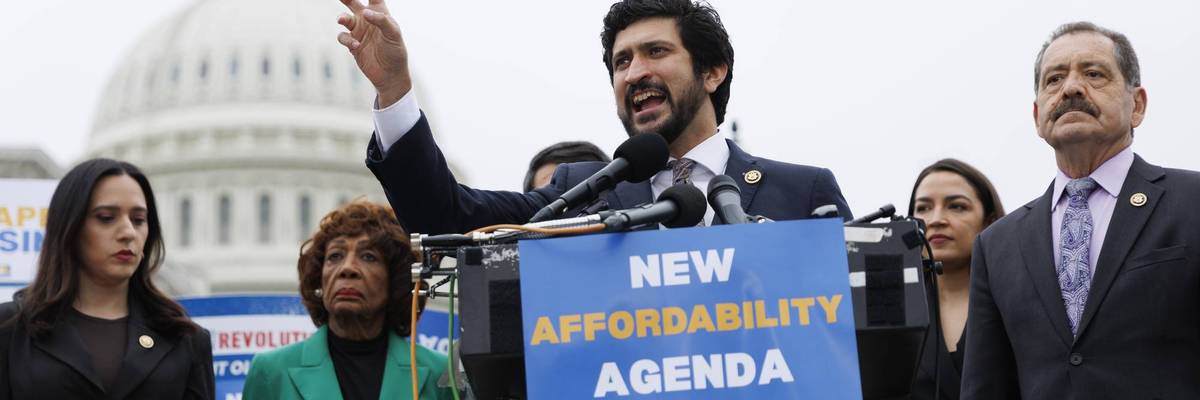
Rep. Greg Casar (D-Texas) speaks during a news conference on April 29, 2026 outside the US Capitol in Washington, DC.
"Taxing AI directly ties the solution directly to the problem," wrote Rep. Greg Casar. "If AI use grows quickly, driving layoffs alongside it, the revenue from an AI tax would go up too."
Two leading progressives in the US Congress are calling for a tax on artificial intelligence to fund programs that would help prevent an economic catastrophe for workers displaced by the rapidly advancing technology.
In separate op-eds published Wednesday and Thursday, Sen. Elizabeth Warren (D-Mass.) and Rep. Greg Casar (D-Texas) warned that AI risks turbocharging existing wealth and income inequality by driving up the fortunes of large companies and their executives, while hurling millions of workers into joblessness without an adequate safety net.
"Taxing AI is one way we make sure the winnings from AI benefit all Americans, rather than channeling them only to the wealthy few. If millions of people lose their jobs to AI, we’ll need the funds to deliver universal healthcare so those workers are not bankrupted by a visit to the doctor," Warren wrote in TIME. "If AI transforms the future of work, we'll need to invest in free education and apprenticeships and a new jobs guarantee so that all Americans have good-paying work. And while workers get back on their feet, we’ll need the revenue to bolster unemployment insurance to keep families afloat. The only way we can get there is by overhauling our tax code."
Casar, chairman of the Congressional Progressive Caucus, made the case for an "AI tax-funded jobs program" in an op-ed for The American Prospect, arguing the initiative "should draw inspiration from the New Deal-era Works Progress Administration, which employed millions of Americans."
The Texas Democrat specifically proposed a tax on AI "tokens," units of data that are processed by artificial intelligence models.
"Taxing AI directly ties the solution directly to the problem," Casar wrote. "If AI use grows quickly, driving layoffs alongside it, the revenue from an AI tax would go up too. Unlike traditional corporate taxes, an AI tax like the one I am proposing works even if employers fire workers before AI companies show a profit."
AI billionaires are threatening layoffs so big we hit Great Depression levels of unemployment.
You don't have to take my word for it. They say it.
We must fight back.
I'm proposing a first step: taxing AI companies to pay for a jobs program that keep Americans employed.…
— Congressman Greg Casar (@RepCasar) May 28, 2026
The progressive lawmakers' call for a new AI tax come amid mounting concerns, in the US and around the world, about burgeoning technology's impact on workers whose jobs could be replaced by robots. Pope Leo XIV used his first encyclical to warn of the threat AI poses to employment, and prominent lawmakers such as US Sen. Bernie Sanders (I-Vt.) have predicted "economic devastation for working people" if tech oligarchs get their way.
"Corporations are already using AI to cut jobs," Sanders' office noted in a recent report. "Amazon, Walmart, UnitedHealth Group, JPMorgan Chase,and other companies are openly telling investors that AI will allow them to slash payrolls—even as they post tens of billions in profits and reward CEOs with pay packages of $25 million, $35 million, or more."
Warren and Casar argued that nightmare scenarios envisioned by AI critics and industry leaders alike are entirely preventable—but averting them would require bold and urgent legislative action that's a longshot with President Donald Trump and Republicans in control the federal government.
"Congress should act now, and not wait to see if the worst-case scenario arrives," wrote Casar. "AI companies are already pouring hundreds of millions of dollars into elections to try to shape what regulations get considered. We cannot wait for these companies to become even wealthier and more powerful."
Warren called for "taxing AI companies directly," including by imposing levies on AI data centers, which have drawn grassroots backlash across the country. The senator also pushed for broader action, including a wealth tax, to ensure that mega-rich beneficiaries of the AI boom don't "pay lower tax rates than the workers they fire."
"Here’s what I see clearly: If we overhaul our tax code and tax AI, we can use that money to build a country that works for everyone," Warren wrote. "A country where healthcare is treated as a human right, where every American is guaranteed a good job, and where education isn’t a privilege reserved for the wealthy. That’s what I believe taxing AI promises."
Dear Common Dreams reader, It’s been nearly 30 years since I co-founded Common Dreams with my late wife, Lina Newhouser. We had the radical notion that journalism should serve the public good, not corporate profits. It was clear to us from the outset what it would take to build such a project. No paid advertisements. No corporate sponsors. No millionaire publisher telling us what to think or do. Many people said we wouldn't last a year, but we proved those doubters wrong. Together with a tremendous team of journalists and dedicated staff, we built an independent media outlet free from the constraints of profits and corporate control. Our mission has always been simple: To inform. To inspire. To ignite change for the common good. Building Common Dreams was not easy. Our survival was never guaranteed. When you take on the most powerful forces—Wall Street greed, fossil fuel industry destruction, Big Tech lobbyists, and uber-rich oligarchs who have spent billions upon billions rigging the economy and democracy in their favor—the only bulwark you have is supporters who believe in your work. But here’s the urgent message from me today. It's never been this bad out there. And it's never been this hard to keep us going. At the very moment Common Dreams is most needed, the threats we face are intensifying. We need your support now more than ever. We don't accept corporate advertising and never will. We don't have a paywall because we don't think people should be blocked from critical news based on their ability to pay. Everything we do is funded by the donations of readers like you. When everyone does the little they can afford, we are strong. But if that support retreats or dries up, so do we. Will you donate now to make sure Common Dreams not only survives but thrives? —Craig Brown, Co-founder |
Two leading progressives in the US Congress are calling for a tax on artificial intelligence to fund programs that would help prevent an economic catastrophe for workers displaced by the rapidly advancing technology.
In separate op-eds published Wednesday and Thursday, Sen. Elizabeth Warren (D-Mass.) and Rep. Greg Casar (D-Texas) warned that AI risks turbocharging existing wealth and income inequality by driving up the fortunes of large companies and their executives, while hurling millions of workers into joblessness without an adequate safety net.
"Taxing AI is one way we make sure the winnings from AI benefit all Americans, rather than channeling them only to the wealthy few. If millions of people lose their jobs to AI, we’ll need the funds to deliver universal healthcare so those workers are not bankrupted by a visit to the doctor," Warren wrote in TIME. "If AI transforms the future of work, we'll need to invest in free education and apprenticeships and a new jobs guarantee so that all Americans have good-paying work. And while workers get back on their feet, we’ll need the revenue to bolster unemployment insurance to keep families afloat. The only way we can get there is by overhauling our tax code."
Casar, chairman of the Congressional Progressive Caucus, made the case for an "AI tax-funded jobs program" in an op-ed for The American Prospect, arguing the initiative "should draw inspiration from the New Deal-era Works Progress Administration, which employed millions of Americans."
The Texas Democrat specifically proposed a tax on AI "tokens," units of data that are processed by artificial intelligence models.
"Taxing AI directly ties the solution directly to the problem," Casar wrote. "If AI use grows quickly, driving layoffs alongside it, the revenue from an AI tax would go up too. Unlike traditional corporate taxes, an AI tax like the one I am proposing works even if employers fire workers before AI companies show a profit."
AI billionaires are threatening layoffs so big we hit Great Depression levels of unemployment.
You don't have to take my word for it. They say it.
We must fight back.
I'm proposing a first step: taxing AI companies to pay for a jobs program that keep Americans employed.…
— Congressman Greg Casar (@RepCasar) May 28, 2026
The progressive lawmakers' call for a new AI tax come amid mounting concerns, in the US and around the world, about burgeoning technology's impact on workers whose jobs could be replaced by robots. Pope Leo XIV used his first encyclical to warn of the threat AI poses to employment, and prominent lawmakers such as US Sen. Bernie Sanders (I-Vt.) have predicted "economic devastation for working people" if tech oligarchs get their way.
"Corporations are already using AI to cut jobs," Sanders' office noted in a recent report. "Amazon, Walmart, UnitedHealth Group, JPMorgan Chase,and other companies are openly telling investors that AI will allow them to slash payrolls—even as they post tens of billions in profits and reward CEOs with pay packages of $25 million, $35 million, or more."
Warren and Casar argued that nightmare scenarios envisioned by AI critics and industry leaders alike are entirely preventable—but averting them would require bold and urgent legislative action that's a longshot with President Donald Trump and Republicans in control the federal government.
"Congress should act now, and not wait to see if the worst-case scenario arrives," wrote Casar. "AI companies are already pouring hundreds of millions of dollars into elections to try to shape what regulations get considered. We cannot wait for these companies to become even wealthier and more powerful."
Warren called for "taxing AI companies directly," including by imposing levies on AI data centers, which have drawn grassroots backlash across the country. The senator also pushed for broader action, including a wealth tax, to ensure that mega-rich beneficiaries of the AI boom don't "pay lower tax rates than the workers they fire."
"Here’s what I see clearly: If we overhaul our tax code and tax AI, we can use that money to build a country that works for everyone," Warren wrote. "A country where healthcare is treated as a human right, where every American is guaranteed a good job, and where education isn’t a privilege reserved for the wealthy. That’s what I believe taxing AI promises."
Two leading progressives in the US Congress are calling for a tax on artificial intelligence to fund programs that would help prevent an economic catastrophe for workers displaced by the rapidly advancing technology.
In separate op-eds published Wednesday and Thursday, Sen. Elizabeth Warren (D-Mass.) and Rep. Greg Casar (D-Texas) warned that AI risks turbocharging existing wealth and income inequality by driving up the fortunes of large companies and their executives, while hurling millions of workers into joblessness without an adequate safety net.
"Taxing AI is one way we make sure the winnings from AI benefit all Americans, rather than channeling them only to the wealthy few. If millions of people lose their jobs to AI, we’ll need the funds to deliver universal healthcare so those workers are not bankrupted by a visit to the doctor," Warren wrote in TIME. "If AI transforms the future of work, we'll need to invest in free education and apprenticeships and a new jobs guarantee so that all Americans have good-paying work. And while workers get back on their feet, we’ll need the revenue to bolster unemployment insurance to keep families afloat. The only way we can get there is by overhauling our tax code."
Casar, chairman of the Congressional Progressive Caucus, made the case for an "AI tax-funded jobs program" in an op-ed for The American Prospect, arguing the initiative "should draw inspiration from the New Deal-era Works Progress Administration, which employed millions of Americans."
The Texas Democrat specifically proposed a tax on AI "tokens," units of data that are processed by artificial intelligence models.
"Taxing AI directly ties the solution directly to the problem," Casar wrote. "If AI use grows quickly, driving layoffs alongside it, the revenue from an AI tax would go up too. Unlike traditional corporate taxes, an AI tax like the one I am proposing works even if employers fire workers before AI companies show a profit."
AI billionaires are threatening layoffs so big we hit Great Depression levels of unemployment.
You don't have to take my word for it. They say it.
We must fight back.
I'm proposing a first step: taxing AI companies to pay for a jobs program that keep Americans employed.…
— Congressman Greg Casar (@RepCasar) May 28, 2026
The progressive lawmakers' call for a new AI tax come amid mounting concerns, in the US and around the world, about burgeoning technology's impact on workers whose jobs could be replaced by robots. Pope Leo XIV used his first encyclical to warn of the threat AI poses to employment, and prominent lawmakers such as US Sen. Bernie Sanders (I-Vt.) have predicted "economic devastation for working people" if tech oligarchs get their way.
"Corporations are already using AI to cut jobs," Sanders' office noted in a recent report. "Amazon, Walmart, UnitedHealth Group, JPMorgan Chase,and other companies are openly telling investors that AI will allow them to slash payrolls—even as they post tens of billions in profits and reward CEOs with pay packages of $25 million, $35 million, or more."
Warren and Casar argued that nightmare scenarios envisioned by AI critics and industry leaders alike are entirely preventable—but averting them would require bold and urgent legislative action that's a longshot with President Donald Trump and Republicans in control the federal government.
"Congress should act now, and not wait to see if the worst-case scenario arrives," wrote Casar. "AI companies are already pouring hundreds of millions of dollars into elections to try to shape what regulations get considered. We cannot wait for these companies to become even wealthier and more powerful."
Warren called for "taxing AI companies directly," including by imposing levies on AI data centers, which have drawn grassroots backlash across the country. The senator also pushed for broader action, including a wealth tax, to ensure that mega-rich beneficiaries of the AI boom don't "pay lower tax rates than the workers they fire."
"Here’s what I see clearly: If we overhaul our tax code and tax AI, we can use that money to build a country that works for everyone," Warren wrote. "A country where healthcare is treated as a human right, where every American is guaranteed a good job, and where education isn’t a privilege reserved for the wealthy. That’s what I believe taxing AI promises."