SUBSCRIBE TO OUR FREE NEWSLETTER
Daily news & progressive opinion—funded by the people, not the corporations—delivered straight to your inbox.
5
#000000
#FFFFFF
To donate by check, phone, or other method, see our More Ways to Give page.
Daily news & progressive opinion—funded by the people, not the corporations—delivered straight to your inbox.
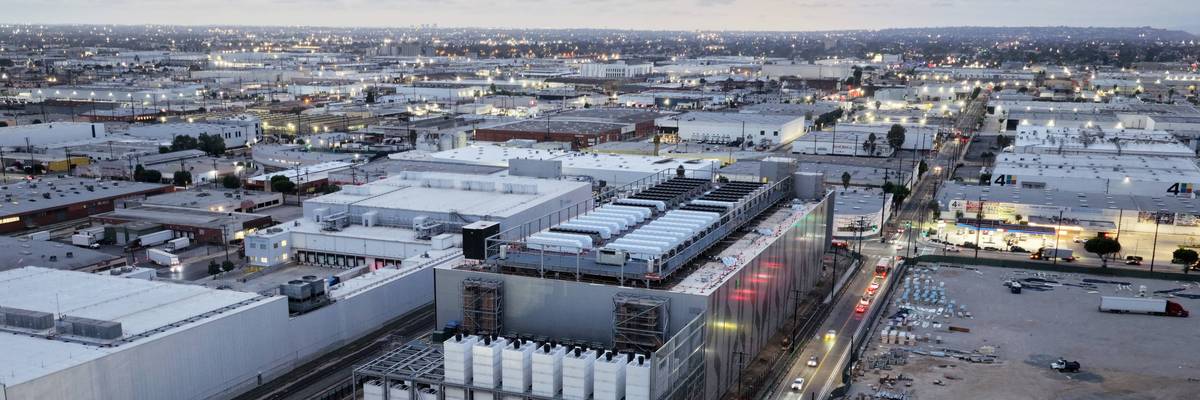
An aerial view shows a 49.5 megawatt three-level data center under construction on October 29, 2026 in Vernon, California.
The rapid data center build-out represents the "nail in the coffin for the planet’s life support systems," said one expert.
With the US and China turning to fossil fuels to power the data centers that the countries are pushing to rapidly build, the International Energy Agency said in its annual World Energy Outlook on Thursday that planet-heating emissions from the facilities are projected to rise by 70% by 2030.
The two countries are not alone in pushing for the expansion of massive data centers, which require large amounts of energy to operate and cool continuously running servers.
But the IEA noted that in the European Union, developers are expected to use renewable energy for about 70% of their data center needs by 2030. In Canada, the agency identified plans for 11 gigawatts of gas generation to power data centers over the next four years, and in the rest of the world, developers are expected to use gas plants for their energy needs with a combined capacity of just 4 gigawatts.
Developers in the US, meanwhile, currently have plans for about 180 gigawatts of new gas-fired plants to power their data centers, and the country is expected to rely on gas for about 60% of its electricity needs for the facilities.
In China, about half of data centers' electricity will come from coal-fired plants by the end of the decade.
The IEA's report was released a day after 14 Democrats in the US Congress joined Republicans in advancing the Bipartisan American Affordability and Jobs Act (BAAJA), a key permitting reform bill that would speed up fossil fuel projects and artificial intelligence data centers by limiting environmental reviews.
Christopher Wright, a professor at the University of Sydney and author of Organizing Responses to Climate Change, said the IEA report showed that the rapid data center build-out represents the "nail in the coffin for the planet’s life support systems."
The report was released as world leaders continued negotiations at the United Nations Climate Change Conference in Antalya, Türkiye, where campaigners, scientists, and policymakers have demanded a final agreement that includes concrete commitments to phase out the emissions that are projected to explode due to data centers.
The Climate Action Tracker said last week that without decisive action to slash fossil fuel emissions, the planet is headed for an "irrevocable overshoot" of the 1.5°C limit set by the Paris climate agreement in 2015. UN agencies have also warned in recent weeks that avoiding at least a temporary overshoot of the threshold is no longer possible, and drawing down fossil fuel emissions is now needed to ensure the breach is only temporary.
Following the disruption to world energy markets by the Iran War started by Israel and the US earlier this year, IEA executive director Fatih Birol said Thursday that he does not "see any credible pathway for the energy world to return to the way it was before."
Policy decisions, suggested the IEA, including those regarding how to power artificial intelligence and data centers, will determine the world's energy and climate future.
This country and this world are at a monumental crossroads. US voters have an opportunity to beat back the forces of fascism and confront the billionaires who are rigging the economy, our media system, and our democracy, making it increasingly impossible for ordinary people to get by. We’re not just talking about the election. We’re talking about what must be done once these fascist elements are vanquished from power. We need a bolder set of solutions than what either major party has so far been willing to offer and a working-class movement ready to fight like hell for it. Trump didn't emerge from nowhere. The conditions that fueled MAGA authoritarianism were created by decades of radical neoliberal economic policies and a corrupt political system dominated by corporate interests. They slashed taxes on the super-rich, promising that the benefits would trickle down. They said giveaways to the corporate titans would make life more affordable for the rest of us. It was all bullshit. And when a bitter, betrayed populace searches for someone to blame, right-wing demagogues have little trouble finding scapegoats. People know when they're being lied to, but you won't hear any of this from the corporate media. Only independent journalism—powered and funded by people who believe in building a better world—can deliver truly trustworthy daily news. If you share our vision, please contribute whatever you can to sustain our work. |
With the US and China turning to fossil fuels to power the data centers that the countries are pushing to rapidly build, the International Energy Agency said in its annual World Energy Outlook on Thursday that planet-heating emissions from the facilities are projected to rise by 70% by 2030.
The two countries are not alone in pushing for the expansion of massive data centers, which require large amounts of energy to operate and cool continuously running servers.
But the IEA noted that in the European Union, developers are expected to use renewable energy for about 70% of their data center needs by 2030. In Canada, the agency identified plans for 11 gigawatts of gas generation to power data centers over the next four years, and in the rest of the world, developers are expected to use gas plants for their energy needs with a combined capacity of just 4 gigawatts.
Developers in the US, meanwhile, currently have plans for about 180 gigawatts of new gas-fired plants to power their data centers, and the country is expected to rely on gas for about 60% of its electricity needs for the facilities.
In China, about half of data centers' electricity will come from coal-fired plants by the end of the decade.
The IEA's report was released a day after 14 Democrats in the US Congress joined Republicans in advancing the Bipartisan American Affordability and Jobs Act (BAAJA), a key permitting reform bill that would speed up fossil fuel projects and artificial intelligence data centers by limiting environmental reviews.
Christopher Wright, a professor at the University of Sydney and author of Organizing Responses to Climate Change, said the IEA report showed that the rapid data center build-out represents the "nail in the coffin for the planet’s life support systems."
The report was released as world leaders continued negotiations at the United Nations Climate Change Conference in Antalya, Türkiye, where campaigners, scientists, and policymakers have demanded a final agreement that includes concrete commitments to phase out the emissions that are projected to explode due to data centers.
The Climate Action Tracker said last week that without decisive action to slash fossil fuel emissions, the planet is headed for an "irrevocable overshoot" of the 1.5°C limit set by the Paris climate agreement in 2015. UN agencies have also warned in recent weeks that avoiding at least a temporary overshoot of the threshold is no longer possible, and drawing down fossil fuel emissions is now needed to ensure the breach is only temporary.
Following the disruption to world energy markets by the Iran War started by Israel and the US earlier this year, IEA executive director Fatih Birol said Thursday that he does not "see any credible pathway for the energy world to return to the way it was before."
Policy decisions, suggested the IEA, including those regarding how to power artificial intelligence and data centers, will determine the world's energy and climate future.