SUBSCRIBE TO OUR FREE NEWSLETTER
Daily news & progressive opinion—funded by the people, not the corporations—delivered straight to your inbox.
5
#000000
#FFFFFF
To donate by check, phone, or other method, see our More Ways to Give page.
Daily news & progressive opinion—funded by the people, not the corporations—delivered straight to your inbox.
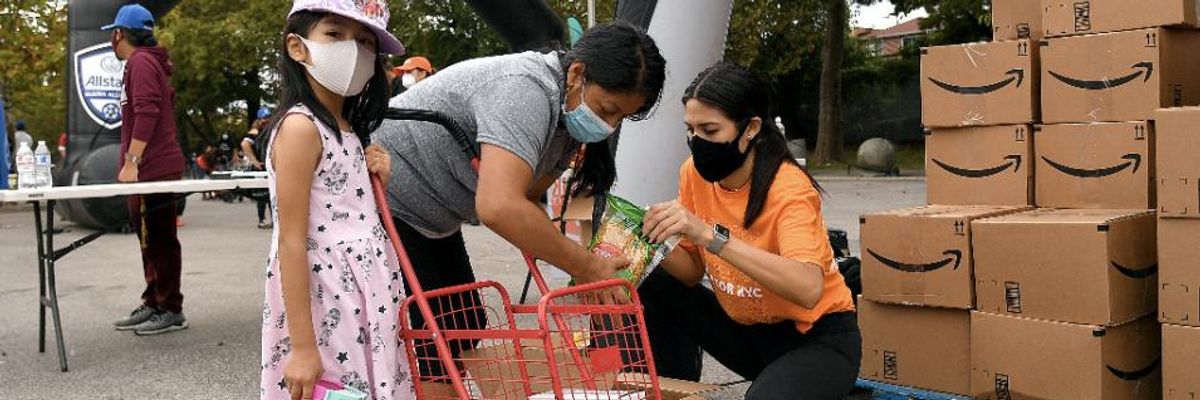
Food Bank for New York City hosts a food distribution pop-up in partnership with Alianza De Futbol during Hunger Action Month at New York Hall of Science on September 27, 2020 in Queens. (Photo: Michael Loccisano/Getty Images for Food Bank For New York City)
With over 262,000 Americans killed by Covid-19, millions jobless and at risk of soon losing unemployment aid, and families and friends warned against spending Thanksgiving together because of the dangers of the ongoing coronavirus pandemic, new polling results revealed Thursday that people with low incomes agree upon a range of policy solutions to poverty and hunger.
"Rising hunger in America is a moral and policy failure--addressing it should never be a partisan issue."
--Rep. Marcia Fudge
Conducted in November by the Colorado-based firm Kupersmit Research on behalf of the national anti-hunger direct service and advocacy group Hunger Free America, the survey found that many people across the country with household incomes of $50,000 or below share views about raising the minimum wage as well as expanding access to and benefits of public assistance programs.
According to the poll, 73% of Americans living in or near poverty somewhat or strongly agree that "the U.S. government should enact the policies and programs necessary to end U.S. hunger by ensuring that all Americans can afford and access sufficient, nutritious, culturally compatible food."
Majorities of those polled said boosting the Supplemental Nutrition Assistance Program (SNAP), also known as food stamps, would help some or a lot, and that all school meals should be "universal, free, and nutritious, regardless of family income."
Raising the federal minimum wage--currently just $7.25 an hour--was also popular among respondents. When asked to describe the three most important things "that need to happen or change so that low-income Americans are able to have a better quality of life and a more secure economic outlook for the future," responses included:
Other respondents suggested having a federal jobs guarantee, more labor unions, a universal basic income (UBI) program, a solution to the climate crisis that centers renewable energy, higher taxes on wealthy people and companies, and one application for all government assistance.
The poll found that majorities of low-income Americans support increasing government subsidies for home purchases and believe that it should be "free to open bank accounts, cash checks, pay bills, and pay for things by smart phone and/or at stores without hassles, fees, or fine print."
While all the respondents have low incomes, they are diverse in terms of age, race, and political party, and live in rural, suburban, and urban areas.
The survey results, released just weeks after the divisive presidential election, show that 67% of low-income Americans agree that "if the U.S. government decided to spend as much as necessary, we could eliminate U.S. poverty, homelessness, and hunger."
Hunger Free America CEO Joel Berg on Thursday expressed hope that President-elect Joe Biden and Vice President-elect Kamala Harris--whose victory this month denied President Donald Trump and Vice President Mike Pence a second term--will learn from the findings.
"In the last election, virtually the only thing that united the most pro-Trump rural counties and the most pro-Biden cities was high levels of poverty and low levels of income," Berg said. "Instead of assuming we knew what people in and near poverty were going through and what policies they wanted, we asked them. We found from this new ground-breaking research that most low-income Americans face multiple barriers to getting ahead."
"The good news is that we also found that low-income Americans of all parties, regions, and races broadly agree upon a bold policy agenda for government to make work pay and ensure that everyone has high-quality, affordable healthcare, housing, and food. We hope the incoming Biden-Harris administration can find common ground with the incoming Congress to make such goals a reality," he added, while calling on businesses to also step up and "pledge to pay all workers a living wage."
"Low-income Americans are sending a clear message to elected officials in both parties," said the research firm's president Benjamin Kupersmit. "First, they demand government intervention to raise wages, to lower costs and remove barriers to basic necessities, starting with healthcare. Second, they want to reform the safety net so these programs are expanded to be sufficient and re-designed with compassion and dignity for people working as hard as they can, or facing significant disability or illness."
The poll results come as Republican lawmakers and the Trump administration are under fire for months of delayed Covid-19 relief for Americans, despite the intense need and multiple measures passed by the Democrat-controlled U.S. House, and as progressives are maintaining pressure on Biden to avoid appointing a "corporate Cabinet," and instead nominate people committed to serving public good.
Among the potential Cabinet picks favored by progressive activists and advocacy groups is Rep. Marcia Fudge (D-Ohio); earlier this month, more than 50 organizations came together to send a letter to the incoming president urging him to nominate her to lead the U.S. Department of Agriculture.
"Congresswoman Fudge is a skilled and compassionate leader of unparalleled reputation and integrity," the groups' letter explained. "She has long been an ally to farmers, food-chain workers, consumers, and rural communities. She is best positioned to help the department navigate today's unprecedented challenges--from the ongoing rural crisis, to climate change, to the pandemic's rupturing of our food system."
In a statement about the survey, Fudge said Thursday that "today, hunger, poverty, and inequality are all on the rise across America. This new poll not only identifies the barriers low-income Americans face to getting ahead, it also shows there is broad agreement on the policy solutions that would give them a hand up during this difficult time."
"From raising the minimum wage and ensuring access to healthcare to boosting SNAP benefits, these are commonsense solutions that Congress can act on now to help struggling families put food on the table," she added. "Rising hunger in America is a moral and policy failure--addressing it should never be a partisan issue."
Dear Common Dreams reader, It’s been nearly 30 years since I co-founded Common Dreams with my late wife, Lina Newhouser. We had the radical notion that journalism should serve the public good, not corporate profits. It was clear to us from the outset what it would take to build such a project. No paid advertisements. No corporate sponsors. No millionaire publisher telling us what to think or do. Many people said we wouldn't last a year, but we proved those doubters wrong. Together with a tremendous team of journalists and dedicated staff, we built an independent media outlet free from the constraints of profits and corporate control. Our mission has always been simple: To inform. To inspire. To ignite change for the common good. Building Common Dreams was not easy. Our survival was never guaranteed. When you take on the most powerful forces—Wall Street greed, fossil fuel industry destruction, Big Tech lobbyists, and uber-rich oligarchs who have spent billions upon billions rigging the economy and democracy in their favor—the only bulwark you have is supporters who believe in your work. But here’s the urgent message from me today. It's never been this bad out there. And it's never been this hard to keep us going. At the very moment Common Dreams is most needed, the threats we face are intensifying. We need your support now more than ever. We don't accept corporate advertising and never will. We don't have a paywall because we don't think people should be blocked from critical news based on their ability to pay. Everything we do is funded by the donations of readers like you. When everyone does the little they can afford, we are strong. But if that support retreats or dries up, so do we. Will you donate now to make sure Common Dreams not only survives but thrives? —Craig Brown, Co-founder |
With over 262,000 Americans killed by Covid-19, millions jobless and at risk of soon losing unemployment aid, and families and friends warned against spending Thanksgiving together because of the dangers of the ongoing coronavirus pandemic, new polling results revealed Thursday that people with low incomes agree upon a range of policy solutions to poverty and hunger.
"Rising hunger in America is a moral and policy failure--addressing it should never be a partisan issue."
--Rep. Marcia Fudge
Conducted in November by the Colorado-based firm Kupersmit Research on behalf of the national anti-hunger direct service and advocacy group Hunger Free America, the survey found that many people across the country with household incomes of $50,000 or below share views about raising the minimum wage as well as expanding access to and benefits of public assistance programs.
According to the poll, 73% of Americans living in or near poverty somewhat or strongly agree that "the U.S. government should enact the policies and programs necessary to end U.S. hunger by ensuring that all Americans can afford and access sufficient, nutritious, culturally compatible food."
Majorities of those polled said boosting the Supplemental Nutrition Assistance Program (SNAP), also known as food stamps, would help some or a lot, and that all school meals should be "universal, free, and nutritious, regardless of family income."
Raising the federal minimum wage--currently just $7.25 an hour--was also popular among respondents. When asked to describe the three most important things "that need to happen or change so that low-income Americans are able to have a better quality of life and a more secure economic outlook for the future," responses included:
Other respondents suggested having a federal jobs guarantee, more labor unions, a universal basic income (UBI) program, a solution to the climate crisis that centers renewable energy, higher taxes on wealthy people and companies, and one application for all government assistance.
The poll found that majorities of low-income Americans support increasing government subsidies for home purchases and believe that it should be "free to open bank accounts, cash checks, pay bills, and pay for things by smart phone and/or at stores without hassles, fees, or fine print."
While all the respondents have low incomes, they are diverse in terms of age, race, and political party, and live in rural, suburban, and urban areas.
The survey results, released just weeks after the divisive presidential election, show that 67% of low-income Americans agree that "if the U.S. government decided to spend as much as necessary, we could eliminate U.S. poverty, homelessness, and hunger."
Hunger Free America CEO Joel Berg on Thursday expressed hope that President-elect Joe Biden and Vice President-elect Kamala Harris--whose victory this month denied President Donald Trump and Vice President Mike Pence a second term--will learn from the findings.
"In the last election, virtually the only thing that united the most pro-Trump rural counties and the most pro-Biden cities was high levels of poverty and low levels of income," Berg said. "Instead of assuming we knew what people in and near poverty were going through and what policies they wanted, we asked them. We found from this new ground-breaking research that most low-income Americans face multiple barriers to getting ahead."
"The good news is that we also found that low-income Americans of all parties, regions, and races broadly agree upon a bold policy agenda for government to make work pay and ensure that everyone has high-quality, affordable healthcare, housing, and food. We hope the incoming Biden-Harris administration can find common ground with the incoming Congress to make such goals a reality," he added, while calling on businesses to also step up and "pledge to pay all workers a living wage."
"Low-income Americans are sending a clear message to elected officials in both parties," said the research firm's president Benjamin Kupersmit. "First, they demand government intervention to raise wages, to lower costs and remove barriers to basic necessities, starting with healthcare. Second, they want to reform the safety net so these programs are expanded to be sufficient and re-designed with compassion and dignity for people working as hard as they can, or facing significant disability or illness."
The poll results come as Republican lawmakers and the Trump administration are under fire for months of delayed Covid-19 relief for Americans, despite the intense need and multiple measures passed by the Democrat-controlled U.S. House, and as progressives are maintaining pressure on Biden to avoid appointing a "corporate Cabinet," and instead nominate people committed to serving public good.
Among the potential Cabinet picks favored by progressive activists and advocacy groups is Rep. Marcia Fudge (D-Ohio); earlier this month, more than 50 organizations came together to send a letter to the incoming president urging him to nominate her to lead the U.S. Department of Agriculture.
"Congresswoman Fudge is a skilled and compassionate leader of unparalleled reputation and integrity," the groups' letter explained. "She has long been an ally to farmers, food-chain workers, consumers, and rural communities. She is best positioned to help the department navigate today's unprecedented challenges--from the ongoing rural crisis, to climate change, to the pandemic's rupturing of our food system."
In a statement about the survey, Fudge said Thursday that "today, hunger, poverty, and inequality are all on the rise across America. This new poll not only identifies the barriers low-income Americans face to getting ahead, it also shows there is broad agreement on the policy solutions that would give them a hand up during this difficult time."
"From raising the minimum wage and ensuring access to healthcare to boosting SNAP benefits, these are commonsense solutions that Congress can act on now to help struggling families put food on the table," she added. "Rising hunger in America is a moral and policy failure--addressing it should never be a partisan issue."
With over 262,000 Americans killed by Covid-19, millions jobless and at risk of soon losing unemployment aid, and families and friends warned against spending Thanksgiving together because of the dangers of the ongoing coronavirus pandemic, new polling results revealed Thursday that people with low incomes agree upon a range of policy solutions to poverty and hunger.
"Rising hunger in America is a moral and policy failure--addressing it should never be a partisan issue."
--Rep. Marcia Fudge
Conducted in November by the Colorado-based firm Kupersmit Research on behalf of the national anti-hunger direct service and advocacy group Hunger Free America, the survey found that many people across the country with household incomes of $50,000 or below share views about raising the minimum wage as well as expanding access to and benefits of public assistance programs.
According to the poll, 73% of Americans living in or near poverty somewhat or strongly agree that "the U.S. government should enact the policies and programs necessary to end U.S. hunger by ensuring that all Americans can afford and access sufficient, nutritious, culturally compatible food."
Majorities of those polled said boosting the Supplemental Nutrition Assistance Program (SNAP), also known as food stamps, would help some or a lot, and that all school meals should be "universal, free, and nutritious, regardless of family income."
Raising the federal minimum wage--currently just $7.25 an hour--was also popular among respondents. When asked to describe the three most important things "that need to happen or change so that low-income Americans are able to have a better quality of life and a more secure economic outlook for the future," responses included:
Other respondents suggested having a federal jobs guarantee, more labor unions, a universal basic income (UBI) program, a solution to the climate crisis that centers renewable energy, higher taxes on wealthy people and companies, and one application for all government assistance.
The poll found that majorities of low-income Americans support increasing government subsidies for home purchases and believe that it should be "free to open bank accounts, cash checks, pay bills, and pay for things by smart phone and/or at stores without hassles, fees, or fine print."
While all the respondents have low incomes, they are diverse in terms of age, race, and political party, and live in rural, suburban, and urban areas.
The survey results, released just weeks after the divisive presidential election, show that 67% of low-income Americans agree that "if the U.S. government decided to spend as much as necessary, we could eliminate U.S. poverty, homelessness, and hunger."
Hunger Free America CEO Joel Berg on Thursday expressed hope that President-elect Joe Biden and Vice President-elect Kamala Harris--whose victory this month denied President Donald Trump and Vice President Mike Pence a second term--will learn from the findings.
"In the last election, virtually the only thing that united the most pro-Trump rural counties and the most pro-Biden cities was high levels of poverty and low levels of income," Berg said. "Instead of assuming we knew what people in and near poverty were going through and what policies they wanted, we asked them. We found from this new ground-breaking research that most low-income Americans face multiple barriers to getting ahead."
"The good news is that we also found that low-income Americans of all parties, regions, and races broadly agree upon a bold policy agenda for government to make work pay and ensure that everyone has high-quality, affordable healthcare, housing, and food. We hope the incoming Biden-Harris administration can find common ground with the incoming Congress to make such goals a reality," he added, while calling on businesses to also step up and "pledge to pay all workers a living wage."
"Low-income Americans are sending a clear message to elected officials in both parties," said the research firm's president Benjamin Kupersmit. "First, they demand government intervention to raise wages, to lower costs and remove barriers to basic necessities, starting with healthcare. Second, they want to reform the safety net so these programs are expanded to be sufficient and re-designed with compassion and dignity for people working as hard as they can, or facing significant disability or illness."
The poll results come as Republican lawmakers and the Trump administration are under fire for months of delayed Covid-19 relief for Americans, despite the intense need and multiple measures passed by the Democrat-controlled U.S. House, and as progressives are maintaining pressure on Biden to avoid appointing a "corporate Cabinet," and instead nominate people committed to serving public good.
Among the potential Cabinet picks favored by progressive activists and advocacy groups is Rep. Marcia Fudge (D-Ohio); earlier this month, more than 50 organizations came together to send a letter to the incoming president urging him to nominate her to lead the U.S. Department of Agriculture.
"Congresswoman Fudge is a skilled and compassionate leader of unparalleled reputation and integrity," the groups' letter explained. "She has long been an ally to farmers, food-chain workers, consumers, and rural communities. She is best positioned to help the department navigate today's unprecedented challenges--from the ongoing rural crisis, to climate change, to the pandemic's rupturing of our food system."
In a statement about the survey, Fudge said Thursday that "today, hunger, poverty, and inequality are all on the rise across America. This new poll not only identifies the barriers low-income Americans face to getting ahead, it also shows there is broad agreement on the policy solutions that would give them a hand up during this difficult time."
"From raising the minimum wage and ensuring access to healthcare to boosting SNAP benefits, these are commonsense solutions that Congress can act on now to help struggling families put food on the table," she added. "Rising hunger in America is a moral and policy failure--addressing it should never be a partisan issue."