SUBSCRIBE TO OUR FREE NEWSLETTER
Daily news & progressive opinion—funded by the people, not the corporations—delivered straight to your inbox.
5
#000000
#FFFFFF
To donate by check, phone, or other method, see our More Ways to Give page.
Daily news & progressive opinion—funded by the people, not the corporations—delivered straight to your inbox.
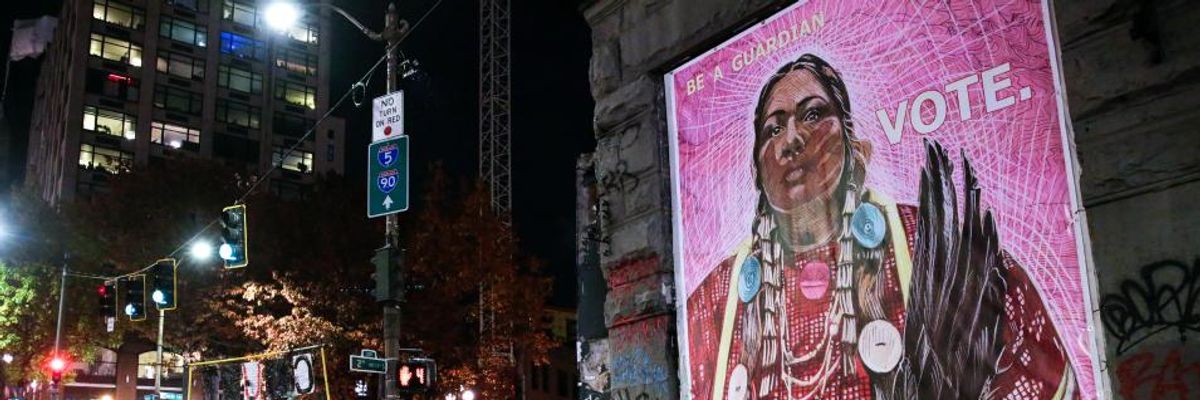
Protestors walk past an image of a Native American woman during a march to "Count Every Vote, Protect Every Person" after the U.S. presidential Election in Seattle, Washington on November 4, 2020. (Photo: Jason Redmond/AFP via Getty Images)
A leading environmental advocacy group marked Native American Heritage Month on Wednesday by urging President-elect Joe Biden, Vice President-elect Kamala Kamala Harris, and the entire incoming administration "to honor Indigenous sovereignty and immediately halt the Keystone XL, Dakota Access, and Line 3 pipelines."
"Fossil fuel executives and racist climate criminals continue to assault treaty rights and Indigenous sovereignty, attempting to ram toxic and unnecessary pipelines."
--Thanu Yakupitiyage, 350.org
That call from 350.org U.S. communications director Thanu Yakupitiyage for Indigenous #LandBack came just ahead of Thanksgiving in the United States and as the coronavirus pandemic continues to devastate communities across the country--with more than 12.7 million Covid-19 cases and over 261,000 deaths nationwide as of Wednesday afternoon.
"As we embark on a just recovery from the compound crises of climate disasters, racist police brutality, economic injustice, and Covid-19, we are in a pivotal moment of reckoning that requires us to ground in the history of the United States as a country built on stolen Indigenous land by stolen Black and African labor," Yakupitiyage said.
"As we act to stop state-sanctioned violence against Black and Brown communities," she continued, "we also acknowledge the decades and centuries of white supremacy, colonialism, and capitalism that continue to have devastating and genocidal impacts on the lives, livelihoods, and traditions of Native and Indigenous communities across the United States, North America, and around the world."
The activist drew attention to three controversial pipelines against which Indigenous people have led the opposition, highlighting some of the destructive impacts that such projects have on Native communities and lands, in addition to the climate effects.
"Fossil fuel executives and racist climate criminals continue to assault treaty rights and Indigenous sovereignty, attempting to ram toxic and unnecessary pipelines like Keystone XL, Dakota Access, and Line 3 through sacred Indigenous land and waters, while perpetuating threats and violence against Indigenous womxn, girls, and two-spirit people," said Yakupitiyage.
"Transformative climate solutions to truly tackle the root of climate change require systemic action to decolonize from the very systems that have created the crisis in the first place," she added. "Our leap toward a just recovery must start with honoring treaties with sovereign Indigenous nations and returning land back to Native peoples. The time is now for meaningful care and repair."
For months, 350.org has spearheaded global calls for a just recovery from the pandemic--demanding that policymakers prioritize human health, provide economic relief directly to the people, help workers and communities rather than corporate executives, work to create resilience for future crises, and build solidarity across borders.
Yakupitiyage's comments centering Indigenous communities in relation to a just recovery come as Biden is facing calls from Native Americans and climate campaigners to consider appointing Rep. Deb Haaland (D-N.M.), a member of Pueblo of Laguna, as his interior secretary. Two years ago, she and Rep. Sharice Davids (D-Kan.) became the first two Native American women elected to Congress.
Broadly, Biden is facing pressure from progressives--and public opinion--to stock the next administration, including his Cabinet, with people committed to serving in the public interest rather than corporate insiders. Earlier this month, the Sunrise Movement and Justice Democrats launched a campaign that includes Cabinet suggestions; Haaland is among them.
"A visionary secretary of the interior has enormous latitude to crack down on giveaways to fossil fuel corporations, like permits to drill for oil on public lands and in public waters. With a progressive leader at the helm, we can make real progress," the groups explain on the campaign website.
"As the first Native American to hold this position, Rep. Deb Haaland would usher in a new era of Indigenous authority over stolen land," they added. "She is a fierce ally of our movement who has fought for renewable energy job creation in the House as vice chair of the House Natural Resources Committee and chair of the Subcommittee on National Parks, Forests, and Public Lands."
"When Sharice [Davids] and I got sworn in, everybody was so happy," said the congresswoman. "It means a lot to a group of people who have been here since time immemorial to know that they're truly being represented. I think it would really change the way people see our federal government."
"Being able to listen," Haaland added, "being able to move issues forward, bringing people to the table--I think that would make a huge difference."
From Arizona to Wisconsin, reporters have highlighted in the messy aftermath of Election Day that Native voters were key contributors to Biden's victory over President Donald Trump, who has yet to formally concede even though the transition process is already underway.
After election-callers and major news networks named Biden the winner, Navajo Nation President Jonathan Nez released a statement noting the significance of the Native vote.
"The First Americans of this country, including a large majority of Navajo voters, had a major impact in the outcome of the presidential election in several swing states--that needs to be recognized and acknowledged by all," he said. "Both campaigns fought hard for Native American votes, particularly Navajo votes, and that's truly a reflection of the growing influence and power of tribal nations across the country."
Nez, who met with Biden and Harris to discuss tribal policy, added that "the Navajo Nation now looks forward to working together with the Biden-Harris administration to put that plan into action."
This country and this world are at a monumental crossroads. US voters have an opportunity to beat back the forces of fascism and confront the billionaires who are rigging the economy, our media system, and our democracy, making it increasingly impossible for ordinary people to get by. We’re not just talking about the election. We’re talking about what must be done once these fascist elements are vanquished from power. We need a bolder set of solutions than what either major party has so far been willing to offer and a working-class movement ready to fight like hell for it. Trump didn't emerge from nowhere. The conditions that fueled MAGA authoritarianism were created by decades of radical neoliberal economic policies and a corrupt political system dominated by corporate interests. They slashed taxes on the super-rich, promising that the benefits would trickle down. They said giveaways to the corporate titans would make life more affordable for the rest of us. It was all bullshit. And when a bitter, betrayed populace searches for someone to blame, right-wing demagogues have little trouble finding scapegoats. People know when they're being lied to, but you won't hear any of this from the corporate media. Only independent journalism—powered and funded by people who believe in building a better world—can deliver truly trustworthy daily news. If you share our vision, please contribute whatever you can to sustain our work. |
A leading environmental advocacy group marked Native American Heritage Month on Wednesday by urging President-elect Joe Biden, Vice President-elect Kamala Kamala Harris, and the entire incoming administration "to honor Indigenous sovereignty and immediately halt the Keystone XL, Dakota Access, and Line 3 pipelines."
"Fossil fuel executives and racist climate criminals continue to assault treaty rights and Indigenous sovereignty, attempting to ram toxic and unnecessary pipelines."
--Thanu Yakupitiyage, 350.org
That call from 350.org U.S. communications director Thanu Yakupitiyage for Indigenous #LandBack came just ahead of Thanksgiving in the United States and as the coronavirus pandemic continues to devastate communities across the country--with more than 12.7 million Covid-19 cases and over 261,000 deaths nationwide as of Wednesday afternoon.
"As we embark on a just recovery from the compound crises of climate disasters, racist police brutality, economic injustice, and Covid-19, we are in a pivotal moment of reckoning that requires us to ground in the history of the United States as a country built on stolen Indigenous land by stolen Black and African labor," Yakupitiyage said.
"As we act to stop state-sanctioned violence against Black and Brown communities," she continued, "we also acknowledge the decades and centuries of white supremacy, colonialism, and capitalism that continue to have devastating and genocidal impacts on the lives, livelihoods, and traditions of Native and Indigenous communities across the United States, North America, and around the world."
The activist drew attention to three controversial pipelines against which Indigenous people have led the opposition, highlighting some of the destructive impacts that such projects have on Native communities and lands, in addition to the climate effects.
"Fossil fuel executives and racist climate criminals continue to assault treaty rights and Indigenous sovereignty, attempting to ram toxic and unnecessary pipelines like Keystone XL, Dakota Access, and Line 3 through sacred Indigenous land and waters, while perpetuating threats and violence against Indigenous womxn, girls, and two-spirit people," said Yakupitiyage.
"Transformative climate solutions to truly tackle the root of climate change require systemic action to decolonize from the very systems that have created the crisis in the first place," she added. "Our leap toward a just recovery must start with honoring treaties with sovereign Indigenous nations and returning land back to Native peoples. The time is now for meaningful care and repair."
For months, 350.org has spearheaded global calls for a just recovery from the pandemic--demanding that policymakers prioritize human health, provide economic relief directly to the people, help workers and communities rather than corporate executives, work to create resilience for future crises, and build solidarity across borders.
Yakupitiyage's comments centering Indigenous communities in relation to a just recovery come as Biden is facing calls from Native Americans and climate campaigners to consider appointing Rep. Deb Haaland (D-N.M.), a member of Pueblo of Laguna, as his interior secretary. Two years ago, she and Rep. Sharice Davids (D-Kan.) became the first two Native American women elected to Congress.
Broadly, Biden is facing pressure from progressives--and public opinion--to stock the next administration, including his Cabinet, with people committed to serving in the public interest rather than corporate insiders. Earlier this month, the Sunrise Movement and Justice Democrats launched a campaign that includes Cabinet suggestions; Haaland is among them.
"A visionary secretary of the interior has enormous latitude to crack down on giveaways to fossil fuel corporations, like permits to drill for oil on public lands and in public waters. With a progressive leader at the helm, we can make real progress," the groups explain on the campaign website.
"As the first Native American to hold this position, Rep. Deb Haaland would usher in a new era of Indigenous authority over stolen land," they added. "She is a fierce ally of our movement who has fought for renewable energy job creation in the House as vice chair of the House Natural Resources Committee and chair of the Subcommittee on National Parks, Forests, and Public Lands."
"When Sharice [Davids] and I got sworn in, everybody was so happy," said the congresswoman. "It means a lot to a group of people who have been here since time immemorial to know that they're truly being represented. I think it would really change the way people see our federal government."
"Being able to listen," Haaland added, "being able to move issues forward, bringing people to the table--I think that would make a huge difference."
From Arizona to Wisconsin, reporters have highlighted in the messy aftermath of Election Day that Native voters were key contributors to Biden's victory over President Donald Trump, who has yet to formally concede even though the transition process is already underway.
After election-callers and major news networks named Biden the winner, Navajo Nation President Jonathan Nez released a statement noting the significance of the Native vote.
"The First Americans of this country, including a large majority of Navajo voters, had a major impact in the outcome of the presidential election in several swing states--that needs to be recognized and acknowledged by all," he said. "Both campaigns fought hard for Native American votes, particularly Navajo votes, and that's truly a reflection of the growing influence and power of tribal nations across the country."
Nez, who met with Biden and Harris to discuss tribal policy, added that "the Navajo Nation now looks forward to working together with the Biden-Harris administration to put that plan into action."