

SUBSCRIBE TO OUR FREE NEWSLETTER
Daily news & progressive opinion—funded by the people, not the corporations—delivered straight to your inbox.
5
#000000
#FFFFFF
To donate by check, phone, or other method, see our More Ways to Give page.
Daily news & progressive opinion—funded by the people, not the corporations—delivered straight to your inbox.
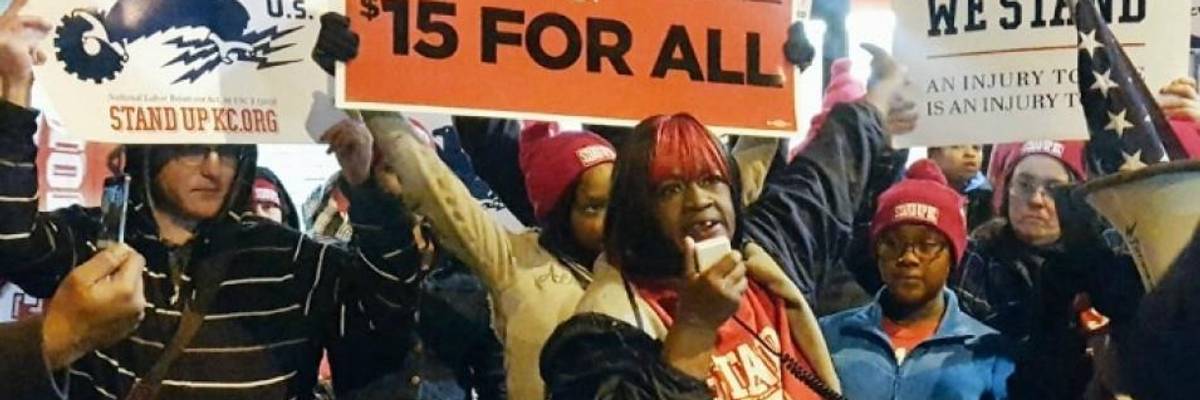
In recent years, the grassroots Fight for $15 movement has organized strikes and demonstrations across the United States. (Photo: Stand Up KC/Twitter)
Progressives in Congress were joined by workers, business owners, and labor rights advocates in celebrating the "historic" passage on Thursday of the Raise the Wage Act, aimed at guaranteeing all American workers a minimum wage of $15.
Two hundred thirty House Democrats were joined by only three Republicans--Reps. Brian Fitzpatrick of Pennsylvania, Will Hurd of Texas, and Christopher H. Smith of New Jersey--in supporting the Raise the Wage Act (RTWA), which would raise the federal minimum wage to $15 per hour by 2025 and end the use of sub-minimum wages for tipped workers.
"1.5 percent of House Republicans voted to raise the federal minimum wage. If we're being generous with rounding, 98 percent of House Republicans don't believe in raising Americans' pay."
--Rep. Bill Pascrell (D-N.J.)The bill is projected to help lift 1.3 million people out of poverty--half of whom are children--and raise annual earnings by about $2,800 for about 27 million people.
Despite the bill's popularity across political affiliations and numerous studies showing it would strengthen small businesses and communities, Republicans on Thursday claimed the passage of the RTWA was akin to sacrificing "the wages, families, and livelihoods of American workers...upon the altar of socialist ideology."
As Rep. Bill Pascrell (D-N.J.) wrote on Twitter, just 1.5 percent of the Republicans in the House expressed agreement with the Democrats and the majority of the U.S. public that the minimum wage--which studies have shown cannot support a family of four--should be raised.
"We just voted to raise the federal minimum wage for the first time in a decade and Republicans are on the floor wailing, 'socialism.' How pathetic," Pascrell said. "If we're being generous with rounding, 98 percent of House Republicans don't believe in raising Americans' pay."
The nationwide grassroots group Fight for $15, which since 2012 has pushed for a living wage for all workers and whose campaigning helped force Disneyland and a number of states to raise their minimum wages, was among the groups who applauded the RTWA's passage as "historic."
Christine Owens, executive director of the National Employment Law Project, credited Fight for $15 and other workers' rights groups with persisting in their demand that lawmakers pass a fair wage for all employees.
"This victory is only possible thanks to the bravery and resolve of all the workers who have stood up over the past six years and stopped asking only for the crumbs they thought were politically palatable, and instead, demanded what they deserve," Owens said. "We are proud to stand with all of them, the real leaders of this movement."
The federal minimum wage has been stagnant for a decade at $7.25 per hour. As the Economic Policy Institute (EPI) noted Thursday, adjusting for inflation, workers today earn less than they did five decades ago--while the costs of housing, education, and basic necessities have skyrocketed in that time.
"The real (inflation-adjusted) minimum wage is now roughly 30 percent lower than it was in 1968, and it has been more than 10 years since Congress raised the minimum wage--the longest stretch in history," EPI said in a statament.
"To end this shameful streak, it is incumbent upon the Senate to take up and pass the Raise the Wage Act immediately," the group added.
The RTWA now goes to the Senate, where the NELP said Republicans, led by Senate Majority Leader Mitch McConnell (R-Ky.), will "face strong and sustained pressure from workers, advocates, progressive lawmakers, and constituents to increase the minimum wage after the longest period in U.S. history without a raise."
"We applaud the House for doing its job," said Owens. "Now there's no other moral choice but for the Senate to take up the Raise the Wage Act and move it forward."
As Common Dreams reported, Sen. Bernie Sanders (I-Vt.), the lead sponsor of the Raise the Wage Act in the Senate (S.150), expressed agreement with EPI and NELP, demanding that McConnell bring the bill to the Senate floor for a vote and move workers a step closer to narrowing the wealth gap.
Dear Common Dreams reader, It’s been nearly 30 years since I co-founded Common Dreams with my late wife, Lina Newhouser. We had the radical notion that journalism should serve the public good, not corporate profits. It was clear to us from the outset what it would take to build such a project. No paid advertisements. No corporate sponsors. No millionaire publisher telling us what to think or do. Many people said we wouldn't last a year, but we proved those doubters wrong. Together with a tremendous team of journalists and dedicated staff, we built an independent media outlet free from the constraints of profits and corporate control. Our mission has always been simple: To inform. To inspire. To ignite change for the common good. Building Common Dreams was not easy. Our survival was never guaranteed. When you take on the most powerful forces—Wall Street greed, fossil fuel industry destruction, Big Tech lobbyists, and uber-rich oligarchs who have spent billions upon billions rigging the economy and democracy in their favor—the only bulwark you have is supporters who believe in your work. But here’s the urgent message from me today. It's never been this bad out there. And it's never been this hard to keep us going. At the very moment Common Dreams is most needed, the threats we face are intensifying. We need your support now more than ever. We don't accept corporate advertising and never will. We don't have a paywall because we don't think people should be blocked from critical news based on their ability to pay. Everything we do is funded by the donations of readers like you. When everyone does the little they can afford, we are strong. But if that support retreats or dries up, so do we. Will you donate now to make sure Common Dreams not only survives but thrives? —Craig Brown, Co-founder |
Progressives in Congress were joined by workers, business owners, and labor rights advocates in celebrating the "historic" passage on Thursday of the Raise the Wage Act, aimed at guaranteeing all American workers a minimum wage of $15.
Two hundred thirty House Democrats were joined by only three Republicans--Reps. Brian Fitzpatrick of Pennsylvania, Will Hurd of Texas, and Christopher H. Smith of New Jersey--in supporting the Raise the Wage Act (RTWA), which would raise the federal minimum wage to $15 per hour by 2025 and end the use of sub-minimum wages for tipped workers.
"1.5 percent of House Republicans voted to raise the federal minimum wage. If we're being generous with rounding, 98 percent of House Republicans don't believe in raising Americans' pay."
--Rep. Bill Pascrell (D-N.J.)The bill is projected to help lift 1.3 million people out of poverty--half of whom are children--and raise annual earnings by about $2,800 for about 27 million people.
Despite the bill's popularity across political affiliations and numerous studies showing it would strengthen small businesses and communities, Republicans on Thursday claimed the passage of the RTWA was akin to sacrificing "the wages, families, and livelihoods of American workers...upon the altar of socialist ideology."
As Rep. Bill Pascrell (D-N.J.) wrote on Twitter, just 1.5 percent of the Republicans in the House expressed agreement with the Democrats and the majority of the U.S. public that the minimum wage--which studies have shown cannot support a family of four--should be raised.
"We just voted to raise the federal minimum wage for the first time in a decade and Republicans are on the floor wailing, 'socialism.' How pathetic," Pascrell said. "If we're being generous with rounding, 98 percent of House Republicans don't believe in raising Americans' pay."
The nationwide grassroots group Fight for $15, which since 2012 has pushed for a living wage for all workers and whose campaigning helped force Disneyland and a number of states to raise their minimum wages, was among the groups who applauded the RTWA's passage as "historic."
Christine Owens, executive director of the National Employment Law Project, credited Fight for $15 and other workers' rights groups with persisting in their demand that lawmakers pass a fair wage for all employees.
"This victory is only possible thanks to the bravery and resolve of all the workers who have stood up over the past six years and stopped asking only for the crumbs they thought were politically palatable, and instead, demanded what they deserve," Owens said. "We are proud to stand with all of them, the real leaders of this movement."
The federal minimum wage has been stagnant for a decade at $7.25 per hour. As the Economic Policy Institute (EPI) noted Thursday, adjusting for inflation, workers today earn less than they did five decades ago--while the costs of housing, education, and basic necessities have skyrocketed in that time.
"The real (inflation-adjusted) minimum wage is now roughly 30 percent lower than it was in 1968, and it has been more than 10 years since Congress raised the minimum wage--the longest stretch in history," EPI said in a statament.
"To end this shameful streak, it is incumbent upon the Senate to take up and pass the Raise the Wage Act immediately," the group added.
The RTWA now goes to the Senate, where the NELP said Republicans, led by Senate Majority Leader Mitch McConnell (R-Ky.), will "face strong and sustained pressure from workers, advocates, progressive lawmakers, and constituents to increase the minimum wage after the longest period in U.S. history without a raise."
"We applaud the House for doing its job," said Owens. "Now there's no other moral choice but for the Senate to take up the Raise the Wage Act and move it forward."
As Common Dreams reported, Sen. Bernie Sanders (I-Vt.), the lead sponsor of the Raise the Wage Act in the Senate (S.150), expressed agreement with EPI and NELP, demanding that McConnell bring the bill to the Senate floor for a vote and move workers a step closer to narrowing the wealth gap.
Progressives in Congress were joined by workers, business owners, and labor rights advocates in celebrating the "historic" passage on Thursday of the Raise the Wage Act, aimed at guaranteeing all American workers a minimum wage of $15.
Two hundred thirty House Democrats were joined by only three Republicans--Reps. Brian Fitzpatrick of Pennsylvania, Will Hurd of Texas, and Christopher H. Smith of New Jersey--in supporting the Raise the Wage Act (RTWA), which would raise the federal minimum wage to $15 per hour by 2025 and end the use of sub-minimum wages for tipped workers.
"1.5 percent of House Republicans voted to raise the federal minimum wage. If we're being generous with rounding, 98 percent of House Republicans don't believe in raising Americans' pay."
--Rep. Bill Pascrell (D-N.J.)The bill is projected to help lift 1.3 million people out of poverty--half of whom are children--and raise annual earnings by about $2,800 for about 27 million people.
Despite the bill's popularity across political affiliations and numerous studies showing it would strengthen small businesses and communities, Republicans on Thursday claimed the passage of the RTWA was akin to sacrificing "the wages, families, and livelihoods of American workers...upon the altar of socialist ideology."
As Rep. Bill Pascrell (D-N.J.) wrote on Twitter, just 1.5 percent of the Republicans in the House expressed agreement with the Democrats and the majority of the U.S. public that the minimum wage--which studies have shown cannot support a family of four--should be raised.
"We just voted to raise the federal minimum wage for the first time in a decade and Republicans are on the floor wailing, 'socialism.' How pathetic," Pascrell said. "If we're being generous with rounding, 98 percent of House Republicans don't believe in raising Americans' pay."
The nationwide grassroots group Fight for $15, which since 2012 has pushed for a living wage for all workers and whose campaigning helped force Disneyland and a number of states to raise their minimum wages, was among the groups who applauded the RTWA's passage as "historic."
Christine Owens, executive director of the National Employment Law Project, credited Fight for $15 and other workers' rights groups with persisting in their demand that lawmakers pass a fair wage for all employees.
"This victory is only possible thanks to the bravery and resolve of all the workers who have stood up over the past six years and stopped asking only for the crumbs they thought were politically palatable, and instead, demanded what they deserve," Owens said. "We are proud to stand with all of them, the real leaders of this movement."
The federal minimum wage has been stagnant for a decade at $7.25 per hour. As the Economic Policy Institute (EPI) noted Thursday, adjusting for inflation, workers today earn less than they did five decades ago--while the costs of housing, education, and basic necessities have skyrocketed in that time.
"The real (inflation-adjusted) minimum wage is now roughly 30 percent lower than it was in 1968, and it has been more than 10 years since Congress raised the minimum wage--the longest stretch in history," EPI said in a statament.
"To end this shameful streak, it is incumbent upon the Senate to take up and pass the Raise the Wage Act immediately," the group added.
The RTWA now goes to the Senate, where the NELP said Republicans, led by Senate Majority Leader Mitch McConnell (R-Ky.), will "face strong and sustained pressure from workers, advocates, progressive lawmakers, and constituents to increase the minimum wage after the longest period in U.S. history without a raise."
"We applaud the House for doing its job," said Owens. "Now there's no other moral choice but for the Senate to take up the Raise the Wage Act and move it forward."
As Common Dreams reported, Sen. Bernie Sanders (I-Vt.), the lead sponsor of the Raise the Wage Act in the Senate (S.150), expressed agreement with EPI and NELP, demanding that McConnell bring the bill to the Senate floor for a vote and move workers a step closer to narrowing the wealth gap.

