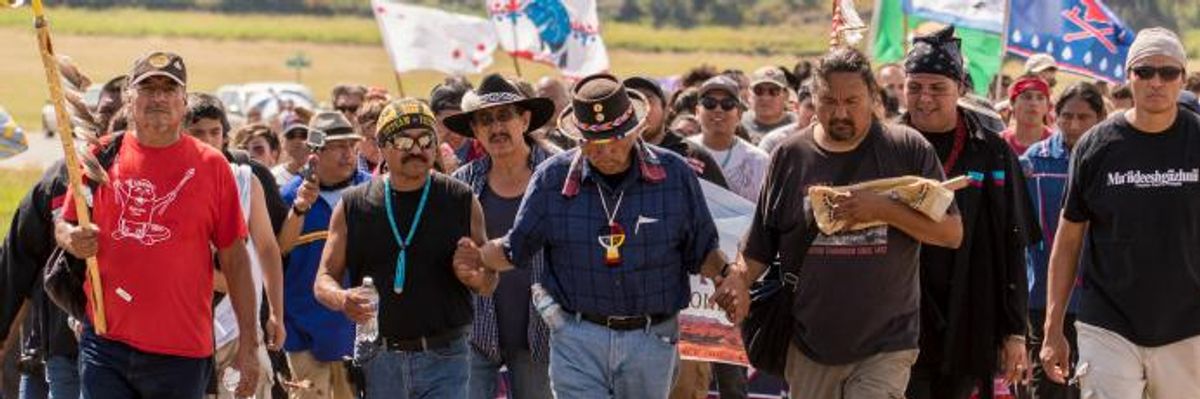
Protesters march at the Sacred Stone Camp in Cannon Ball, North Dakota. (Photo: Joe Brusky/Flickr/cc)
From 'Depleted' Food Stores to Understaffed Health Clinics, Native Americans 'Among Hardest Hit' by Trump Shutdown
"The longer the D.C. stalemate lasts, the more dire their situation becomes."
Adding to the long and ever-growing list of harmful consequences stemming from President Donald Trump's government shutdown--from hundreds of thousands of furloughed workers to gutted food stamps offices to trashed public parks--the New York Times published a report late Tuesday highlighting the damage Trump's prolonged border wall temper tantrum has done to Native American communities.
"For one tribe of Chippewa Indians in Michigan's Upper Peninsula, the government shutdown comes with a price tag: about $100,000, every day, of federal money that does not arrive to keep health clinics staffed, food pantry shelves full, and employees paid," the Times noted. "The tribe is using its own funds to cover the shortfalls for now. But if the standoff in Washington continues much longer, that stopgap money will be depleted. Later this month, workers could be furloughed and health services could be pared back."
Because the staff of the Interior Department's Bureau of Indian Affairs has been significantly diminished due to the shutdown--which entered its 12th day on Wednesday--basic services such as road maintenance, healthcare, and disaster relief have been cut or put at risk, the Times reported.
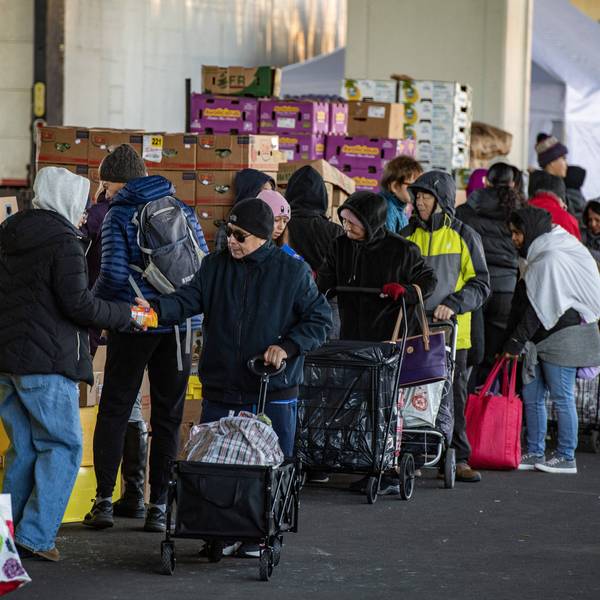
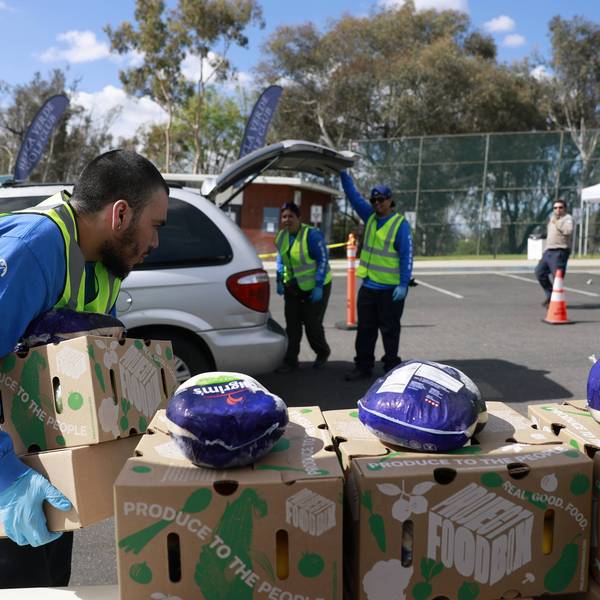
The shutdown has also "curtailed a Department of Agriculture food program that helped feed about 90,000 Native American people in fiscal year 2017," the Times notes.
Joseph Rupnick, chairman of the Prairie Band Potawatomi Nation in Kansas, said his tribe's food distribution center "will be depleted" if the partial government shutdown continues for much longer.
The Times report on the impact the shutdown has had on Indigenous communities comes as federal workers continue to share stories of the deep financial stress they have faced since the government partially closed just before Christmas.
As media critic Adam Johnson argued on Twitter, government shutdowns should be called "shutdown of government for the poor," as partial lapses in federal funding have always disproportionately harmed vulnerable populations while leaving "right-wing" elements of government--such as the military--untouched.
With no government funding agreement in sight, Trump is expected to meet with congressional leaders in the White House Situation Room on Wednesday for a "border security" briefing, in which the president is expected to continue pushing for $5 billion in "wall" funding, which Democrats have rejected.
As Trump refuses to budge, an estimated 800,000 federal employees remain furloughed or continue to work without pay. As Common Dreams reported, the American Federation of Government Employees (AFGE) sued the Trump administration on Monday for requiring workers to perform dangerous jobs without pay.
"This is an example of dysfunction at its best," Heidi Burakiewicz--partner at Kalijarvi, Chuzi, Newman & Fitch, the law firm representing AFGE's members in the lawsuit--said in an interview with Democracy Now! on Wednesday. "The federal workforce has already been severely harmed by the shutdown and how long it's lasted thus far. They don't know when it's going to end, and they don't know how to budget for their own finances, because they don't know when they're going to get another paycheck."
We are at a crossroads
This country and this world are at a monumental crossroads. In a few short weeks, US voters will have an opportunity to beat back the forces of fascism and confront the billionaires who are rigging the economy, our media system, and our democracy, making it increasingly impossible for ordinary people to get by. We’re not just talking about the election. We’re talking about what must be done once these fascist elements are vanquished from power. We need a bolder set of solutions than what either major party has so far been willing to offer and a working-class movement ready to fight like hell for it. Trump didn't emerge from nowhere. The conditions that fueled MAGA authoritarianism were created by decades of radical neoliberal economic policies and a corrupt political system dominated by corporate interests. They slashed taxes on the super-rich, promising that the benefits would trickle down. They said giveaways to the corporate titans would make life more affordable for the rest of us. It was all bullshit. And when a bitter, betrayed populace searches for someone to blame, right-wing demagogues have little trouble finding scapegoats. People know when they're being lied to, but you won't hear any of this from the corporate media. Only independent journalism—powered and funded by people who believe in building a better world—can deliver truly trustworthy daily news. Our Fall Campaign is underway, and we need your help. To power our newsroom through the rest of the year, we need to raise $125,000 by midnight on October 31. So if you share our vision, please contribute whatever you can to sustain our work. |
Adding to the long and ever-growing list of harmful consequences stemming from President Donald Trump's government shutdown--from hundreds of thousands of furloughed workers to gutted food stamps offices to trashed public parks--the New York Times published a report late Tuesday highlighting the damage Trump's prolonged border wall temper tantrum has done to Native American communities.
"For one tribe of Chippewa Indians in Michigan's Upper Peninsula, the government shutdown comes with a price tag: about $100,000, every day, of federal money that does not arrive to keep health clinics staffed, food pantry shelves full, and employees paid," the Times noted. "The tribe is using its own funds to cover the shortfalls for now. But if the standoff in Washington continues much longer, that stopgap money will be depleted. Later this month, workers could be furloughed and health services could be pared back."
Because the staff of the Interior Department's Bureau of Indian Affairs has been significantly diminished due to the shutdown--which entered its 12th day on Wednesday--basic services such as road maintenance, healthcare, and disaster relief have been cut or put at risk, the Times reported.
The shutdown has also "curtailed a Department of Agriculture food program that helped feed about 90,000 Native American people in fiscal year 2017," the Times notes.
Joseph Rupnick, chairman of the Prairie Band Potawatomi Nation in Kansas, said his tribe's food distribution center "will be depleted" if the partial government shutdown continues for much longer.
The Times report on the impact the shutdown has had on Indigenous communities comes as federal workers continue to share stories of the deep financial stress they have faced since the government partially closed just before Christmas.
As media critic Adam Johnson argued on Twitter, government shutdowns should be called "shutdown of government for the poor," as partial lapses in federal funding have always disproportionately harmed vulnerable populations while leaving "right-wing" elements of government--such as the military--untouched.
With no government funding agreement in sight, Trump is expected to meet with congressional leaders in the White House Situation Room on Wednesday for a "border security" briefing, in which the president is expected to continue pushing for $5 billion in "wall" funding, which Democrats have rejected.
As Trump refuses to budge, an estimated 800,000 federal employees remain furloughed or continue to work without pay. As Common Dreams reported, the American Federation of Government Employees (AFGE) sued the Trump administration on Monday for requiring workers to perform dangerous jobs without pay.
"This is an example of dysfunction at its best," Heidi Burakiewicz--partner at Kalijarvi, Chuzi, Newman & Fitch, the law firm representing AFGE's members in the lawsuit--said in an interview with Democracy Now! on Wednesday. "The federal workforce has already been severely harmed by the shutdown and how long it's lasted thus far. They don't know when it's going to end, and they don't know how to budget for their own finances, because they don't know when they're going to get another paycheck."