SUBSCRIBE TO OUR FREE NEWSLETTER
Daily news & progressive opinion—funded by the people, not the corporations—delivered straight to your inbox.
5
#000000
#FFFFFF
To donate by check, phone, or other method, see our More Ways to Give page.
Daily news & progressive opinion—funded by the people, not the corporations—delivered straight to your inbox.
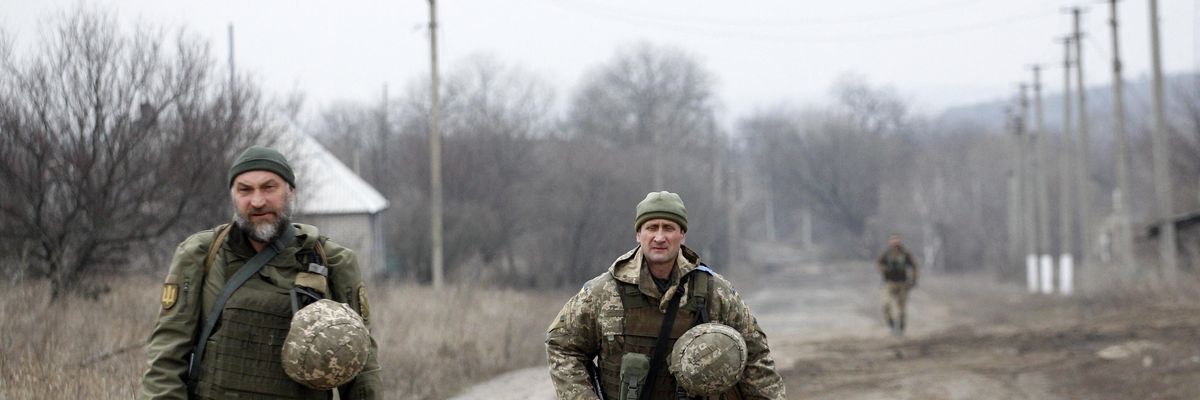
Ukrainian servicemen patrol in the settlement of Troitske in the Lugansk region near the front line with Russia-backed separatists on February 22, 2022, a day after Russia recognised east Ukraine's separatist republics and ordered the Russian army to send troops there as "peacekeepers." (Photo by Anatolii Stepanov / AFP via Getty Images)
Fifty-nine years ago, Bob Dylan recorded "With God on Our Side." You probably haven't heard it on the radio for a very long time, if ever, but right now you could listen to it as his most evergreen of topical songs:
I've learned to hate the Russians
All through my whole life
If another war comes
It's them we must fight
To hate them and fear them
To run and to hide
And accept it all bravely
With God on my side
In recent days, media coverage of a possible summit between Joe Biden and Vladimir Putin has taken on almost wistful qualities, as though the horsemen of the apocalypse are already out of the barn.
On Capitol Hill, it's hard to find a single member of Congress willing to call NATO what it has long been: an alliance for war...
Fatalism is easy for the laptop warriors and blow-dried studio pundits who keep insisting on the need to get tough with "the Russians," by which they mean the Russian government. Actual people who suffer and die in war easily become faraway abstractions. "And you never ask questions / When God's on your side."
During the last six decades, the religiosity of U.S. militarism has faded into a more generalized set of assumptions--shared, in the current crisis, across traditional political spectrums. Ignorance about NATO's history feeds into the good vs. evil bromides that are so easy to ingest and internalize.
On Capitol Hill, it's hard to find a single member of Congress willing to call NATO what it has long been: an alliance for war (Kosovo, Afghanistan, Libya) with virtually nothing to do with "defense" other than the defense of vast weapons sales and, at times, even fantasies of regime change in Russia.
The reverence and adulation gushing from the Capitol and corporate media (including NPR and PBS) toward NATO and its U.S. leadership are wonders of thinly veiled jingoism. About other societies, reviled ones, we would hear labels like "propaganda." Here the supposed truisms are laundered and flat-ironed as common sense.
Glimmers of inconvenient truth have flickered only rarely in mainstream U.S. media outlets, while a bit more likely in Europe. "Biden has said repeatedly that the U.S. is open to diplomacy with Russia, but on the issue that Moscow has most emphasized--NATO enlargement--there has been no American diplomacy at all," Jeffrey Sachs wrote in the Financial Times as this week began. "Putin has repeatedly demanded that the U.S. forswear NATO's enlargement into Ukraine, while Biden has repeatedly asserted that membership of the alliance is Ukraine's choice."
As Sachs noted, "Many insist that NATO enlargement is not the real issue for Putin and that he wants to recreate the Russian empire, pure and simple. Everything else, including NATO enlargement, they claim, is a mere distraction. This is utterly mistaken. Russia has adamantly opposed NATO expansion towards the east for 30 years, first under Boris Yeltsin and now Putin.... Neither the U.S. nor Russia wants the other's military on their doorstep. Pledging no NATO enlargement is not appeasement. It does not cede Ukrainian territory. It does not undermine Ukraine's sovereignty."
Whether or not they know much about such history, American media elites and members of Congress don't seem to care about it. Red-white-and-blue chauvinism is running wild. Yet there are real diplomatic alternatives to the collision course for war.
Speaking Monday on Democracy Now!, Katrina vanden Heuvel--editorial director of The Nation and a longtime Russia expert--said that implementing the Minsk accords could be a path toward peace in Ukraine. Also, she pointed out, "there is talk now not just of the NATO issue, which is so key, but also a new security architecture in Europe."
Desperately needed is a new European security framework, to demilitarize and defuse conflicts between Russia and U.S. allies. But the same approach that for three decades pushed to expand NATO to Russia's borders is now gung-ho to keep upping the ante, no matter how much doing so increases the chances of a direct clash between the world's two nuclear-weapons superpowers.
The last U.S. ambassador to the Soviet Union before it collapsed, Jack Matlock, wrote last week: "Since President Putin's major demand is an assurance that NATO will take no further members, and specifically not Ukraine or Georgia, obviously there would have been no basis for the present crisis if there had been no expansion of the alliance following the end of the Cold War, or if the expansion had occurred in harmony with building a security structure in Europe that included Russia."
If you think those weapons transactions were about keeping up with the Russians, you've been trusting way too much U.S. corporate media.
But excluding Russia from security structures, while encircling it with armed-to-the-teeth adversaries, was a clear goal of NATO's expansion. Less obvious was the realized goal of turning Eastern European nations into customers for vast arms sales.
A gripping chapter in "The Spoils of War," a new book by Andrew Cockburn, spells out the mega-corporate zeal behind the massive campaigns to expand NATO beginning in the 1990s. Huge Pentagon contractors like Lockheed Martin were downcast about the dissolution of the USSR and feared that military sales would keep slumping. But there were some potential big new markets on the horizon.
"One especially promising market was among the former members of the defunct Warsaw Pact," Cockburn wrote. "Were they to join NATO, they would be natural customers for products such as the F-16 fighter that Lockheed had inherited from General Dynamics. There was one minor impediment: the [George H. W.] Bush administration had already promised Moscow that NATO would not move east, a pledge that was part of the settlement ending the Cold War."
By the time legendary foreign-policy sage George F. Kennan issued his unequivocal warning in 1997--"expanding NATO would be the most fateful error of American policy in the post-Cold War era"--the expansion was already happening.
As Cockburn notes, "By 2014, the 12 new members had purchased close to $17 billion worth of American weapons."
If you think those weapons transactions were about keeping up with the Russians, you've been trusting way too much U.S. corporate media. "As of late 2020," Cockburn's book explains, NATO's collective military spending "had hit $1.03 trillion, or roughly 20 times Russia's military budget."
Let's leave the last words here to Bob Dylan, from another song that isn't on radio playlists. "Masters of War."
Let me ask you one question
Is your money that good?
Will it buy you forgiveness
Do you think that it could?
Dear Common Dreams reader, It’s been nearly 30 years since I co-founded Common Dreams with my late wife, Lina Newhouser. We had the radical notion that journalism should serve the public good, not corporate profits. It was clear to us from the outset what it would take to build such a project. No paid advertisements. No corporate sponsors. No millionaire publisher telling us what to think or do. Many people said we wouldn't last a year, but we proved those doubters wrong. Together with a tremendous team of journalists and dedicated staff, we built an independent media outlet free from the constraints of profits and corporate control. Our mission has always been simple: To inform. To inspire. To ignite change for the common good. Building Common Dreams was not easy. Our survival was never guaranteed. When you take on the most powerful forces—Wall Street greed, fossil fuel industry destruction, Big Tech lobbyists, and uber-rich oligarchs who have spent billions upon billions rigging the economy and democracy in their favor—the only bulwark you have is supporters who believe in your work. But here’s the urgent message from me today. It's never been this bad out there. And it's never been this hard to keep us going. At the very moment Common Dreams is most needed, the threats we face are intensifying. We need your support now more than ever. We don't accept corporate advertising and never will. We don't have a paywall because we don't think people should be blocked from critical news based on their ability to pay. Everything we do is funded by the donations of readers like you. When everyone does the little they can afford, we are strong. But if that support retreats or dries up, so do we. Will you donate now to make sure Common Dreams not only survives but thrives? —Craig Brown, Co-founder |
Norman Solomon is the national director of RootsAction.org and executive director of the Institute for Public Accuracy. The paperback edition of his latest book, War Made Invisible: How America Hides the Human Toll of Its Military Machine, includes an afterword about the Gaza war.
Fifty-nine years ago, Bob Dylan recorded "With God on Our Side." You probably haven't heard it on the radio for a very long time, if ever, but right now you could listen to it as his most evergreen of topical songs:
I've learned to hate the Russians
All through my whole life
If another war comes
It's them we must fight
To hate them and fear them
To run and to hide
And accept it all bravely
With God on my side
In recent days, media coverage of a possible summit between Joe Biden and Vladimir Putin has taken on almost wistful qualities, as though the horsemen of the apocalypse are already out of the barn.
On Capitol Hill, it's hard to find a single member of Congress willing to call NATO what it has long been: an alliance for war...
Fatalism is easy for the laptop warriors and blow-dried studio pundits who keep insisting on the need to get tough with "the Russians," by which they mean the Russian government. Actual people who suffer and die in war easily become faraway abstractions. "And you never ask questions / When God's on your side."
During the last six decades, the religiosity of U.S. militarism has faded into a more generalized set of assumptions--shared, in the current crisis, across traditional political spectrums. Ignorance about NATO's history feeds into the good vs. evil bromides that are so easy to ingest and internalize.
On Capitol Hill, it's hard to find a single member of Congress willing to call NATO what it has long been: an alliance for war (Kosovo, Afghanistan, Libya) with virtually nothing to do with "defense" other than the defense of vast weapons sales and, at times, even fantasies of regime change in Russia.
The reverence and adulation gushing from the Capitol and corporate media (including NPR and PBS) toward NATO and its U.S. leadership are wonders of thinly veiled jingoism. About other societies, reviled ones, we would hear labels like "propaganda." Here the supposed truisms are laundered and flat-ironed as common sense.
Glimmers of inconvenient truth have flickered only rarely in mainstream U.S. media outlets, while a bit more likely in Europe. "Biden has said repeatedly that the U.S. is open to diplomacy with Russia, but on the issue that Moscow has most emphasized--NATO enlargement--there has been no American diplomacy at all," Jeffrey Sachs wrote in the Financial Times as this week began. "Putin has repeatedly demanded that the U.S. forswear NATO's enlargement into Ukraine, while Biden has repeatedly asserted that membership of the alliance is Ukraine's choice."
As Sachs noted, "Many insist that NATO enlargement is not the real issue for Putin and that he wants to recreate the Russian empire, pure and simple. Everything else, including NATO enlargement, they claim, is a mere distraction. This is utterly mistaken. Russia has adamantly opposed NATO expansion towards the east for 30 years, first under Boris Yeltsin and now Putin.... Neither the U.S. nor Russia wants the other's military on their doorstep. Pledging no NATO enlargement is not appeasement. It does not cede Ukrainian territory. It does not undermine Ukraine's sovereignty."
Whether or not they know much about such history, American media elites and members of Congress don't seem to care about it. Red-white-and-blue chauvinism is running wild. Yet there are real diplomatic alternatives to the collision course for war.
Speaking Monday on Democracy Now!, Katrina vanden Heuvel--editorial director of The Nation and a longtime Russia expert--said that implementing the Minsk accords could be a path toward peace in Ukraine. Also, she pointed out, "there is talk now not just of the NATO issue, which is so key, but also a new security architecture in Europe."
Desperately needed is a new European security framework, to demilitarize and defuse conflicts between Russia and U.S. allies. But the same approach that for three decades pushed to expand NATO to Russia's borders is now gung-ho to keep upping the ante, no matter how much doing so increases the chances of a direct clash between the world's two nuclear-weapons superpowers.
The last U.S. ambassador to the Soviet Union before it collapsed, Jack Matlock, wrote last week: "Since President Putin's major demand is an assurance that NATO will take no further members, and specifically not Ukraine or Georgia, obviously there would have been no basis for the present crisis if there had been no expansion of the alliance following the end of the Cold War, or if the expansion had occurred in harmony with building a security structure in Europe that included Russia."
If you think those weapons transactions were about keeping up with the Russians, you've been trusting way too much U.S. corporate media.
But excluding Russia from security structures, while encircling it with armed-to-the-teeth adversaries, was a clear goal of NATO's expansion. Less obvious was the realized goal of turning Eastern European nations into customers for vast arms sales.
A gripping chapter in "The Spoils of War," a new book by Andrew Cockburn, spells out the mega-corporate zeal behind the massive campaigns to expand NATO beginning in the 1990s. Huge Pentagon contractors like Lockheed Martin were downcast about the dissolution of the USSR and feared that military sales would keep slumping. But there were some potential big new markets on the horizon.
"One especially promising market was among the former members of the defunct Warsaw Pact," Cockburn wrote. "Were they to join NATO, they would be natural customers for products such as the F-16 fighter that Lockheed had inherited from General Dynamics. There was one minor impediment: the [George H. W.] Bush administration had already promised Moscow that NATO would not move east, a pledge that was part of the settlement ending the Cold War."
By the time legendary foreign-policy sage George F. Kennan issued his unequivocal warning in 1997--"expanding NATO would be the most fateful error of American policy in the post-Cold War era"--the expansion was already happening.
As Cockburn notes, "By 2014, the 12 new members had purchased close to $17 billion worth of American weapons."
If you think those weapons transactions were about keeping up with the Russians, you've been trusting way too much U.S. corporate media. "As of late 2020," Cockburn's book explains, NATO's collective military spending "had hit $1.03 trillion, or roughly 20 times Russia's military budget."
Let's leave the last words here to Bob Dylan, from another song that isn't on radio playlists. "Masters of War."
Let me ask you one question
Is your money that good?
Will it buy you forgiveness
Do you think that it could?
Norman Solomon is the national director of RootsAction.org and executive director of the Institute for Public Accuracy. The paperback edition of his latest book, War Made Invisible: How America Hides the Human Toll of Its Military Machine, includes an afterword about the Gaza war.
Fifty-nine years ago, Bob Dylan recorded "With God on Our Side." You probably haven't heard it on the radio for a very long time, if ever, but right now you could listen to it as his most evergreen of topical songs:
I've learned to hate the Russians
All through my whole life
If another war comes
It's them we must fight
To hate them and fear them
To run and to hide
And accept it all bravely
With God on my side
In recent days, media coverage of a possible summit between Joe Biden and Vladimir Putin has taken on almost wistful qualities, as though the horsemen of the apocalypse are already out of the barn.
On Capitol Hill, it's hard to find a single member of Congress willing to call NATO what it has long been: an alliance for war...
Fatalism is easy for the laptop warriors and blow-dried studio pundits who keep insisting on the need to get tough with "the Russians," by which they mean the Russian government. Actual people who suffer and die in war easily become faraway abstractions. "And you never ask questions / When God's on your side."
During the last six decades, the religiosity of U.S. militarism has faded into a more generalized set of assumptions--shared, in the current crisis, across traditional political spectrums. Ignorance about NATO's history feeds into the good vs. evil bromides that are so easy to ingest and internalize.
On Capitol Hill, it's hard to find a single member of Congress willing to call NATO what it has long been: an alliance for war (Kosovo, Afghanistan, Libya) with virtually nothing to do with "defense" other than the defense of vast weapons sales and, at times, even fantasies of regime change in Russia.
The reverence and adulation gushing from the Capitol and corporate media (including NPR and PBS) toward NATO and its U.S. leadership are wonders of thinly veiled jingoism. About other societies, reviled ones, we would hear labels like "propaganda." Here the supposed truisms are laundered and flat-ironed as common sense.
Glimmers of inconvenient truth have flickered only rarely in mainstream U.S. media outlets, while a bit more likely in Europe. "Biden has said repeatedly that the U.S. is open to diplomacy with Russia, but on the issue that Moscow has most emphasized--NATO enlargement--there has been no American diplomacy at all," Jeffrey Sachs wrote in the Financial Times as this week began. "Putin has repeatedly demanded that the U.S. forswear NATO's enlargement into Ukraine, while Biden has repeatedly asserted that membership of the alliance is Ukraine's choice."
As Sachs noted, "Many insist that NATO enlargement is not the real issue for Putin and that he wants to recreate the Russian empire, pure and simple. Everything else, including NATO enlargement, they claim, is a mere distraction. This is utterly mistaken. Russia has adamantly opposed NATO expansion towards the east for 30 years, first under Boris Yeltsin and now Putin.... Neither the U.S. nor Russia wants the other's military on their doorstep. Pledging no NATO enlargement is not appeasement. It does not cede Ukrainian territory. It does not undermine Ukraine's sovereignty."
Whether or not they know much about such history, American media elites and members of Congress don't seem to care about it. Red-white-and-blue chauvinism is running wild. Yet there are real diplomatic alternatives to the collision course for war.
Speaking Monday on Democracy Now!, Katrina vanden Heuvel--editorial director of The Nation and a longtime Russia expert--said that implementing the Minsk accords could be a path toward peace in Ukraine. Also, she pointed out, "there is talk now not just of the NATO issue, which is so key, but also a new security architecture in Europe."
Desperately needed is a new European security framework, to demilitarize and defuse conflicts between Russia and U.S. allies. But the same approach that for three decades pushed to expand NATO to Russia's borders is now gung-ho to keep upping the ante, no matter how much doing so increases the chances of a direct clash between the world's two nuclear-weapons superpowers.
The last U.S. ambassador to the Soviet Union before it collapsed, Jack Matlock, wrote last week: "Since President Putin's major demand is an assurance that NATO will take no further members, and specifically not Ukraine or Georgia, obviously there would have been no basis for the present crisis if there had been no expansion of the alliance following the end of the Cold War, or if the expansion had occurred in harmony with building a security structure in Europe that included Russia."
If you think those weapons transactions were about keeping up with the Russians, you've been trusting way too much U.S. corporate media.
But excluding Russia from security structures, while encircling it with armed-to-the-teeth adversaries, was a clear goal of NATO's expansion. Less obvious was the realized goal of turning Eastern European nations into customers for vast arms sales.
A gripping chapter in "The Spoils of War," a new book by Andrew Cockburn, spells out the mega-corporate zeal behind the massive campaigns to expand NATO beginning in the 1990s. Huge Pentagon contractors like Lockheed Martin were downcast about the dissolution of the USSR and feared that military sales would keep slumping. But there were some potential big new markets on the horizon.
"One especially promising market was among the former members of the defunct Warsaw Pact," Cockburn wrote. "Were they to join NATO, they would be natural customers for products such as the F-16 fighter that Lockheed had inherited from General Dynamics. There was one minor impediment: the [George H. W.] Bush administration had already promised Moscow that NATO would not move east, a pledge that was part of the settlement ending the Cold War."
By the time legendary foreign-policy sage George F. Kennan issued his unequivocal warning in 1997--"expanding NATO would be the most fateful error of American policy in the post-Cold War era"--the expansion was already happening.
As Cockburn notes, "By 2014, the 12 new members had purchased close to $17 billion worth of American weapons."
If you think those weapons transactions were about keeping up with the Russians, you've been trusting way too much U.S. corporate media. "As of late 2020," Cockburn's book explains, NATO's collective military spending "had hit $1.03 trillion, or roughly 20 times Russia's military budget."
Let's leave the last words here to Bob Dylan, from another song that isn't on radio playlists. "Masters of War."
Let me ask you one question
Is your money that good?
Will it buy you forgiveness
Do you think that it could?