
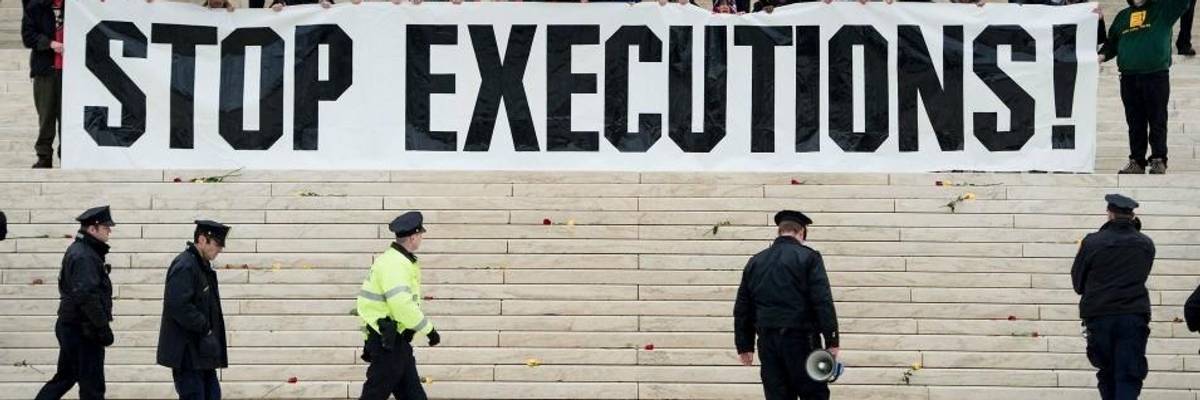
Police officers gather to remove activists during an anti-death penalty protest in front of the US Supreme Court in Washington, DC. (Photo: Brendan Smialowski/AFP/Getty Images)
Execution Will Mark MLK's Birthday
Trump's benevolence has yet to reach two Black men who’ve been on death row since the 1990s and are slated to be killed in mid-January at the federal government’s maximum security prison in Terre Haute, Indiana.
Shakespeare got it right. Something is definitely rotten, but not in Denmark. The decay is made in America and engulfs the fortress at 1600 Pennsylvania Ave.
Just before Christmas and with true holiday spirit, the master of the White House manor pardoned 41 convicted criminals (aka friends and relatives) and commuted the sentences of eight others. When added to earlier ones, the total is a whopping 94. But who's counting? The number will mount before he exits the stage.
The list is noteworthy. First in line are the cabal of white collar criminals--such as those who fraudulently charged over $1 billion in nursing home claims, those who tried to block Congressional investigations, those who turned public funds into personal piggy banks, those who buried millions in overseas banks to dodge U.S. taxes, and those who defrauded charities. Next there's the long list of those who lied and lied and lied to prosecutors, Congress and the FBI.
Trump has also conferred his compassion on convicted killers such as the Blackwater Security guys who gunned down 17 unarmed Baghdad men, women and children and injured 20 in 2007; the Prince Georges County (MD) police officer who unleashed her police dog on an unarmed homeless man in 1995; and the two Border Patrol agents who killed a man (again unarmed) suspected of carrying drugs, who was fleeing to Mexico.
However, his benevolence has yet to reach two Black men who've been on death row since the 1990s and are slated to be killed in mid-January at the federal government's maximum security prison in Terre Haute, Indiana. Nor was his kindness extended to the 10 inmates who were executed since July.
Cory Johnson, a 52-year-old Virginia man, will be executed on January 14. When he was 23, Johnson, along with other gang members, was convicted of killing rival gang members in 1992. Johnson's lawyer say he is "intellectually disabled" which should prohibit him from being executed: A 2002 U.S. Supreme Court decision barred the death penalty for those in this category. The lawyer also argues that no jury or court has heard evidence to determine if he suffers from intellectual disability.
Dustin Higgs, a 48-year-old Maryland man who was convicted of killing three women in 1996, will be executed on January 15. Former Attorney General William Barr picked who would be put to death and when. And since January 15 happens to be Martin Luther King's birthday, one has to wonder if he was clueless (and none of his staff knew it either, to inform him) or he thought it was a meaningful way to mark the date.
It's worth noting that at Higgs' trial, all the witnesses said he didn't do the shooting; rather, his co-defendant, Willis Haynes, pulled the trigger. For this, Haynes was sentenced to life in prison. Higgs' lawyer insists the jury wasn't given this evidence. Instead, it based its verdict on the testimony of one man who struck a deal in exchange for cooperating.
In a remarkably passionate November 20, 2020 press release, the Department of Justice discarded its usual lawyerly language to announce it would execute these men because of their "staggeringly brutal murders."
In the U.S., while 61 percent of Whites and 47 percent of Blacks support the death penalty, some who work in the prison system do not. A now-retired warden at a federal prison (who asked for anonymity) says executions "serve no purpose other than vengeance. Because some innocent people have been executed in error, I oppose it. Even if there was just one execution of an innocent person, that's one too many. The other reason is because I was in the system long enough to see young men, say 20 years old, who changed completely after decades in prison and were no longer a threat to society."
She adds that she's not alone. "Just before one execution set for the early 2000s, the Bureau of Prisons had to ask staff at other federal prisons to volunteer to work at Terre Haute temporarily, to help with the event--since many of that prison's staff refused to participate: They needed health professionals to administer the injections and psychologists to treat the prison staff who had developed mental problems related to the state-sponsored killings.
Robert Hood (now retired), the warden at the federal super-max penitentiary in Colorado from 2002 to 2005 and who worked in the system for 45 years, says he turned down the warden's job at Terre Haute for two reasons. "If I took it, I would have had to participate in executions. I would also have had to direct my staff to take part. I didn't think either action was desirable," he says.
Robert Dunham, director of the Death Penalty Information Center, says no president before Trump has carried out more than one execution in the transition period before a new President is sworn in. Yet under the current Administration, the number is now 10 and the next two will make it 12.
Wouldn't it be commendable if President Trump could feel the same compassion for just two more? Alas, the likelihood is close to zero.
We are at a crossroads
This country and this world are at a monumental crossroads. In a few short weeks, US voters will have an opportunity to beat back the forces of fascism and confront the billionaires who are rigging the economy, our media system, and our democracy, making it increasingly impossible for ordinary people to get by. We’re not just talking about the election. We’re talking about what must be done once these fascist elements are vanquished from power. We need a bolder set of solutions than what either major party has so far been willing to offer and a working-class movement ready to fight like hell for it. Trump didn't emerge from nowhere. The conditions that fueled MAGA authoritarianism were created by decades of radical neoliberal economic policies and a corrupt political system dominated by corporate interests. They slashed taxes on the super-rich, promising that the benefits would trickle down. They said giveaways to the corporate titans would make life more affordable for the rest of us. It was all bullshit. And when a bitter, betrayed populace searches for someone to blame, right-wing demagogues have little trouble finding scapegoats. People know when they're being lied to, but you won't hear any of this from the corporate media. Only independent journalism—powered and funded by people who believe in building a better world—can deliver truly trustworthy daily news. Our Fall Campaign is underway, and we need your help. To power our newsroom through the rest of the year, we need to raise $125,000 by midnight on October 31. So if you share our vision, please contribute whatever you can to sustain our work. |
Shakespeare got it right. Something is definitely rotten, but not in Denmark. The decay is made in America and engulfs the fortress at 1600 Pennsylvania Ave.
Just before Christmas and with true holiday spirit, the master of the White House manor pardoned 41 convicted criminals (aka friends and relatives) and commuted the sentences of eight others. When added to earlier ones, the total is a whopping 94. But who's counting? The number will mount before he exits the stage.
The list is noteworthy. First in line are the cabal of white collar criminals--such as those who fraudulently charged over $1 billion in nursing home claims, those who tried to block Congressional investigations, those who turned public funds into personal piggy banks, those who buried millions in overseas banks to dodge U.S. taxes, and those who defrauded charities. Next there's the long list of those who lied and lied and lied to prosecutors, Congress and the FBI.
Trump has also conferred his compassion on convicted killers such as the Blackwater Security guys who gunned down 17 unarmed Baghdad men, women and children and injured 20 in 2007; the Prince Georges County (MD) police officer who unleashed her police dog on an unarmed homeless man in 1995; and the two Border Patrol agents who killed a man (again unarmed) suspected of carrying drugs, who was fleeing to Mexico.
However, his benevolence has yet to reach two Black men who've been on death row since the 1990s and are slated to be killed in mid-January at the federal government's maximum security prison in Terre Haute, Indiana. Nor was his kindness extended to the 10 inmates who were executed since July.
Cory Johnson, a 52-year-old Virginia man, will be executed on January 14. When he was 23, Johnson, along with other gang members, was convicted of killing rival gang members in 1992. Johnson's lawyer say he is "intellectually disabled" which should prohibit him from being executed: A 2002 U.S. Supreme Court decision barred the death penalty for those in this category. The lawyer also argues that no jury or court has heard evidence to determine if he suffers from intellectual disability.
Dustin Higgs, a 48-year-old Maryland man who was convicted of killing three women in 1996, will be executed on January 15. Former Attorney General William Barr picked who would be put to death and when. And since January 15 happens to be Martin Luther King's birthday, one has to wonder if he was clueless (and none of his staff knew it either, to inform him) or he thought it was a meaningful way to mark the date.
It's worth noting that at Higgs' trial, all the witnesses said he didn't do the shooting; rather, his co-defendant, Willis Haynes, pulled the trigger. For this, Haynes was sentenced to life in prison. Higgs' lawyer insists the jury wasn't given this evidence. Instead, it based its verdict on the testimony of one man who struck a deal in exchange for cooperating.
In a remarkably passionate November 20, 2020 press release, the Department of Justice discarded its usual lawyerly language to announce it would execute these men because of their "staggeringly brutal murders."
In the U.S., while 61 percent of Whites and 47 percent of Blacks support the death penalty, some who work in the prison system do not. A now-retired warden at a federal prison (who asked for anonymity) says executions "serve no purpose other than vengeance. Because some innocent people have been executed in error, I oppose it. Even if there was just one execution of an innocent person, that's one too many. The other reason is because I was in the system long enough to see young men, say 20 years old, who changed completely after decades in prison and were no longer a threat to society."
She adds that she's not alone. "Just before one execution set for the early 2000s, the Bureau of Prisons had to ask staff at other federal prisons to volunteer to work at Terre Haute temporarily, to help with the event--since many of that prison's staff refused to participate: They needed health professionals to administer the injections and psychologists to treat the prison staff who had developed mental problems related to the state-sponsored killings.
Robert Hood (now retired), the warden at the federal super-max penitentiary in Colorado from 2002 to 2005 and who worked in the system for 45 years, says he turned down the warden's job at Terre Haute for two reasons. "If I took it, I would have had to participate in executions. I would also have had to direct my staff to take part. I didn't think either action was desirable," he says.
Robert Dunham, director of the Death Penalty Information Center, says no president before Trump has carried out more than one execution in the transition period before a new President is sworn in. Yet under the current Administration, the number is now 10 and the next two will make it 12.
Wouldn't it be commendable if President Trump could feel the same compassion for just two more? Alas, the likelihood is close to zero.
Shakespeare got it right. Something is definitely rotten, but not in Denmark. The decay is made in America and engulfs the fortress at 1600 Pennsylvania Ave.
Just before Christmas and with true holiday spirit, the master of the White House manor pardoned 41 convicted criminals (aka friends and relatives) and commuted the sentences of eight others. When added to earlier ones, the total is a whopping 94. But who's counting? The number will mount before he exits the stage.
The list is noteworthy. First in line are the cabal of white collar criminals--such as those who fraudulently charged over $1 billion in nursing home claims, those who tried to block Congressional investigations, those who turned public funds into personal piggy banks, those who buried millions in overseas banks to dodge U.S. taxes, and those who defrauded charities. Next there's the long list of those who lied and lied and lied to prosecutors, Congress and the FBI.
Trump has also conferred his compassion on convicted killers such as the Blackwater Security guys who gunned down 17 unarmed Baghdad men, women and children and injured 20 in 2007; the Prince Georges County (MD) police officer who unleashed her police dog on an unarmed homeless man in 1995; and the two Border Patrol agents who killed a man (again unarmed) suspected of carrying drugs, who was fleeing to Mexico.
However, his benevolence has yet to reach two Black men who've been on death row since the 1990s and are slated to be killed in mid-January at the federal government's maximum security prison in Terre Haute, Indiana. Nor was his kindness extended to the 10 inmates who were executed since July.
Cory Johnson, a 52-year-old Virginia man, will be executed on January 14. When he was 23, Johnson, along with other gang members, was convicted of killing rival gang members in 1992. Johnson's lawyer say he is "intellectually disabled" which should prohibit him from being executed: A 2002 U.S. Supreme Court decision barred the death penalty for those in this category. The lawyer also argues that no jury or court has heard evidence to determine if he suffers from intellectual disability.
Dustin Higgs, a 48-year-old Maryland man who was convicted of killing three women in 1996, will be executed on January 15. Former Attorney General William Barr picked who would be put to death and when. And since January 15 happens to be Martin Luther King's birthday, one has to wonder if he was clueless (and none of his staff knew it either, to inform him) or he thought it was a meaningful way to mark the date.
It's worth noting that at Higgs' trial, all the witnesses said he didn't do the shooting; rather, his co-defendant, Willis Haynes, pulled the trigger. For this, Haynes was sentenced to life in prison. Higgs' lawyer insists the jury wasn't given this evidence. Instead, it based its verdict on the testimony of one man who struck a deal in exchange for cooperating.
In a remarkably passionate November 20, 2020 press release, the Department of Justice discarded its usual lawyerly language to announce it would execute these men because of their "staggeringly brutal murders."
In the U.S., while 61 percent of Whites and 47 percent of Blacks support the death penalty, some who work in the prison system do not. A now-retired warden at a federal prison (who asked for anonymity) says executions "serve no purpose other than vengeance. Because some innocent people have been executed in error, I oppose it. Even if there was just one execution of an innocent person, that's one too many. The other reason is because I was in the system long enough to see young men, say 20 years old, who changed completely after decades in prison and were no longer a threat to society."
She adds that she's not alone. "Just before one execution set for the early 2000s, the Bureau of Prisons had to ask staff at other federal prisons to volunteer to work at Terre Haute temporarily, to help with the event--since many of that prison's staff refused to participate: They needed health professionals to administer the injections and psychologists to treat the prison staff who had developed mental problems related to the state-sponsored killings.
Robert Hood (now retired), the warden at the federal super-max penitentiary in Colorado from 2002 to 2005 and who worked in the system for 45 years, says he turned down the warden's job at Terre Haute for two reasons. "If I took it, I would have had to participate in executions. I would also have had to direct my staff to take part. I didn't think either action was desirable," he says.
Robert Dunham, director of the Death Penalty Information Center, says no president before Trump has carried out more than one execution in the transition period before a new President is sworn in. Yet under the current Administration, the number is now 10 and the next two will make it 12.
Wouldn't it be commendable if President Trump could feel the same compassion for just two more? Alas, the likelihood is close to zero.