SUBSCRIBE TO OUR FREE NEWSLETTER
Daily news & progressive opinion—funded by the people, not the corporations—delivered straight to your inbox.
5
#000000
#FFFFFF
To donate by check, phone, or other method, see our More Ways to Give page.
Daily news & progressive opinion—funded by the people, not the corporations—delivered straight to your inbox.
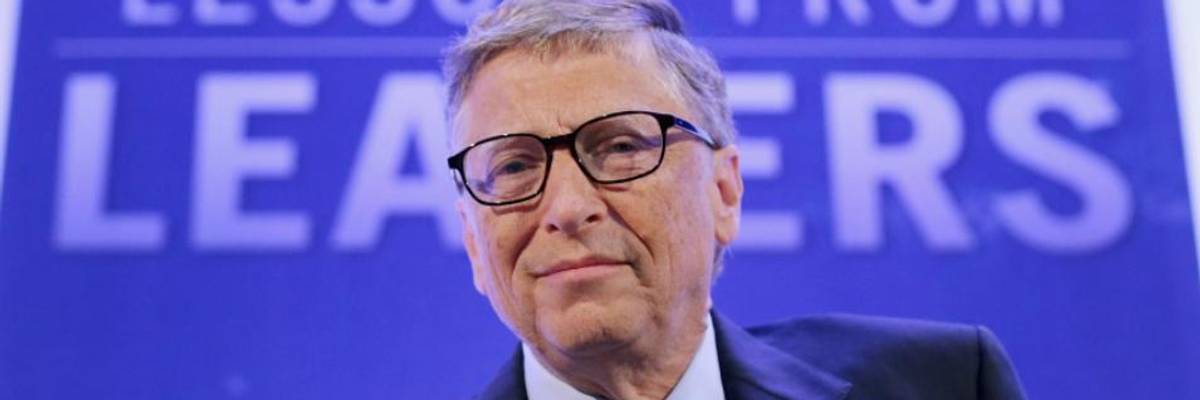
Bill Gates, founder of Microsoft and co-chair of the Bill and Melinda Gates Foundation, speaks during the Politico 'Lessons from Leaders' series at the Bank of America offices September 29, 2014 in Washington, DC. (Photo: Chip Somodevilla/Getty Images)
In February 2018, West Virginia teachers launched a strike that reawakened a movement. Tens of thousands of teachers from around the country have taken part in what is now the largest strike wave in decades, demanding better public education in the face of years of austerity.
The fight for public education reminds us that working-class struggles around the world are linked--and that international solidarity is the key to victory.
On Feb. 11, 2019, as the U.S. wave continued, teachers union leaders from across Africa gathered in Addis Ababa for a meeting of African Union heads of state with their own demands: to halt the continent's moves toward privatized education and provide "inclusive and equitable quality free public education for all."
Though an ocean apart, West Virginia and Addis Ababa are two fronts in the same war. The fight for public education reminds us that working-class struggles around the world are linked--and that international solidarity is the key to victory.
In many U.S. districts, school funding still hasn't recovered from cuts made during the Great Recession. Teachers are underpaid, classrooms are overcrowded, and textbooks are out of date. Rather than increase funding, conservative public figures like Betsy DeVos, Trump's secretary of education, have turned to private and charter schools that deepen inequality and further drain resources from the public system.
At the same time, foreign-owned, for-profit schools like Bridge International Academies and GEMS Education have swept Africa. There is no doubt that the status quo of public education in much of the region is dire: Education systems are largely underfunded, illiteracy remains high, and a large gender gaps prevail. But an unaccountable, profit-driven system funded largely by American and European investors is not the solution. Private schools crowd out the public sector, base education on ability to pay, and exacerbate economic and social stratification.
Investors like Bridge's digital Taylorist curricula, which are identical across all schools, planned down to the minute, and require specialized tablets that track the finger movements of their teachers. However, there's little evidence that such lessons adequately serve poor and working-class students. School privatization in Africa is part of the same neoliberal project that inspired teachers to walk out in West Virginia.
Milton Friedman--free market ideologue, adviser to both Ronald Reagan and Margaret Thatcher, and mentor of the "Chicago Boys"--is considered the founding father of the school choice movement in the United States. It was his brand of market fundamentalism that was then foisted on the Global South in the 1980s, leading to Africa's "lost decade" of growth and the continent's current state of education. International Monetary Fund austerity demands inevitably forced public funding cuts while the World Bank pushed school fees and privatization. The World Bank, along with international aid agencies like the United Kingdom's Department for International Development, continue to promote for-profit models even today.
Philanthrocapitalist Bill Gates has given roughly $10 million to a fund attempting to push Oakland to the "New Orleans" model: full privatization.
In some cases, privatization efforts in the United States and Africa are led by the very same billionaires and corporations. Philanthrocapitalist Bill Gates has given roughly $10 million to a fund attempting to push Oakland to the "New Orleans" model: full privatization. It is no coincidence that Gates is also one of the top funders behind Bridge. Pearson, the controversial education giant of Common Core fame, holds stakes in both Bridge and the comparable Omega Schools in Ghana.
These are more than theoretical ties. These are proof that we are in the same fight.
In 2016, Ugandan courts ruled that Bridge was not adequately licensed to operate and ordered the closure of its 63 schools in the country. Shortly thereafter, 10 Bridge schools were shuttered in Kenya, thanks in part to sustained pressure from the Kenya National Union of Teachers. Ghanaian teachers are now pushing for the same.
Since the beginning of the strike wave in the United States, teachers have won vastly improved contracts, including pay raises and increased school spending, in West Virginia, Oklahoma, Arizona, Colorado, Los Angeles, and Oakland.
Each of these victories is a blow against the global education privatization movement. Each is a material loss for funders like Gates and Pearson, and a political loss for DeVos and her sympathizers at the World Bank. Each builds the power of global union federations like Education International. And each fuels mobilization for further victories.
A court ruling against Bridge International in Kenya is a win against "school choice" in the United States. A teachers' strike in West Virginia is a success for public education in Africa.
The U.S. labor movement must not retreat into economic nationalism, winning material gains for American workers while abandoning those beyond its borders. The workers of the world are a part of the same fight. To win the war, a revitalized Left must transcend borders--building global solidarity not out of altruism, but from an understanding that the struggle of the working class is global.
Dear Common Dreams reader, It’s been nearly 30 years since I co-founded Common Dreams with my late wife, Lina Newhouser. We had the radical notion that journalism should serve the public good, not corporate profits. It was clear to us from the outset what it would take to build such a project. No paid advertisements. No corporate sponsors. No millionaire publisher telling us what to think or do. Many people said we wouldn't last a year, but we proved those doubters wrong. Together with a tremendous team of journalists and dedicated staff, we built an independent media outlet free from the constraints of profits and corporate control. Our mission has always been simple: To inform. To inspire. To ignite change for the common good. Building Common Dreams was not easy. Our survival was never guaranteed. When you take on the most powerful forces—Wall Street greed, fossil fuel industry destruction, Big Tech lobbyists, and uber-rich oligarchs who have spent billions upon billions rigging the economy and democracy in their favor—the only bulwark you have is supporters who believe in your work. But here’s the urgent message from me today. It's never been this bad out there. And it's never been this hard to keep us going. At the very moment Common Dreams is most needed, the threats we face are intensifying. We need your support now more than ever. We don't accept corporate advertising and never will. We don't have a paywall because we don't think people should be blocked from critical news based on their ability to pay. Everything we do is funded by the donations of readers like you. When everyone does the little they can afford, we are strong. But if that support retreats or dries up, so do we. Will you donate now to make sure Common Dreams not only survives but thrives? —Craig Brown, Co-founder |
In February 2018, West Virginia teachers launched a strike that reawakened a movement. Tens of thousands of teachers from around the country have taken part in what is now the largest strike wave in decades, demanding better public education in the face of years of austerity.
The fight for public education reminds us that working-class struggles around the world are linked--and that international solidarity is the key to victory.
On Feb. 11, 2019, as the U.S. wave continued, teachers union leaders from across Africa gathered in Addis Ababa for a meeting of African Union heads of state with their own demands: to halt the continent's moves toward privatized education and provide "inclusive and equitable quality free public education for all."
Though an ocean apart, West Virginia and Addis Ababa are two fronts in the same war. The fight for public education reminds us that working-class struggles around the world are linked--and that international solidarity is the key to victory.
In many U.S. districts, school funding still hasn't recovered from cuts made during the Great Recession. Teachers are underpaid, classrooms are overcrowded, and textbooks are out of date. Rather than increase funding, conservative public figures like Betsy DeVos, Trump's secretary of education, have turned to private and charter schools that deepen inequality and further drain resources from the public system.
At the same time, foreign-owned, for-profit schools like Bridge International Academies and GEMS Education have swept Africa. There is no doubt that the status quo of public education in much of the region is dire: Education systems are largely underfunded, illiteracy remains high, and a large gender gaps prevail. But an unaccountable, profit-driven system funded largely by American and European investors is not the solution. Private schools crowd out the public sector, base education on ability to pay, and exacerbate economic and social stratification.
Investors like Bridge's digital Taylorist curricula, which are identical across all schools, planned down to the minute, and require specialized tablets that track the finger movements of their teachers. However, there's little evidence that such lessons adequately serve poor and working-class students. School privatization in Africa is part of the same neoliberal project that inspired teachers to walk out in West Virginia.
Milton Friedman--free market ideologue, adviser to both Ronald Reagan and Margaret Thatcher, and mentor of the "Chicago Boys"--is considered the founding father of the school choice movement in the United States. It was his brand of market fundamentalism that was then foisted on the Global South in the 1980s, leading to Africa's "lost decade" of growth and the continent's current state of education. International Monetary Fund austerity demands inevitably forced public funding cuts while the World Bank pushed school fees and privatization. The World Bank, along with international aid agencies like the United Kingdom's Department for International Development, continue to promote for-profit models even today.
Philanthrocapitalist Bill Gates has given roughly $10 million to a fund attempting to push Oakland to the "New Orleans" model: full privatization.
In some cases, privatization efforts in the United States and Africa are led by the very same billionaires and corporations. Philanthrocapitalist Bill Gates has given roughly $10 million to a fund attempting to push Oakland to the "New Orleans" model: full privatization. It is no coincidence that Gates is also one of the top funders behind Bridge. Pearson, the controversial education giant of Common Core fame, holds stakes in both Bridge and the comparable Omega Schools in Ghana.
These are more than theoretical ties. These are proof that we are in the same fight.
In 2016, Ugandan courts ruled that Bridge was not adequately licensed to operate and ordered the closure of its 63 schools in the country. Shortly thereafter, 10 Bridge schools were shuttered in Kenya, thanks in part to sustained pressure from the Kenya National Union of Teachers. Ghanaian teachers are now pushing for the same.
Since the beginning of the strike wave in the United States, teachers have won vastly improved contracts, including pay raises and increased school spending, in West Virginia, Oklahoma, Arizona, Colorado, Los Angeles, and Oakland.
Each of these victories is a blow against the global education privatization movement. Each is a material loss for funders like Gates and Pearson, and a political loss for DeVos and her sympathizers at the World Bank. Each builds the power of global union federations like Education International. And each fuels mobilization for further victories.
A court ruling against Bridge International in Kenya is a win against "school choice" in the United States. A teachers' strike in West Virginia is a success for public education in Africa.
The U.S. labor movement must not retreat into economic nationalism, winning material gains for American workers while abandoning those beyond its borders. The workers of the world are a part of the same fight. To win the war, a revitalized Left must transcend borders--building global solidarity not out of altruism, but from an understanding that the struggle of the working class is global.
In February 2018, West Virginia teachers launched a strike that reawakened a movement. Tens of thousands of teachers from around the country have taken part in what is now the largest strike wave in decades, demanding better public education in the face of years of austerity.
The fight for public education reminds us that working-class struggles around the world are linked--and that international solidarity is the key to victory.
On Feb. 11, 2019, as the U.S. wave continued, teachers union leaders from across Africa gathered in Addis Ababa for a meeting of African Union heads of state with their own demands: to halt the continent's moves toward privatized education and provide "inclusive and equitable quality free public education for all."
Though an ocean apart, West Virginia and Addis Ababa are two fronts in the same war. The fight for public education reminds us that working-class struggles around the world are linked--and that international solidarity is the key to victory.
In many U.S. districts, school funding still hasn't recovered from cuts made during the Great Recession. Teachers are underpaid, classrooms are overcrowded, and textbooks are out of date. Rather than increase funding, conservative public figures like Betsy DeVos, Trump's secretary of education, have turned to private and charter schools that deepen inequality and further drain resources from the public system.
At the same time, foreign-owned, for-profit schools like Bridge International Academies and GEMS Education have swept Africa. There is no doubt that the status quo of public education in much of the region is dire: Education systems are largely underfunded, illiteracy remains high, and a large gender gaps prevail. But an unaccountable, profit-driven system funded largely by American and European investors is not the solution. Private schools crowd out the public sector, base education on ability to pay, and exacerbate economic and social stratification.
Investors like Bridge's digital Taylorist curricula, which are identical across all schools, planned down to the minute, and require specialized tablets that track the finger movements of their teachers. However, there's little evidence that such lessons adequately serve poor and working-class students. School privatization in Africa is part of the same neoliberal project that inspired teachers to walk out in West Virginia.
Milton Friedman--free market ideologue, adviser to both Ronald Reagan and Margaret Thatcher, and mentor of the "Chicago Boys"--is considered the founding father of the school choice movement in the United States. It was his brand of market fundamentalism that was then foisted on the Global South in the 1980s, leading to Africa's "lost decade" of growth and the continent's current state of education. International Monetary Fund austerity demands inevitably forced public funding cuts while the World Bank pushed school fees and privatization. The World Bank, along with international aid agencies like the United Kingdom's Department for International Development, continue to promote for-profit models even today.
Philanthrocapitalist Bill Gates has given roughly $10 million to a fund attempting to push Oakland to the "New Orleans" model: full privatization.
In some cases, privatization efforts in the United States and Africa are led by the very same billionaires and corporations. Philanthrocapitalist Bill Gates has given roughly $10 million to a fund attempting to push Oakland to the "New Orleans" model: full privatization. It is no coincidence that Gates is also one of the top funders behind Bridge. Pearson, the controversial education giant of Common Core fame, holds stakes in both Bridge and the comparable Omega Schools in Ghana.
These are more than theoretical ties. These are proof that we are in the same fight.
In 2016, Ugandan courts ruled that Bridge was not adequately licensed to operate and ordered the closure of its 63 schools in the country. Shortly thereafter, 10 Bridge schools were shuttered in Kenya, thanks in part to sustained pressure from the Kenya National Union of Teachers. Ghanaian teachers are now pushing for the same.
Since the beginning of the strike wave in the United States, teachers have won vastly improved contracts, including pay raises and increased school spending, in West Virginia, Oklahoma, Arizona, Colorado, Los Angeles, and Oakland.
Each of these victories is a blow against the global education privatization movement. Each is a material loss for funders like Gates and Pearson, and a political loss for DeVos and her sympathizers at the World Bank. Each builds the power of global union federations like Education International. And each fuels mobilization for further victories.
A court ruling against Bridge International in Kenya is a win against "school choice" in the United States. A teachers' strike in West Virginia is a success for public education in Africa.
The U.S. labor movement must not retreat into economic nationalism, winning material gains for American workers while abandoning those beyond its borders. The workers of the world are a part of the same fight. To win the war, a revitalized Left must transcend borders--building global solidarity not out of altruism, but from an understanding that the struggle of the working class is global.