

SUBSCRIBE TO OUR FREE NEWSLETTER
Daily news & progressive opinion—funded by the people, not the corporations—delivered straight to your inbox.
5
#000000
#FFFFFF
To donate by check, phone, or other method, see our More Ways to Give page.
Daily news & progressive opinion—funded by the people, not the corporations—delivered straight to your inbox.
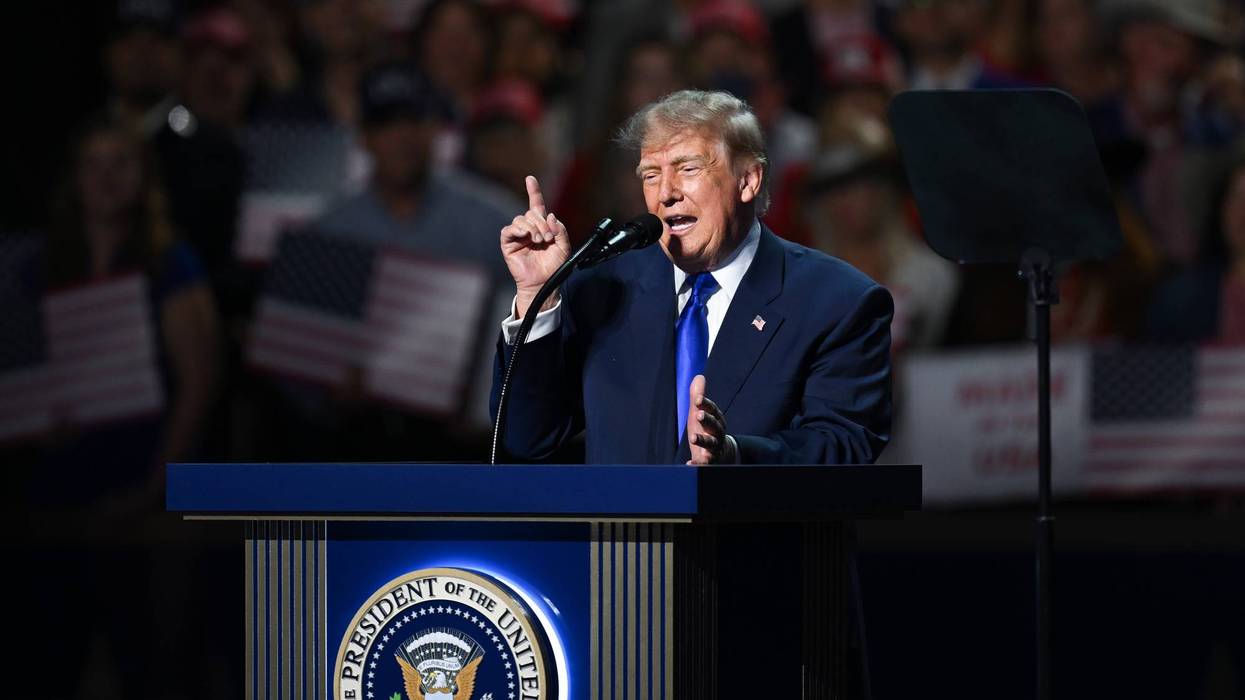
Trump’s promise of money in exchange for Republican votes was blatantly anti-democratic; the loyalty oath that he then asked his audience to take was even worse.
President Donald Trump is losing badly, and he knows it. At the MAGA rally billed as the Republican midterm convention on September 9-10, he mounted yet another brazen attack on the democratic process that threatens to hold him accountable. He tried to buy votes, imbue personal loyalty to him over allegiance to democracy, and encourage voter fraud.
Most of the media dismissed the episode as just another bizarre Trump moment.
Eight minutes into his second keynote speech on Day Two of the rally, the president promised a $5,000 “Trump dividend” to every US adult citizen if Republicans retained control of Congress in November. That would add more than $1 trillion to the burgeoning federal deficit and fuel persistent inflation.
“Outside historical norms”? Trump’s actions are so far beyond the pale that it’s inappropriate to describe them in such sanitized terms.
Some observers dismissed it as a campaign promise. But federal law provides:
Whoever makes or offers to make an expenditure to any person, either to vote or withhold his vote, or to vote for or against any candidate; and
Whoever solicits, accepts, or receives any such expenditure in consideration of his vote or the withholding of his vote—
Shall be fined under this title or imprisoned not more than one year, or both; and if the violation was willful, shall be fined under this title or imprisoned not more than two years, or both. (18 U.S.C. Sec. 597—“Expenditures to Influence Voting”)
Of course, the Trump Justice Department that is prosecuting former FBI Director James Comey for posting a photograph of seashells on a beach will never investigate or prosecute Trump for anything. And Trump’s position will always be that Chief Justice John Roberts’ opinion in Trump v. United States effectively gave him a permanent “get-out-of-jail-free” card for anything he does as president.
Even so, Trump’s promise of money in exchange for Republican votes was blatantly anti-democratic; the loyalty oath that he then asked his audience to take was worse.
Ten minutes after his $5,000 promise, Trump asked attendees to raise their right hands and swear—not to defend democracy, but to undermine it as an act of personal loyalty to him: “I pledge to the greatest president in the history of the United States that loves us so much he can’t even breathe.”
The audience repeated his words. Ignoring the evidence that voter fraud is virtually non-existent, Trump continued:
That I will go out with my family, my friends. I’ll do it anyway. I don’t care if I’m registered or not, I’m gonna try and cheat like hell like they do. They never, there’s never been bigger cheaters. They don’t care. I am gonna go out and I'm gonna get my friends, my family, and we are going to vote on November 3 or we are going to vote before that.
Ready? To finish the pledge? So we swear [Audience responded: “We swear.”] on November 3, we are going to go out and vote.
Then Trump added: “And you know what? If you want, you can vote Democrat, but I don't think there's one person in this room that's gonna vote [Democrat]. [Audience responded: "No."]
“I don't think so. So I don't have to preface, I don't wanna waste the words vote Republican, just go out. If you vote, you're voting Republican. Okay.”
Then he concluded the pledge: “So help me God.”
[Audience responded: "So help me God"]
It’s no secret that Trump values personal loyalty to him above all else. Competence has never been a job requirement in his administration. See, for example, Robert F. Kennedy Jr. (Health and Human Services), Pete Hegseth (Defense), Kristi Noem (Department of Homeland Security), Tulsi Gabbard (Director of National Intelligence), Lori Chavez-DeRemer (Labor), and more.
But Trump’s oath is particularly unsettling. A US president asking any audience to swear personal fealty to him should trouble any citizen. When coupled with a pledge to commit voter fraud aimed at preserving that president’s compliant legislative majority for another two years, it’s stunning. And the historical parallels are frightening.
Pundits responded with their usual euphemisms: “Trump acted outside historical norms;” “Don’t take Trump literally;” “Trump is being Trump.”
Then they moved on.
“Outside historical norms”? Trump’s actions are so far beyond the pale that it’s inappropriate to describe them in such sanitized terms. He has already destroyed many of democracy’s guardrails, and he’s not done.
“Don’t take Trump literally”? Maybe pundits don’t, but even with a dismal approval rating in the mid-30s, millions of people will. After all, he concluded his September 10 pledge with a warning:
You know what happens if you don't vote? You go to hell. You know that. Okay? You go to hell. And I don't want that to happen to you, so please go and vote because together we will defeat the communists. We will defeat the communists. We will reject, and that's what they are. They're not socialists. They're not Democrats. They're communists. We will reject these radical left lunatics. We will demolish the extremists, fanatics, lunatics, and criminals who want to destroy our country.
“Trump is being Trump”? That’s true in the sense that he’s saying the quiet part out loud. But the response should be more than a collective shrug. With the help of a complicit Republican majority in Congress, a cooperative US Supreme Court, and Republican controlled-state governments across the country, Trump has amassed unprecedented presidential power—and abused it in unprecedented ways.
The November election must become the reckoning that Trump does not want.
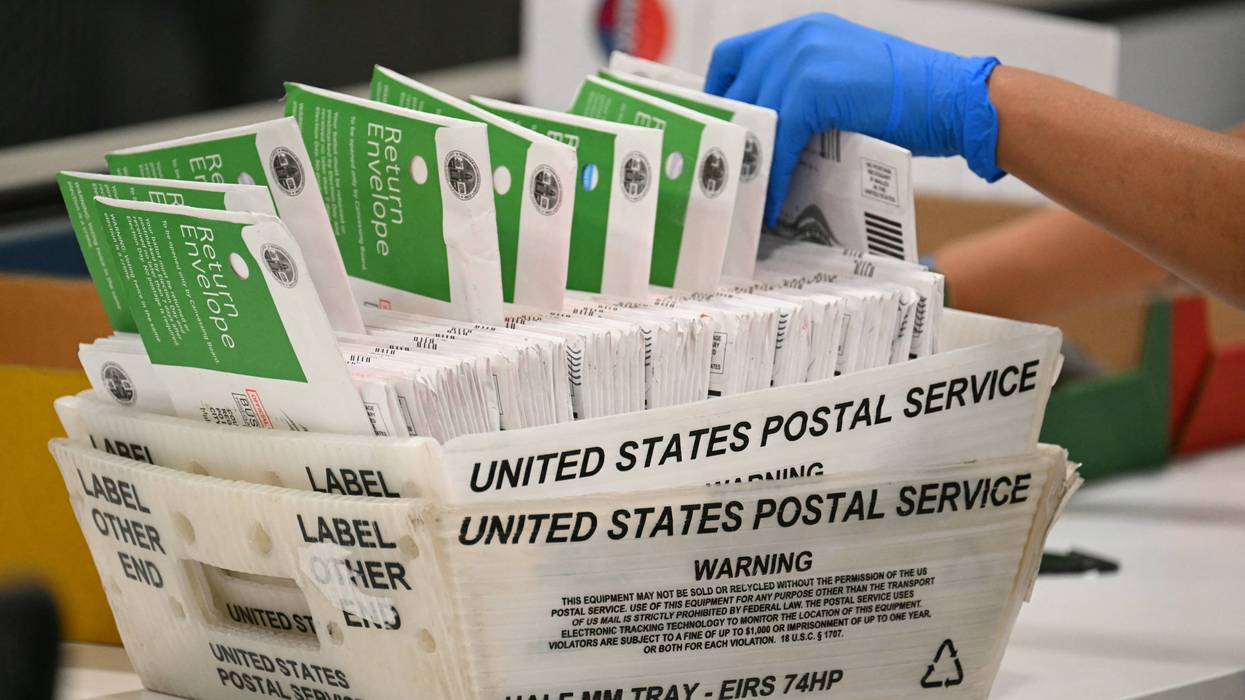
One voting rights advocate said the administration "is abusing the Census Bureau data to generate sensational headlines that Trump wants."
As he gears up to sow doubt about this year's midterms, President Donald Trump is once again attempting to use the government to lend legitimacy to his long-debunked claims that he was cheated out of the 2020 election.
In a Tuesday post to Truth Social, Trump shared a report from the US Census Bureau, which he said "proves that over 24,000 Noncitizens voted illegally" after an analysis of 128 million voter records.
"I WON THE ELECTION," he declared, adding that the bureau would soon analyze the remaining 32 million voting records and that the number of illegitimate votes would "explode."
The report Trump was referring to was real, but highly unusual. The seven-page document posted on the Census Bureau website did not list any authors.
While the use of the "Census Bureau" label implies an air of seriousness and professionalism, Misty Heggeness, a former senior adviser for the Census Bureau, told Democracy Docket that the lack of clear authorship signified that it was "suspect of any integrity or rigor" and said it would be hard to trust unless career bureau staff put their name on it.
Sure enough, NPR reported on Wednesday that "work on the analysis was not conducted by career civil servants at the Census Bureau, and the team behind it included individuals affiliated with the America First Policy Institute," a Trump-aligned think tank that has helped to turn the president's election denial narrative into Republican policy.
The group has helped to push for aggressive voting rights restrictions in states, and its director for "election integrity" policy, Thomas Lane, was involved in the effort to create a slate of fake electors in Arizona, one of several states where Trump claimed to have won in 2020.
Earlier this year, according to CNN, Trump "installed a group of partisan analysts" from AFPI inside the Census Bureau. But their identities have not been publicly disclosed, and other bureau officials who spoke to NPR did not identify which AFPI officials worked on the new report "because they fear retaliation at work."
Bureau officials told CNN that the lack of listed authors suggests that the career employees were "sidelined."
Experts who reviewed the report have identified several "fatal" flaws that make its conclusions difficult to take seriously.
The authors of the report used a commercial voter database and matched its records to those from the Internal Revenue Service, Social Security Administration, State Department, and Department of Homeland Security, and matched noncitizen records to those identified as voters in 2020.
As Yunior Rivas and Jim Saksa of Democracy Docket explained, there are numerous problems with this approach:
Record matching... is fallible. The Census Bureau previously published research in 2014 specifically devoted to measuring false matches in the same identification system...
Census researchers have previously warned that the likelihood of successfully linking administrative records can vary across demographic groups, potentially introducing bias when researchers analyze only records they can confidently match.
That limitation is particularly significant when the result in question is relatively small compared with the enormous volume of records being searched: A mistaken link between an eligible citizen’s voter record and another person’s immigration record could produce a false positive.
The report also does not address another obvious danger: mistaking a naturalized citizen for a noncitizen due to an older immigration record... If evidence of a person’s citizenship is missing or fails to link correctly, the methodology can treat the existing noncitizen record as evidence of the person’s status at the time they voted. The report does not estimate how frequently such a misclassification could occur.
Aaron Reichlin-Melnick, a fellow at the American Immigration Council noted that the system used to find noncitizen voters is "riddled with false positives." According to the Texas Tribune, when states like Texas and Missouri used the tool, it resulted in hundreds of voters being flagged incorrectly.
But even if the Census Bureau report were factually bulletproof, it would be far short of what Trump needs to claim that he "won" the election. The number of supposedly illegitimate votes is not anywhere near enough to swing the result in any of the states where Trump lost to former President Joe Biden, who won the national popular vote by more than 7 million.
The report claims to have found 1,100 noncitizen votes in Arizona, which Biden won by 10,457; 400 noncitizen votes in Georgia, which Biden won by 11,779; and 500 noncitizen votes in Wisconsin, which Biden won by 20,682. Since voting is secret, there is also no basis to assume that all of these votes went to Biden.
Commerce Secretary Howard Lutnick, whose department contains the Census Bureau, has said the report was "just the beginning" and that the next one "will likely show tens of thousands of additional illegal voters.”
But the first report says it analyzed the vast majority of those who voted in 2020. Assuming that the remaining 32 million votes had similar match rates, it would only generate about 6,000 more supposedly illegitimate votes.
Even if every single one of those votes went for Biden, which can't be proved, it would still not be enough to swing a single state to Trump, let alone enough for him to declare victory.
Trump used this report to call for Congress to pass his "SAVE America Act," which would abolish most forms of mail-in voting and introduce new proof of citizenship requirements that voting rights experts have warned would lead millions of eligible voters to be wrongly kicked off the rolls.
He has also signed an executive order directing states to verify their voter lists against a federal citizenship verification system that has been found to erroneously flag many eligible voters.
Amanda Carpenter, an editor at the nonpartisan group Protect Democracy, said the Census Bureau report was "nothing but junk data science" and that Lutnick "is abusing the Census Bureau data to generate sensational headlines that Trump wants."
"He has been searching for these massive pots of fraudulent votes for years," Carpenter said. "It is like they are looking for the Loch Ness Monster. It does not exist, but they keep searching, and hoping, and lying and pointing to something shadowy that you kind of have to squint real hard at to pretend is there, but it isn't."
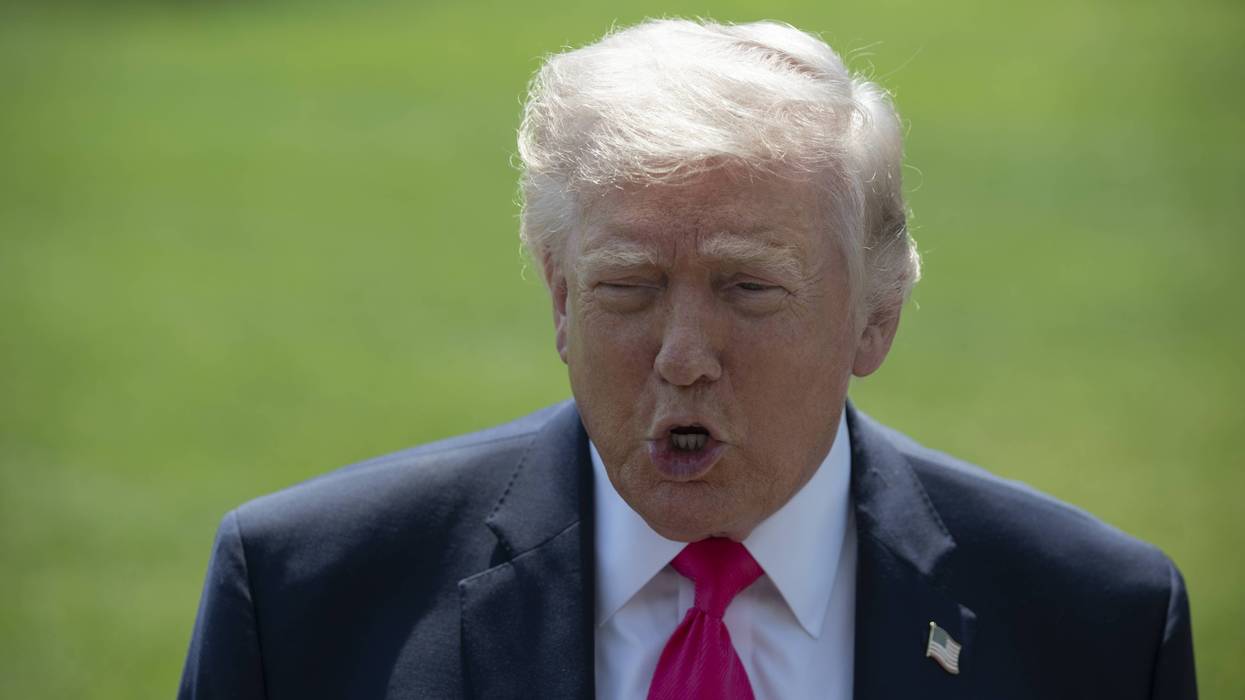
"The hypocrisy is the point," said Rep. Ayanna Pressley.
President Donald Trump has pushed to strip millions of Americans of the right to vote by mail. But he doesn't seem to think these restrictions should apply to him.
The White House confirmed to The New York Times that the president voted by mail ahead of Florida's Republican primary on Tuesday, marking at least the third time he has done so since becoming president. He also voted by mail in a state legislative special election earlier this year and in the 2020 Republican primary.
Though Trump has repeatedly characterized mail-in voting itself as a form of "cheating" and pushed to abolish it for most Americans under his proposed SAVE America Act, White House spokesperson Olivia Wales said it was a "non-story" that he chose to participate in the practice himself.
"The SAVE America Act has commonsense exceptions for Americans to use mail-in ballots for illness, disability, military, or travel— but universal mail-in voting should not be allowed because it’s highly susceptible to fraud," she said. "As everyone knows, the president is a resident of Palm Beach and participates in Florida elections, but he obviously primarily lives at the White House in Washington, DC."
Florida notably does not distinguish between absentee and other forms of mail-in voting, allowing residents to cast votes without an excuse—so the system Trump used to vote by mail is the same one he wants to make illegal.
Failing to pass his SAVE America Act through Congress, Trump has attempted to restrict mail-in voting via executive order.
An order he signed in March required states to hand over lists of eligible voters to the federal government and said that the US Postal Service could block residents of states from voting by mail if they refused to comply. The order also directed the Department of Homeland Security (DHS) to create state "citizenship lists" to be sent to election officials.
This order has been blocked in federal court, and Trump has pushed for the Supreme Court to allow it to go into effect before the November 3 midterm election. Voting rights advocates have warned that if the order goes into effect, many eligible voters will be wrongly excluded because their names don't appear on DHS's federal lists.
There is scarce evidence that any form of mail-in balloting is susceptible to fraud anywhere near the levels that would be necessary to swing the result of an election.
An analysis by the Brookings Institution last year, which examined data from the right-wing Heritage Foundation's election fraud database, found that for every 10 million mail ballots cast, about four ballots were associated with voting fraud, though the database is not exhaustive.
It's not clear why voting by mail for convenience would be any more "susceptible to fraud" than doing so for illness, disability, military, or travel, as the White House claims.
In fact, the Brookings study found that states with universal no-excuse mail-in voting have the lowest rates of mail-in fraud, and some states, like Washington, have seen reductions in fraud after transitioning to universal mail-in voting.
Advocates for universal mail-in balloting have emphasized that it makes voting easier and more accessible than when it's restricted to election days at physical polling places. They also say restricting it is especially harmful to voters from racial minority groups who face greater barriers to in-person voting and are more likely to have absentee ballot applications rejected.
Rep. Ayanna Pressley (D-Mass.) rejected the idea that the right of other Americans to vote by mail was any less legitimate than Trump's right to do so.
"Trump just voted by mail AGAIN while trying to take away the right for millions of people to do the same," Pressley wrote in a social media post. "The hypocrisy is the point. We won't let Republicans attack the sacred right to vote, including by mail."
Mass voter challenges threaten voters, they swamp overburdened election officials with unnecessary work, and they fuel mistrust in our elections.
In March 2025, two members of the Department of Government Efficiency team communicated with a political advocacy group that was seeking to “find evidence of voter fraud and to overturn election results in certain States.” The group was trying to match Social Security records with copies of voter files that it had acquired. One of the DOGE team members even signed a “voter data agreement” with the group. While it’s still unclear if DOGE members shared any personal Social Security data, the revelation raised a scary prospect: that the federal government might collaborate with election deniers looking to block American voters from the ballot box.
Most states have laws that allow voters to challenge other voters’ eligibility. Baseless mass challenges to hundreds or thousands of voters at a time are a growing problem. They threaten voters. They swamp overburdened election officials with unnecessary work. And they fuel mistrust in our elections.
As my colleague Andrew Garber lays out in a new report, the rise of the election denier movement and technological advances have come together to make mass voter challenges a persistent problem in recent elections. Our research found that at least 185,232 voter challenges were filed in 2024 alone, and that follows hundreds of thousands of challenges filed in the previous two election cycles.
Mass challenges by private citizens add little value because of the work by dedicated and professional election officials to keep the voter rolls clean. In contrast, these challenges rely on shoddy data-matching techniques often designed to confirm wild conspiracy theories.
The reality is that the president has no more power to run our elections than the activists bringing these challenges. So the only way their efforts to undermine our elections will succeed is if voters lose faith in the whole enterprise and stay home this fall.
Until recently, these challengers have been outsider activists. The idea they may now have the support of the federal government sends chills.
The Trump administration’s efforts to support baseless voter challenges go beyond a couple of stooges at DOGE. As we’ve been tracking for months, the Department of Justice (DOJ) has been pressuring states to cough up their voters’ confidential personal data. Like all the Trump administration’s election interference efforts, this pressure campaign has mostly fallen flat, with courts consistently blocking the requests. But 16 states were all too happy to hand over their voters’ data. And when they did, the DOJ asked them to sign a data security agreement that contained an ominous loophole in the protocols for private contractors with whom the department might share voter data. Meanwhile, one of the primary perpetrators of mass challenges in recent years, Rick Richards, creator of a mass challenge software called EagleAI, reportedly met with the DOJ in 2023 to demonstrate the tool. “They like it,” he claimed.
For these reasons and more, Garber predicts that “challenges will continue to be an integral strategy in the playbook to undermine the democratic process” in this year’s elections and beyond.
Promisingly, the Brennan Center’s research also reveals that thanks to the tireless efforts of election workers and federal legal protections, the vast majority of mass challenges do not lead to inappropriate purges of voters from the rolls.
But even small rates of disenfranchisement are a concern, and challenges can confuse or intimidate voters even when they don’t formally block them from voting. And the harms of mass challenges extend much further.
For one thing, they create tremendous burdens on election officials during a time when they should be preparing for the daunting task of running elections. In 2022, in Gwinnett County, Georgia, it took between 5 -10 experienced elections staff working “all day, every day, six days a week” to evaluate the 37,000 challenges filed by just one organization, VoterGA. In the end, not a single ineligible voter was removed as a result of the challenge.
You may be asking yourself: If these mass challenges do nothing to help election officials and only make their jobs more difficult, why do our laws allow them? There must be some good reason why we let Americans challenge their neighbors’ right to vote. Well, no, not really. The answer, as is so often the case when it comes to restrictive voting laws, is racism.
In a separate publication released Tuesday, my colleague Justin Lam lays out the racially discriminatory history of voter challenge laws. They were one of many devices states used to undermine the promise of the 15th Amendment and continue to deny Black people the right to vote. Some of these tools, such as poll taxes and literacy tests, were outlawed in the 1960s. Others, such as felony disenfranchisement and voter challenge laws, survived, perhaps because they were not so closely associated with Jim Crow. But history makes the association clear. As just one example, in 1946, Georgia gubernatorial candidate Eugene Talmadge distributed challenge forms to his supporters and urged them to “disqualify and mark off the voters’ list three-fourths of the Negro vote in this state.” Lam explains that these laws have also been used to successfully suppress the votes of Native, Latino, and Asian American voters.
Modern challenges look a little different. They are often more noteworthy for how incredibly wide a net they cast. Activists challenge everyone to create the illusion of issues with voter rolls. Today’s challengers often seem less concerned with targeting a particular group than they are with advancing conspiracy theories. In Allegheny County, Pennsylvania, a Republican member of the board of elections griped, “I can’t tell you how many hours of my life I’ve wasted trying to debunk” the false narratives of voter challengers.
That official’s complaint hints at the final harm of mass challenges and their true purpose: undermining public faith in elections. Indeed, it makes sense that the Trump administration might be looking to partner with mass challengers. The administration’s election interference campaign has the same goal. The reality is that the president has no more power to run our elections than the activists bringing these challenges. So the only way their efforts to undermine our elections will succeed is if voters lose faith in the whole enterprise and stay home this fall.
Garber’s report ends with a series of policy recommendations for ending mass challenges. We hope lawmakers take them up. But, as with so many other threats to our democracy, perhaps the most important response will come from voters. Check your registration and make a plan to vote. Read and respond to election mail sent by your local officials. Cast your ballot as early as possible. Consider all the options in your state and consider returning your ballot in person or via drop box if you can. Encourage your friends and family to do the same. The more we invest in our democracy, the harder it will be to undermine it.
By constantly raising the alarm about election fraud, Trump seeks to stir fear, doubt, and confusion in the minds of voters.
With 112 days to go until Election Day, President Donald Trump’s drive to undermine the vote continues. As time runs short, his efforts grow more aggressive, more brazen. But they are facing pushback with ever greater assurance.
Last Friday, Trump pushed out the remaining commissioners on the Election Assistance Commission. This tiny agency exists to provide help and funding for states. Trump had previously tried to force the commission to implement his pet voter suppression policy—requiring a passport to register to vote—but a federal court barred it from doing so in a lawsuit brought last year by the Brennan Center and others. Now, without any commissioners, the agency can’t do much of anything.
Another federal judge quashed Justice Department subpoenas issued to hundreds of election workers in Fulton County, Georgia. The judge said the subpoenas were “staggering,” and that the Justice Department was engaged in a “fishing expedition.”
Also last week, the Department of Justice (DOJ) sent a scarifying letter to state officials warning that they will be held criminally liable if noncitizens are found on the voter rolls or voting.
All of us who care about free, fair, and secure elections in 2026 should say loud and clear: Voters can vote with certainty.
Utah’s Republican lieutenant governor, who runs elections in that state, wrote: “Got another love letter this morning from the DOJ sprinkled throughout with threats of criminal prosecution. I’m sure I’m not the only chief election officer of a state who is being targeted for following state and federal laws by resisting DOJ’s demands for private voter data that have thus far been ruled illegal by at least a dozen courts. This is truly bizarre behavior by the federal agency that is supposed to be protecting civil rights.”
Trump even claimed that recently deceased Sen. Lindsey Graham’s (R-SC) last conversation with him involved his allegedly ardent support for the anti-voter SAVE Act.
Now comes word that on Thursday, Trump will deliver an address to the nation, rumored to be when he will reveal that the 2020 election was hacked by... China? Iran? Whoever.
Why is the president continuing to press on like this? Yes, he’s relitigating the 2020 election. And some of his desired election policy changes, were they to become law, could restrict the vote for millions.
But the bigger reason is to stir fear, doubt, and confusion in the minds of voters.
We’re seeing a psychological warfare campaign waged against American democracy by leaders of its own government.
People tell me of encounters they’ve recently had with voters. One voter is convinced she will have a hard time voting because she changed her name when she got married from the one on her birth certificate, even though the SAVE Act has not become law. Another worries that the Supreme Court’s Voting Rights Act ruling in Louisiana v. Callais means they cannot vote.
Crazy rumors fly. That former Venezuelan leader Nicolás Maduro, for example, will “confess” to stealing the 2020 election in exchange for leniency. And so on. Few pan out. But the decibel level can be deafening.
All this requires deftness by those who would protect the vote. Every election year, voting advocates like the Brennan Center weigh carefully whether and how to reassure voters, as merely mentioning the potential threats to voting could backfire and scare people away from the polls.
Latino voters and other immigrants, for example, may fear Immigration and Custom Enforcement being present at polling places. Even though such a deployment would be illegal, simply raising it as a possibility may cause voters to stay home. Fear would have done its work.
For other voters, though, we may see a new phenomenon: Efforts at suppression could fuel mobilization. In the South, Black voters are outraged by the efforts to redraw election maps after the Supreme Court’s Callais decision gutted the Voting Rights Act. They could turn out in historic numbers. People get really mad when you try to take something from them—and when it’s representation and the vote, watch out.
All of us who care about free, fair, and secure elections in 2026 should say loud and clear: Voters can vote with certainty. Make a plan to vote. Vote as early as you can. In person, via drop box, in the mail.
One hundred twelve days. It will feel like longer. But when this year is done, the strong response across the country to an egregious effort to undermine our democracy may be the real story.
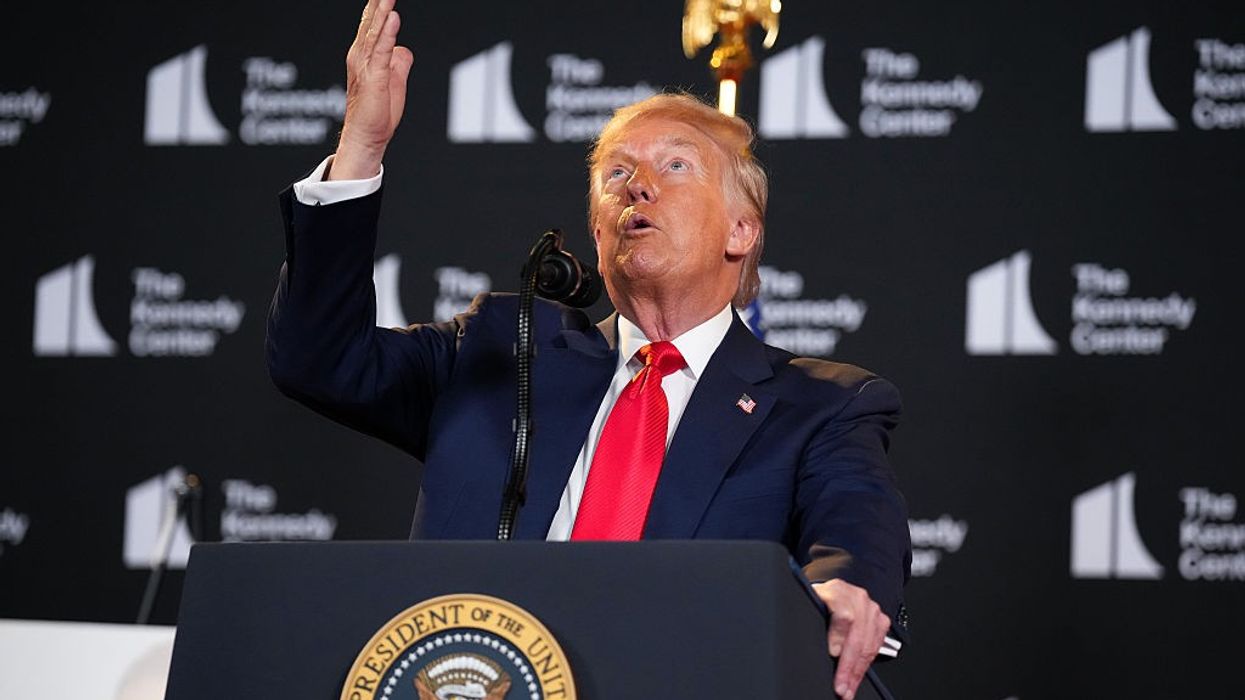
The GOP is using this lie to censor speech, ban comedians and commentators, prosecute people who’ve spoken out against Trump, violently attack protesters, and to justify the monopolization of our media by right-wing billionaires.
US President Donald Trump’s assault on our elections system and the GOP’s successful 2024 effort to deny at least (according to official US government statistics) 4.2 million Americans their right to vote (which gave Trump the election and Republicans the House and Senate) was based on his 2020 Big Lie that our elections were corrupted by “millions” of “illegals” voting, along with “massive” voter fraud.
They’re continuing that Big Lie (which the GOP first embraced in the 1960s with Operation Eagle Eye that intimidated mostly Hispanic and Native American voters) going forward, with some observers expecting as many as 10 million Americans being denied their vote in 2028.
But corrupting and stealing elections was just their first effort, starting back in the 1960s, the one that brought them to power. Now, with that power, they’re doing their best to gut the basic guardrails of our 250-year-old constitutional system with brand-new Big Lies.
The newest Big Lie for 2025 is that America is racked by “radical left violence” leading to the disintegration of law and order in our cities and the spread of terror among politicians and anybody else who dares speak out about the issues of our day.
Republican Big Lies have caused enormous damage, from FDR’s era through Joe McCarthy’s witch hunts to George W. Bush lying us into two illegal and unnecessary wars to today.
They’re using this to censor speech, ban comedians and commentators, prosecute people (including lifelong Republicans like Comey, Krebs, and Taylor) who’ve spoken out against Trump, violently attack protesters, and to justify the monopolization of our media by right-wing billionaires.
Most recently, when a Trump-supporting (Trump sign in his yard, Trump “Make Liberals Cry Again” T-shirt) straight, white, self-proclaimed Christian who thought Mormons were the anti-Christ murdered worshipers in a Latter Day Saints church in Michigan, Trump’s first response was to claim it was “anti-Christian violence.”
Instead, it appears this former Marine war vet with PTSD thought he was defending Christianity. But instead of asking if he was “radicalized” by preachers like Trump’s guy “Pastor” Robert Jeffress (who goes on and on about how the LDS Church is a “false religion”) or the algorithms on YouTube, Facebook, or X, right-wing media is today filled with rants about “attacks on Christianity,” blaming “the left” even for this attack.
It echo’s the GOP’s efforts to portray the two people who tried to assassinate Trump, Charlie Kirk’s killer, the Immigration and Customs Enforcement (ICE) shooter last week, and other political violence as originating from the “radical left.”
Which is really and truly another Big Lie.
First, there’s basically no “radical left” in America anymore. The anti-capitalist pro-violence subset of Students for a Democratic Society (SDS) that I knew back in the 1960s when I was part of Michigan State University’s SDS are long gone and well discredited (and a few imprisoned).
Second, the “far left” folks who are still around aren’t violent, by and large. Lefties are more interested in protecting Social Security, getting a national healthcare system into place, raising taxes on the morbidly rich, and getting guns off the streets instead of pointing them at people. The last high-profile “leftie” shooter was the mentally ill guy who took a shot at Republican Congressman Steve Scalise back in 2017.
Even the FBI and the Department of Justice themselves had acknowledged the fact that the vast majority of politically-inspired violence in America was coming from the right, at least until puppy-killer Kristi Noem or one of her lickspittles (or her boyfriend) ordered the reports removed from the government websites.
The independent and nonpartisan Center for Strategic and International Studies analyzed 893 terrorist plots that took place between 1994 and 2020. Their report concluded:
Right-wing attacks and plots account for the majority of all terrorist incidents in the United States since 1994.
But don’t expect to hear that from anybody in the administration or on Fox “News” or other right-wing media outlets. Instead, they’re using “far left violence” as their excuse to dismantle our rights, impose soldiers on cities run by Democrats, and pour your tax dollars into extreme policing and militarization of our society.
This isn’t the first time the GOP has used the Big Lie technique to sway public opinion in a way that demonizes Democrats. On September 23, 1944 President Franklin D. Roosevelt addressed the Teamsters and said:
“he opposition in this year has already imported into this campaign a very interesting thing, because it is foreign. They have imported the propaganda technique invented by the dictators abroad.
Remember, a number of years ago, there was a book, Mein Kampf, written by Hitler himself. The technique was all set out in Hitler’s book—and it was copied by the aggressors of Italy and Japan.
According to that technique, you should never use a small falsehood; always a big one, for its very fantastic nature would make it more credible, if only you keep repeating it over and over and over again.
He then did what Democrats—and what honest news media we have left—need to be doing today: He called out their lies and exposed their technique:
Well, let us take some simple illustrations that come to mind. For example, although I rubbed my eyes when I read it, we have been told that it was not a Republican depression, but a Democratic depression from which this Nation was saved in 1933.
That this Administration—this one today—is responsible for all the suffering and misery that the history books and the American people have always thought had been brought about during the twelve ill-fated years when the Republican party was in power.
He followed that with a list of four other Republican lies, including their assertion that he’d tried to get America into WWII, that he was secretly planning to prevent GIs from leaving the service when the war was over, and even a lie about his dog (Fala, after which his speech was named in the press). He summed it up:
Well, I think we all recognize the old technique. The people of this country know the past too well to be deceived into forgetting. Too much is at stake to forget.
They’re still doing it. Which raises the question: What will be Trump’s and the GOP’s next Big Lie?
They’ve already tried convincing Americans that:
This after promoting the Big Lie that got three police officers killed and 140 hospitalized on January 6 about the 2020 election was “stolen” and their Big Lie about immigrants voting that resulted in over 4 million citizens being denied their right to vote last year.
Republican Big Lies have caused enormous damage, from FDR’s era through Joe McCarthy’s witch hunts to George W. Bush lying us into two illegal and unnecessary wars to today.
It’s way past time that Democrats and the media start calling these Big Lies exactly what they are, and pointing out that the strategy originated in the modern era with Joseph Goebbels and Adolf Hitler.
Enough is enough.
The Heritage Foundation’s efforts to undermine trust in elections have taken a dangerous new turn—a boots-on-the-ground approach to fish for voter fraud where there is none.
The D.C.-based Heritage Foundation has long spread disinformation about elections, claiming there is widespread voter fraud despite ample evidence to the contrary. More recently, it has gained attention for its authoritarian and antidemocratic Project 2025 plan for a second Trump administration.
Ahead of this fall’s election, Heritage has been at the forefront of pushing the lie that noncitizens are registering and voting in significant numbers, laying the groundwork for election deniers to use in case the results don’t go their way.
Now its efforts to undermine trust in elections have taken a dangerous new turn—a boots-on-the-ground approach to fish for voter fraud where there is none. In July, men working with Heritage knocked on the doors of suspected noncitizens in an apartment complex outside Atlanta, asking about the residents’ citizenship status and whether they are registered to vote. The pair misrepresented themselves as being with a company that assists Latinos with navigating the election system and secretly videotaped their interactions.
In its quest to convince people that fraud is rampant, the organization has now resorted to unconscionable behavior that puts people at risk of harassment.
Several of the people said they were noncitizens and had registered, which the Heritage Foundation touted as supporting its false claims on the topic—but according to state investigators, The New York Times reported, there is no record of any of these people being registered. At least one of the people recorded told investigators that she was just giving answers she hoped would make the two men go away.
But Heritage posted the videos to its website and claimed that based on a mere seven people, 14% of noncitizens in Georgia were registered to vote—an estimated 47,000 people. It’s a ludicrous assertion. The office of Georgia’s Republican secretary of state dismissed the video as a “stunt.”
Earlier this year, the Heritage Foundation used its social media presence to amplify similar deceptive behavior, which led to online harassment and death threats for the leader of a nonprofit assisting asylum seekers. In April, Anthony Rubin—the founder of Muckraker, an online media website with “very, very powerful” ties to Heritage—and his brother misrepresented themselves as staff members of an immigrants rights organization seeking to volunteer at a nonprofit providing services to asylum seekers in Matamoros, Mexico. Rubin kept trying to get staff at the nonprofit to state they would help migrants vote for U.S. President Joe Biden. In a multi-part thread on social media, Heritage posted a snippet of a conversation between Rubin and the head of the nonprofit, in which she is misconstrued as encouraging noncitizens to vote.
In its quest to convince people that fraud is rampant, the organization has now resorted to unconscionable behavior that puts people at risk of harassment. Secretly videotaping people in conversations under false pretenses is not a way to expose voter fraud,—which itself is vanishingly rare—but it is a way to get false information, risk intimidating eligible voters in violation of federal and state laws, and sow doubt in the integrity of our elections.
The Heritage Foundation is using old scare tactics
While these methods may be new to the organization, we’ve seen them before from others. And it hasn’t ended well for the perpetrators.
Project Veritas, a right-wing activist group, long used unverified, undercover, and deceptively edited recordings to misconstrue the truth, including about supposed voter fraud. In 2020, the group published an unverified video that the campaign of Rep. Ilhan Omar (D-Minn.) had collected ballots illegally, as well as videos falsely alleging voter fraud in one Pennsylvania city. In the Pennsylvania incident, the group ended up settling a lawsuit brought by the local postmaster and publicly apologized, noting that it was not aware of any evidence of fraud in the that city during the 2020 election.
In 2016, a Project Veritas member infiltrated a democratic consulting firm and secretly recorded conversations. The firm claimed the footage was then “heavily edited” to suggest that the firm conspired to incite violence at Trump rallies and promote voter fraud. In a civil lawsuit, Project Veritas was found liable for misrepresentation and violating wiretapping laws, and was required to pay $120,000 in damages. And in 2009, Project Veritas founder James O’Keefe secretly recorded conversations with staff at the Association of Community Organizations for Reform Now (ACORN). ACORN was a network of community-based organizations advocating for low and moderate-income families. The deceptively edited videos construed ACORN employees as advising O’Keefe on tax evasion. But the videos set off a political firestorm that led to public funding for ACORN to be cut off, effectively shuttering the organization. Later, O’Keefe faced a civil lawsuit from a former-ACORN staff member and settled for $100,000.
In 2016 and 2017, the Public Interest Legal Foundation (PILF), a conservative legal organization, published two reports purporting to show that thousands of noncitizens were registered to vote in Virginia. The reports included the home addresses and phone numbers of many innocent people, including U.S. citizens. Four of those citizens sued PILF for defamation and voter intimidation. The case settled in 2019, and the leader of PILF was required to issue a written apology.
The disgraceful tactics employed by these groups have failed to hold up in court time and again, and now Heritage looks like it wants to join their ranks.
As for the issue of noncitizen voting—it’s a myth. Noncitizen voting does not occur in any significant manner, and it’s already illegal under federal and state law. The Heritage Foundation’s actions are hurting our democracy, not helping it.
Trump did not start the myth of voter fraud—that has been a partisan staple for two decades now.
Congress has approved a budget that includes essential reforms to the Electoral Count Act. The updates, which have broad bipartisan support, eliminate ambiguities in the electoral count process that former President Trump and his allies seized on as they tried to overturn the 2020 election. Anyone looking to undermine future election results will have fewer options, and that is a victory for our democracy.
The passage comes on the heels of the January 6 committee’s release of its full report. The panel made news by making four criminal referrals for the former president. Senate Minority Leader Mitch McConnell, of all people, put it well in response: “The entire nation knows who is responsible for that day.”
In the wake of the committee’s extraordinary work, an important remaining question is not who caused the insurrection but rather what caused the insurrection.
First, let’s take a moment to appreciate the panel’s achievement. It made clear through riveting hearings and careful leaks that this was not just a rally that got out of control but a vigorously pursued plot to overthrow American democracy. The committee documented extraordinary crimes. We thought we knew it all, but it was gripping.
Such congressional investigations once regularly commanded headlines. The most famously effective was the Senate Watergate committee in 1973. That — together with the Church Committee, which exposed wrongdoing by the FBI and CIA — dominated the news but also led to reforms, from the federal campaign finance laws to the establishment of the joint congressional intelligence committee.
Reform sometimes follows scandal. And there has been no greater scandal than Donald Trump’s effort to block the peaceful transfer of power.
But putting the blame squarely and exclusively on Donald Trump is not enough to protect our democracy. Trump did not start the myth of voter fraud — that has been a partisan staple for two decades now. His attempt to subvert the 2020 election exposed vulnerabilities in our legal and electoral systems. Most of them remain, waiting for a second Donald Trump to come along and exploit them again. Those weaknesses are what caused the January 6 insurrection. The committee’s work could have even longer-lasting benefits if its revelations help spur reform.
It starts with fixing the Electoral Count Act. Trump’s loony reading of the creaky and outdated 19th-century law provided the foundation for his pressure campaign against Vice President Mike Pence. The newly passed reform makes clear that vice presidents have a merely ministerial role and makes it harder for members of Congress to object to duly cast electoral votes. These changes cement that the reading of the electoral votes is a ceremony, nothing more. They and other important fixes to the Electoral Count Act are included in the budget bill.
That bill also includes federal funding to upgrade election infrastructure and keep election officials safe, though not nearly enough. We should never forget that Trump’s pressure campaign did not stop with Pence. Trump personally called state election officials, urging them — without any cogent rationale — to overturn his defeat. Trump’s counsel, Rudy Giuliani, falsely accused local election workers of fraud. As a result of Trump’s campaign against these public servants, election workers in several states were harassed, threatened, and chased from their homes. Going forward, Congress must act decisively to protect election officials in their homes and in their offices, providing a reliable source of funding for much-needed security.
Other changes will require sustained pressure from the American people. National baseline standards for federal elections should be high on that list. For example, Trump’s team argued for the invalidation of Pennsylvania’s slate of electors, on the theory that state officials should not have complied with a state supreme court ruling requiring them to count mail votes received several days after the election but postmarked by Election Day. A spurious argument, but the silence of federal law on when and how mail ballots should be counted gave it unnecessary fuel. With 50 states conducting the election with almost 50 different procedures, close elections will lead to similar claims in the future.
The Constitution unquestionably gives Congress the power to fix this problem. With every state playing by the same rules, there would be less room for allegations of impropriety.
These are just the beginning of the necessary reforms. There should be guaranteed funding for states to conduct reliable post-election audits. Congress should fund state efforts to combat election-related disinformation and restore the protections of the Voting Rights Act to prevent racial discrimination in voting — Trump’s attempt to overturn the 2020 election primarily targeted voters of color. The list goes on.
The January 6 committee performed a vital service. It left us with indelible images. But now that its work is over, focusing solely on Trump himself would be a major mistake. Mending weak points in our election system should be a bipartisan priority. It starts with the Electoral Count Act, but I hope it will not end there.
Dear Wolf Blitzer,
On February 17 and 18, your CNN colleague Anderson Cooper moderated town halls in South Carolina at which the Republican candidates for president were questioned by the audience and the moderator.
Cooper chose to stick to the standard issues -- national security, the economy, immigration, terrorism and the like. The audience followed suit. This allowed the candidates to regurgitate talking points they have used repeatedly since the debate season began last August 6.
He also spent time on what he apparently thought was crucial personal information about the candidates. "What's your favorite cocktail?" Mr. Cooper asked Senator Ted Cruz. Answer: scotch. Donald Trump is "a big fast food guy" and Marco Rubio's wardrobe was a mess until his "godly and wonderful wife" began selecting his clothes.
But tonight, Wolf Blitzer, you will moderate the last Republican debate before the all-important Super Tuesday primary elections. You have the chance to be the FIRST journalist to seek the candidates' views on one subject that has never been discussed in a televised Republican debate or town hall: voter suppression, the passage in at least 16 states by Republican legislatures of new laws that make it more difficult for African Americans, Hispanics, Asian-Americans, students, the poor and disabled to cast a ballot. You can break new ground, forcing the candidates to reveal their views on one issue that may well affect the outcome of the presidential election.
First, a bit of history. For decades, Republicans were proud to be known as "the party of Lincoln" and many of its leaders played a key role creating and then defending the historic 1965 Voting Rights Act. The original act was written in the office of Senate Minority Leader Senator Everett Dirksen. He joined with President Lyndon Johnson's lawyers to craft a bill that would win bipartisan support. They were successful: 92 percent of Senate Republicans supported the passage of the act, a number greater than Senate Democrats (73 percent, the disparity explained by Southern segregationists who were still Democrats.)
When the act's temporary provisions were reviewed in 1970, 1975, 1982, and 2006, Republican Presidents Nixon, Ford, Reagan and George W. Bush signed renewals into law. In 2006, every member of the US Senate voted in favor.
The Voting Rights Act helped elect our first African-American president in 2008, and the coalition President Obama built persuaded Republicans that the only way they could take back the presidency was through voter suppression. Following the Republican congressional victory in 2010 (when the GOP controlled both legislative bodies in 26 states, and 26 governorships), legislatures passed and governors enacted a series of laws designed to make voting more difficult for Obama's constituency -- minorities, especially the growing Hispanic community; the poor; students; and the elderly or handicapped. These restrictions included the creation of voter photo ID laws, measures affecting registration and early voting, and, in Iowa and Florida, laws to prevent ex-felons from exercising their franchise.
Democrats were stunned. "There has never been in my lifetime, since we got rid of the poll tax and all the Jim Crow burdens in voting the determined effort to limit the franchise that we see today," former President Bill Clinton said in July 2011. Then, in 2013, the Supreme Court's conservative majority struck down a crucial provision of the Voting Rights Act, weakening it severely. Once again, the voting rights of American minorities were in peril.
A bipartisan group in the US House of Representatives has drafted a new Voting Rights Act but Rep. Bob Goodlatte (R-VA), chair of the House Judiciary Committee, believes the bill is unnecessary, and Speaker Paul Ryan, although a supporter of the legislation, refuses to force Goodlatte to hold hearings.
So much for history. Where do today's current Republican presidential contenders stand on the issue of voter suppression?
Donald Trump has said nothing about it during the nine previous debates, although in fairness, not a single moderator has sought his views. His website describes his position on guns, US-China trade reform, Veterans Administration reform, tax and immigration reform, but is silent on voting rights. Wolf, please ask him what he thinks.
Despite John Kasich's pleasant demeanor, he is no friend of voting rights. As governor of Ohio, he enacted a law that significantly limits opportunities for early voting (known in Ohio as "Golden Week") and abolished same day voter registration. In 2012, it's estimated that 90,000 voters, mostly minorities, voted during Golden Week. They will not have that opportunity in 2016. Do such policies contradict Kasich's oft-repeated pledge "to renew the American spirit"?
"I'm going to be a president for all Americans," Senator Marco Rubio told Anderson Cooper, "because an American president has to love the American people, even those that don't love you back." Yet Rubio believes that his Florida constituents should not be allowed to vote in federal elections without first showing a government-issued voter ID, although evidence of voter fraud has been shown to be almost non-existent. Rubio has also opposed early voting and is against allowing nonviolent ex-felons to again have the right to vote.
Texas Senator Ted Cruz's website offers a litany of his achievements -- protecting the 10 Commandments, the Pledge of Allegiance and the Second Amendment. It also offers "Get Cruz Gear" -- cups, glasses, cell phone covers, caps and sweatshirts bearing the campaign logo. But it is silent on voting rights. Nevertheless, his public statements make it clear that he is rabidly opposed to making it easier for Texans to vote. The ACLU's Voting Rights Project found that approximately 600,000 Texans, predominately minorities and the poor, lack the documents needed, documents which are too expensive or time consuming to acquire. For many Texans, going to the polls is no longer a practical option and they have chosen not to vote at all.
Finally, there is retired neurosurgeon Ben Carson. A visit to his website reveals his views on cyber security, education, energy, healthcare and more, but nothing on voting rights. That's a bit strange because he has publicly mentioned the Voting Rights Act -- and it was to you, Wolf, in an interview last October: "Of course I want the Voting Rights Act to be protected. Whether we still need it or not, or whether we've outgrown the need for it is questionable. Maybe we have, maybe we haven't. But I wouldn't jeopardize it." Ask him to be more precise.
So three of the candidates -- Kasich, Rubio and Cruz -- clearly favor policies that make it harder for African-Americans, Hispanics, students and the poor to vote. Trump is uncharacteristically silent while Carson is equivocal. Are Republicans still the party of Lincoln, or even Everett McKinley Dirksen? Forcing them to discuss their views on voting rights will be a first, Wolf. Call them out.
Don't believe a word of it: It's all about race.
Despite state officials' quick denial that the closing of 31 Alabama DMVs has nothing to do with race, it is a fact that the closures - mostly in poor, majority-black counties - disproportionately hurt Black voters. Period.
Fifty years ago, in Selma, the civil rights movement won a hard-fought battle to gain the right to register to vote. Bloodshed in the streets, lost lives, a march to Montgomery, and the passage of the Voting Rights Act ensured that African-American citizens had the right to vote. It was all about race.
Unfortunately, some things in Alabama never change. When it comes to making sure people can vote, the state of Alabama has an avoidable problem. Our legislature passed an unnecessary law that put excessive burdens on citizens by requiring them to get a photo ID to exercise their fundamental constitutional right to vote -- despite the well-known fact that in-person voter fraud is rare.
Now Alabama closes 31 0f 67 Department of Motor Vehicle locations where most people get the most commonly used voter ID, the driver's license. The majority of these counties in the state that are home to poor and Black people are on that list. The photo ID law already disenfranchises voters who cannot obtain IDs. It has been reported that there are currently 250,000 registered voters who don't have IDs, so are now unable to vote in Alabama unless they either travel outside their county to get a driver's license or take a burdensome trip to a separate location (which is even harder without a driver's license!) just for a voter ID. And that disproportionately hurts Black voters.
Before the United States Supreme Court gutted the Voting Rights Act in 2013, Alabama would have had to submit this change for review by the U.S. Department of Justice to determine whether the closure was against the law. The fact that it was implemented without approval is the most recent example of why Congress must restore the Voting Rights Act.
Indeed, the very day that Alabama was no longer required to submit voting changes to the Department of Justice, Alabama announced its implementation of the photo ID requirement that had been delayed because of the requirements of the Voting Rights Act. This is all about race and what communities are most affected by the bad choices in Alabama.