SUBSCRIBE TO OUR FREE NEWSLETTER
Daily news & progressive opinion—funded by the people, not the corporations—delivered straight to your inbox.
5
#000000
#FFFFFF
To donate by check, phone, or other method, see our More Ways to Give page.
Daily news & progressive opinion—funded by the people, not the corporations—delivered straight to your inbox.
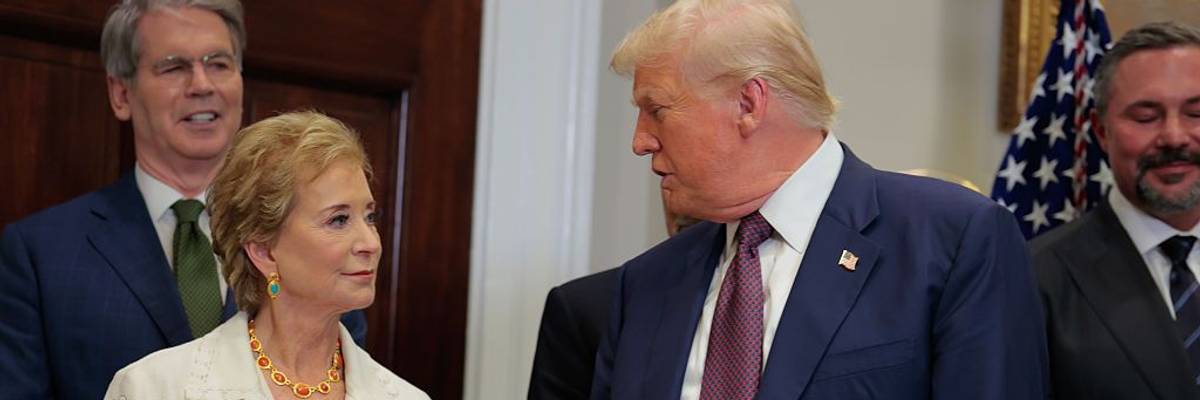
U.S. President Donald Trump speaks with Secretary of Education Linda McMahon during an executive order signing ceremony in the Roosevelt Room of the White House on July 31, 2025, in Washington, DC.
One advocate said privatization "will limit access for students from the most underrepresented communities, raise borrowing costs, and eliminate vital protections that current federal borrowers rely on."
The Trump administration is reportedly weighing the privatization of federal student loans, fulfilling yet another Project 2025 agenda item.
Politico reported on Tuesday:
Trump administration officials are exploring options to sell off parts of the federal government's $1.6 trillion student loan portfolio to the private market, according to three people familiar with the matter.
The discussions have taken place among senior Education Department and Treasury Department officials and have focused on selling high-performing portions of the government's massive portfolio of student debt, which is owed by about 45 million Americans.
Since retaking office, Trump has already enacted numerous changes to student loan policy that have squeezed borrowers, including resuming wage garnishments for millions of borrowers with overdue debt payments after a five-year reprieve.
Meanwhile, he has slashed programs that helped those in debt pay their loans. These include the Biden-era Saving on a Valuable Education (SAVE) Plan, which provided payment assistance to over 8 million student debtors based on income level. The One Big Beautiful Bill Act (OBBBA) set the SAVE program to formally shut down in July 2028, giving borrowers until then to find a new payment plan.
With little notice, the administration also paused forgiveness from the Income-Based Repayment (IBR) system, which was established in 2007 and enabled 2 million more borrowers to pay rates pegged to their income, with the promise of forgiveness after 20 to 25 years.
The OBBBA included a total $300 billion worth of cuts to higher education programs, primarily through federal student loans.
As Persis Yu, the deputy executive director and managing counsel at the advocacy group Protect Borrowers, explained, this included "the elimination of certain loans for graduate students, new annual and lifetime limits on federal loans for parents, cuts to Pell Grant eligibility, and new, stingier repayment options that will spike monthly costs and push borrowers further into debt."
The idea of bringing in private consultants to determine the value of the government's debt holdings and selling some student loan debt to private investors was floated during the first Trump term, but never came to fruition. However, this idea was fleshed out more thoroughly in the Heritage Foundation's Project 2025 playbook, which states that "student loans and grants should ultimately be restored to the private sector."
While details of how exactly the administration may plan to sell off this debt are scarce, critics have warned that privatization will put even more borrowers in precarious situations.
"Private student loans generally have more onerous repayment terms than federal loans, lacking options such as Income-Driven Repayment and often limiting and imposing fees for the use of forbearances," Yu said. "Private loans also lack vital cancellation protections found in federal student loans, such as disability and death discharges, or Public Service Loan Forgiveness."
"Private loans will not merely replace federal student loans," she continued. "Instead, they will limit access for students from the most underrepresented communities, raise borrowing costs, and eliminate vital protections that current federal borrowers rely on."
Private loans are also more rife with abuse. According to the Century Foundation, while private loans account for just 8% of all student loan debt, they have accounted for more than 40% of student loan-related complaints to the Consumer Financial Protection Bureau. One third of those complaints come from borrowers who say they are unable to afford their monthly loan payments.
At the same time, even while the Trump administration claims privatizing debt would save money for taxpayers, Preston Cooper, a senior fellow at the conservative American Enterprise Institute, told Politico that savings would likely be minimal because investors would be unlikely to pay more for the loans than they are worth.
"The only way for [Trump's plan] to make economic sense is to structure the deal in a way that really short-changes borrowers," said Eileen Connor, executive director of the Project on Predatory Student Lending.
Yu says that the goal of privatization rests on a faulty premise: "The argument that free markets will control the cost and improve the quality of higher education underestimates the harm that can be caused by setting private lenders loose on students and fundamentally misunderstands the relationship between these market participants. In a debt-financed higher education system, students are not the consumer; they are the commodity."
Sara Partridge, associate director for Higher Education Policy for the Center for American Progress, said, "Once again, this Administration seeks to line the pockets of private companies at student borrowers’ expense while moving away from a system that provides consumer protections under the law."
Dear Common Dreams reader, It’s been nearly 30 years since I co-founded Common Dreams with my late wife, Lina Newhouser. We had the radical notion that journalism should serve the public good, not corporate profits. It was clear to us from the outset what it would take to build such a project. No paid advertisements. No corporate sponsors. No millionaire publisher telling us what to think or do. Many people said we wouldn't last a year, but we proved those doubters wrong. Together with a tremendous team of journalists and dedicated staff, we built an independent media outlet free from the constraints of profits and corporate control. Our mission has always been simple: To inform. To inspire. To ignite change for the common good. Building Common Dreams was not easy. Our survival was never guaranteed. When you take on the most powerful forces—Wall Street greed, fossil fuel industry destruction, Big Tech lobbyists, and uber-rich oligarchs who have spent billions upon billions rigging the economy and democracy in their favor—the only bulwark you have is supporters who believe in your work. But here’s the urgent message from me today. It's never been this bad out there. And it's never been this hard to keep us going. At the very moment Common Dreams is most needed, the threats we face are intensifying. We need your support now more than ever. We don't accept corporate advertising and never will. We don't have a paywall because we don't think people should be blocked from critical news based on their ability to pay. Everything we do is funded by the donations of readers like you. When everyone does the little they can afford, we are strong. But if that support retreats or dries up, so do we. Will you donate now to make sure Common Dreams not only survives but thrives? —Craig Brown, Co-founder |
The Trump administration is reportedly weighing the privatization of federal student loans, fulfilling yet another Project 2025 agenda item.
Politico reported on Tuesday:
Trump administration officials are exploring options to sell off parts of the federal government's $1.6 trillion student loan portfolio to the private market, according to three people familiar with the matter.
The discussions have taken place among senior Education Department and Treasury Department officials and have focused on selling high-performing portions of the government's massive portfolio of student debt, which is owed by about 45 million Americans.
Since retaking office, Trump has already enacted numerous changes to student loan policy that have squeezed borrowers, including resuming wage garnishments for millions of borrowers with overdue debt payments after a five-year reprieve.
Meanwhile, he has slashed programs that helped those in debt pay their loans. These include the Biden-era Saving on a Valuable Education (SAVE) Plan, which provided payment assistance to over 8 million student debtors based on income level. The One Big Beautiful Bill Act (OBBBA) set the SAVE program to formally shut down in July 2028, giving borrowers until then to find a new payment plan.
With little notice, the administration also paused forgiveness from the Income-Based Repayment (IBR) system, which was established in 2007 and enabled 2 million more borrowers to pay rates pegged to their income, with the promise of forgiveness after 20 to 25 years.
The OBBBA included a total $300 billion worth of cuts to higher education programs, primarily through federal student loans.
As Persis Yu, the deputy executive director and managing counsel at the advocacy group Protect Borrowers, explained, this included "the elimination of certain loans for graduate students, new annual and lifetime limits on federal loans for parents, cuts to Pell Grant eligibility, and new, stingier repayment options that will spike monthly costs and push borrowers further into debt."
The idea of bringing in private consultants to determine the value of the government's debt holdings and selling some student loan debt to private investors was floated during the first Trump term, but never came to fruition. However, this idea was fleshed out more thoroughly in the Heritage Foundation's Project 2025 playbook, which states that "student loans and grants should ultimately be restored to the private sector."
While details of how exactly the administration may plan to sell off this debt are scarce, critics have warned that privatization will put even more borrowers in precarious situations.
"Private student loans generally have more onerous repayment terms than federal loans, lacking options such as Income-Driven Repayment and often limiting and imposing fees for the use of forbearances," Yu said. "Private loans also lack vital cancellation protections found in federal student loans, such as disability and death discharges, or Public Service Loan Forgiveness."
"Private loans will not merely replace federal student loans," she continued. "Instead, they will limit access for students from the most underrepresented communities, raise borrowing costs, and eliminate vital protections that current federal borrowers rely on."
Private loans are also more rife with abuse. According to the Century Foundation, while private loans account for just 8% of all student loan debt, they have accounted for more than 40% of student loan-related complaints to the Consumer Financial Protection Bureau. One third of those complaints come from borrowers who say they are unable to afford their monthly loan payments.
At the same time, even while the Trump administration claims privatizing debt would save money for taxpayers, Preston Cooper, a senior fellow at the conservative American Enterprise Institute, told Politico that savings would likely be minimal because investors would be unlikely to pay more for the loans than they are worth.
"The only way for [Trump's plan] to make economic sense is to structure the deal in a way that really short-changes borrowers," said Eileen Connor, executive director of the Project on Predatory Student Lending.
Yu says that the goal of privatization rests on a faulty premise: "The argument that free markets will control the cost and improve the quality of higher education underestimates the harm that can be caused by setting private lenders loose on students and fundamentally misunderstands the relationship between these market participants. In a debt-financed higher education system, students are not the consumer; they are the commodity."
Sara Partridge, associate director for Higher Education Policy for the Center for American Progress, said, "Once again, this Administration seeks to line the pockets of private companies at student borrowers’ expense while moving away from a system that provides consumer protections under the law."
The Trump administration is reportedly weighing the privatization of federal student loans, fulfilling yet another Project 2025 agenda item.
Politico reported on Tuesday:
Trump administration officials are exploring options to sell off parts of the federal government's $1.6 trillion student loan portfolio to the private market, according to three people familiar with the matter.
The discussions have taken place among senior Education Department and Treasury Department officials and have focused on selling high-performing portions of the government's massive portfolio of student debt, which is owed by about 45 million Americans.
Since retaking office, Trump has already enacted numerous changes to student loan policy that have squeezed borrowers, including resuming wage garnishments for millions of borrowers with overdue debt payments after a five-year reprieve.
Meanwhile, he has slashed programs that helped those in debt pay their loans. These include the Biden-era Saving on a Valuable Education (SAVE) Plan, which provided payment assistance to over 8 million student debtors based on income level. The One Big Beautiful Bill Act (OBBBA) set the SAVE program to formally shut down in July 2028, giving borrowers until then to find a new payment plan.
With little notice, the administration also paused forgiveness from the Income-Based Repayment (IBR) system, which was established in 2007 and enabled 2 million more borrowers to pay rates pegged to their income, with the promise of forgiveness after 20 to 25 years.
The OBBBA included a total $300 billion worth of cuts to higher education programs, primarily through federal student loans.
As Persis Yu, the deputy executive director and managing counsel at the advocacy group Protect Borrowers, explained, this included "the elimination of certain loans for graduate students, new annual and lifetime limits on federal loans for parents, cuts to Pell Grant eligibility, and new, stingier repayment options that will spike monthly costs and push borrowers further into debt."
The idea of bringing in private consultants to determine the value of the government's debt holdings and selling some student loan debt to private investors was floated during the first Trump term, but never came to fruition. However, this idea was fleshed out more thoroughly in the Heritage Foundation's Project 2025 playbook, which states that "student loans and grants should ultimately be restored to the private sector."
While details of how exactly the administration may plan to sell off this debt are scarce, critics have warned that privatization will put even more borrowers in precarious situations.
"Private student loans generally have more onerous repayment terms than federal loans, lacking options such as Income-Driven Repayment and often limiting and imposing fees for the use of forbearances," Yu said. "Private loans also lack vital cancellation protections found in federal student loans, such as disability and death discharges, or Public Service Loan Forgiveness."
"Private loans will not merely replace federal student loans," she continued. "Instead, they will limit access for students from the most underrepresented communities, raise borrowing costs, and eliminate vital protections that current federal borrowers rely on."
Private loans are also more rife with abuse. According to the Century Foundation, while private loans account for just 8% of all student loan debt, they have accounted for more than 40% of student loan-related complaints to the Consumer Financial Protection Bureau. One third of those complaints come from borrowers who say they are unable to afford their monthly loan payments.
At the same time, even while the Trump administration claims privatizing debt would save money for taxpayers, Preston Cooper, a senior fellow at the conservative American Enterprise Institute, told Politico that savings would likely be minimal because investors would be unlikely to pay more for the loans than they are worth.
"The only way for [Trump's plan] to make economic sense is to structure the deal in a way that really short-changes borrowers," said Eileen Connor, executive director of the Project on Predatory Student Lending.
Yu says that the goal of privatization rests on a faulty premise: "The argument that free markets will control the cost and improve the quality of higher education underestimates the harm that can be caused by setting private lenders loose on students and fundamentally misunderstands the relationship between these market participants. In a debt-financed higher education system, students are not the consumer; they are the commodity."
Sara Partridge, associate director for Higher Education Policy for the Center for American Progress, said, "Once again, this Administration seeks to line the pockets of private companies at student borrowers’ expense while moving away from a system that provides consumer protections under the law."