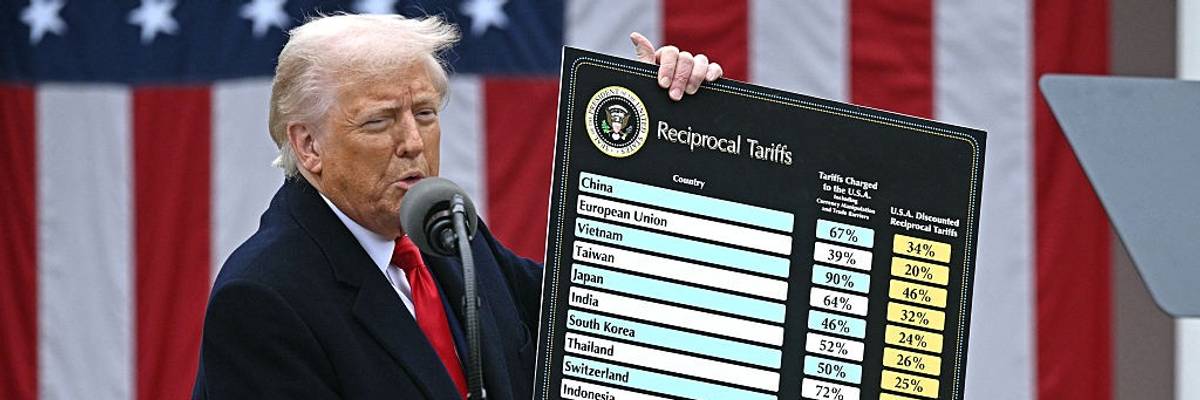
US President Donald Trump delivers remarks on reciprocal tariffs as US Secretary of Commerce Howard Lutnick holds a chart during an event in the Rose Garden entitled "Make America Wealthy Again" at the White House in Washington, DC, on April 2, 2025.
Stop Pretending Trump Has a Coherent Economic Strategy
It is bad for the country and the world that policy in the United States is being determined by a man child who has no idea what he is doing beyond stuffing his pockets, but that is the reality.
It is striking that many people feel the need to claim that President Donald Trump has some coherent economic plan for the country. It’s understandable that Trump’s team likes to pretend that his random ramblings and angry acts of revenge are all part of some grand strategy, but why would anyone not on his payroll play along with this obvious absurdity?
To anyone paying attention, it should be pretty clear that Donald Trump is clueless about the economy. Just to take an obvious example to make the point: Trump has repeatedly promised to lower drug prices by 800, 900, or even 1,500%. As he rightly says, no one thought it was possible.
It wouldn’t be a big deal that he got confused once or twice and forgot that you can’t lower prices by more than 100%, unless you envision drug companies paying people to use their drugs. But Trump has done this repeatedly, over many months.
This tells us two things. First, he really doesn’t have even a basic understanding of arithmetic and percentages. That would be bad in and of itself. After all the president is sometimes directly negotiating deals, and it would be bad if he agreed to something and then had to call back his negotiating partner and tell them he didn’t understand what he had agreed to.
There may be a market for thoughtful pieces describing the grand Trump strategy in major intellectual outlets, but that is yet one more example of market failure.
But the other issue is even more serious. Surely people like Treasury Secretary Scott Bessent and Kevin Hassett, Trump’s national economic adviser, understand percentages. But apparently, they are too scared of Trump to explain how they work. Instead, they let him go out week after week and make a fool of himself by making nonsensical promises on lowering drug prices.
This fact is crucial if we are trying to assess whether Trump has a coherent economic strategy. The point is he is obviously confused about many things when it comes to the economy. He seems to think that other countries pay tariffs and send the US checks. He also seems to think that wind and solar power are very expensive sources of energy. And he seems to think that the economy was collapsing when he took office.
All of these claims are 180° at odds with reality, but it is extremely unlikely that his aides would be able to correct him on these or other absurd views that Trump seems to hold. Given how out of touch Trump is with reality and the inability of his aides to correct him on anything, why would anyone think that he has a coherent economic strategy?
As many of us have pointed out, even most hardcore free traders will concede tariffs can serve a useful purpose. They can be used strategically to build up important industries. This is what Joe Biden tried to do when he used tariffs, along with subsidies and regulatory changes, to promote domestic production of advanced computer chips, electric vehicles, batteries, and wind and solar and other forms of clean energy.
But what is the coherence in a tariff policy when some of the highest tariffs, like Trump’s 50% tariff on imported steel, are reserved for intermediate goods that are inputs for other manufacturing industries? How does it make sense to impose an extra 10 percentage point tariff on imports from Canada because Trump didn’t like a television ad they ran during the World Series? And India got whacked with a tariff of 50% on its exports because its president would not support Trump’s drive to get a Nobel Peace Prize.
Anyone trying to weave together these and other tariff decisions by Trump, along with many other economic decisions he has made since taking office, is really stretching if they think they can find anything coherent. It is bad for the country and the world that policy in the United States is being determined by a man child who has no idea what he is doing beyond stuffing his pockets, but that is the reality.
There may be a market for thoughtful pieces describing the grand Trump strategy in major intellectual outlets, but that is yet one more example of market failure. There ain’t nothing there.
We are at a crossroads
This country and this world are at a monumental crossroads. In a few short weeks, US voters will have an opportunity to beat back the forces of fascism and confront the billionaires who are rigging the economy, our media system, and our democracy, making it increasingly impossible for ordinary people to get by. We’re not just talking about the election. We’re talking about what must be done once these fascist elements are vanquished from power. We need a bolder set of solutions than what either major party has so far been willing to offer and a working-class movement ready to fight like hell for it. Trump didn't emerge from nowhere. The conditions that fueled MAGA authoritarianism were created by decades of radical neoliberal economic policies and a corrupt political system dominated by corporate interests. They slashed taxes on the super-rich, promising that the benefits would trickle down. They said giveaways to the corporate titans would make life more affordable for the rest of us. It was all bullshit. And when a bitter, betrayed populace searches for someone to blame, right-wing demagogues have little trouble finding scapegoats. People know when they're being lied to, but you won't hear any of this from the corporate media. Only independent journalism—powered and funded by people who believe in building a better world—can deliver truly trustworthy daily news. Our Fall Campaign is underway, and we need your help. To power our newsroom through the rest of the year, we need to raise $125,000 by midnight on October 31. So if you share our vision, please contribute whatever you can to sustain our work. |
It is striking that many people feel the need to claim that President Donald Trump has some coherent economic plan for the country. It’s understandable that Trump’s team likes to pretend that his random ramblings and angry acts of revenge are all part of some grand strategy, but why would anyone not on his payroll play along with this obvious absurdity?
To anyone paying attention, it should be pretty clear that Donald Trump is clueless about the economy. Just to take an obvious example to make the point: Trump has repeatedly promised to lower drug prices by 800, 900, or even 1,500%. As he rightly says, no one thought it was possible.
It wouldn’t be a big deal that he got confused once or twice and forgot that you can’t lower prices by more than 100%, unless you envision drug companies paying people to use their drugs. But Trump has done this repeatedly, over many months.
This tells us two things. First, he really doesn’t have even a basic understanding of arithmetic and percentages. That would be bad in and of itself. After all the president is sometimes directly negotiating deals, and it would be bad if he agreed to something and then had to call back his negotiating partner and tell them he didn’t understand what he had agreed to.
There may be a market for thoughtful pieces describing the grand Trump strategy in major intellectual outlets, but that is yet one more example of market failure.
But the other issue is even more serious. Surely people like Treasury Secretary Scott Bessent and Kevin Hassett, Trump’s national economic adviser, understand percentages. But apparently, they are too scared of Trump to explain how they work. Instead, they let him go out week after week and make a fool of himself by making nonsensical promises on lowering drug prices.
This fact is crucial if we are trying to assess whether Trump has a coherent economic strategy. The point is he is obviously confused about many things when it comes to the economy. He seems to think that other countries pay tariffs and send the US checks. He also seems to think that wind and solar power are very expensive sources of energy. And he seems to think that the economy was collapsing when he took office.
All of these claims are 180° at odds with reality, but it is extremely unlikely that his aides would be able to correct him on these or other absurd views that Trump seems to hold. Given how out of touch Trump is with reality and the inability of his aides to correct him on anything, why would anyone think that he has a coherent economic strategy?
As many of us have pointed out, even most hardcore free traders will concede tariffs can serve a useful purpose. They can be used strategically to build up important industries. This is what Joe Biden tried to do when he used tariffs, along with subsidies and regulatory changes, to promote domestic production of advanced computer chips, electric vehicles, batteries, and wind and solar and other forms of clean energy.
But what is the coherence in a tariff policy when some of the highest tariffs, like Trump’s 50% tariff on imported steel, are reserved for intermediate goods that are inputs for other manufacturing industries? How does it make sense to impose an extra 10 percentage point tariff on imports from Canada because Trump didn’t like a television ad they ran during the World Series? And India got whacked with a tariff of 50% on its exports because its president would not support Trump’s drive to get a Nobel Peace Prize.
Anyone trying to weave together these and other tariff decisions by Trump, along with many other economic decisions he has made since taking office, is really stretching if they think they can find anything coherent. It is bad for the country and the world that policy in the United States is being determined by a man child who has no idea what he is doing beyond stuffing his pockets, but that is the reality.
There may be a market for thoughtful pieces describing the grand Trump strategy in major intellectual outlets, but that is yet one more example of market failure. There ain’t nothing there.
- 'Batsh*t Crazy' Trump Tariffs Should Be Seen as $7,000 Tax Hike on Workers, Says Economist ›
- Trump Follows Through With High Tariffs on Canada, Mexico, and China ›
- Trump's Tariffs Are Extremely Dumb, Just Not For The Reasons You Might Think ›
- Trump’s Sovereigntist Imperialism Will Trigger Self-Defeating US Decline ›
- Trump's Tariffs: Crony Capitalism and the New Economy of Obedience ›
It is striking that many people feel the need to claim that President Donald Trump has some coherent economic plan for the country. It’s understandable that Trump’s team likes to pretend that his random ramblings and angry acts of revenge are all part of some grand strategy, but why would anyone not on his payroll play along with this obvious absurdity?
To anyone paying attention, it should be pretty clear that Donald Trump is clueless about the economy. Just to take an obvious example to make the point: Trump has repeatedly promised to lower drug prices by 800, 900, or even 1,500%. As he rightly says, no one thought it was possible.
It wouldn’t be a big deal that he got confused once or twice and forgot that you can’t lower prices by more than 100%, unless you envision drug companies paying people to use their drugs. But Trump has done this repeatedly, over many months.
This tells us two things. First, he really doesn’t have even a basic understanding of arithmetic and percentages. That would be bad in and of itself. After all the president is sometimes directly negotiating deals, and it would be bad if he agreed to something and then had to call back his negotiating partner and tell them he didn’t understand what he had agreed to.
There may be a market for thoughtful pieces describing the grand Trump strategy in major intellectual outlets, but that is yet one more example of market failure.
But the other issue is even more serious. Surely people like Treasury Secretary Scott Bessent and Kevin Hassett, Trump’s national economic adviser, understand percentages. But apparently, they are too scared of Trump to explain how they work. Instead, they let him go out week after week and make a fool of himself by making nonsensical promises on lowering drug prices.
This fact is crucial if we are trying to assess whether Trump has a coherent economic strategy. The point is he is obviously confused about many things when it comes to the economy. He seems to think that other countries pay tariffs and send the US checks. He also seems to think that wind and solar power are very expensive sources of energy. And he seems to think that the economy was collapsing when he took office.
All of these claims are 180° at odds with reality, but it is extremely unlikely that his aides would be able to correct him on these or other absurd views that Trump seems to hold. Given how out of touch Trump is with reality and the inability of his aides to correct him on anything, why would anyone think that he has a coherent economic strategy?
As many of us have pointed out, even most hardcore free traders will concede tariffs can serve a useful purpose. They can be used strategically to build up important industries. This is what Joe Biden tried to do when he used tariffs, along with subsidies and regulatory changes, to promote domestic production of advanced computer chips, electric vehicles, batteries, and wind and solar and other forms of clean energy.
But what is the coherence in a tariff policy when some of the highest tariffs, like Trump’s 50% tariff on imported steel, are reserved for intermediate goods that are inputs for other manufacturing industries? How does it make sense to impose an extra 10 percentage point tariff on imports from Canada because Trump didn’t like a television ad they ran during the World Series? And India got whacked with a tariff of 50% on its exports because its president would not support Trump’s drive to get a Nobel Peace Prize.
Anyone trying to weave together these and other tariff decisions by Trump, along with many other economic decisions he has made since taking office, is really stretching if they think they can find anything coherent. It is bad for the country and the world that policy in the United States is being determined by a man child who has no idea what he is doing beyond stuffing his pockets, but that is the reality.
There may be a market for thoughtful pieces describing the grand Trump strategy in major intellectual outlets, but that is yet one more example of market failure. There ain’t nothing there.
- 'Batsh*t Crazy' Trump Tariffs Should Be Seen as $7,000 Tax Hike on Workers, Says Economist ›
- Trump Follows Through With High Tariffs on Canada, Mexico, and China ›
- Trump's Tariffs Are Extremely Dumb, Just Not For The Reasons You Might Think ›
- Trump’s Sovereigntist Imperialism Will Trigger Self-Defeating US Decline ›
- Trump's Tariffs: Crony Capitalism and the New Economy of Obedience ›