SUBSCRIBE TO OUR FREE NEWSLETTER
Daily news & progressive opinion—funded by the people, not the corporations—delivered straight to your inbox.
5
#000000
#FFFFFF
To donate by check, phone, or other method, see our More Ways to Give page.
Daily news & progressive opinion—funded by the people, not the corporations—delivered straight to your inbox.

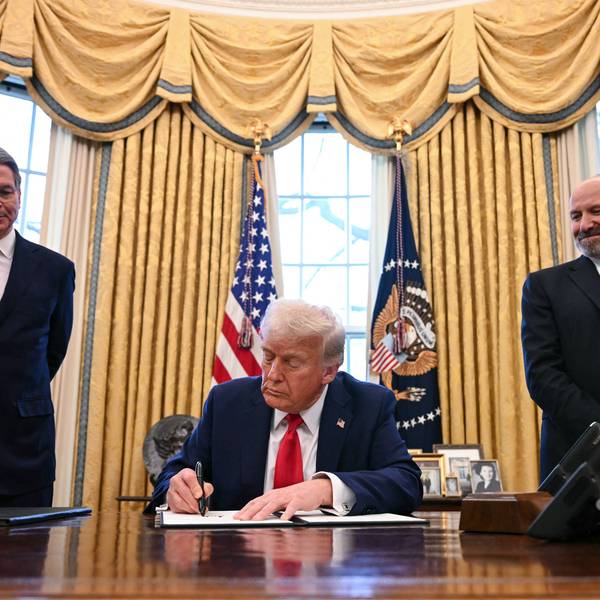
US Secretary of Education Linda McMahon and Treasury Secretary Scott Bessent listen after the signing of an executive order in Washington, DC on July 31, 2025.
"By selling parts of the federal student loan portfolio, the Trump administration may seek to unlawfully strip borrowers of their legally guaranteed protections," wrote a group of more than 40 Democratic lawmakers.
Dozens of Democratic lawmakers in the US House and Senate warned Monday that the Trump administration's reported push to sell off the federal government's massive student portfolio to the private market would be disastrous for borrowers and a "lucrative giveaway" to predatory corporations.
The lawmakers, led by Sens. Elizabeth Warren (D-Mass.) and Bernie Sanders (I-Vt.) in the Senate and Rep. Ayanna Pressley (D-Mass.) in the House, pointed with alarm to recent reports indicating that Treasury and Education Department officials have met repeatedly with finance industry executives for the purpose of valuing the federal government's student loan portfolio, which is believed to be worth around $1.7 trillion.
"By selling parts of the federal student loan portfolio, the Trump administration may seek to unlawfully strip borrowers of their legally guaranteed protections," the lawmakers wrote in a letter to Education Secretary Linda McMahon and Treasury Secretary Scott Bessent. "As experts have explained, private investors' 'interest would likely be to squeeze as much profit from the repayment as they could.' Those profits would likely come at the expense of the borrower via fewer protections and less generous benefits."
Politico reported last month that the Trump administration is considering selling at least part of the federal government's student loan portfolio to private companies.
Though small relative to the federal portfolio, the private student loan market has an "outsized" impact on borrowers, the advocacy group Protect Borrowers explained earlier this year.
"While private student loans account for roughly 8% of all student loan debt, more than 40% of student-loan-related complaints submitted to the Consumer Financial Protection Bureau (CFPB) are about private loans," the group said. "Of these private student loan complaints, roughly one-third are from borrowers who are struggling and can’t afford their monthly payment. This is because, unlike federal student loans, private loans lack critical safeguards for students and parents."
In their letter to McMahon and Bessent, the Democratic lawmakers demanded that the Trump administration "immediately cease any efforts to privatize the federal student loan portfolio," arguing that "this sale would be a giveaway to wealthy insiders at the expense of working-class borrowers and taxpayers."
Warren echoed that sentiment in a statement, saying, "Any way you spin it, this sale would be a massive giveaway to giant companies."
"It'd be a tremendous mistake," the senator added.
Dear Common Dreams reader, It’s been nearly 30 years since I co-founded Common Dreams with my late wife, Lina Newhouser. We had the radical notion that journalism should serve the public good, not corporate profits. It was clear to us from the outset what it would take to build such a project. No paid advertisements. No corporate sponsors. No millionaire publisher telling us what to think or do. Many people said we wouldn't last a year, but we proved those doubters wrong. Together with a tremendous team of journalists and dedicated staff, we built an independent media outlet free from the constraints of profits and corporate control. Our mission has always been simple: To inform. To inspire. To ignite change for the common good. Building Common Dreams was not easy. Our survival was never guaranteed. When you take on the most powerful forces—Wall Street greed, fossil fuel industry destruction, Big Tech lobbyists, and uber-rich oligarchs who have spent billions upon billions rigging the economy and democracy in their favor—the only bulwark you have is supporters who believe in your work. But here’s the urgent message from me today. It's never been this bad out there. And it's never been this hard to keep us going. At the very moment Common Dreams is most needed, the threats we face are intensifying. We need your support now more than ever. We don't accept corporate advertising and never will. We don't have a paywall because we don't think people should be blocked from critical news based on their ability to pay. Everything we do is funded by the donations of readers like you. When everyone does the little they can afford, we are strong. But if that support retreats or dries up, so do we. Will you donate now to make sure Common Dreams not only survives but thrives? —Craig Brown, Co-founder |
Dozens of Democratic lawmakers in the US House and Senate warned Monday that the Trump administration's reported push to sell off the federal government's massive student portfolio to the private market would be disastrous for borrowers and a "lucrative giveaway" to predatory corporations.
The lawmakers, led by Sens. Elizabeth Warren (D-Mass.) and Bernie Sanders (I-Vt.) in the Senate and Rep. Ayanna Pressley (D-Mass.) in the House, pointed with alarm to recent reports indicating that Treasury and Education Department officials have met repeatedly with finance industry executives for the purpose of valuing the federal government's student loan portfolio, which is believed to be worth around $1.7 trillion.
"By selling parts of the federal student loan portfolio, the Trump administration may seek to unlawfully strip borrowers of their legally guaranteed protections," the lawmakers wrote in a letter to Education Secretary Linda McMahon and Treasury Secretary Scott Bessent. "As experts have explained, private investors' 'interest would likely be to squeeze as much profit from the repayment as they could.' Those profits would likely come at the expense of the borrower via fewer protections and less generous benefits."
Politico reported last month that the Trump administration is considering selling at least part of the federal government's student loan portfolio to private companies.
Though small relative to the federal portfolio, the private student loan market has an "outsized" impact on borrowers, the advocacy group Protect Borrowers explained earlier this year.
"While private student loans account for roughly 8% of all student loan debt, more than 40% of student-loan-related complaints submitted to the Consumer Financial Protection Bureau (CFPB) are about private loans," the group said. "Of these private student loan complaints, roughly one-third are from borrowers who are struggling and can’t afford their monthly payment. This is because, unlike federal student loans, private loans lack critical safeguards for students and parents."
In their letter to McMahon and Bessent, the Democratic lawmakers demanded that the Trump administration "immediately cease any efforts to privatize the federal student loan portfolio," arguing that "this sale would be a giveaway to wealthy insiders at the expense of working-class borrowers and taxpayers."
Warren echoed that sentiment in a statement, saying, "Any way you spin it, this sale would be a massive giveaway to giant companies."
"It'd be a tremendous mistake," the senator added.
Dozens of Democratic lawmakers in the US House and Senate warned Monday that the Trump administration's reported push to sell off the federal government's massive student portfolio to the private market would be disastrous for borrowers and a "lucrative giveaway" to predatory corporations.
The lawmakers, led by Sens. Elizabeth Warren (D-Mass.) and Bernie Sanders (I-Vt.) in the Senate and Rep. Ayanna Pressley (D-Mass.) in the House, pointed with alarm to recent reports indicating that Treasury and Education Department officials have met repeatedly with finance industry executives for the purpose of valuing the federal government's student loan portfolio, which is believed to be worth around $1.7 trillion.
"By selling parts of the federal student loan portfolio, the Trump administration may seek to unlawfully strip borrowers of their legally guaranteed protections," the lawmakers wrote in a letter to Education Secretary Linda McMahon and Treasury Secretary Scott Bessent. "As experts have explained, private investors' 'interest would likely be to squeeze as much profit from the repayment as they could.' Those profits would likely come at the expense of the borrower via fewer protections and less generous benefits."
Politico reported last month that the Trump administration is considering selling at least part of the federal government's student loan portfolio to private companies.
Though small relative to the federal portfolio, the private student loan market has an "outsized" impact on borrowers, the advocacy group Protect Borrowers explained earlier this year.
"While private student loans account for roughly 8% of all student loan debt, more than 40% of student-loan-related complaints submitted to the Consumer Financial Protection Bureau (CFPB) are about private loans," the group said. "Of these private student loan complaints, roughly one-third are from borrowers who are struggling and can’t afford their monthly payment. This is because, unlike federal student loans, private loans lack critical safeguards for students and parents."
In their letter to McMahon and Bessent, the Democratic lawmakers demanded that the Trump administration "immediately cease any efforts to privatize the federal student loan portfolio," arguing that "this sale would be a giveaway to wealthy insiders at the expense of working-class borrowers and taxpayers."
Warren echoed that sentiment in a statement, saying, "Any way you spin it, this sale would be a massive giveaway to giant companies."
"It'd be a tremendous mistake," the senator added.