SUBSCRIBE TO OUR FREE NEWSLETTER
Daily news & progressive opinion—funded by the people, not the corporations—delivered straight to your inbox.
5
#000000
#FFFFFF
To donate by check, phone, or other method, see our More Ways to Give page.
Daily news & progressive opinion—funded by the people, not the corporations—delivered straight to your inbox.

Treasury Secretary Scott Bessent speaks to reporters in the US Capitol in Washington, DC on June 27, 2025.
"Only a right-wing elitist would think that owning a bunch of farmland makes you a farmer," said one critic. "No, farming makes you a farmer, Scott. You’re an investor and landowner."
US Treasury Secretary Scott Bessent—a large landowner and former hedge fund manager worth north of half a billion dollars—faced widespread derision Sunday after claiming that he's a soybean farmer who, like actual farmers, is suffering from President Donald Trump's tariff war.
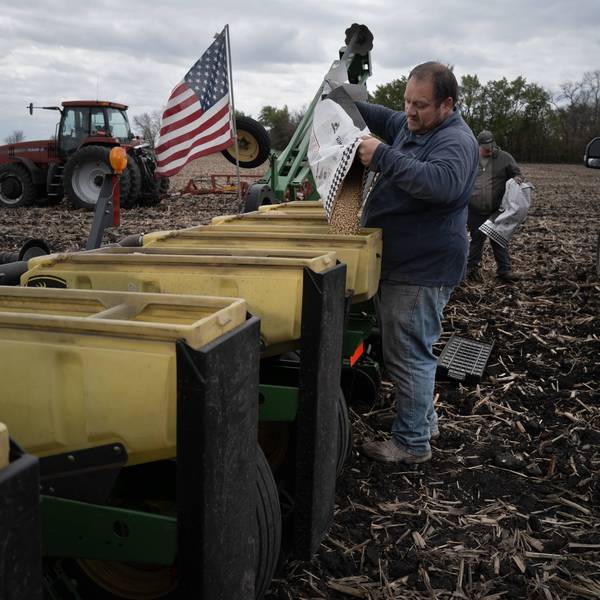
Asked by ABC "This Week" co-anchor Martha Raddatz about the apparent contradiction between Trump's claim to care about American farmers and the pain inflicted upon them by his trade war—especially with China, which is boycotting US agricultural exports—Bessent said: "Well, Martha, I'm actually a soybean farmer. So... I have felt this pain, too."
Bessent then tried to blame China for slashing US soybean imports and "using American farmers, who are amongst President Trump's biggest supporters."
The treasury secretary also mentioned the double whammy of tariffs and this season's bumper soybean crop, which he said have created a "perfect storm."
After Trump slapped 30% tariffs on Chinese imports in May, Beijing retaliated with measures including stopping all purchases of US soybeans. Before the trade war, a quarter of the soybeans—the nation’s number one export crop—produced in the United States were exported to China. Trump’s tariffs mean American soybean growers can’t compete with countries like Brazil, the world’s leading producer and exporter of the staple crop and itself the target of a 50% US tariff.
Critics swiftly pounced on Bessent's comments, with one actual farmer pointing out on X that the centimillionaire "owns up to $25 million worth of corn and soybean farmland... and earns as much as $1 million a year in rental income from the land."
Some social media users sardonically shared an artificial intelligence-generated image of Bessent standing in a field wearing overalls. Others posted a photo of John Ravenel House, the historic Charleston mansion he sold earlier this year for $18.5 million plus $3 million for furniture and fixtures—reportedly the highest price ever in the South Carolina city.
Spencer Ross, an associate professor at the Lowell Manning School of Business at the University of Massachusetts, noted that Bessent "promised—and failed—to divest his "$25 million of rent-seeking soybean property."
"I cannot imagine another farmer considering [Bessent's investments] actively being a 'farmer,'" Ross added before referencing the last president who actually grew crops. "I'm fairly certain Jimmy Carter wouldn't."
Author and activist Tim Wise quipped on social media: "Only a right-wing elitist would think that owning a bunch of farmland makes you a farmer. No, farming makes you a farmer, Scott. You’re an investor and landowner."
Dear Common Dreams reader, It’s been nearly 30 years since I co-founded Common Dreams with my late wife, Lina Newhouser. We had the radical notion that journalism should serve the public good, not corporate profits. It was clear to us from the outset what it would take to build such a project. No paid advertisements. No corporate sponsors. No millionaire publisher telling us what to think or do. Many people said we wouldn't last a year, but we proved those doubters wrong. Together with a tremendous team of journalists and dedicated staff, we built an independent media outlet free from the constraints of profits and corporate control. Our mission has always been simple: To inform. To inspire. To ignite change for the common good. Building Common Dreams was not easy. Our survival was never guaranteed. When you take on the most powerful forces—Wall Street greed, fossil fuel industry destruction, Big Tech lobbyists, and uber-rich oligarchs who have spent billions upon billions rigging the economy and democracy in their favor—the only bulwark you have is supporters who believe in your work. But here’s the urgent message from me today. It's never been this bad out there. And it's never been this hard to keep us going. At the very moment Common Dreams is most needed, the threats we face are intensifying. We need your support now more than ever. We don't accept corporate advertising and never will. We don't have a paywall because we don't think people should be blocked from critical news based on their ability to pay. Everything we do is funded by the donations of readers like you. When everyone does the little they can afford, we are strong. But if that support retreats or dries up, so do we. Will you donate now to make sure Common Dreams not only survives but thrives? —Craig Brown, Co-founder |
US Treasury Secretary Scott Bessent—a large landowner and former hedge fund manager worth north of half a billion dollars—faced widespread derision Sunday after claiming that he's a soybean farmer who, like actual farmers, is suffering from President Donald Trump's tariff war.
Asked by ABC "This Week" co-anchor Martha Raddatz about the apparent contradiction between Trump's claim to care about American farmers and the pain inflicted upon them by his trade war—especially with China, which is boycotting US agricultural exports—Bessent said: "Well, Martha, I'm actually a soybean farmer. So... I have felt this pain, too."
Bessent then tried to blame China for slashing US soybean imports and "using American farmers, who are amongst President Trump's biggest supporters."
The treasury secretary also mentioned the double whammy of tariffs and this season's bumper soybean crop, which he said have created a "perfect storm."
After Trump slapped 30% tariffs on Chinese imports in May, Beijing retaliated with measures including stopping all purchases of US soybeans. Before the trade war, a quarter of the soybeans—the nation’s number one export crop—produced in the United States were exported to China. Trump’s tariffs mean American soybean growers can’t compete with countries like Brazil, the world’s leading producer and exporter of the staple crop and itself the target of a 50% US tariff.
Critics swiftly pounced on Bessent's comments, with one actual farmer pointing out on X that the centimillionaire "owns up to $25 million worth of corn and soybean farmland... and earns as much as $1 million a year in rental income from the land."
Some social media users sardonically shared an artificial intelligence-generated image of Bessent standing in a field wearing overalls. Others posted a photo of John Ravenel House, the historic Charleston mansion he sold earlier this year for $18.5 million plus $3 million for furniture and fixtures—reportedly the highest price ever in the South Carolina city.
Spencer Ross, an associate professor at the Lowell Manning School of Business at the University of Massachusetts, noted that Bessent "promised—and failed—to divest his "$25 million of rent-seeking soybean property."
"I cannot imagine another farmer considering [Bessent's investments] actively being a 'farmer,'" Ross added before referencing the last president who actually grew crops. "I'm fairly certain Jimmy Carter wouldn't."
Author and activist Tim Wise quipped on social media: "Only a right-wing elitist would think that owning a bunch of farmland makes you a farmer. No, farming makes you a farmer, Scott. You’re an investor and landowner."
US Treasury Secretary Scott Bessent—a large landowner and former hedge fund manager worth north of half a billion dollars—faced widespread derision Sunday after claiming that he's a soybean farmer who, like actual farmers, is suffering from President Donald Trump's tariff war.
Asked by ABC "This Week" co-anchor Martha Raddatz about the apparent contradiction between Trump's claim to care about American farmers and the pain inflicted upon them by his trade war—especially with China, which is boycotting US agricultural exports—Bessent said: "Well, Martha, I'm actually a soybean farmer. So... I have felt this pain, too."
Bessent then tried to blame China for slashing US soybean imports and "using American farmers, who are amongst President Trump's biggest supporters."
The treasury secretary also mentioned the double whammy of tariffs and this season's bumper soybean crop, which he said have created a "perfect storm."
After Trump slapped 30% tariffs on Chinese imports in May, Beijing retaliated with measures including stopping all purchases of US soybeans. Before the trade war, a quarter of the soybeans—the nation’s number one export crop—produced in the United States were exported to China. Trump’s tariffs mean American soybean growers can’t compete with countries like Brazil, the world’s leading producer and exporter of the staple crop and itself the target of a 50% US tariff.
Critics swiftly pounced on Bessent's comments, with one actual farmer pointing out on X that the centimillionaire "owns up to $25 million worth of corn and soybean farmland... and earns as much as $1 million a year in rental income from the land."
Some social media users sardonically shared an artificial intelligence-generated image of Bessent standing in a field wearing overalls. Others posted a photo of John Ravenel House, the historic Charleston mansion he sold earlier this year for $18.5 million plus $3 million for furniture and fixtures—reportedly the highest price ever in the South Carolina city.
Spencer Ross, an associate professor at the Lowell Manning School of Business at the University of Massachusetts, noted that Bessent "promised—and failed—to divest his "$25 million of rent-seeking soybean property."
"I cannot imagine another farmer considering [Bessent's investments] actively being a 'farmer,'" Ross added before referencing the last president who actually grew crops. "I'm fairly certain Jimmy Carter wouldn't."
Author and activist Tim Wise quipped on social media: "Only a right-wing elitist would think that owning a bunch of farmland makes you a farmer. No, farming makes you a farmer, Scott. You’re an investor and landowner."