SUBSCRIBE TO OUR FREE NEWSLETTER
Daily news & progressive opinion—funded by the people, not the corporations—delivered straight to your inbox.
5
#000000
#FFFFFF
To donate by check, phone, or other method, see our More Ways to Give page.
Daily news & progressive opinion—funded by the people, not the corporations—delivered straight to your inbox.
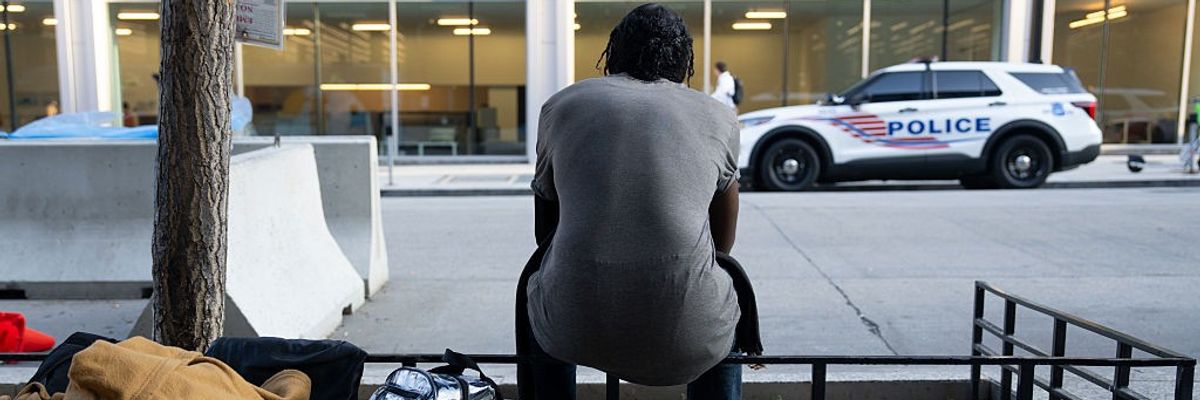
A homeless individual sits on a fence outside of the Martin Luther King Jr. Memorial Library on August 14, 2025, in Washington, DC.
The National Alliance to End Homelessness estimates that the proposal could increase the number of homeless people in the US by 36%.
As US President Donald Trump moves forward with a nationwide purge of homeless people from America's streets, his administration is moving to kill a program that has helped many of those in need find permanent housing.
The White House's fiscal year 2026 budget proposes ending a program under the Department of Housing and Urban Development known as Continuum of Care, which has helped cities across the country address or, in some cases, nearly eliminate their homelessness problem.
To receive federal funds, cities are required to adopt community-wide plans to end homelessness with the goal of moving people from the streets into shelters and then into stable housing.
The National Alliance to End Homelessness describes Continuum of Care as "the federal government's key vehicle for distributing homelessness funds."
As the Washington Post reports, Dallas has become a model for the program's effectiveness:
Instead of shuffling people to other neighborhoods, [the city] offered wraparound social services—and a permanent place to live.
The approach worked. Even as homelessness nationwide has surged to record levels, Dallas has emerged as a national model. The city declared an end to downtown homelessness in May after more than 270 people moved off the streets.
Other places, it says, have used Continuum of Care to substantially reduce homelessness, including San Bernardino, California, and Montgomery County, Maryland.
But the White House budget, unveiled in May, would eliminate Continuum of Care, instead shifting its resources to the Emergency Solutions Grant (ESG) program, which prioritizes shelters and transitional housing, as well as mental health and substance abuse counselling, rather than "Housing First" solutions.
The National Alliance to End Homelessness says the administration's plan to consolidate the program "would place thousands of projects and the hundreds of thousands of people they serve at risk."
The Alliance estimated that the proposal would effectively end funding of permanent supportive housing for 170,000 residents and potentially increase the number of homeless people in the US by 36%.
In addition to eliminating Continuum of Care, the White House budget cuts $532 million in funding to the federal government's Homeless Assistance Grants account. That money, the Alliance says, could fund over 60,000 Rapid Re-Housing Units—enough to serve 8% of the US homeless population.
"Between 2023 and 2024, homelessness increased by 18%, yet this proposal would strip funding for the US Department of Housing and Urban Development (HUD)'s homelessness programs by 12%," said Ann Oliva, CEO of the National Alliance to End Homelessness. "That is a recipe for disaster. We know that these programs have been chronically underfunded for decades."
In recent weeks, the Trump administration has declared an all-out war on the nation's homeless population. In July, he signed an executive order requiring states and cities to remove homeless people from public places, expanding cases where they must be involuntarily committed to psychiatric hospitals, and requiring sobriety preconditions for them to receive housing assistance.
During his federal takeover of Washington, DC, Trump ordered homeless people in encampments to move "FAR from the Capital." Press secretary Karoline Leavitt has said those who refuse to accept services at a shelter will face jail time.
The advocacy group Housing Not Handcuffs reported Friday that "police evicted and destroyed the property of homeless people throughout DC, throwing away people's personal belongings, including tents and other property."
"Homelessness is a market failure, a housing problem," said Rob Robinson, a formerly homeless community organizer in New York City, in USA Today. "Rent prices have exceeded income gains by 325% nationally since 1985. Rates of homelessness are tied to rental affordability."
"The White House's recent moves toward the criminalization of homelessness and forced institutionalization," he said, "ignore decades of research and real-world outcomes."
"If Donald Trump really wanted to help people and solve homelessness, he would use his power to lower rents and help people make ends meet," said Jesse Rabinowitz from the National Homelessness Law Center. "Estimates show that taxpayers are spending over $400,000 a day for Trump to use the DC National Guard for photo ops. Why can they find money for that but not for housing and help?"
Dear Common Dreams reader, It’s been nearly 30 years since I co-founded Common Dreams with my late wife, Lina Newhouser. We had the radical notion that journalism should serve the public good, not corporate profits. It was clear to us from the outset what it would take to build such a project. No paid advertisements. No corporate sponsors. No millionaire publisher telling us what to think or do. Many people said we wouldn't last a year, but we proved those doubters wrong. Together with a tremendous team of journalists and dedicated staff, we built an independent media outlet free from the constraints of profits and corporate control. Our mission has always been simple: To inform. To inspire. To ignite change for the common good. Building Common Dreams was not easy. Our survival was never guaranteed. When you take on the most powerful forces—Wall Street greed, fossil fuel industry destruction, Big Tech lobbyists, and uber-rich oligarchs who have spent billions upon billions rigging the economy and democracy in their favor—the only bulwark you have is supporters who believe in your work. But here’s the urgent message from me today. It's never been this bad out there. And it's never been this hard to keep us going. At the very moment Common Dreams is most needed, the threats we face are intensifying. We need your support now more than ever. We don't accept corporate advertising and never will. We don't have a paywall because we don't think people should be blocked from critical news based on their ability to pay. Everything we do is funded by the donations of readers like you. When everyone does the little they can afford, we are strong. But if that support retreats or dries up, so do we. Will you donate now to make sure Common Dreams not only survives but thrives? —Craig Brown, Co-founder |
As US President Donald Trump moves forward with a nationwide purge of homeless people from America's streets, his administration is moving to kill a program that has helped many of those in need find permanent housing.
The White House's fiscal year 2026 budget proposes ending a program under the Department of Housing and Urban Development known as Continuum of Care, which has helped cities across the country address or, in some cases, nearly eliminate their homelessness problem.
To receive federal funds, cities are required to adopt community-wide plans to end homelessness with the goal of moving people from the streets into shelters and then into stable housing.
The National Alliance to End Homelessness describes Continuum of Care as "the federal government's key vehicle for distributing homelessness funds."
As the Washington Post reports, Dallas has become a model for the program's effectiveness:
Instead of shuffling people to other neighborhoods, [the city] offered wraparound social services—and a permanent place to live.
The approach worked. Even as homelessness nationwide has surged to record levels, Dallas has emerged as a national model. The city declared an end to downtown homelessness in May after more than 270 people moved off the streets.
Other places, it says, have used Continuum of Care to substantially reduce homelessness, including San Bernardino, California, and Montgomery County, Maryland.
But the White House budget, unveiled in May, would eliminate Continuum of Care, instead shifting its resources to the Emergency Solutions Grant (ESG) program, which prioritizes shelters and transitional housing, as well as mental health and substance abuse counselling, rather than "Housing First" solutions.
The National Alliance to End Homelessness says the administration's plan to consolidate the program "would place thousands of projects and the hundreds of thousands of people they serve at risk."
The Alliance estimated that the proposal would effectively end funding of permanent supportive housing for 170,000 residents and potentially increase the number of homeless people in the US by 36%.
In addition to eliminating Continuum of Care, the White House budget cuts $532 million in funding to the federal government's Homeless Assistance Grants account. That money, the Alliance says, could fund over 60,000 Rapid Re-Housing Units—enough to serve 8% of the US homeless population.
"Between 2023 and 2024, homelessness increased by 18%, yet this proposal would strip funding for the US Department of Housing and Urban Development (HUD)'s homelessness programs by 12%," said Ann Oliva, CEO of the National Alliance to End Homelessness. "That is a recipe for disaster. We know that these programs have been chronically underfunded for decades."
In recent weeks, the Trump administration has declared an all-out war on the nation's homeless population. In July, he signed an executive order requiring states and cities to remove homeless people from public places, expanding cases where they must be involuntarily committed to psychiatric hospitals, and requiring sobriety preconditions for them to receive housing assistance.
During his federal takeover of Washington, DC, Trump ordered homeless people in encampments to move "FAR from the Capital." Press secretary Karoline Leavitt has said those who refuse to accept services at a shelter will face jail time.
The advocacy group Housing Not Handcuffs reported Friday that "police evicted and destroyed the property of homeless people throughout DC, throwing away people's personal belongings, including tents and other property."
"Homelessness is a market failure, a housing problem," said Rob Robinson, a formerly homeless community organizer in New York City, in USA Today. "Rent prices have exceeded income gains by 325% nationally since 1985. Rates of homelessness are tied to rental affordability."
"The White House's recent moves toward the criminalization of homelessness and forced institutionalization," he said, "ignore decades of research and real-world outcomes."
"If Donald Trump really wanted to help people and solve homelessness, he would use his power to lower rents and help people make ends meet," said Jesse Rabinowitz from the National Homelessness Law Center. "Estimates show that taxpayers are spending over $400,000 a day for Trump to use the DC National Guard for photo ops. Why can they find money for that but not for housing and help?"
As US President Donald Trump moves forward with a nationwide purge of homeless people from America's streets, his administration is moving to kill a program that has helped many of those in need find permanent housing.
The White House's fiscal year 2026 budget proposes ending a program under the Department of Housing and Urban Development known as Continuum of Care, which has helped cities across the country address or, in some cases, nearly eliminate their homelessness problem.
To receive federal funds, cities are required to adopt community-wide plans to end homelessness with the goal of moving people from the streets into shelters and then into stable housing.
The National Alliance to End Homelessness describes Continuum of Care as "the federal government's key vehicle for distributing homelessness funds."
As the Washington Post reports, Dallas has become a model for the program's effectiveness:
Instead of shuffling people to other neighborhoods, [the city] offered wraparound social services—and a permanent place to live.
The approach worked. Even as homelessness nationwide has surged to record levels, Dallas has emerged as a national model. The city declared an end to downtown homelessness in May after more than 270 people moved off the streets.
Other places, it says, have used Continuum of Care to substantially reduce homelessness, including San Bernardino, California, and Montgomery County, Maryland.
But the White House budget, unveiled in May, would eliminate Continuum of Care, instead shifting its resources to the Emergency Solutions Grant (ESG) program, which prioritizes shelters and transitional housing, as well as mental health and substance abuse counselling, rather than "Housing First" solutions.
The National Alliance to End Homelessness says the administration's plan to consolidate the program "would place thousands of projects and the hundreds of thousands of people they serve at risk."
The Alliance estimated that the proposal would effectively end funding of permanent supportive housing for 170,000 residents and potentially increase the number of homeless people in the US by 36%.
In addition to eliminating Continuum of Care, the White House budget cuts $532 million in funding to the federal government's Homeless Assistance Grants account. That money, the Alliance says, could fund over 60,000 Rapid Re-Housing Units—enough to serve 8% of the US homeless population.
"Between 2023 and 2024, homelessness increased by 18%, yet this proposal would strip funding for the US Department of Housing and Urban Development (HUD)'s homelessness programs by 12%," said Ann Oliva, CEO of the National Alliance to End Homelessness. "That is a recipe for disaster. We know that these programs have been chronically underfunded for decades."
In recent weeks, the Trump administration has declared an all-out war on the nation's homeless population. In July, he signed an executive order requiring states and cities to remove homeless people from public places, expanding cases where they must be involuntarily committed to psychiatric hospitals, and requiring sobriety preconditions for them to receive housing assistance.
During his federal takeover of Washington, DC, Trump ordered homeless people in encampments to move "FAR from the Capital." Press secretary Karoline Leavitt has said those who refuse to accept services at a shelter will face jail time.
The advocacy group Housing Not Handcuffs reported Friday that "police evicted and destroyed the property of homeless people throughout DC, throwing away people's personal belongings, including tents and other property."
"Homelessness is a market failure, a housing problem," said Rob Robinson, a formerly homeless community organizer in New York City, in USA Today. "Rent prices have exceeded income gains by 325% nationally since 1985. Rates of homelessness are tied to rental affordability."
"The White House's recent moves toward the criminalization of homelessness and forced institutionalization," he said, "ignore decades of research and real-world outcomes."
"If Donald Trump really wanted to help people and solve homelessness, he would use his power to lower rents and help people make ends meet," said Jesse Rabinowitz from the National Homelessness Law Center. "Estimates show that taxpayers are spending over $400,000 a day for Trump to use the DC National Guard for photo ops. Why can they find money for that but not for housing and help?"