SUBSCRIBE TO OUR FREE NEWSLETTER
Daily news & progressive opinion—funded by the people, not the corporations—delivered straight to your inbox.
5
#000000
#FFFFFF
To donate by check, phone, or other method, see our More Ways to Give page.
Daily news & progressive opinion—funded by the people, not the corporations—delivered straight to your inbox.
"These findings fly in the face of Biden's preferred framing of international politics as a 'battle between democracies and autocracies,'" says the author of a new report.
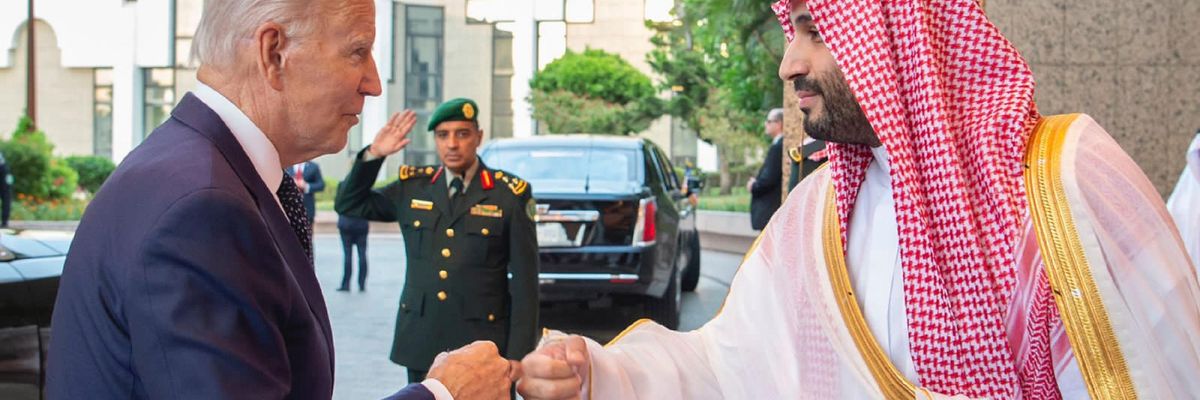
President Joe Biden claims that the United States is leading "democracies" in a fight against "autocracies" to establish a peaceful international order, but his administration approved weapons sales to nearly three-fifths of the world's authoritarian countries in 2022.
That's according to a new analysis conducted by Security Policy Reform Institute co-founder Stephen Semler and published Thursday in The Intercept.
The U.S. has been the world's largest arms dealer since the end of the Cold War. Data released in March showed that the U.S. accounted for 40% of global weapons exports from 2018 to 2022.
As Semler explained:
In general, these exports are funded through grants or sales. There are two pathways for the latter category: foreign military sales and direct commercial sales.
The U.S. government acts as an intermediary for FMS acquisitions: It buys the materiel from a company first and then delivers the goods to the foreign recipient. DCS acquisitions are more straightforward: They're the result of an agreement between a U.S. company and a foreign government. Both categories of sales require the government's approval.
Country-level data for last year's DCS authorizations was released in late April through the State Department's Directorate of Defense Trade Controls. FMS figures for fiscal year 2022 were released earlier this year through the Pentagon's Defense Security Cooperation Agency. According to their data, a total of 142 countries and territories bought weapons from the U.S. in 2022, for a total of $85 billion in bilateral sales.
To determine how many of those governments were democratic and how many were autocratic, Semler relied on data from the Varieties of Democracy project at the University of Gothenburg in Sweden, which uses a classification system called Regimes of the World.
"Of the 84 countries codified as autocracies under the Regimes of the World system in 2022, the United States sold weapons to at least 48, or 57%, of them," Semler wrote. "The 'at least' qualifier is necessary because several factors frustrate the accurate tracking of U.S. weapons sales. The State Department's report of commercial arms sales during the fiscal year makes prodigious use of 'various' in its recipients category; as a result, the specific recipients for nearly $11 billion in weapons sales are not disclosed."
"The Regimes of the World system is just one of the several indices that measure democracy worldwide, but running the same analysis with other popular indices produces similar results," Semler observed. "For example, Freedom House listed 195 countries and for each one labeled whether it qualified as an electoral democracy in its annual Freedom in the World report. Of the 85 countries Freedom House did not designate as an electoral democracy, the United States sold weapons to 49, or 58%, of them in fiscal year 2022."
Despite the White House's lofty rhetoric, it is actively bolstering the military power of a majority of the world's authoritarian countries, from Saudi Arabia and the United Arab Emirates to dozens of others, including some overlooked by researchers at the University of Gothenburg.
For instance, the Varieties of Democracy project characterizes Israel as a "liberal democracy" even though human rights groups around the world have condemned it as a decidedly anti-democratic apartheid state. Washington, meanwhile, showers Israel with $3.8 billion in military support each year, resources that the government uses to violently dispossess and frequently kill Palestinians at will.
As Semler put it Saturday in his "Speaking Security" newsletter, "These findings fly in the face of Biden's preferred framing of international politics as a "battle between democracies and autocracies."
The president's narrative "lends itself more to a self-righteous foreign policy than an honest or productive one," Semler argued. "Dividing the world between democratic and autocratic countries—in the spirit of 'with us or against us'—makes conflict more likely and has had a chilling effect on calls for diplomacy and détente. It's also harder to cooperate with the international community while insisting you're locked in an existential fight with roughly half of them."
Dear Common Dreams reader, It’s been nearly 30 years since I co-founded Common Dreams with my late wife, Lina Newhouser. We had the radical notion that journalism should serve the public good, not corporate profits. It was clear to us from the outset what it would take to build such a project. No paid advertisements. No corporate sponsors. No millionaire publisher telling us what to think or do. Many people said we wouldn't last a year, but we proved those doubters wrong. Together with a tremendous team of journalists and dedicated staff, we built an independent media outlet free from the constraints of profits and corporate control. Our mission has always been simple: To inform. To inspire. To ignite change for the common good. Building Common Dreams was not easy. Our survival was never guaranteed. When you take on the most powerful forces—Wall Street greed, fossil fuel industry destruction, Big Tech lobbyists, and uber-rich oligarchs who have spent billions upon billions rigging the economy and democracy in their favor—the only bulwark you have is supporters who believe in your work. But here’s the urgent message from me today. It's never been this bad out there. And it's never been this hard to keep us going. At the very moment Common Dreams is most needed, the threats we face are intensifying. We need your support now more than ever. We don't accept corporate advertising and never will. We don't have a paywall because we don't think people should be blocked from critical news based on their ability to pay. Everything we do is funded by the donations of readers like you. When everyone does the little they can afford, we are strong. But if that support retreats or dries up, so do we. Will you donate now to make sure Common Dreams not only survives but thrives? —Craig Brown, Co-founder |
President Joe Biden claims that the United States is leading "democracies" in a fight against "autocracies" to establish a peaceful international order, but his administration approved weapons sales to nearly three-fifths of the world's authoritarian countries in 2022.
That's according to a new analysis conducted by Security Policy Reform Institute co-founder Stephen Semler and published Thursday in The Intercept.
The U.S. has been the world's largest arms dealer since the end of the Cold War. Data released in March showed that the U.S. accounted for 40% of global weapons exports from 2018 to 2022.
As Semler explained:
In general, these exports are funded through grants or sales. There are two pathways for the latter category: foreign military sales and direct commercial sales.
The U.S. government acts as an intermediary for FMS acquisitions: It buys the materiel from a company first and then delivers the goods to the foreign recipient. DCS acquisitions are more straightforward: They're the result of an agreement between a U.S. company and a foreign government. Both categories of sales require the government's approval.
Country-level data for last year's DCS authorizations was released in late April through the State Department's Directorate of Defense Trade Controls. FMS figures for fiscal year 2022 were released earlier this year through the Pentagon's Defense Security Cooperation Agency. According to their data, a total of 142 countries and territories bought weapons from the U.S. in 2022, for a total of $85 billion in bilateral sales.
To determine how many of those governments were democratic and how many were autocratic, Semler relied on data from the Varieties of Democracy project at the University of Gothenburg in Sweden, which uses a classification system called Regimes of the World.
"Of the 84 countries codified as autocracies under the Regimes of the World system in 2022, the United States sold weapons to at least 48, or 57%, of them," Semler wrote. "The 'at least' qualifier is necessary because several factors frustrate the accurate tracking of U.S. weapons sales. The State Department's report of commercial arms sales during the fiscal year makes prodigious use of 'various' in its recipients category; as a result, the specific recipients for nearly $11 billion in weapons sales are not disclosed."
"The Regimes of the World system is just one of the several indices that measure democracy worldwide, but running the same analysis with other popular indices produces similar results," Semler observed. "For example, Freedom House listed 195 countries and for each one labeled whether it qualified as an electoral democracy in its annual Freedom in the World report. Of the 85 countries Freedom House did not designate as an electoral democracy, the United States sold weapons to 49, or 58%, of them in fiscal year 2022."
Despite the White House's lofty rhetoric, it is actively bolstering the military power of a majority of the world's authoritarian countries, from Saudi Arabia and the United Arab Emirates to dozens of others, including some overlooked by researchers at the University of Gothenburg.
For instance, the Varieties of Democracy project characterizes Israel as a "liberal democracy" even though human rights groups around the world have condemned it as a decidedly anti-democratic apartheid state. Washington, meanwhile, showers Israel with $3.8 billion in military support each year, resources that the government uses to violently dispossess and frequently kill Palestinians at will.
As Semler put it Saturday in his "Speaking Security" newsletter, "These findings fly in the face of Biden's preferred framing of international politics as a "battle between democracies and autocracies."
The president's narrative "lends itself more to a self-righteous foreign policy than an honest or productive one," Semler argued. "Dividing the world between democratic and autocratic countries—in the spirit of 'with us or against us'—makes conflict more likely and has had a chilling effect on calls for diplomacy and détente. It's also harder to cooperate with the international community while insisting you're locked in an existential fight with roughly half of them."
President Joe Biden claims that the United States is leading "democracies" in a fight against "autocracies" to establish a peaceful international order, but his administration approved weapons sales to nearly three-fifths of the world's authoritarian countries in 2022.
That's according to a new analysis conducted by Security Policy Reform Institute co-founder Stephen Semler and published Thursday in The Intercept.
The U.S. has been the world's largest arms dealer since the end of the Cold War. Data released in March showed that the U.S. accounted for 40% of global weapons exports from 2018 to 2022.
As Semler explained:
In general, these exports are funded through grants or sales. There are two pathways for the latter category: foreign military sales and direct commercial sales.
The U.S. government acts as an intermediary for FMS acquisitions: It buys the materiel from a company first and then delivers the goods to the foreign recipient. DCS acquisitions are more straightforward: They're the result of an agreement between a U.S. company and a foreign government. Both categories of sales require the government's approval.
Country-level data for last year's DCS authorizations was released in late April through the State Department's Directorate of Defense Trade Controls. FMS figures for fiscal year 2022 were released earlier this year through the Pentagon's Defense Security Cooperation Agency. According to their data, a total of 142 countries and territories bought weapons from the U.S. in 2022, for a total of $85 billion in bilateral sales.
To determine how many of those governments were democratic and how many were autocratic, Semler relied on data from the Varieties of Democracy project at the University of Gothenburg in Sweden, which uses a classification system called Regimes of the World.
"Of the 84 countries codified as autocracies under the Regimes of the World system in 2022, the United States sold weapons to at least 48, or 57%, of them," Semler wrote. "The 'at least' qualifier is necessary because several factors frustrate the accurate tracking of U.S. weapons sales. The State Department's report of commercial arms sales during the fiscal year makes prodigious use of 'various' in its recipients category; as a result, the specific recipients for nearly $11 billion in weapons sales are not disclosed."
"The Regimes of the World system is just one of the several indices that measure democracy worldwide, but running the same analysis with other popular indices produces similar results," Semler observed. "For example, Freedom House listed 195 countries and for each one labeled whether it qualified as an electoral democracy in its annual Freedom in the World report. Of the 85 countries Freedom House did not designate as an electoral democracy, the United States sold weapons to 49, or 58%, of them in fiscal year 2022."
Despite the White House's lofty rhetoric, it is actively bolstering the military power of a majority of the world's authoritarian countries, from Saudi Arabia and the United Arab Emirates to dozens of others, including some overlooked by researchers at the University of Gothenburg.
For instance, the Varieties of Democracy project characterizes Israel as a "liberal democracy" even though human rights groups around the world have condemned it as a decidedly anti-democratic apartheid state. Washington, meanwhile, showers Israel with $3.8 billion in military support each year, resources that the government uses to violently dispossess and frequently kill Palestinians at will.
As Semler put it Saturday in his "Speaking Security" newsletter, "These findings fly in the face of Biden's preferred framing of international politics as a "battle between democracies and autocracies."
The president's narrative "lends itself more to a self-righteous foreign policy than an honest or productive one," Semler argued. "Dividing the world between democratic and autocratic countries—in the spirit of 'with us or against us'—makes conflict more likely and has had a chilling effect on calls for diplomacy and détente. It's also harder to cooperate with the international community while insisting you're locked in an existential fight with roughly half of them."