

SUBSCRIBE TO OUR FREE NEWSLETTER
Daily news & progressive opinion—funded by the people, not the corporations—delivered straight to your inbox.
5
#000000
#FFFFFF
To donate by check, phone, or other method, see our More Ways to Give page.
Daily news & progressive opinion—funded by the people, not the corporations—delivered straight to your inbox.
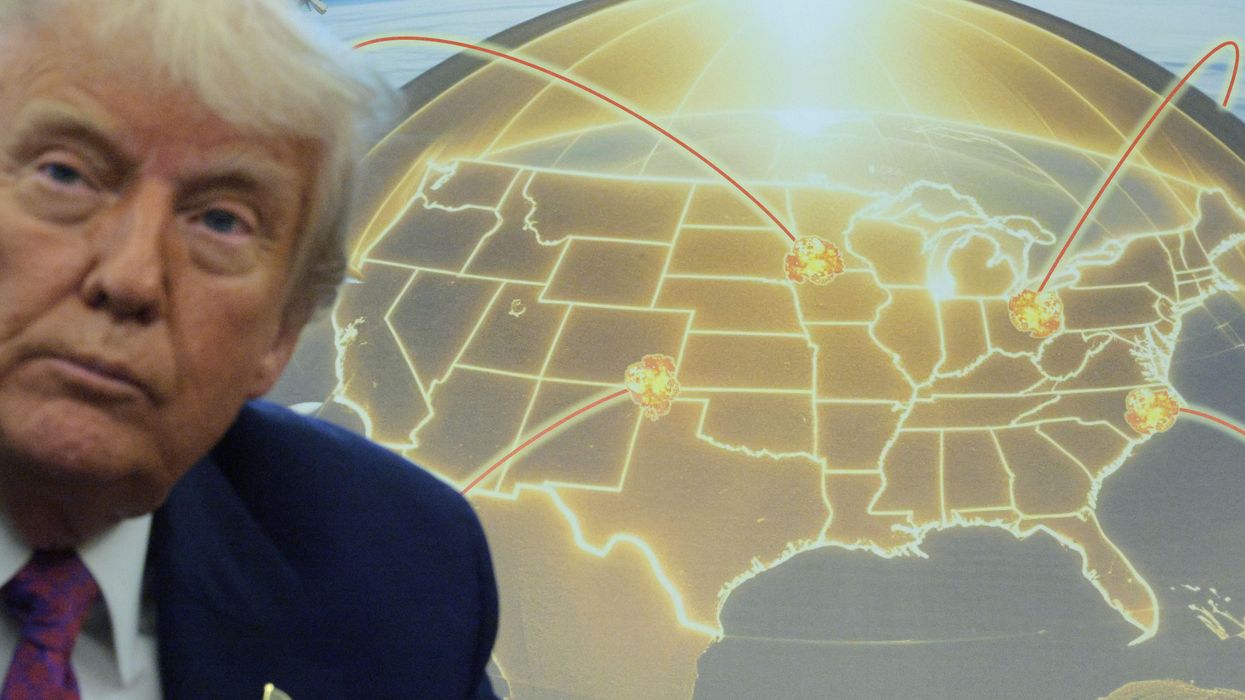
"Trump’s dangerous... boondoggle will not protect Americans. It’s just a giveaway to defense contractor buddies like Elon Musk," said US Sen. Ed Markey.
Democratic lawmakers are taking aim at President Donald Trump's proposed “Golden Dome” missile defense system, which the Congressional Budget Office projected last month would cost $1.2 trillion to create, deploy, and operate over the first 20 years of its existence.
Ten members of Congress, led by Sens. Ed Markey (D-Mass.) and Jeff Merkley (D-Ore.) and Reps. John Garamendi (D-Calif.) and Don Beyer (D-Va.), sent a letter to US Defense Secretary Pete Hegseth on Wednesday demanding information on the proposed project's cost to taxpayers and its projected effectiveness.
The letter begins by noting that officials working on the Golden Dome still have not shared key details about the project with the CBO, which the independent agency said has made it "impossible to estimate the long-term cost" of the system.
"It is one thing to withhold design details or performance specifications of certain systems," the letter says, "but it is quite another to withhold the entire system architecture that you expect Congress to approve and fund. Congress and the American public have a right to know what they are paying for."
The letter says that transparency about the system's architecture is particularly important given the questions that have been raised about how successful it would be at halting missile attacks. This is especially true, the letter emphasized, given the administration's insistence that the true cost of the system will be less than one-fifth of the CBO's projections.
"Simply put, there is no way that a Golden Dome system that costs $185 billion could possibly live up to the promise of 'forever ending the missile threat to the American homeland,'" the letter states. "According to CBO’s calculations, even a system that would cost $3 trillion would not meet that ambitious goal, which would need to be able to engage hundreds of missiles. If the administration has not scaled back its goals for the system, the current official price tag is woefully unrealistic."
The letter concludes by asking several questions about the project, including the administration's estimated 20-year cost, the type of system architecture being planned, and the anticipated responses to the missile shield from rival nations including China and Russia.
"We urge you to halt this dangerous plan," the letter says, "and return to the more limited missile defense policies that have earned bipartisan support in the past."
In a separate social media post, Markey pointed out that the project is being used to funnel money to administration allies such as SpaceX CEO Elon Musk, who last week became the world's first trillionaire and is promoting racist far-right political parties throughout the world.
"Trump’s dangerous $1.2 trillion 'Golden Dome' boondoggle will not protect Americans," Markey wrote. "It’s just a giveaway to defense contractor buddies like Elon Musk. We’re demanding answers from Hegseth on Trump’s trillion-dollar scam."
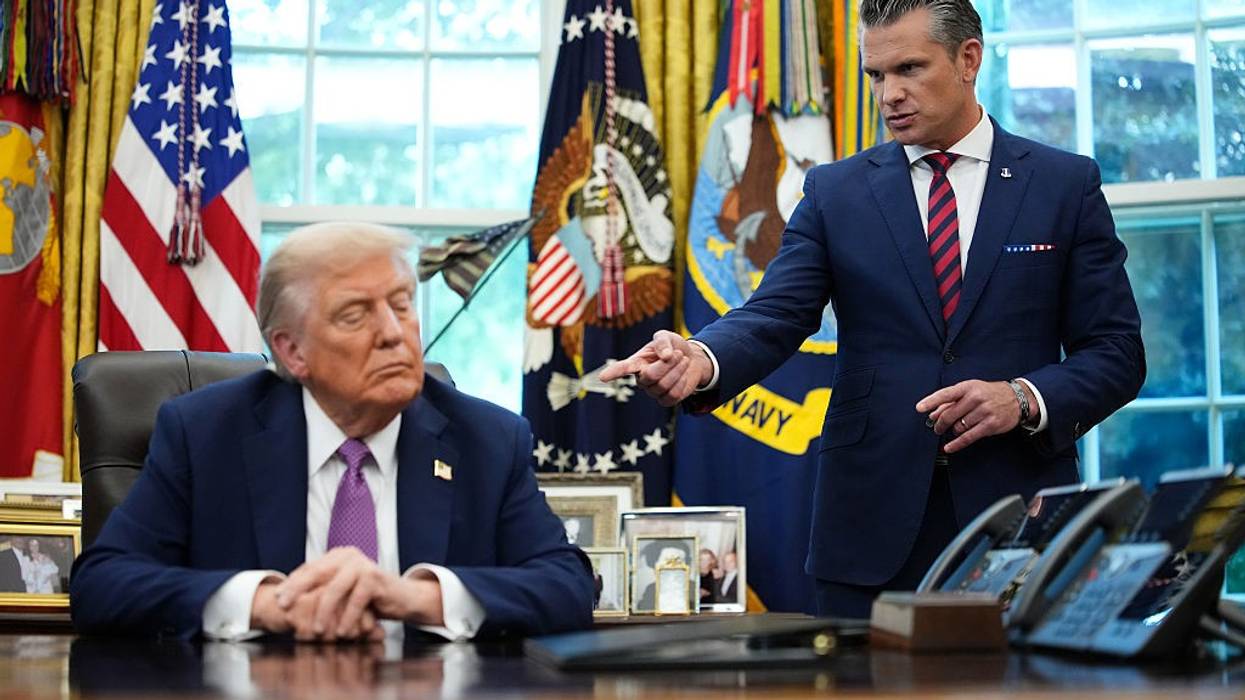
Holding peace as an organizing principle? Developing policies that promote peaceful resolution of conflict? Can you imagine this at the core to the American government? With significant funding?
It’s hard to avoid noticing, and internally screaming over, the Trump administration’s proposed military budget upgrade to $1.5 trillion annually—as though the present trillion-dollar annual gift to the end of the world weren’t enough.
It’s not just the proposed taxpayer bleed. It’s the collective assumption that “self-defense” requires an ever-present readiness to kill lots of people—and beyond that the utter certainty that we have soulless enemies out there who want what we have, hate our freedoms, and will take what they can the moment we relax. This is just the way it is. No questions allowed.
And our enemies aren’t pussycats. One of them, for instance, is China. Indeed, as Megan Russell of CODEPINK writes:
US lawmakers have been using China as a military budget increaser and ultimate policy-generator for years. Competition with Beijing is invoked to justify military expansion, new regional alliances, AI weapons development, semiconductor restrictions, and rising nuclear expenditures. In Washington, framing a policy as necessary to "counter China" has become one of the quickest ways to secure bipartisan support. As a result, the "China threat" rhetoric proliferates while the military budget skyrockets.
“A quick way to secure bipartisan support”—that says it all. Nothing holds a country together like a good enemy. This is who we are; this is the identity we’re stuck with. We unify when we fight. Apparently that’s at our political core, which is why any cries for peace—which is oh, so complex—are ignored, belittled, and virtually always voted down. All of which is to our own detriment, not to mention the world’s detriment.
As Russell notes:
...currently, the US and China are building their own tech ecosystems, especially in the fields of artificial intelligence, semiconductors, and quantum computing. The US refers to this as a "strategic rivalry" with wider national security implications. This perspective only exists because China is considered a rival. China does not have to be considered a rival. China could just as easily be considered a development partner. And indeed it should, because cooperation on tech is the only potential avenue for ensuring the continued existence of the planet.
Uh, too bad, Planet Earth. Collective humanity refuses to think at that level. Technology serves only our belief in dominance. Consider President Donald Trump’s proposed “Golden Dome” nuclear defense system: thousands of satellites patrolling the planet, on the lookout for enemy nuclear missiles, a deeply flawed reincarnation of the Reagan-era Strategic Defense Initiative plan that went nowhere. The cost, though minimized by the Trump administration, could wind up, according to some estimates, amounting to well over $3 trillion.
And, according to Taxpayers for Common Sense:
Pursuing Golden Dome also poses serious strategic risks, including the potential to accelerate nuclear arms and space arms races and to undermine opportunities to secure verifiable arms control agreements that reduce the nuclear threat. The program has also raised troubling conflict-of-interest concerns involving individuals within the Trump administration and companies vying for Golden Dome contracts.
Wars. Sometimes you stop ’em, sometimes you start ’em, but they ain’t going away. The most powerful people on the planet are utterly committed to the limited nature of their thinking. That’s just how it goes. What about that do you not understand, Rep. Kucinich?
Remember US Rep. Dennis Kucinich (D-Ohio) and his Department of Peace legislation, which he introduced in Congress every year from 2001 to 2011? And it was introduced again in 2013 by Rep. Barbara Lee (D-Calif.). It, uh, never passed.
Here’s how it was defined in 2001, as HR2458:
Establishes a Department of Peace, which shall be headed by a Secretary of Peace appointed by the President, with the advice and consent of the Senate. Sets forth the mission of the Department, including to: (1) hold peace as an organizing principle; (2) endeavor to promote justice and democratic principles to expand human rights; and (3) develop policies that promote national and international conflict prevention, nonviolent intervention, mediation, peaceful resolution of conflict, and structured mediation of conflict.
Establishes in the Department the Intergovernmental Advisory Council on Peace, which shall provide assistance and make recommendations to the Secretary and the President concerning intergovernmental policies relating to peace and nonviolent conflict resolution.
Holding peace as an organizing principle? Developing policies that promote peaceful resolution of conflict? Can you imagine this at the core to the American government? With significant funding? As I read these words today, I feel compelled to help keep them alive. I want that level of sanity in my government—that level of commitment to something I believe in, with all my heart.
Instead:
Taken together, the Trump administration’s rhetoric and actions point to a clear conclusion about its recent request for a whopping $1.5 trillion in military spending: This is not a defense budget. It is a war budget, designed to enable a pattern of aggressive military action and escalating threats that are already imposing a devastating toll on civilians abroad, while the combination of spending cuts and rising costs imposed on Americans is deepening injustice at home.
This is Scott Paul, writing at The Hill. He goes on: “This budget is certainly not business as usual. It is a dramatic reordering of national priorities. Trump has made this shift explicit, arguing that the US cannot afford childcare, Medicaid or Medicare because, as he put it, ‘we’re fighting wars.’”
Sen. Jeff Merkley called the project “nothing more than a massive giveaway to defense contractors paid for entirely by working Americans.”
The Congressional Budget Office on Tuesday released a report estimating that President Donald Trump's proposed "Golden Dome" missile defense system would cost $1.2 trillion to create, deploy, and operate over the first 20 years of its existence.
The CBO report projects that acquisition costs for the proposed national missile defense (NMD) system would account for the vast majority of the $1.2 trillion total, including "costs for the system’s major components—namely, the interceptor layers and a space-based missile warning and tracking system."
In fact, the report says that the NMD system's space-based interceptor layer will be so expensive that it "accounts for about 70% of acquisition costs and 60% of total costs."
The CBO also questioned whether this massive investment would successfully protect the US from a foreign missile attack.
"Although the notional NMD system... would be far more capable than defenses the United States fields today," the report states, "it would not be an impenetrable shield or be able to fully counter a large attack of the sort that Russia or China might be able to launch."
"The strategic consequences of deploying an NMD system with the capacity considered here are unclear," the report continues, "because they hinge on an adversary’s perception of the defense's capability and how that adversary chose to respond."
The CBO's estimate on the missile system's cost was nearly seven times the projection Trump made last year, when he said it would cost just $175 billion.
And because the US Department of Defense still hasn't delivered key details about the proposed system, the CBO wrote, it is currently "impossible to estimate the long-term cost" of the initiative.
Sen. Jeff Merkley (D-Ore.), a longtime critic of the "Golden Dome" proposal, said the CBO report shows the Trump-backed project is "nothing more than a massive giveaway to defense contractors paid for entirely by working Americans."
"Just like the president’s symbolic renaming of the Department of Defense or deploying National Guard troops to our cities," added Merkley, who is the ranking member of the Senate Budget Committee, "this move to fund the ‘Golden Dome’ will be far more effective at squandering money than protecting American lives."
The Oregon Democrat vowed to "continue to work with my colleagues in the Senate to prevent another dime from flowing to this racket."
Sen. Ed Markey (D-Mass.), also a longtime critic of the president's proposed missile system, wrote in a social media post that "Trump’s Golden Dome is a $1.2 trillion golden sieve that won’t stop a nuclear attack, but will balloon the deficit and boost the bottom lines of billionaires."
Tommy Vietor, former National Security Council staffer under President Barack Obama and current co-host of Pod Save America, was even blunter in his criticism of the "Golden Dome" plan.
"$1.2 TRILLION for this dumb fucking Golden Dome missile defense system," he wrote in a social media post. "The initial estimate was $175 billion! Madness. No one wants this."
Daniel Larison, contributing editor at Antiwar.com and former senior editor at The American Conservative magazine, wrote that the CBO report exposed Trump's dome as a "trillion-dollar boondoggle."
Trump has said that he was inspired to develop such a missile system after being impressed by Israel’s “Iron Dome," despite the fact that Israel has a vastly smaller landmass to defend compared to the US and has historically faced far more danger from missile and rocket attacks.

"This is not defense, it's deception—an illusion of safety. The Pentagon has spent hundreds of billions of dollars over the last several decades proving that this freaking thing doesn't work."
Critics of the 'Golden Dome' missile defense shield program championed by US President Donald Trump gathered on the National Mall in Washington, DC on Wednesday to ridicule and condemn the wasteful military program, which experts warn will never work as promised but will plow billions of taxpayer dollars into the coffers of the weapons industry.
Ben Cohen, co-founder of Ben & Jerry’s ice cream and found of the anti-war group Up In Arms, led the event which included the unveiling of an art installation—complete with a statue of Trump holding a golden umbrella filled with holes, urinating missiles, and running water—to represent the "unworkable space shield" known as the Golden Dome, a space-based missile defense shield that varying studies estimate could cost from $540 billion to a mind-blowing $6 trillion over 20 years to operate.
With the DC event taking place on April 1, Cohen told those gathered that the problem with the Golden Dome is that "it's not a prank," but rather a real program that Trump is trying pursue despite its deep and obvious flaws.
"Sure, you know, an invisible shield that protects you from any possible threat, is a nice idea," said Cohen, "but it's full of holes."
"This is not defense, it's deception—an illusion of safety," Cohen continued. "The Pentagon has spent hundreds of billions of dollars over the last several decades proving that this freaking thing doesn't work, but it's just such an attractive fantasy that it's being pulled out of the trash bins of history to soak the taxpayer once again."
"It's another one of the harebrained ideas that pops out of our president's head every now and then, but the Hole-in-Dome [statue] demonstrates that he's all wet on this one," said Cohen. "The other thing the Hole-in-Dome demonstrates is that our country is under water—we are drowning in debt. And wasting another $4 trillion on a holey dome ain't gonna help, especially when we need that money for Social Security, affordable housing, and healthcare."
The overall message, he said, was that "if we don't stop this boondoggle, we're sunk."
Dr. Igor Moric, a research physicist at the Princeton Program on Science and Global Security, also spoke at the event, explaining how the Golden Dome system—despite Trump's unfounded claims that it will be able to shield the American people from future ballistic missile attacks—runs up against fundamental scientific limits.
“The United States has been building ballistic missile defense, a magical shield against nuclear weapons for over 80 years,” Moric said. “The reality is ballistic missile defense does not work, it cannot work, and it will not work. Space-based missile defense, as envisioned by the Golden Dome, cannot work because of known physical and technological realities limiting what it can do."
According to the Up In Arms website, "Golden Dome would be an enormously expensive system that would not provide an effective defense. It would instead fuel an arms race that would reduce US and international security, and increase the risk of nuclear war."
Dr. Ira Helfand, co-founder of Physicians for Social Responsibility and the Back from the Brink campaign, noted that even "optimistic scenarios" of success by a Golden Dome system would not prevent catastrophic consequences, warning that even if the system could intercept 80% of incoming weapons, tens of millions of Americans could still be killed in a large-scale nuclear attack.
“This system does not protect the American people,” he says. “The attempt to build this system will fuel the arms race and torpedo efforts to actually get rid of [nuclear] weapons."
Other speakers focused on the need to use precious tax dollars not for unrealistic and unworkable weapons like Golden Dome, but rather to invest in social programs—including education, Social Security, healthcare, and affordable housing—that the nation desperately needs.
“The Golden Dome is not golden for the people of the United States or the world,” said former Ohio state senator Nina Turner, who also spoke at the event.
People in Cleveland and other US cities, Turner said, would “much rather have the money that is being wasted on a pipe dream and a fantasy invested in lifting them and their children out of poverty.”
“There is a connection between this foolishness and folly and the reason we can't have nice things in the United States of America," added Turner. "They tell us they can't afford universal healthcare, but they can afford this!"
In an era of illegal wars and dangerous domestic military operations, Trump’s budget plan would hand trillions of additional dollars to defense contractors and militarize our country in ways not seen since World War II.
Congress expects to receive the Trump administration’s official budget request for fiscal year 2027 sometime next week. If it is consistent with President Donald Trump’s “announcement” on Truth Social on January 8 that his administration would request a defense budget of $1.5 trillion—$600 billion more than this year—that would be a whopping 66% increase in military spending.
If passed and sustained, analysis shows the plan will add almost $6 trillion to the national debt in the next decade. In an era of illegal wars and dangerous domestic military operations, Trump’s plan would hand trillions of additional dollars to defense contractors and militarize our country in ways not seen since World War II—what we might call a “Bloody New Deal.”
The original New Deal took place over six years in the 1930s and infused the US economy with government spending to end the Great Depression. It cost $41.7 billion at the time, translating to around $1 trillion in today’s dollars. Given the comparatively small size of the US economy in the 1930s, the New Deal remains one of the largest economic stimulus packages in US history (if not the largest).
Among modern spending packages, the Bloody New Deal would stand alone in scope. If enacted and sustained over the next 10 years, it will cost roughly six times as much as President Joe Biden’s Inflation Reduction Act (although many of its provisions have been rolled back by the Trump administration since this cost estimate), four times as much as President Barack Obama’s Affordable Care Act, and twice as much as President Trump’s One Big Beautiful Bill Act. Even though Trump has claimed he will use tariff revenue to pay for his spending increase—now in question due to the recent Supreme Court decision striking down most of his tariffs—the Bloody New Deal will add at least $5.8 trillion dollars to the national debt over the next decade, which will harm our financial security and long-term warfighting ability. And that figure is based on a rosy outlook for tariff revenue and a conservative outlook of defense spending growth.
Pouring funds into a defense sector that has repeatedly failed basic tests of accountability will not miraculously produce innovation.
By comparing this massive spending plan to other options, the potential scope of President Trump’s announcement becomes even clearer. For $6 trillion over 10 years, the US government could simultaneously fund all the following:
While the president was, as usual, frustratingly vague when announcing the largest single increase in US defense spending, congressional Republicans have recently provided more clues about what they would fund and how long this increase would last. The chair of the House Armed Services Committee has indicated the funding will be used to grow the “defense industrial base” and Trump’s pet projects, the missile defense scheme “Golden Dome” and the Navy modernization project “Golden Fleet.”
Growing the industrial base for our military has been a long-term bipartisan priority in Congress. Almost all new military acquisition projects this century have struggled with brittle supply chains and out-of-date procurement practices that could be helped by a stronger industrial base. But this goal either means a one-time increase would be a fool’s errand, unable to solve the problem, or an admission that the spending increase would be made permanent, as some House Republicans have already called for. On a very basic and intuitive level, long-term capacity cannot be created without long-term funding commitments to the defense industry.
Setting aside all the wasted money on infeasible fantasy projects like Golden Dome and Golden Fleet, the Bloody New Deal, even if sustained, won’t fix the problems it sets out to solve. A host of structural issues, not a lack of funding, have caused a failure in output from our defense industrial base.
One of these issues, monopolization, provides an example of something that cannot be fixed with more funds. Both former President Biden’s and President Trump’s defense appointees have pointed out that the shrinking number of contractors has kneecapped our ability to produce military equipment due to a lack of competition, anti-competitive behavior, and contractor influence in Congress. In the 1990s, there were 51 major defense contractors. Today, there are only five.
The Bloody New Deal would likely cause a temporary feeding frenzy for new entrants into the defense sector in its first year like that seen in the massive Golden Dome bidding process currently underway. But history has shown the market will likely reward existing firms when all is said and done. After 9/11, rapid-procurement authorities and emergency funding briefly pulled hundreds of non-traditional firms into defense contracting before mergers and closures quickly narrowed the field again.
In the end, it is likely the Bloody New Deal will only grow the power of incumbent contractors. Even the Pentagon has signaled it wouldn’t know how to deal with this amount of money if it was passed. In 10 years, the largest increase in discretionary spending in modern US history could very well be regarded as the largest corporate welfare plan for defense contractors and arms salesmen, not remembered for making anyone more secure.
For a spending plan of potentially unparalleled scope, the lack of attention it has received is shocking. If this Bloody New Deal actually passes, it could give unparalleled increases in financial power to defense contractors and support for the political work they already do to influence Congress. The Trump administration may also try to get a rumored $200 billion supplemental defense spending package through Congress to support its ongoing war against Iran. Although this is a different way of increasing the defense budget, the outcome would be much the same.
Sane voices need to act now, building opposition to this unprecedented plan. Especially in the context of attacks decrying President Biden’s Inflation Reduction Act as too expensive or unrealistic, and all of the work the current administration has done to undermine that bill, this infeasible proposal becomes all the more ludicrous. Progressives should be unflinching in defining this proposal as a blank check for the same contractors who cannot deliver ships on time, munitions at scale, or clean audits. Pouring funds into a defense sector that has repeatedly failed basic tests of accountability will not miraculously produce innovation.
As the Trump administration makes clear its unchecked willingness to attack other countries regardless of legality, the stakes of dumping unprecedented funds into the US military-industrial complex have never been higher.
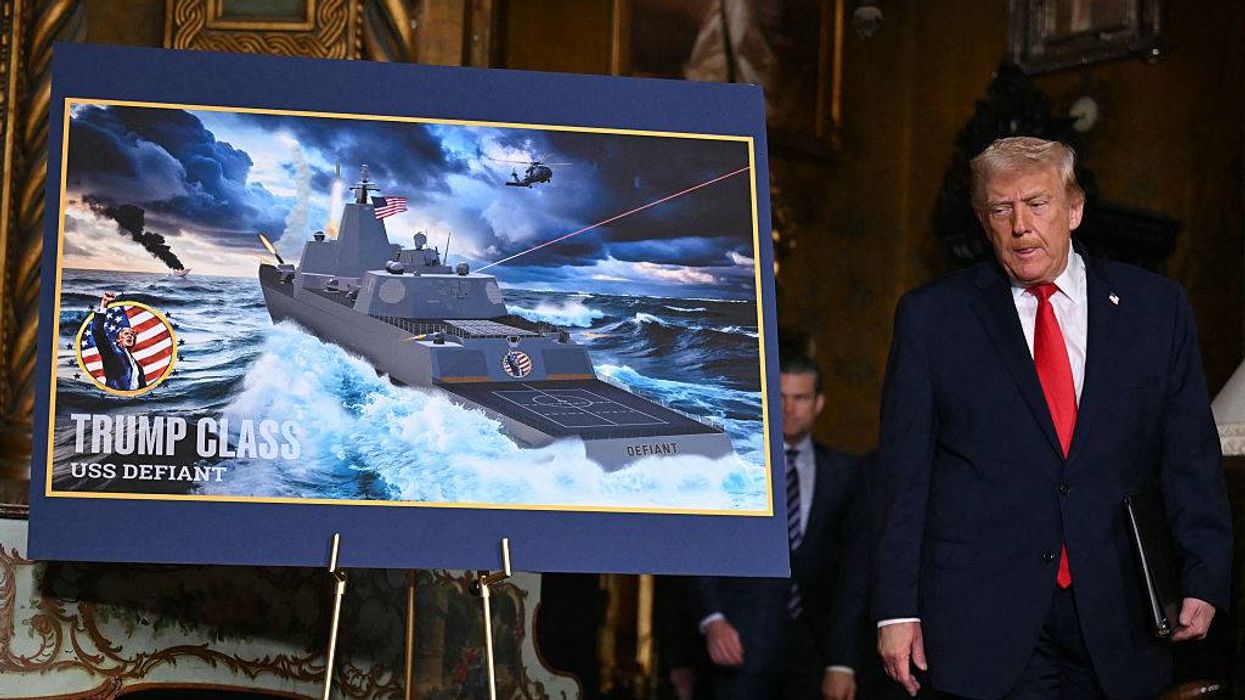
"A future administration will cancel the program before the first ship hits the water," said one critic.
President Donald Trump on Monday announced that the US Navy is building a new class of warship that will be named after him—but naval warfare experts are warning the project looks like a wasteful boondoggle.
Mark Cancian, a senior adviser at the Center for Strategic and International Studies, wrote an analysis of the Trump-branded ships the day after their announcement in which he bluntly predicted that they "will never sail."
Among other things, Cancian argued that the ship being commissioned by the president "will take years to design, cost $9 billion each to build, and contravene the Navy’s new concept of operations, which envisions distributed firepower."
As if that weren't enough, Cancian projected that "a future administration will cancel the program before the first ship hits the water."
Dan Grazier, a senior fellow and program director at the Stimson Center, also predicted doom for Trump's prized ships, which he said would be too overloaded with the latest cutting-edge technology to be effective at naval combat.
"Every gadget you add to one of these systems is one more thing that can break," Grazier wrote in an analysis published by the Quincy Institute for Responsible Statecraft. "When designers lack discipline, as they obviously did while sketching out this latest future boondoggle, a simple mathematical truth asserts itself."
In fact, Grazier felt so confident in his gloomy prognostication for Trump's warships that he told readers they could "take it to the bank."
"The Navy will spend tens of billions of dollars over the course of the next decade on the Trump-class program," he wrote. "At best, the Navy will receive three troublesome ships that will cost more than $10 billion each before then entire scheme is abandoned."
William Hartung, a senior research fellow at the Quincy Institute for Responsible Statecraft, flagged a particularly troubling detail of Trump's warship plan in a lengthy analysis published by Forbes on Thursday.
"The most troubling aspect of the proposed Trump-class ships is that they are supposed to carry sea-launched nuclear armed cruise missiles," Hartung explained. "The last thing the US military needs is yet another way to deliver nuclear weapons. And because nuclear-armed cruise missiles are difficult to tell from cruise missiles armed with nonnuclear bombs, there is a danger that and adversary could mistake an attack with a nonnuclear armed missile with a nuclear attack, with devastating consequences."
Hartung also pointed out that the ships, which are projected to cost billions each, are not the only pricey weapons system that Trump is planning to build, as earlier this year he vowed to build a "Golden Dome" missile defense system that is projected to cost anywhere from $292 billion and $3.6 trillion.
"It’s time for Congress to do its oversight job and slow down these 'golden' programs until the administration can make a plausible case that they can be both affordable and effective," Hartung concluded. "The odds are against them."
Bernard Loo, senior fellow at Singapore’s S. Rajaratnam School of International Studies, said in an interview with CNBC that Trump's proposed ships appear to be "a prestige project more than anything else."
Loo argued that the proposed ships' massive size, with each projected to displace more than 35,000 tons while measuring more than 840 feet, would make each vessel a "bomb magnet" for adversaries.
"The size and the prestige value of it all make it an even more tempting target," Loo added.
Job number one in rolling back the Golden Dome boondoggle is simply making it clear that no missile defense system will protect us in the event of a nuclear attack.
Kathryn Bigelow’s new nuclear thriller, A House of Dynamite, has been criticized by some experts for being unrealistic, most notably because it portrays an unlikely scenario in which an adversary chooses to attack the United States with just a single nuclear-armed missile. Such a move would, of course, leave the vast American nuclear arsenal largely intact and so invite a devastating response that would undoubtedly largely destroy the attacker’s nation. But the film is strikingly on target when it comes to one thing: its portrayal of the way one US missile interceptor after another misses its target, despite the confidence of most American war planners that they would be able to destroy any incoming nuclear warhead and save the day.
At one point in the film, a junior official points out that US interceptors have failed almost half their tests, and the secretary of defense responds by bellowing: “That’s what $50 billion buys us?”
In fact, the situation is far worse than that. We taxpayers, whether we know it or not, are betting on a house of dynamite, gambling on the idea that technology will save us in the event of a nuclear attack. The United States has, in fact, spent more than $350 billion on missile defenses since, more than four decades ago, President Ronald Reagan promised to create a leak-proof defense against incoming intercontinental ballistic missiles (ICBMs). Believe it or not, the Pentagon has yet to even conduct a realistic test of the system, which would involve attempting to intercept hundreds of warheads traveling at 1,500 miles per hour, surrounded by realistic decoys that would make it hard to even know which objects to target.
Laura Grego of the Union of Concerned Scientists has pointed out that the dream of a perfect missile defense—the very thing President Donald Trump has promised that his cherished new “Golden Dome” system will be—is a “fantasy” of the first order, and that “missile defenses are not a useful or long-term strategy for defending the United States from nuclear weapons.”
Trump’s pledge to fund contractors to build a viable Golden Dome system in three years is PR or perhaps PF (presidential fantasy), not realistic planning.
Grego is hardly alone in her assessment. A March 2025 report by the American Physical Society found that “creating a reliable and effective defense against even [a] small number of relatively unsophisticated nuclear-armed ICBMs remains a daunting challenge.” Its report also notes that “few of the main challenges involved in developing and deploying a reliable and effective missile defense have been solved, and… many of the hard problems we identified are likely to remain so during and probably beyond” the 15-year time horizon envisioned in their study.
Despite the evidence that it will do next to nothing to defend us, President Trump remains all in on the Golden Dome project. Perhaps what he really has in mind, however, has little to do with actually defending us. So far, Golden Dome seems like a marketing concept designed to enrich arms contractors and burnish Trump’s image rather than a carefully thought-out defense program.
Contrary to both logic and history, Trump has claimed that his supposedly leak-proof system can be produced in a mere three years for $175 billion. While that’s a serious chunk of change, analysts in the field suggest that the cost is likely to be astronomically higher and that the president’s proposed timeline is, politely put, wildly optimistic. Todd Harrison, a respected Pentagon budget analyst currently based at the conservative American Enterprise Institute, estimates that such a system would cost somewhere between $252 billion and $3.6 trillion over 20 years, depending on its design. Harrison’s high-end estimate is more than 20 times the off-hand price tossed out by President Trump.
As for the president’s proposed timeline of three years, it’s wildly out of line with the Pentagon’s experience with other major systems it’s developed. More than three decades after it was proposed as a possible next-generation fighter jet (under the moniker Joint Strike Fighter, or JSF), for example, the F-35, once touted as a “revolution in military procurement,” is still plagued by hundreds of defects, and the planes spend almost half their time in hangars for repair and maintenance.
Proponents of the Golden Dome project argue that it’s now feasible because of new technologies being developed in Silicon Valley, from artificial intelligence to quantum computing. Those claims are, of course, unproven, and past experience suggests that there is no miracle technological solution to complex security threats. AI-driven weapons may be quicker to locate and destroy targets and capable of coordinating complex responses like swarms of drones. But there is no evidence that AI can help solve the problem of blocking hundreds of fast-flying warheads embedded in a cloud of decoys. Worse yet, a missile defense system needs to work perfectly each and every time if it is to provide leak-proof protection against a nuclear catastrophe, an inconceivable standard in the real world of weaponry and defensive systems.
Of course, the weapons contractors salivating at the prospect of a monstrous payday tied to the development of Golden Dome are well aware that the president’s timeline will be quite literally unmeetable. Lockheed Martin has optimistically suggested that it should be able to perform the first test of a space-based interceptor in 2028, three years from now. And such space-based interceptors have been suggested as a central element of the Golden Dome system. In other words, Trump’s pledge to fund contractors to build a viable Golden Dome system in three years is PR or perhaps PF (presidential fantasy), not realistic planning.
The major contractors for Golden Dome may not be revealed for a few months, but we already know enough to be able to take an educated guess about which companies are likely to play central roles in the program.
The administration has said that Golden Dome will be built on existing hardware and the biggest current producers of missile defense hardware are Lockheed Martin, Boeing, and Raytheon (a major part of RTX Corporation). So, count on at least two of the three of them. Emerging military tech firms like SpaceX and Anduril have also been mentioned as possible system integrators. In other words, one or more of them would help coordinate development of the Golden Dome and provide detection and targeting software for it. The final choice for such an extremely lucrative role is less than certain, but as of now Anduril seems to have an inside track.
Even after the breakup of the Donald Trump-Elon Musk bromance, the tech industry still has a strong influence over the administration, starting with Vice President JD Vance. He was, after all, employed and mentored by Peter Thiel of Palantir, the godfather of the recent surge of military research and financing in Silicon Valley. Thiel was also a major donor to his successful 2022 Senate campaign, and Vance was charged with fundraising in Silicon Valley during the 2024 presidential campaign. Emerging military tech moguls like Thiel and Palmer Luckey, along with their financiers like Marc Andreessen of the venture capital firm Andreessen Horowitz, view Vance as their man in the White House.
Should the Golden Dome system indeed be launched (at a staggering cost to the American taxpayer), its “gold” would further enrich already well-heeled weapons contractors, give us a false sense of security, and let Donald Trump pose as this country’s greatest defender ever.
Other military tech supporters in the Trump administration include Deputy Secretary of Defense Stephen Feinberg, whose company, Cerberus Capital, has a long history of investing in military contractors and is already pressing to reduce regulations on weapons firms in line with Silicon Valley’s wish list; Michael Obadal, a senior director at the military tech firm Anduril, who is now deputy secretary of the Army; Gregory Barbaccia, the former head of intelligence and investigations at Palantir, who is now the federal government’s chief information officer; Undersecretary of State Jacob Helberg, a former executive at Palantir; and numerous key members of Elon Musk’s Department of Government Efficiency, which took a wrecking ball to civilian bodies like the US Agency for International Development while sparing the Pentagon significant cuts.
Some analysts foresee a funding fight in the offing between those Silicon Valley military tech firms and the Big Five firms (Boeing, General Dynamics, Lockheed Martin, Northrop Grumman, and RTX) that now dominate Pentagon contracting. But the Golden Dome project will have room for major players from both factions and may prove one area where the old guard and the Silicon Valley military tech crew join hands to lobby for maximum funding.
The nation’s premier defense firms and missile manufacturers will likely enjoy direct access to Golden Dome, since the project is expected to be headquartered in Huntsville, Alabama, the “Pentagon of the South.” That self-described “Rocket City” houses the US Missile Defense Agency and a myriad of defense firms (including Lockheed Martin, RTX, General Dynamics, and Boeing). It will also soon host the new Space Force headquarters.
While Huntsville has been a hub for missile defense since President Ronald Reagan’s failed ICBM defense efforts, what makes this placement particularly likely is the significance of Huntsville’s Republican representatives in Congress, particularly Rep. Dale Strong. “North Alabama has played a key role in every former and current US missile defense program and will undoubtedly be pivotal to the success of Golden Dome,” he explained, having received $337,600 in campaign contributions from the defense sector during the 2023-2024 election cycle and cofounded the House Golden Dome Caucus.
His advocacy for the project dovetails well with the power vested in House Armed Services Committee Chairman Mike Rogers (also from Alabama), who received $535,000 from the defense sector during the 2024 campaign. Sen. Tommy Tuberville, a senior member of the Senate Armed Services Committee, and Sen. Katie Boyd Britt, a member of the Senate Golden Dome Caucus, round out Alabama’s Republican Senate delegation.
Many of the leading boosters of the Golden Dome represent states like Alabama or districts that stand to benefit from the program. The bicameral congressional Golden Dome caucuses include numerous members from states already enmeshed in missile production, including North Dakota and Montana, which house ICBMs built and maintained by Northrop Grumman and Lockheed Martin, among other companies.
Those same weapons companies have long been donating generously to political campaigns. And only recently, to curry favor and prove themselves worthy of Golden Dome’s lucrative contracts, Palantir and Booz Allen Hamilton joined Lockheed Martin in donating millions of dollars to President Trump’s new ballroom that is to replace the White House’s devastated East Wing. And expect further public displays of financial affection from arms companies awaiting the administration’s final verdict on Golden Dome contracts, which will likely be announced in early 2026.
Golden Dome is already slated to receive nearly $40 billion in the next year when funds from President Trump’s “big beautiful bill” and the administration’s budget request for Fiscal Year 2026 are taken into account. The 2026 request for Golden Dome is more than twice the budget of the Centers for Disease Control and Prevention and three times the budget of the Environmental Protection Agency, essential pillars of any effort to prevent new pandemics or address the challenges of the climate crisis. In addition, Golden Dome will undoubtedly siphon into the military sector significant numbers of scientists and engineers who might otherwise be trying to solve environmental and public health problems, undermining this country’s ability to deal with the greatest threats to our lives and livelihoods to fund a defense system that will never actually be able to defend us.
Worse yet, Golden Dome is likely to be more than just a waste of money. It could also accelerate the nuclear arms race between the US, Russia, and China. If, as is often the case, US adversaries prepare for worst-case scenarios, they are likely to make their plans based on the idea that Golden Dome just might work, which means they’ll increase their offensive forces to ensure that, in a nuclear confrontation, they are able to overwhelm any new missile defense network. It was precisely this sort of offensive-defensive arms race that the Anti-Ballistic Missile Treaty of the era of President Richard Nixon was designed to prevent. That agreement was, however, abandoned by President George W. Bush.
A no less dangerous aspect of any future involving the Golden Dome would be the creation of a new set of space-based interceptors as an integral part of the system. An interceptor in space may not actually be able to block a barrage of nuclear warheads, but it would definitely be capable of taking out civilian and military satellites, which travel in predictable orbits. If the unspoken agreement not to attack such satellites were ever to be lifted, basic functions of the global economy (not to speak of the US military) would be at risk. Not only could attacks on satellites bring the global economy to a grinding halt, but they could also spark a spiral of escalation that might, in the end, lead to the use of nuclear weapons.
Should the Golden Dome system indeed be launched (at a staggering cost to the American taxpayer), its “gold” would further enrich already well-heeled weapons contractors, give us a false sense of security, and let Donald Trump pose as this country’s greatest defender ever. Sadly, fantasies die hard, so job number one in rolling back the Golden Dome boondoggle is simply making it clear that no missile defense system will protect us in the event of a nuclear attack, a point made well by A House of Dynamite. The question is: Can our policymakers be as realistic in their assessment of missile defense as the makers of a major Hollywood movie? Or is that simply too much to ask?
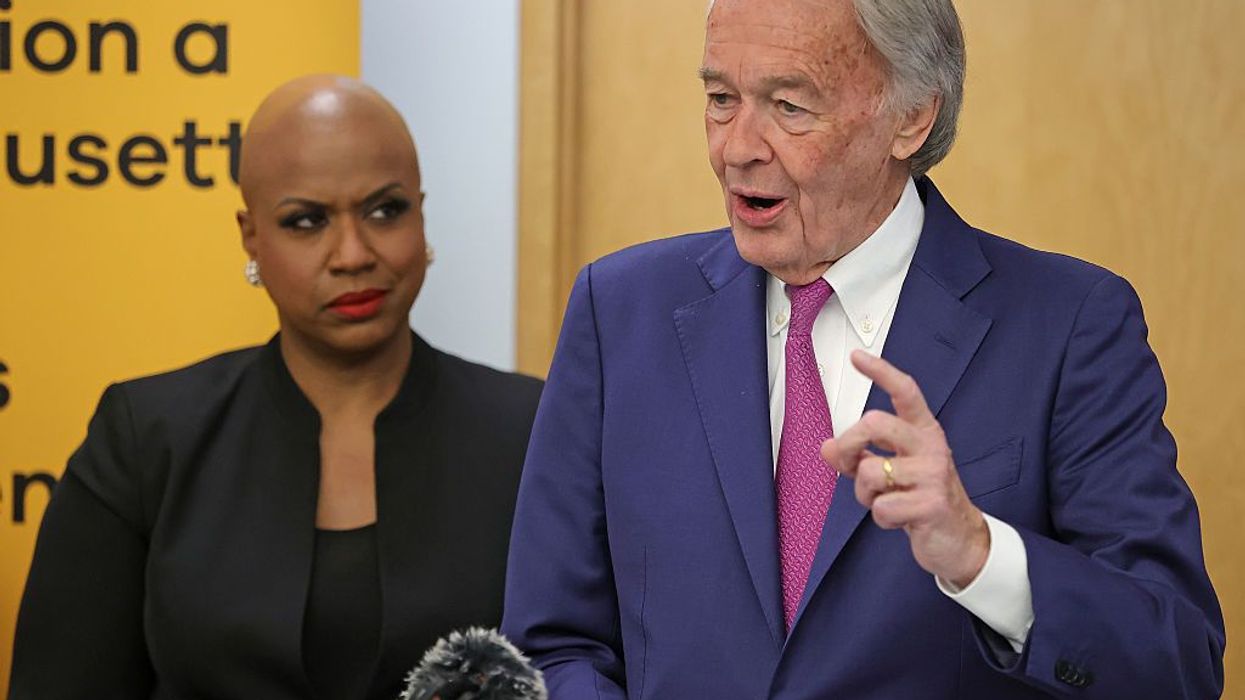
"This is a reckless directive from Trump that will only make the country and the world less safe and lead to a terrible new nuclear arms race," Markey said.
President Donald Trump's surprise order to resume nuclear weapons testing has set off concerns about a potential global arms race, but one Democratic senator is working to stop it from happening.
Sen. Ed Markey (D-Mass.) on Thursday introduced emergency legislation to prevent the president from resuming nuclear weapons tests, which experts have warned could undermine global geopolitical stability as more nations could respond by ramping up weapons tests of their own.
The text of Markey's bill is just two pages and it states that "none of the funds authorized to be appropriated or otherwise made available for fiscal year 2026, or authorized to be appropriated or otherwise made available for any fiscal year before fiscal year 2026, and available for obligation as of the date of the enactment of this act, may be obligated or expended to conduct or make preparations for any explosive nuclear weapons test that produces any yield."
In a statement promoting the bill, Markey warned that restarting nuclear weapons tests would be "a mistake of radioactive proportions," which Congress should intervene to block.
"The United States has not conducted a nuclear test since 1992, and there is absolutely no need to resume," Markey said. "A Trumpatomics plan would provoke Russia and China to resume nuclear testing, and China in particular has much more to gain from this than does the United States. This is a reckless directive from Trump that will only make the country and the world less safe and lead to a terrible new nuclear arms race."
Markey, who co-chairs the Nuclear Weapons and Arms Control Working Group, also urged the US Senate to finally ratify the Comprehensive Test Ban Treaty, which was first adopted by the United Nations General Assembly in 1996 and which has been ratified by 178 other nations.
The UK-based Campaign for Nuclear Disarmament (CND) on Thursday put out a statement condemning Trump's weapons testing announcement, which it described as "a wake-up call that the threat of nuclear war is real and accelerating."
The organization also pointed out that resuming nuclear tests was not the only way that the US under the leadership of both Trump and former President Joe Biden is increasing the risks of nuclear war. Among other things, CND pointed to risks posed by the "Golden Dome" missile shield being pushed by Trump, as well as the AUKUS Agreement signed during Biden's tenure that gives Australia access to nuclear-powered submarines.
CND general secretary Sophie Bol warned of the dire consequences of a global nuclear arms race and said "it is absolutely critical that we rachet up the political pressure to make these world leaders—including the British government—step back from this nuclear escalation."
In an editorial published by Common Dreams on Thursday, Pavel Devyatkin, nonresident fellow at the Quincy Institute for Responsible Statecraft, argued that the resumption of nuclear weapons tests "marks a dangerous turning point in international security."
In particular, Devyatkin argued that resuming such tests would imperil chances of extending the nuclear arms treaty between the US and Russia that has been in effect since 2011.
"The New Strategic Arms Reduction Treaty (New START), the last agreement limiting US and Russian nuclear weapons, expires in February 2026," he explained. "For over a decade, New START has kept a cap on deployed warheads and compelled both sides to transparency through data exchanges and inspections. If this agreement expires, there would be no binding limits on the two countries’ nuclear arsenals."
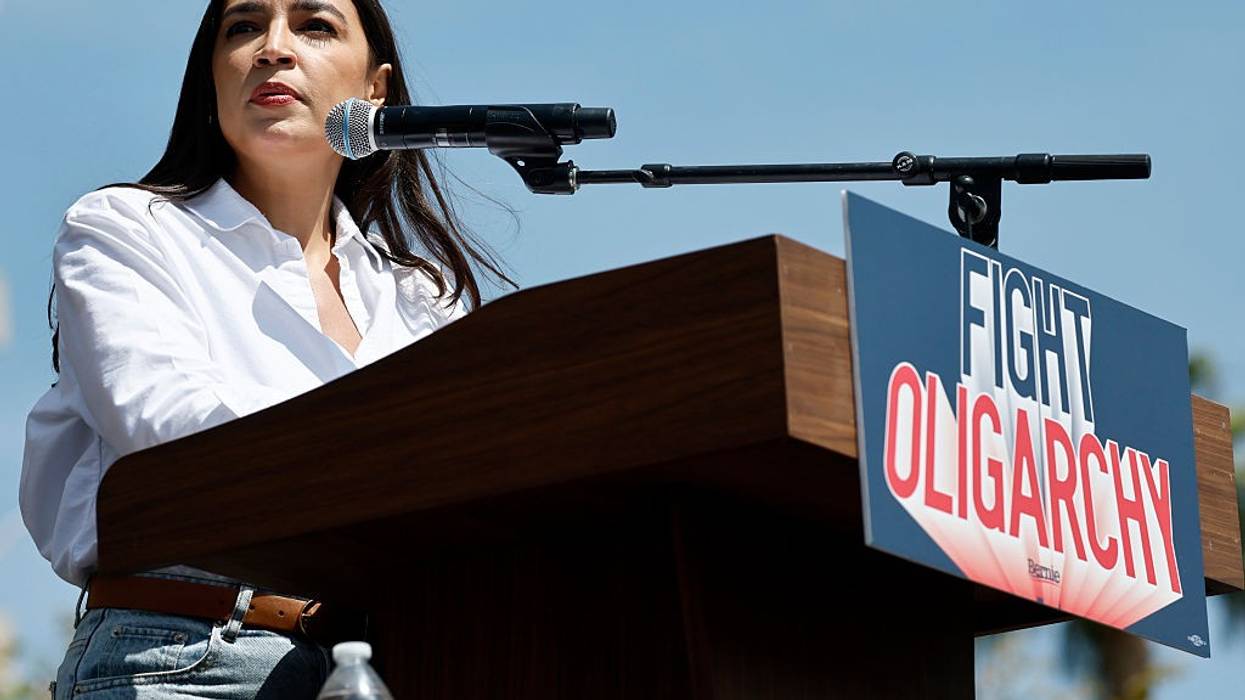
Misguided attacks on progressive leaders like Ocasio-Cortez and Sanders are not only wrong-headed—they are a-political.
Recently a Facebook friend of mine—whom I’ve actually known since before Mark Zuckerberg started at Harvard, and whose political activism I hold in high regard—surprised me by posting an article entitled “AOC is a genocidal con artist.” I can’t tell you what the article said because I’d be as likely to read an article proclaiming that “AOC is a lying communist child-murderer” as I would that one.
And really, the particulars of the article concern me less than the spectacularly myopic political stance on display. Political—allowing smaller or infrequent differences to outweigh broader agreement on larger issues—is always going to be a hazard for a group of intensely committed people whose concern with an issue extends down to the smallest detail. It is, however, a tendency we really can’t afford to fall into if we aspire to actually achieve goals like winding down the nation’s war machine or supplanting our corporate-dominated economy with a democratically controlled one.
The concern here is both general and specific. General, in that this type of short-sightedness diminishes the effectiveness of all of us who share the above-mentioned goals. Specifically, in that I consider attacks upon Rep. Alexandria Ocasio-Cortez (D-N.Y.) particularly wrong-headed and damaging. And while few approach the level of absurdity of the above-mentioned article, claims that she’s only a “so-called progressive” can too often be found coming from people who really might benefit from taking a moment to consider things from a broader perspective.
When Rep. Rashida Tlaib (D-Mich.) authored a letter to U.S. Secretary of State Marco Rubio declaring that the Israeli government food “blockade is starving Palestinian civilians in violation of international law, and the militarization of food will not help,” and going on to “demand an immediate end to the blockade, an immediate resumption of unfettered humanitarian aid entry into Gaza, the restoration of U.S. funding to UNRWA, and an immediate and lasting ceasefire,” she was joined by only 18 other members of Congress—Independent Senator Bernie Sanders of Vermont and 17 Democratic members of the House. This did two things: it told us just how insensitive to the devastation of Gaza the U.S. Congress actually is and it provided a marker of just who constituted its anti-Gaza war hardcore. Ocasio-Cortez was one of those 19.
On the domestic front, the April 16, 2025 New York Times headline said it all: “Sanders and Ocasio-Cortez Electrify Democrats Who Want to Fight Trump.” It referred to their “Fighting Oligarchy” tour which has taken the pair before crowds of 36,000 people in Los Angeles; 34,000 in Denver; 30,000 in Folsom, California, where the line to get in was three miles long and thousands more watched through the fence and from the surrounding hills; 20,000 in Salt Lake City; 20,000 in Tucson, Arizona; 15,000 in Tempe, Arizona, with another thousand outside; 12,500 in Nampa, Idaho; 10,000 in Greeley, Colorado, with an overflow crowd said to be of equal number; 7,500 in Missoula, Montana, with another 1,000 listening outside; 4,000 in Bakersfield, California; and 1,000 in North Las Vegas. Additionally, AOC held a rally with New York Representative Paul Tonko in the district of Elise Stefanik, Trump’s one-time nominee for ambassador to the United Nations.
In short, the claim that Ocasio-Cortez is something less than a “real progressive” is preposterous. If someone were to take such an assertion to court they would have to hope for a Trump-appointed judge to have any hope of winning their case. The only political figure to have done more to rally opposition to the Trump regime than Ocasio-Cortez is Sanders himself. So whence this recent flurry of muttering that she’s not the real deal?
Much of the current discontent concerns a failed amendment to H.R.4016, the Department of Defense Appropriations Act for 2026. The amendment in question would have eliminated funding for Israel’s so-called “Iron Dome,” a missile system designed to intercept incoming missiles. It was offered by one of the most Trumpist members of the House, Georgia Rep. Marjorie Taylor Greene, and received only six votes—that of Greene, one other Republican, and four of the 18 hard-core opponents of Israel’s Gaza devastation. Ocasio-Cortez was not one of the four.
Members of legislative bodies may opt to deal with various amendments to bills in a variety of ways. For one thing, they are obviously taken more seriously if one intends to vote for, rather than against the final bill, as well as if or when the amendment is deemed to have a chance of passing. In a situation such as the one involving this Greene amendment, other considerations may come into play. In this case, for instance, one might imagine some deciding to vote against an amendment with no chance of passage out of disdain for the overall political stance of its author. (The vote in question occurred before the shocker of Greene becoming the first Republican in Congress to call the Israel assault on Gaza genocide.)
I am in no position to speculate as to the reasons that the majority of the Tlaib-letter signatories voted against it, but Ocasio-Cortez actually articulated hers: “Marjorie Taylor Greene’s amendment does nothing to cut off offensive aid to Israel nor end the flow of U.S. munitions being used in Gaza. Of course, I voted against it. What it does do is cut off defensive Iron Dome capacities while allowing the actual bombs killing Palestinians to continue. I have long stated that I do not believe that adding to the death count of innocent victims to this war is constructive to its end. That is a simple and clear difference of opinion that has long been established. I remain focused on cutting the flow of U.S. munitions that are being used to perpetuate the genocide in Gaza.”
The counter-argument to this is that to the extent that the Iron Dome is effective—in itself a disputed matter—it allows Israel to act with impunity, inflicting damage on others without fear of retribution. I share this take on the issue, in fact. At the current moment I’d vote against sending aid of any kind to Israel. However, I do not consider the Ocasio-Cortez viewpoint to be beyond the pale, and I also view her vote in the context of the ongoing necessity of clarity on the point that we opponents of Israel’s military operations oppose both Israeli and Hamas attacks upon civilians. Hopefully, all of us who hope to convince an ever greater sector of our population to oppose the Israeli onslaught recognize that necessity. And the possibility of erring in that direction should by no means be seen as treason to the cause on the part of one of the staunchest congressional opponents of Israel’s effort to destroy Gaza.
To take the question from a different angle, let’s consider the Israelis who are currently publicly demonstrating against this extermination campaign. Surely we’d have to count them among the most courageous and impactful protestors against their government’s actions to be found anywhere in the world. While I personally don’t know any of them, I strongly suspect that there are some among their number who support the Iron Dome system because they believe that it does offer some protection to them and their neighbors in the case of attack—a real possibility in their lives. If that were to be the case, would we deem their opposition to the war as insufficient, or less than genuine? Arguing and debating every fine point regarding the current horrific situation is in many ways an admirable thing; it’s a facet of commitment. But when it creates needless divisions or even turns friends into foes, it ceases to be admirable. And certainly, on this question, Ocasio-Cortez’s stance does not justify articles with absurd titles like the one cited above.
Of course, the phenomenon is not limited to Ocasio-Cortez. Bernie Sanders too is lately under attack by some adherents to what we might characterize as a crossword-puzzle approach to politics—that is to say, if you don’t use the right word, it doesn’t count. The word in question here is “genocide.” Many, perhaps most opponents of Israel’s actions believe they meet the definition of genocide created by the 1948 United Nations Convention on the Prevention and Punishment of the Crime of Genocide. But there are also equally staunch opponents who—because they think Israel’s devastation of Gaza, although abominable, doesn’t fit that definition; or because they adhere to a different definition of the word; or for some other reason – choose not to use the word. Sanders is one of those, which has resulted in some people going to far as to argue that the fact that the word “genocide” does not appear in his statements actually outweighs, for instance, the importance of his authoring the Senate resolution that for the first time drew a majority of that body’s Democrats into public opposition to what Sanders characterized as “an all-out, illegal, immoral and horrific war of annihilation against the Palestinian people.” I even recently ran across someone who called him “a coward” on those grounds. Bernie Sanders—a coward! (He has, by the way, recently extended his Fighting Oligarchy tour to West Virginia and North Carolina and is headed there this weekend.)
Nor is this sort of thing new. Before she even took office, comedian and YouTube program host Jimmy Dore was denouncing Ocasio-Cortez as a “liar ... coward ... gaslighter” for refusing to make her first vote for Speaker of the House contingent on Nancy Pelosi’s agreement to schedule a full House vote on Medicare for All legislation. Ocasio-Cortez and the rest of progressive members of the House ultimately decided against the tactic. Perhaps Dore’s Force-the-Vote advocacy was right, perhaps it was wrong, but one thing the subsequent five and a half years have clearly demonstrated is that he was wrong in his name-calling.
In a sense, these outbursts of political myopia—“I don’t care about what you’ve done or think about anything else, if you disagree with me on this, you’re a (pick one) coward/genocide-supporter/gaslighter/so-called progressive/con-artist/liar—are actually a-political. The decision to be political involves commitment to overcoming the well-known fact that no two people will agree on everything, in the interest of finding areas of agreement to act upon. The Internet does wonders in allowing people to share their ideas—including their differences—but it can unfortunately also make it too easy to forget that commitment.
I stated above that I considered misguided attacks on Alexandria Ocasio-Cortez to be particularly damaging. The reason is 2028 and the next presidential election. Bernie Sanders’s decision to enter the 2016 presidential race was a game changer—his ultimate failure to win the nomination notwithstanding—as it belatedly brought American politics into the 21st Century by introducing working class-oriented democratic socialist ideas into millions of living rooms during the Democratic primary debates. Likewise in 2020. But not so in 2024, when the only candidates in the limelight, Donald Trump, Joe Biden and then Kamala Harris, vied to be Bibi Netanyahu’s best friend, and all opposed Medicare for All.
Assuming that Bernie Sanders will not make another run, we find ourselves very much in need of a candidate who will carry the banner he ran on—one who will reject a minimalist “At least we’re better than Trump” message instead calling for turning away from the disastrous endless-war foreign policy that has reigned supreme for decades and against economic policies that favor the interest of the few who are fabulously wealthy over the interests of the many who are not. It is certainly not too soon to consider this question, as we know all too well how prepared the other side is.
To my eye, at this point the obvious choice would seem to be Alexandria Ocasio-Cortez, should she be interested. Perhaps the reader sees it differently or has another candidate in mind. Nevertheless, we should all be able to agree that it’s imperative not to lose sight of the broader goals because we have obsessed over differences on lesser matters. We should not do the billionaires’ work of dividing us. They have enough money to do it for themselves.
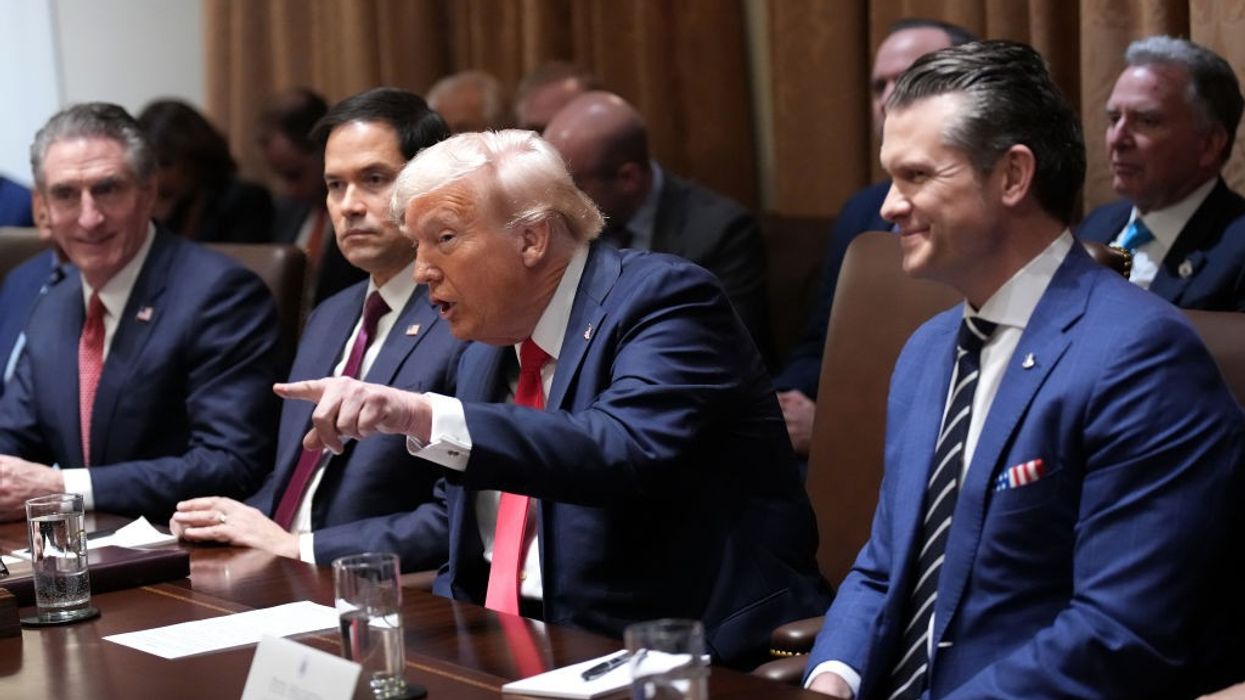
"We are concerned that Golden Dome will be much more effective at wasting taxpayer dollars than countering missile attacks," the lawmakers wrote.
A quartet of Democratic lawmakers are warning that U.S. President Donald Trump's plans to build a "Golden Dome" missile defense system could open the door to a corrupt boondoggle.
In a letter to Defense Secretary Pete Hegseth, Sens. Ed Markey (D-Mass.) and Jeff Merkley (D-Ore.) and Reps. John Garamendi (D-Calif.) and Don Beyer (D-Va.) made the case that the proposed missile defense system goes well beyond what is actually needed to defend the nation against foreign missile attacks.
"The Trump administration's plans for Golden Dome could make it prohibitively expensive, operationally ineffective, massively corrupt, and detrimental to U.S. and global security by igniting a nuclear arms race with Russia and China," the Democrats wrote. "We are concerned that Golden Dome will be much more effective at wasting taxpayer dollars than countering missile attacks. We urge you to rein in this dangerous plan."
The Democrats then pointed to estimates by the Congressional Budget Office that the system could cost up to $542 billion to complete, which is more than three times the cost that the Trump administration projected to have the system "fully operational" within the next four years.
They also warned about conflicts of interest posed by SpaceX, which is owned by estranged Trump ally Elon Musk, being awarded contracts to handle the project.
"In addition, U.S. Department of Defense recently announced plans to significantly scale back the Office of the Director of Operational Test and Evaluation, which in the past conducted essential testing of missile defense systems to ensure their military effectiveness," the lawmakers added. "As a result, the administration could rush ahead to award multibillion-dollar Golden Dome contracts with little ability to assess whether the money is being well-spent."
Trump has said that he was inspired to develop such a missile system for the United States after being impressed by Israel's "Iron Dome" system, despite the fact that Israel has a vastly smaller landmass to defend compared to the U.S. and has historically faced far more danger from missile and rocket attacks than the U.S.