

SUBSCRIBE TO OUR FREE NEWSLETTER
Daily news & progressive opinion—funded by the people, not the corporations—delivered straight to your inbox.
5
#000000
#FFFFFF
To donate by check, phone, or other method, see our More Ways to Give page.
Daily news & progressive opinion—funded by the people, not the corporations—delivered straight to your inbox.
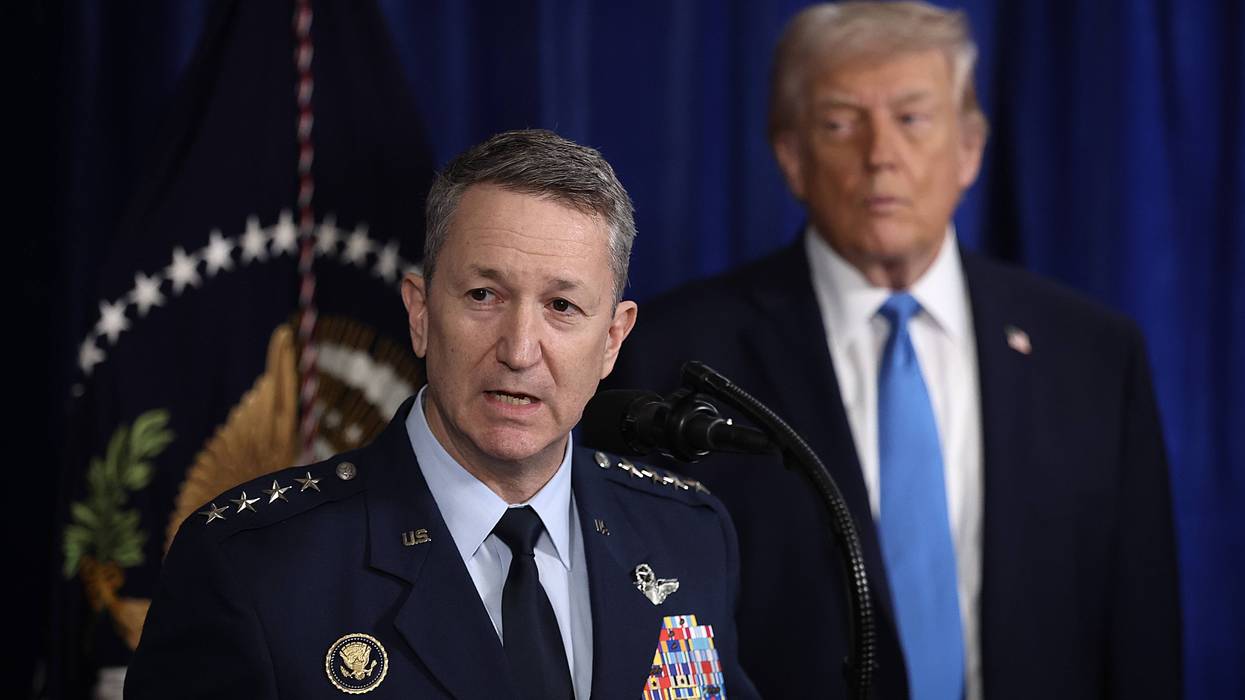
"The stakes are clear," said the National Iranian American Council. "There’s a chance to avert war and disastrous outcomes for the people of Iran, but time may be running out."
President Donald Trump admitted Monday that a US assault on Iran would be disastrous for the Middle East nation's people as he considers options for a military attack, reportedly drawing private warnings from the United States' top general.
In a Truth Social post, Trump pushed back against reports that Gen. Dan Caine, the chairman of the Joint Chiefs of Staff, has voiced concerns about the potentially massive risks of attacking Iran, a country of more than 90 million people. Trump has previously claimed that Caine believed any military conflict with Iran would be "something easily won."
"He has not spoken of not doing Iran, or even the fake limited strikes that I have been reading about, he only knows one thing, how to WIN and, if he is told to do so, he will be leading the pack," Trump wrote of Caine in his Monday post.
The US president—who blew up a landmark diplomatic agreement with Iran during his first term—added that if a new deal with the Iranian government doesn't materialize, "it will be a very bad day for that Country and, very sadly, its people, because they are great and wonderful, and something like this should never have happened to them."
Trump's acknowledgment that a US military assault would likely be devastating for ordinary Iranians runs counter to the narrative pushed by supporters of war, who claim conflict and regime change is necessary to aid Iran's population.
"The stakes are clear," the National Iranian American Council, an advocacy organization that has vocally opposed a US attack on Iran, wrote late Monday. "President Trump himself says that war with Iran will mean a 'very bad day' for Iran and 'very sadly, its people.' There’s a chance to avert war and disastrous outcomes for the people of Iran, but time may be running out."
Lawmakers in the US House of Representatives are expected to vote this week on a resolution aimed at preventing war with Iran without congressional authorization, but the measure stands little chance of reaching Trump's desk.
The president, meanwhile, has shown no indication that he intends to seek congressional authorization for any attack on Iran. One poll conducted earlier this month showed that just 21% of Americans would support the Trump administration "initiating an attack on Iran."
The New York Times reported over the weekend that Trump is considering an "initial targeted US attack" on Iran followed by "a much bigger attack in the coming months" if the nation's government doesn't capitulate to Washington's demands, principally that Iran abandon its nuclear program. Negotiators from the US and Iran are scheduled to meet in Geneva later this week.
"Behind the scenes, a new proposal is being considered by both sides that could create an off-ramp to military conflict: a very limited nuclear enrichment program that Iran could carry out solely for purposes of medical research and treatments," the Times reported. "It is unclear whether either side would agree. But the last-minute proposal comes as two aircraft carrier groups and dozens of fighter jets, bombers,k and refueling aircraft are now massing within striking distance of Iran."
Multiple outlets reported Monday that Caine, the top US general, has offered warnings about the potential risks of attacking Iran. According to the Washington Post, Caine voiced concerns at a recent White House meeting that "any major operation against Iran will face challenges because the US munitions stockpile has been significantly depleted by Washington’s ongoing defense of Israel and support for Ukraine."
The Trump administration's march to war with Iran has also drawn significant outside opposition.
Matt Duss, executive vice president of the Center for International Policy and a former foreign policy adviser to US Sen. Bernie Sanders (I-Vt.), said Monday that "like the June 2025 bombings that failed to destroy Iran’s nuclear program, another US strike would be an illegal act of war."
"As with his false claims that last year’s attack had ‘completely and totally obliterated’ Iran’s nuclear capacity, the president has now dropped the pretense that military intervention would be aimed at protecting Iranian protestors who bravely faced a deadly crackdown to demonstrate against the regime’s many human rights violations," said Duss.
"With Trump sending mixed signals over the timing and scope of possible strikes—and given his record of attacking even when active diplomacy is taking place—Congress must act swiftly to make clear that the president does not have its authorization for the use of the U.S. Armed Forces against Iran," he added.